
A Visa Debit that spends your crypto balance — useful, but thin on published detail
 Available in US

Tonhub is not a bank and does not present itself as one. It is a self-custody card project built around the TON ecosystem: you connect your own wallet, the project fronts the payment at the merchant, and your crypto balance is debited once the network and the merchant confirm. On paper that is a genuinely attractive shape for anyone who already holds TON or USDC and has found ordinary bank cards closed to them — because the card’s own eligibility rule is residence in the EU and age 18 or over, with no citizenship condition published at all.
What I found when I read the project’s public pages carefully is that the shape is clearer than the detail. There is a card. It is Visa Debit. It is virtual, and it appears after identity verification. The fees are the first thing I would want pinned down, and they are not stated on the pages I could read: a “Fees & Conditions” section exists but carries no amounts, and I could not capture issuance cost, monthly fee, conversion fee or foreign-exchange fee from the official pages. A 1.5% transaction fee circulates in third-party reporting from November 2024; I am giving it to you as unofficial, because the card’s own pages do not confirm it.
My score for Tonhub is 5.3 / 10. That is not a verdict on the idea. It is a verdict on how much of the promise is documented in public, which is the thing you actually have to rely on when you are spending real money in a foreign currency.
Conditions are current as of October 28, 2026.
Score, and who this card is for
Let me put the components on the table first, because you should see where the number comes from before you read my reasoning.
| Criterion | Mark | Why |
|---|---|---|
| Who can get it | 5 / 10 | Age 18+ and EU residence required; “25+” countries cited as a usage statistic |
| Cost | 7 / 10 | Not disclosed officially; unofficial: 1.5% transaction fee |
| Top-up options | 5 / 10 | TON and USDC shown, USDT mentioned in a review; SEPA and SWIFT bank transfers |
| Reliability and complaints | 4 / 10 | Operator and issuer not named; contracts audited by Trail of Bits; Trustpilot 3.2 from one review |
| Everyday use | 5 / 10 | Virtual Visa Debit only after verification; unofficial: Apple Pay and Google Pay; ATM not disclosed |
| Total | 5.3 / 10 |
The card suits a narrow and specific person: an EU resident who holds TON or USDC, is comfortable with a self-custody wallet, is 18 or over, and wants a Visa Debit number that spends that balance without going through an exchange account that may or may not accept them. If that is you, the design fits. The project describes its own audience as EU residents spending TON and USDC, and the “25+” countries figure on the site is a usage statistic, not an eligibility list.
The card does not suit someone who needs a physical card, who needs a banking relationship, who wants to know the exact fee before committing, or who plans to rely on the same dispute process across many shops. Here is why each of those is a real exclusion rather than a preference:
- No physical card is mentioned. The published material describes a virtual Visa Debit issued after identity verification. Delivery countries, delivery time and delivery cost are not stated. If you have been declined for a virtual card before and assume a virtual one behaves like a plastic one, that assumption is exactly what will fail you.
- The issuer is not named. Neither the operating entity nor the card issuer appears on the page. I know what that means from the wider industry: the card network routes messages and sets the rules, the issuer is the licensed bank or e-money institution holding the programme, and the crypto brand is often only a programme manager in front. When you cannot see the licence holder, you cannot see the complaint route.
- The complaint record is thin and bad. Trustpilot shows 3.2 out of 5 from a single review, read on 20 October 2026. One review is not a pattern, and I want to be precise about that. But it is also the only public signal, and it is a poor one.
- The fee schedule is not public. Not stated means exactly that: the public pages do not say. No figures are better than bad figures only if you spend very little.
Will they give you the card?
Yes, if you meet two conditions, and both are simple: age 18+ and residence in the EU. There is no citizenship rule published on the card’s pages, which is worth pausing on — nationality is normally recorded and screened separately from residence, because sanctions screening and issuer risk policy often apply to citizenship and country of birth as well as to address. Not knowing the citizenship rule is a gap, not a permission.
The “25+” countries figure that circulates around this project is a usage statistic. It is not the list of places you can sign up from. If you are reading a page that tells you Tonhub works in “25+ countries” and concluding that you are one of them, you are reading a marketing number as an eligibility rule.
The applicant profile is therefore: adult, living in the EU, with a crypto wallet you control the keys to. Everything else about qualification is handled through identity verification at sign-up, and the card comes after that — the page instructs you to “Verify Your identity”. Which documents you will need, and whether proof of address is among them, is not stated.
A word on why residence in the EU matters mechanically, not just legally. In the EU, customer due diligence normally covers name, address, date of birth, nationality and identity documentation, a sanctions check, the purpose of the relationship, and whether you are a politically exposed person. If due diligence cannot be completed, EU rules require the institution to hold back — that is the normal, lawful reason an account gets frozen pending documents rather than a judgement about you. And if your address country differs from the country a shop sees when it looks up your card, that mismatch alone can attract extra scrutiny at the till. So an EU residence rule is not bureaucracy for its own sake; it is the price of being inside the system that issues the card.
How to get it
The route is short, which is one of the card’s real merits.
- Sign up and connect your wallet.
- Complete identity verification — the page calls it “Verify Your identity”.
- Receive the virtual Visa Debit card in the Tonhub app.
That is genuinely the whole flow. What the page does not tell you: which documents count, whether address proof is required, how long verification takes, what the verification levels are, or what the stated rejection reasons are. Processing time in particular is the kind of detail that matters a great deal if you are trying to pay for something on a particular day.
The card itself is Visa Debit, virtual, issued after verification. Physical cards are not mentioned at all — I would read that as “not offered as published” rather than “coming soon”, because nothing on the page promises one. The card’s currency is not stated, which quietly undermines the entire cost question below: if you do not know what currency the card thinks in, you cannot know what a foreign purchase costs you.
Setup happens in the Tonhub app: add your wallet, then tap the Tonhub Card banner. Platforms and store ratings I did not read, so I will not characterise them.
Fees: what it really costs
This is the weakest part of the review, and the weakness is in the disclosure, not necessarily in the pricing. Here is everything the public pages do and do not say.

| Item | What the card publishes |
|---|---|
| Issuance fee | Not stated |
| Monthly fee | Not stated |
| Conversion fee (crypto to balance) | Not stated |
| Foreign-exchange fee | Not stated |
| ATM / cash withdrawal | Not stated |
| Daily spending limit | Not stated — user-set on-chain instead |
| Monthly spending limit | Not stated — user-set on-chain instead |
| Card currency | Not stated |
| Tiers | Not stated; a single card is implied |
One unofficial figure is worth carrying with you as a working assumption rather than a fact: a 1.5% transaction fee, reported by Forklog in November 2024 and repeated in a company profile on Dealroom. Neither is the card’s own page. Treat it as a plausible planning number and confirm it before you rely on it.
Two design choices genuinely help here, and I want to give them their due. First, there are no tiers — no membership levels, no upgrade ladder, nothing that expands over time and quietly starts charging. Second, spending limits are set by you directly on-chain rather than fixed by the issuer, which is unusual in the good direction: you can cap what a compromised or clumsy card can do.
Now let me walk three everyday payments through, because “what does it cost” is only meaningful against actual behaviour.
Coffee, roughly 4 euros, in a euro country. If your balance is already in the token the card spends and the card’s currency matches the shop’s, you are paying 4 euros with nothing but the undocumented conversion fee and the unofficial 1.5%, if it applies to this. If either of those is not what you assumed, this is where you find out.
A typical online subscription paid from a balance you loaded in dollars. Now you have added the foreign-exchange question on top of the conversion question. The FX fee is not stated and the card currency is not stated, so I cannot tell you what this costs. If the issuer country differs from the shop’s idea of your billing address, the payment can also simply be declined or challenged — that is category behaviour, not a defect of this card, but it lands on you either way.
Withdrawing cash at an ATM. Not stated. ATM fees are category-standard territory and are frequently where crypto cards are worst, because several layers can each take a cut. This project publishes nothing about it. I would not plan a cash budget around this card until you have asked.
What is not stated anywhere is also worth naming once and only once, and then leaving alone: the public pages do not publish amounts for these items. I am not going to guess at them, and you should be suspicious of anyone who does.
How to Top up the card
The mechanism is the interesting part, and it is genuinely unlike most cards in this category.
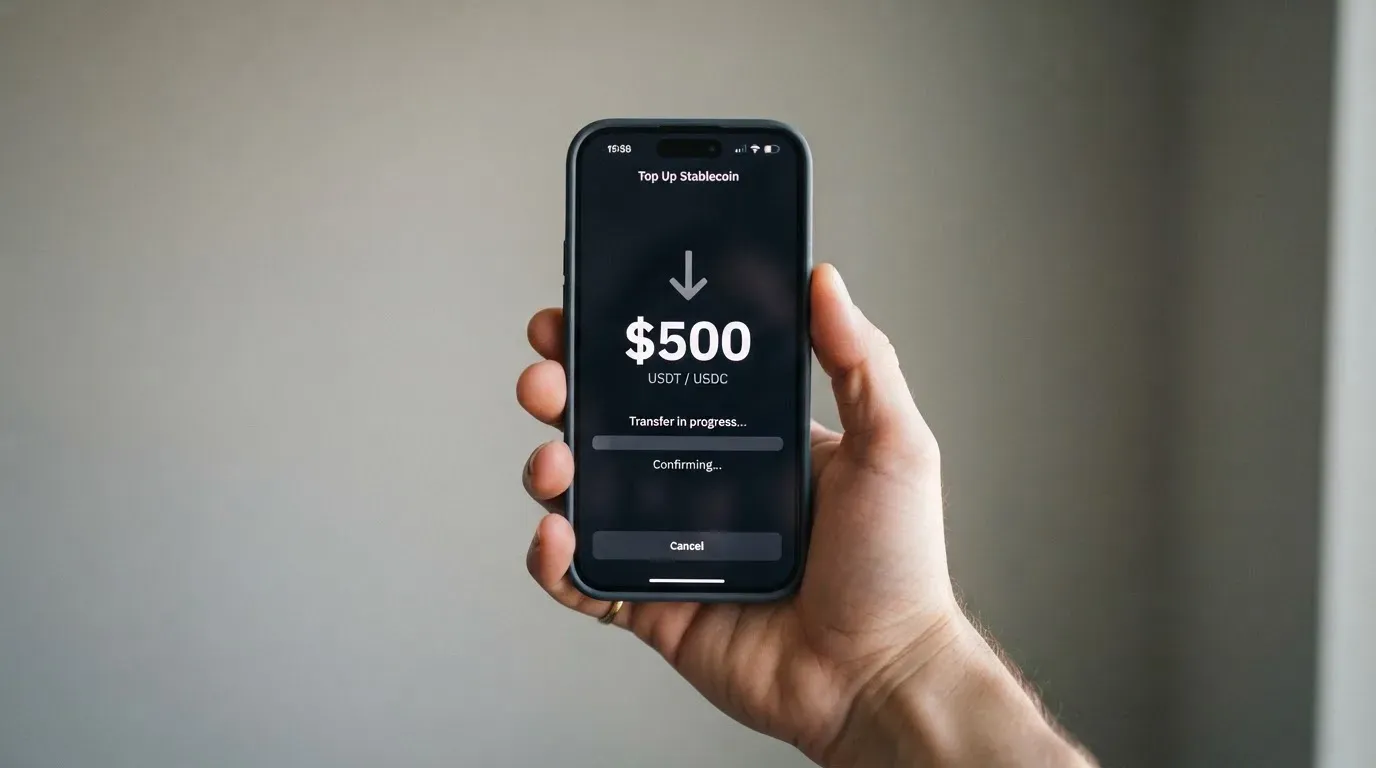
Tonhub pre-funds the payment and debits your balance afterwards, once the network and the merchant have confirmed. The card does not ask your wallet to be instant and it does not need to hold your money; the project fronts the money and settles afterwards. If your balance is insufficient, the payment is declined. That is the same logic as a pre-loaded balance in general terms — the card can spend only what is there, so it cannot overdraw — with the twist that the underlying asset is your own crypto rather than a company’s ledger.
For topping up, you have two distinct routes:
- Crypto, on-chain. TON and USDC are shown on the card’s own page. A user review also mentions paying with USDT, which I treat as a user’s experience rather than a published capability. Specific accepted coins and networks are not listed.
- Bank transfer. SEPA and SWIFT are offered. Fiat top-up fees and minimums are not stated.
The balance must be topped up before a payment, not after. Nothing is described as credit — this is debit from your own funds.
Before you send anything, one hard-won piece of category knowledge applies directly here: the network has to match. A transfer sent on a network the provider does not support, or to an address belonging to a different network, can be lost or need manual recovery with no guarantee. Blockchain transfers are irreversible by design. Check the network on the sending side against the network expected on the receiving side before you confirm, every time.
Two more things worth knowing about the coins you may use. On Ethereum-standard chains, fees are paid only in ETH, so a wallet holding USDT and nothing else cannot actually send — you need a little ETH for gas. On Tron, fees are paid through bandwidth and energy resources, often burning TRX, which works differently. And note that USDC is not natively available on Tron: Circle stopped supporting USDC on Tron in February 2024, so “USDC over TRC20” is not an option you can assume. USDT does exist on Tron.
One feature genuinely distinguishes Tonhub from most cards here: it is non-custodial. Your funds stay in your own wallet, your keys stay with you, and Ledger hardware wallets are supported. There is also an “Emergency Withdrawal” function that lets designated heirs retrieve card-linked funds on-chain. I am describing what is published; I am not making a safety promise, and non-custody cuts both ways — with a self-custody-linked card the funds are yours until the moment of payment, and you bear sole responsibility for key loss, phishing, and malware that swaps copied addresses.
Paying with it every day
Day to day, this is a virtual Visa Debit managed through the Tonhub app. That is the honest summary, and it is worth being clear-eyed about what a virtual card is for.
It works well for recurring online payments and subscriptions, where a stored card number in a browser or an app is exactly what you want. It works less well at a physical till if you have no phone at hand, and there is no physical card published to fall back on. Cash withdrawals are an unknown. If your daily life is a mix of all three, this card covers the first and leaves the other two open questions.
Apple Pay appears only in a user review quoted on the card’s site, which means it is a user’s experience rather than a published feature list. Apple Pay and Google Pay support is reported as unofficial by Forklog in November 2024. Blocked merchant categories are not stated — and merchant category codes matter, because codes like the one covering gambling are blocked by many issuers by policy rather than by law, and each issuer keeps its own list. You cannot know from the public pages which categories fail.
There is a genuinely thoughtful mechanic in how payments settle. Tonhub pre-funds your purchase and debits the balance after network and merchant confirmation, so a failed or declined payment leaves your funds untouched. That is the right default. What is not stated is how long chargebacks take, which matters more than it sounds — the complaint record below shows why.
On refunds the page is blunt: “Refunds are issued only for legitimate, verified transactions.” No rewards programme is stated — no cashback, no points, nothing. Compare that with the alternatives below, several of which publish cashback percentages. If you were hoping for a reward, there is not one on offer.
Setup is: add wallet, tap the Tonhub Card banner, verify identity, use the card.
What can go wrong
The security architecture is the strongest part of this project. Let me be specific, because it is unusual.
- Non-custodial by design. Your keys stay with you; your crypto stays in your wallet. No insolvency risk from a platform holding your balance.
- Contracts audited by Trail of Bits. That is a reputable firm, and the audit is a real, checkable third-party signal rather than a self-assessment.
- User-set on-chain spending limits. You decide the ceiling, on-chain.
- Anti-fraud and AML monitoring. Every transaction is monitored, and suspicious activity is blocked automatically.
That is a solid list. What is missing is equally worth listing: in-app freeze and card insurance are not stated. So the standard refuge of a lost or compromised card — freezing it in the app — may or may not exist, and if it does it is not documented.
Now the harder risks.
The issuer is invisible. Neither the operating entity nor the card issuer is named on the page. In this category that is not a technicality. An electronic money institution can issue e-money and payment cards across the EU, but it must safeguard customer funds in segregated accounts or with insurance — and those funds are not bank deposits, with no deposit guarantee behind them. If you cannot see which institution holds your funds, you cannot see whether they are safeguarded.
The one public review is a bad one. Trustpilot 3.2 out of 5 from a single review, read on 20 October 2026. The review, dated 18 February 2026, reports that chargeback disputes took time — filed in early December 2025, won in January 2026, money still not returned by mid-February. It also describes slow copy-paste support answers and extra AML video-call identity checks despite having verified earlier. One review is not a pattern, and I will not present it as one. But disputes won and not paid is the single most consequential thing a card can get wrong, because a chargeback is the mechanism that makes a card safe to use in the first place. And a help centre exists at help.holders.io, which tells you the project shares infrastructure with a related brand — “Holders” is referenced on the page alongside Tonhub.
Slow money movement. SEPA and SWIFT bank transfers are offered, but withdrawal fees and account-closure handling are not stated. If you ever wanted to move money out through the banking rails, you do not know what that costs or how long it takes.
The news picture is old. The card launch was reported on 8 November 2024, initially for EU residents, with expansion to other regions planned for 2025. I found no confirmation that the expansion happened, and no 2026 news at all. A project whose last public trace is its launch, with no named issuer, is a project you should approach with a small balance rather than a reallocation.
The category’s own history is not encouraging. In November 2022 Visa terminated its global agreements with FTX and the FTX US debit card programme was wound down by its issuer. In 2018 Visa suspended WaveCrest in Europe, closing all WaveCrest-issued Visa programmes. Programme closures typically give notice, then stop spending and loading, then ask users to withdraw remaining balances. Keep enough of your balance outside the card that a shutdown is an inconvenience rather than a loss.
What to take instead
If any of the above makes you uneasy, the sensible response is not to reject crypto cards — it is to pick one that publishes more. Here is how the field looks against the same questions.
| Card | Score | Card and cost | Fees and top-up | Catch |
|---|---|---|---|---|
| Tonhub | 5.3 / 10 | Virtual Visa Debit; single card; no tiers | Official fees not stated; unofficial 1.5% transaction fee; TON and USDC; SEPA/SWIFT | Issuer and operator not named; no rewards; disputes slow in the one review |
| MetaMask | 7.1 / 10 | Mastercard; virtual free, metal $199/year; issuer Monovate, card provider Crypto Life | “Minimal fee” per transaction, amount not stated; no foreign transaction fee, Mastercard rate used; spends from wallet on Linea, Base, Monad, Solana | 45 listed countries; US and UK sign-ups temporarily closed; cashback only above the virtual tier |
| KAST | 6.1 / 10 | Visa, virtual and physical, up to 10 cards; Standard 0 USD/year, Premium 1,000 USD/year, Private 10,000 USD/year | Stablecoin top-up 0%, USD spend 0%, transaction fee 0%; non-USD FX 0.5%–1.75%; declined payment 0.50 USD | Country list not published; residence and ID document both matter; inactivity fee after 12 months |
| TokenPocket | 5.8 / 10 | Visa in Europe, Mastercard across Asia-Pacific and others; virtual; balances in EUR24 and USD24 | 1% fee on depositing crypto, refunded later via rewards; no other fees stated | Americas “planned for Q2 2025”; NFT creation fee partly covered by TokenPocket |
Read that table as a trade, not a ranking. MetaMask is the one I would look at first if you want published numbers: a free virtual card, a named issuer, an explicit statement that there is no foreign transaction fee and that the Mastercard rate applies, and cashback — 1% on virtual, a 3% headline on metal capped at 3% up to the first $10,000 spent and 1% after that. Its catch is geography: 45 listed countries, other regions on a waitlist, and US and UK sign-ups temporarily closed. Its networks are Linea, Base, Monad and Solana, with tokens including mUSD, wETH, EURe, GBPe, USDC and USDT.
KAST publishes the most complete fee schedule in this category, and I would not ignore it for that reason: 0% on stablecoin top-up, 0% on USD spending, 0% transaction fee, 0% for Apple and Google Pay, and a stated 0.5%–1.75% on non-USD transactions depending on where you live, where you spend and which card programme you hold. It also publishes cashback that scales by tier: 1.5% on the first 2,000 USD a month, 2% on the first 10,000, 3% on the first 40,000. But the price of that transparency is the membership ladder — Premium at 1,000 USD a year and Private at 10,000 USD a year — and its eligibility rules are the strictest here: residence and the document you hold both count, a VPN does not help, and the country list itself is not published, so you may find out only at KYC.
TokenPocket is the weakest on disclosure too, which is why it sits below the others: the 1% deposit fee is described as refundable later “through rewards, reduced transaction fees, etc.”, which is not the same as free, and its Americas expansion was a plan rather than a fact.
If you want the same non-custodial, spend-from-your-own-wallet shape as Tonhub but with more published detail and a named issuer, MetaMask is the comparison that flatters Tonhub most.
Who I would recommend it to
Three groups, in order of how confidently I would say it.
Consider it if you are an EU resident aged 18 or over, you already hold TON or USDC in a wallet you control, you are comfortable with self-custody, and your spending is mostly online subscriptions where a virtual Visa Debit is genuinely the right tool. You accept that the fee schedule is unpublished and you start small.
Pause if you need a physical card, you need cash, you spend across many currencies, or you want a named issuer and a visible complaint route before you put meaningful money behind it. Those are not dealbreakers in principle — but you cannot verify them from what is published, and you should not fund a card with gaps on your side of the ledger.
Skip it if you are looking for rewards, are in a hurry, or are deciding where to keep most of your crypto. There is no cashback, no 2026 news, and a single bad review on disputes. Put an amount you would not mind seeing locked up behind a chargeback queue, and nothing you would be upset to lose.
What would move this score for me: the issuer’s name in public, actual numbers in the Fees & Conditions section, an ATM fee, an in-app freeze, a second review on Trustpilot, and any news at all from 2026. Five of those are documentation changes, not product changes — and documentation is the whole gap here.
Frequently asked questions
What is Tonhub?
Tonhub is a crypto card project built around the TON ecosystem. It issues a virtual Visa Debit card that spends the crypto in your own self-custody wallet, rather than a balance held by a company. You connect a wallet, pass identity verification, and get the card in the app. The card’s public pages cite “25+” countries as a usage statistic, but eligibility is stated as age 18+ and residence in the EU.
How does the Tonhub card actually work?
Tonhub pre-funds your payment and debits your crypto balance afterwards, once the network and the merchant have confirmed. The funds stay in your own wallet until that moment. If your balance is too low, the payment is simply declined. Because it debits real balance rather than extending credit, the card cannot overdraw — much like a pre-loaded card, except the balance is crypto you own.
Is Tonhub a bank?
No, and it does not present itself as one. Neither the operating entity nor the card issuer is named on the card’s public pages, which is a real gap: in this category the issuer is the licensed institution that actually holds the programme and your funds, while the crypto brand is often just the front end. Because that name is not public, you cannot check what safeguarding applies to your balance.
Who owns Tonhub?
The brand is Tonhub, and the page also references “Holders”, with a help centre at help.holders.io. The smart contracts are audited by Trail of Bits, which is a reputable external auditor. Beyond that, the operating entity and the card issuer are not named on the public pages, so the corporate side of the question has no public answer I could find.
Does Tonhub require KYC?
Yes. Identity verification is required before the card is issued — the page says “Verify Your identity”. You must also be 18 or over and resident in the EU. The specific documents, whether proof of address is needed, the processing time and the stated rejection reasons are not stated. One user review also reported being asked for an extra video-call identity check despite having verified earlier.
Is Tonhub available in my country?
Only if you live in the EU and are 18 or over. That is the eligibility rule as stated. The “25+” countries figure on the site is a usage statistic, not an eligibility list, and no citizenship rule is published. If you are outside the EU, treat the answer as no until the card’s own pages say otherwise.
What does it cost to use the Tonhub card?
The official fees are not stated — a “Fees & Conditions” section exists but publishes no amounts, and the card currency is not stated either. Unofficial reporting from Forklog in November 2024 puts the transaction fee at 1.5%, repeated in a company profile on Dealroom. Carry that as a planning number, not a fact, and confirm before you rely on it.
How do I top up the Tonhub card?
Two routes: crypto sent on-chain, with TON and USDC shown on the page, or a bank transfer via SEPA and SWIFT. Fiat top-up fees and minimums are not stated. Before sending, check the network matches on both sides — a transfer to the wrong network or an unsupported one can be lost, because blockchain transfers are irreversible.
Is Tonhub safe to use?
Non-custodial by design, with your keys and crypto in your own wallet, user-set on-chain spending limits, contracts audited by Trail of Bits, and automatic blocking of suspicious transactions. Against that: the issuer is not named, in-app freeze and insurance are not stated, and the single Trustpilot review (3.2 from one review) reports disputes taking time and money not returned after winning one.
Is Tonhub worth it?
For an EU resident already holding TON or USDC who wants a virtual Visa Debit for online spending and is comfortable with self-custody — possibly, starting small. Not if you need a physical card, need cash, want rewards, or want published fees and a named issuer. There is no cashback, no ATM fee is published, and I found no news from 2026, so I would not move a large balance onto it.
Wallet cards in the catalogue – cryptocardcatalog
Content created by the «cryptocardcatalog» team