
A virtual crypto card with quiet costs and louder risks
 Available in US

The Cryptomus card is a virtual-only payment card that spends crypto you already hold, converted to fiat when you load it. If you have USDT or USDC sitting on an exchange and you need to pay for something online that a normal bank card will not cover, it does something useful. But the picture it presents and the picture the numbers make are not the same, and the gap between them is where your money can disappear. I scored it 4.7 out of 10, and the reasoning sits below along with every fact behind it.
Conditions are current as of October 28, 2026.
Verdict: 4.7 / 10 — useful in a narrow lane, costly in the ways that are hard to see
This card suits a specific person: someone already inside the Cryptomus ecosystem who pays online with USDT and who has accepted that the card is virtual, that the fee schedule is only partly published, and that the support line is a Telegram bot. For that person, it is a working prepaid card at a known 3.2% top-up fee.
It does not suit anyone who wants a physical card, who wants published limits, who wants to know exactly what a foreign exchange transaction will cost, or who has a history of funds being frozen. The score is not a slight: it reflects a product where the essential numbers are missing from the public pages, where the issuer is not named, and where third-party reviews of the parent service are poor.
| Criterion | Mark | Why |
|---|---|---|
| Who can get it | 8 / 10 | “Most countries worldwide,” with local regulation caveats; no country list is published |
| Cost | 3 / 10 | Issuance $4, top-up 3.2%, monthly or inactivity fee depends on card type; an unofficial FX fee of 3.9% is reported elsewhere |
| Top-up options | 5 / 10 | USDT and USDC, networks not specified, list may grow |
| Reliability and complaints | 3 / 10 | Issuer and legal entity unnamed; Trustpilot 2.4/5 across 521 reviews; card deactivated after a $1,200 payment with refund refused; AML holds |
| Everyday use | 4 / 10 | Virtual Visa and Mastercard only, NFC phone payment mentioned; unofficial sources mention Apple Pay and Google Pay, and disagree about ATMs |
| Total | 4.7 / 10 | A narrow tool with wide gaps in what it tells you |
Read the score table as a description of what I could verify, not as a verdict on whether the card works. It does work. The problem is that the terms you would need to judge it are not published, and the one hard number the card does give you (3.2% on top-up) is not the number that determines your final cost.
Will they give you the card?
Yes, for most people in most places — with one caveat the card itself does not resolve.
The published position is “Most countries worldwide,” and it may be restricted by local regulation. That is the whole eligibility statement. There is no country list, no list of excluded countries, and no explanation of how that list could change. The list, in other words, exists somewhere; it just is not written down where you can read it before you try.
Two questions the card does not answer, and that matter more than they sound. First, residence versus citizenship. Whether you need a passport from a particular country, or merely an address there, changes who can qualify in a way that is not documented. Second, if you live somewhere where crypto is restricted, “most countries” stops meaning much, because local regulation is exactly the exception the card invokes without defining.
If your situation is unusual — a jurisdiction with strict rules, or a country where your address and your nationality point in different directions — the honest answer is that you cannot pre-check eligibility from public information. You will find out at the application stage. That is a reason to keep any first transfer small until you know where you stand.
How to get it
The route is short. You register on Cryptomus and pass KYC before you can get a card. That single sentence is the entire documented process.
What you are not told is almost everything else: which documents qualify, whether proof of address is required, what the minimum age is, how many KYC levels there are, how long verification takes, or on what grounds an application can be refused. In practice, expect the standard verification any regulated provider runs — identity document, and in most jurisdictions an address check — but treat that as the general rule for this industry rather than as a Cryptomus promise.
Once approved, the card is virtual. Only virtual. Visa and Mastercard, spread across “10+ BINs,” multi-currency, though the currencies themselves are not named. It is issued in about five minutes, and it is described as issued instantly and working immediately after activation.
There is no physical card at all. This is the single most important thing to know before you apply, because people sign up expecting a plastic card in the post and there is nothing coming. Your only path to a physical card, if one exists, would be a card type you have to discover yourself; the pages I read did not describe one.
The official pages also mention NFC payment from your phone, which suggests tapping at terminals works. Beyond that, they are silent.
What it really costs: Fees
This is where the card is least forthcoming, and where your actual cost lives.

The one clear figure is issuance: $4 to get the card. Then there is the top-up fee of 3.2%, charged every time you load the card. And that is where the disclosure stops. The monthly fee is not stated. Optional maintenance or inactivity fees are said to depend on the card type, but no card types are named, so you cannot find out if you have one. Payment and conversion fees “may vary,” with no percentage given. The foreign exchange fee is not stated at all. Cash machine fees are not stated. Spending limits are not stated.
Crypto is converted to fiat at the market rate at the time of top-up. That sounds generous and is not the same as “no conversion cost.” A “market rate” is a reference price, not a price you are quoted; who takes the spread, and how wide it is, is exactly the number the card does not publish.
An unofficial figure circulating on third-party sites puts the foreign exchange fee at 3.9%. I cannot confirm it from Cryptomus’s own pages, and I would not plan a budget around it. But it is directionally useful: if the top-up is 3.2% and any exchange conversion adds another few percent, a single load-and-spend cycle can plausibly cost you high single digits. Compare that with an ordinary bank card and you will see the gap.
| Fee or limit | What the card publishes |
|---|---|
| Card issuance | $4 |
| Monthly fee | Not stated; optional maintenance or inactivity fees depend on card type |
| Top-up fee | 3.2% |
| Crypto-to-fiat conversion | At the market rate at top-up; payment/conversion fees “may vary,” no figure |
| Foreign exchange fee | Not stated (unofficial sources say 3.9%) |
| Cash machine fees | Not stated |
| Daily and monthly spending limits | Not stated (unofficial sources say $10,000 daily, $25,000 monthly) |
Three everyday payments, against the published fees
A $20 subscription you pay monthly. You top up at least $20. The top-up fee at 3.2% is roughly $0.64. If your crypto is not already in dollars, the conversion spread applies on top, and an unofficial FX figure of 3.9% would add about $0.78 more. You might land near $21.40 for a $20 service — a meaningful cost on a small recurring bill, and one that recurs every month.
A $200 online purchase paid from a USDT balance held on a non-native network. Here you have three possible costs, not one: the 3.2% top-up fee (about $6.40), the crypto network fee for getting the USDT to the provider (charged by the blockchain, not by the card), and the conversion spread. If the token sits on the wrong network, that last piece can become a support ticket rather than a fee. On-chain transfers are irreversible; a deposit to an unsupported network or a mismatched address can be lost or need manual recovery with no guarantee.
A $1,200 purchase abroad, in a currency the card is not denominated in. This is where the missing FX figure hurts most. You have a $4 card, a 3.2% top-up (about $38.40), and an unstated conversion and exchange cost. On a sum this size, a percentage nobody has published is not a rounding error. And a card that is virtual-only and unnamed at the issuer level is also a card more likely to be declined by a merchant abroad — the BIN lookup shows the issuer and country, and foreign-issued cards get extra scrutiny.
One more thing that costs nothing at the point of sale but can cost you later: a declined authorisation may leave a hold on your funds for several days, sometimes up to seven.
How to Top up the card
Topping up starts with crypto, not with a bank transfer. The card accepts USDT and USDC, and the list may expand. Networks are not specified. Minimum top-up is not stated. Card-funding in fiat directly is not stated — the documented flow is crypto in, fiat balance on the card.
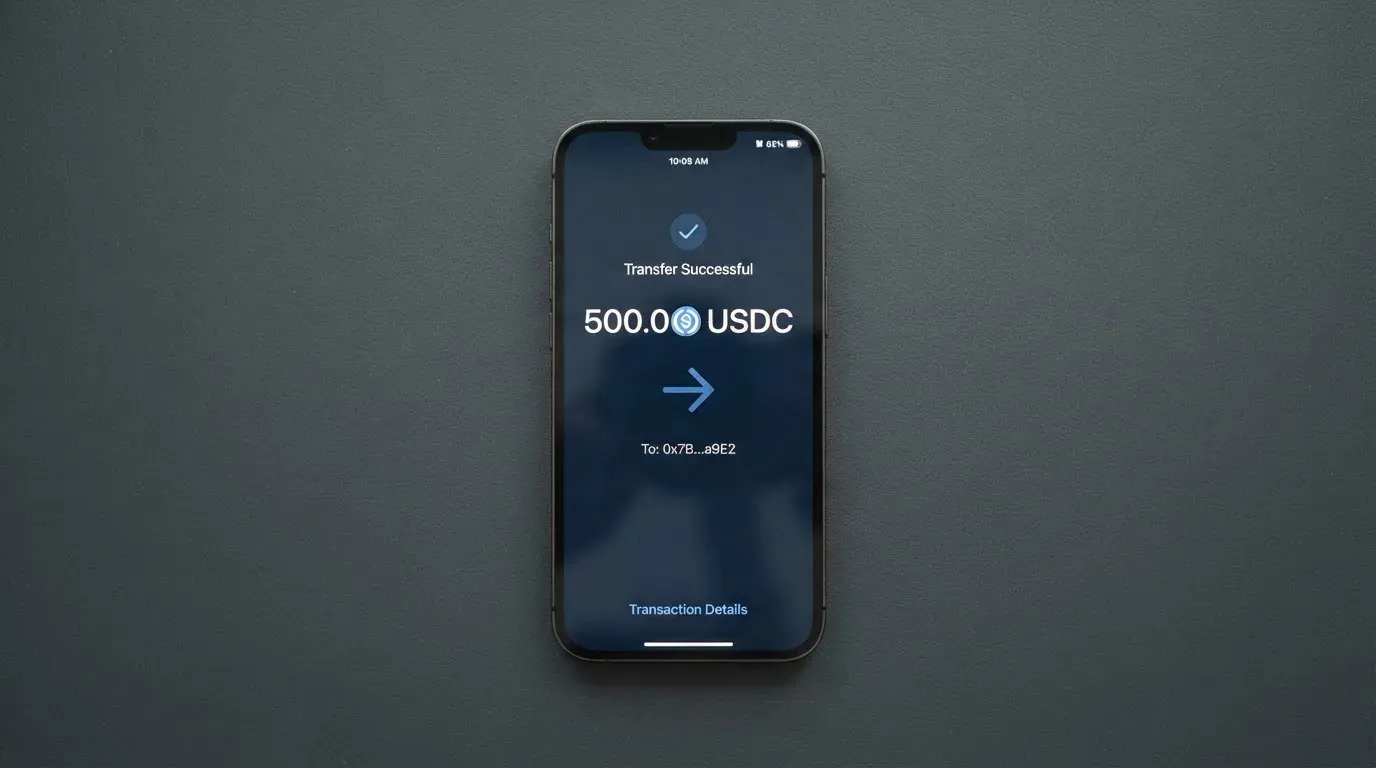
That flow is simple to describe and easy to get wrong. You convert your crypto to a fiat balance on the card, at 3.2% plus whatever the conversion spread is, and then the card spends that balance like a prepaid card. Because the card spends a pre-loaded balance rather than a bank account, it cannot overdraw — but it also means the moment you load is the moment the cost hits, whether or not you spend it all.
The networks gap deserves one warning, not a how-to. USDT exists on several blockchains, and Circle stopped supporting USDC on Tron in February 2024, so “USDC” alone does not tell you which chain. Send on the wrong network and the transfer is irreversible; the blockchain cannot freeze or return it. If you are unsure which network the card expects, the safe move is to ask support before transferring anything, not after.
Getting money back off the card — returning a balance to crypto or to a bank, or closing the account — is not stated anywhere on the pages I read. That is a real asymmetry: the way in is documented, the way out is not.
Paying with it every day
Day to day, the card does a narrower set of things than you might expect.
It is a virtual card in your phone or your browser wallet, in Visa or Mastercard form, spending a balance you loaded yourself. Expense control and transaction history live in the app, which is available in the App Store and Google Play; the store ratings are not stated on the pages I read.
Apple Pay and Google Pay are not mentioned on the official pages, which mention only NFC payment from the phone. Third-party product listings do list them as supported. Treat that as unofficial and unconfirmed — if wallet support matters to you, check it on your own device before relying on it.
What is not stated anywhere: which merchant categories are blocked. This matters more than it sounds. Gambling is a special case in this industry — category code 7995, and many issuers block it by policy rather than by law, with the list varying by issuer — but the card does not tell you what else it declines. Nor does it mention any cashback or rewards; the cards page lists none.
There are no charges for having the card in your app. The costs are all in the load-and-convert step, which is covered above.
What can go wrong
This is the section I would ask you to read twice.
The card’s own security claims are respectable. 3D Secure authentication, the ability to freeze and unfreeze, biometric login, and a promise that no one will withdraw funds or pay without your knowledge. A CertiK project page is linked. But the custody model is not stated, insurance is not stated, and — importantly — the issuing institution is not named. When something goes wrong, knowing who holds the card programme is the first question, and there is no public answer to it.
Then the complaints. Trustpilot, read on 20 October 2026, gives Cryptomus 2.4 out of 5 across 521 reviews, 43% one-star and 49% five-star — a bimodal distribution, which usually means a service many people love and a smaller group who feel badly let down. Most of those reviews concern the wider payment service rather than the card specifically, and Trustpilot flags that the profile may be associated with high-risk investments. On the card itself, one user reported that on 24 September 2026 a virtual card was deactivated after a $1,200 transaction and the refund refused; Cryptomus’s explanation was that the issuing bank blocked the card after a high rate of declines and that Cryptomus does not control that card programme. Across August to October 2026 there are reports of recurring AML and KYC holds on funds, and of slow support with tickets closed as duplicates.
Read that pattern and the structural reason becomes visible. Crypto platforms hold your balance as an e-money-style liability. Under EU rules, if due diligence cannot be completed, the institution must refrain from the transaction or relationship and, where necessary, end it — which is why accounts get frozen pending documents. And because blockchain transfers are irreversible, a hold on the crypto side and a decline on the card side are two separate things happening at two separate speeds, with no mechanism that reconciles them.
I should be straight about a limit in what I could check: I found no official incident report, and I read no primary user report or news item of my own. The complaint material above comes from third-party review sites and is reported as fact by them, not verified by me. Where third-party sources also disagree with each other — as they do about fees — the fee schedule is simply unconfirmed, and I have said so rather than picking a winner.
Two structural risks also sit under the product. Holding crypto with a provider is counterparty risk: custodial platforms have a history of failures, from Mt. Gox and Coincheck to the Ronin bridge. And under EU and US law, nationality and country of birth are screened separately from address, because sanctions and issuer risk policy apply to citizenship as well as residence. That is a general fact of the industry, not a criticism of Cryptomus, but it is the mechanism behind a lot of the holds people report.
If you do hold funds here, treat the balance as money you could lose access to on any given day, not as savings.
What to take instead
If the Cryptomus card is not quite right, three alternatives sit in the same general space. None is clearly safer; they differ mostly in geography and in how much they tell you.
| Alternative | Score | Card type | Top-up | What is published |
|---|---|---|---|---|
| Cryptomus | 4.7 / 10 | Virtual Visa and Mastercard | USDT, USDC | Issuance $4, top-up 3.2% |
| Cardex | 5.6 / 10 | Debit card on VERVE, Visa, Mastercard and UnionPay; virtual and physical | USDT, USDC and BTC | Real-time conversion; no fee percentage stated |
| CardFlow | 4.9 / 10 | Virtual USD Mastercard, about 3 minutes to create | Bitcoin, USDT, ETH or Naira bank transfer | Virtual card creation free |
| HyperCard | 4.7 / 10 | Prepaid card, network not stated on the store page; balance in USD or EUR | Crypto such as USDT, BTC, ETH | Nothing on fees |
Cardex is the one that scores highest here, and the reason is partly structural: it offers physical as well as virtual cards, across four networks including UnionPay, and converts in real time at the moment of payment rather than at top-up. Its weakness is transparency and geography. It claims 200+ countries but publishes no exclusions, its app-store listing is Naira-focused, and it quotes an “AI-Powered Conversion Rate” that picks the best rate without ever stating what it charges for the service. The marketing is louder than the disclosure.
CardFlow is aimed squarely at Nigeria, and says so, while also claiming to serve “Nigerians and global users.” Its one clear number is a good one: creating a virtual card is free. Its fees after that are not stated at all, and the card is virtual USD Mastercard only.
HyperCard scores the same as Cryptomus and is similar in shape — a prepaid card funded with crypto. The store page says it works in more than 176 countries, but that is a statement about acceptance, not eligibility; no country list appears on the official pages. Fees are not stated.
The pattern across all four is worth noticing, because it tells you something about the category rather than about one company: crypto cards are young, and the published fee schedules lag the products. Whichever you consider, the numbers you will actually pay are the ones you discover in the app, not the ones on the marketing page.
Who I would recommend it to
I would recommend this card to one person: someone already holding USDT or USDC on Cryptomus who pays online in dollars, regularly, and who treats the balance as spending money rather than as savings. For them the 3.2% top-up is a known, budgetable cost, the virtual form is a feature rather than a disappointment, and the speed — a card in about five minutes that works after activation — is genuinely useful.
I would not recommend it to anyone who needs a physical card, anyone whose income depends on predictable margins, anyone who has been targeted by an AML hold before, or anyone who is uneasy about a payment provider that does not name its issuing bank.
Before you commit, check three things yourself: whether your country is on whatever list actually exists, what your real all-in cost is on a transaction you can afford to lose, and what the support channel is when something goes wrong at 2am. If the answers are acceptable, the card does what it says. If any of them is a shrug, that shrug is the answer.
Frequently asked questions
What is the Cryptomus card?
It is a virtual payment card that spends crypto you already hold. You load it with USDT or USDC, the crypto is converted to a fiat balance at 3.2%, and the card behaves like a prepaid card from then on. It comes as virtual Visa and Mastercard, issued in about five minutes. There is no physical card version described on the public pages.
How does the Cryptomus card work?
You top up, and the crypto converts to fiat at the market rate at the moment of top-up, with a 3.2% fee. The card then spends that stored balance, so it cannot overdraw. Because it is a pre-loaded balance rather than a linked bank account, your spend limit is whatever you have loaded, not whatever your bank allows.
Is Cryptomus a bank?
No — the public pages do not describe it as a bank, and the issuing institution behind the card is not named. Cryptomus markets itself as a crypto payment service; the card sits on top of that. Which bank actually issues the card programme is something you may need to ask support directly.
Who can get the Cryptomus card?
The card says “Most countries worldwide,” with the caveat that local regulation may restrict it. No country list is published, and whether the requirement is residence or citizenship is not stated. If your address and your nationality sit in different countries, you cannot pre-check eligibility from the public information.
Does the Cryptomus card require KYC?
Yes. You must register on Cryptomus and pass KYC before getting a card. Which documents qualify, whether proof of address is needed, the minimum age, and the processing time are all not stated on the pages I read — so expect the standard identity checks any regulated provider runs.
Is the Cryptomus card free?
No. Card issuance is $4, and every top-up costs 3.2%. The monthly fee is not stated, though optional maintenance or inactivity fees are said to depend on card type. Unofficial sources also cite a 3.9% foreign exchange fee, which the card itself does not confirm.
Can I use the Cryptomus card in my country?
You can spend it wherever merchants accept Visa or Mastercard, which is nearly everywhere. Whether you can hold it depends on your country. Some merchants also decline prepaid or foreign-issued cards because the BIN lookup reveals the issuer country, so a decline abroad is possible even where the card is valid.
Can I add the Cryptomus card to Apple Wallet or Google Pay?
Official pages mention only NFC payment from your phone, without naming either wallet. Third-party listings do say Apple Pay and Google Pay are supported. I would treat that as unconfirmed and test it yourself on your own device before relying on it for anything important.
Is the Cryptomus card safe?
The card advertises 3D Secure, freeze and unfreeze, and biometric authentication, which are the standard safeguards. What is not stated is the custody model, whether funds are insured, and which institution issues the card. Separately, Trustpilot showed 2.4/5 across 521 reviews for the wider Cryptomus service, with reports of AML holds and a card deactivated after a $1,200 transaction with the refund refused.
How do I withdraw money from Cryptomus?
The public pages do not describe it. There is no documented route for returning a card balance to crypto or to a bank account, and none for closing the account. That asymmetry is worth asking about before you load funds you might want back — and remember that blockchain transfers are irreversible in the other direction, so a wrong network can mean money that is simply gone.
Virtual cards in the catalogue – cryptocardcatalog
Content created by the «cryptocardcatalog» team