
A USDT-funded virtual card from Hong Kong that answers a real problem, and leaves the numbers in the app
 Available in US
MothCard is a virtual payment card aimed at people who cannot get an ordinary bank card, or who want to spend a crypto balance online instead of moving it through an exchange. You hold a balance, you top it up, and the card spends from it like a prepaid card would. The card is issued on Visa or Mastercard, settlement is in US dollars, and the whole setup lives in an iOS or Android app. My score for it is 5.4 out of 10 — a card that solves a genuine problem while publishing almost none of the numbers you need to decide whether it is worth your money.
The conditions described here are current as of October 28, 2026.
The verdict: 5.4 out of 10
Let me show the whole picture first, because the average hides more than it explains. These are the six criteria I scored, each out of 10, with the total the card comes to.
| Criterion | Mark | Why |
|---|---|---|
| Who can get it | 6 / 10 | Accepted worldwide, but with country and regional restrictions; issuing region varies by card and is visible in the app; company in Hong Kong |
| Cost | 5 / 10 | Issuing and maintaining the card are paid services, amounts only in the app; transaction fees are not disclosed |
| Top-up options | 5 / 10 | Wallet top-up in USDT per the App Store listing; other coins and networks are shown in the app, not published |
| Reliability and complaints | 5 / 10 | Hong Kong Yunmo Technology Co., Limited; issuing bank and licences not named; App Store rating 5.0 from one rating; no complaints found |
| Everyday use | 6 / 10 | Virtual card, Apple Pay and Google Pay available; ATM not disclosed |
| Total | 5.4 / 10 |
So who does this suit? In plain terms: someone who already holds USDT, cannot get a bank card, and wants to pay for online subscriptions or services where a normal card would work. If that is you, the card’s core function — online payments with a virtual card funded in USDT — is the right shape for the job.
And who it does not suit is just as important. If you want to know what the card costs per month before you sign up, this is not the card. The amounts are not published anywhere I could read. If you need cash from an ATM, that is not documented either, and the card is described as being for online payments. If you want physical plastic in your hand, there is no physical card described. If you are choosing on the basis of reputation — licences, a named issuing bank, an established track record — you will not find them here.
The absence of complaints deserves a careful reading rather than a happy one. I searched for MothCard reviews across Trustpilot and Reddit and found nothing about the card at all. That is not a clean bill of health; it is closer to silence, and a young service with a thin public footprint can be perfectly honest or simply too small to have attracted attention. The App Store rating of 5.0 is based on a single rating. One rating is not a signal.
Will they give you the card?
Short answer: probably, depending on where you are, and you will not find out until you look in the app.
The starting data point comes from the Terms of Service, section 3.1, which puts MothCard in Hong Kong. The site says the card is accepted worldwide, but adds that some countries or regions may have restrictions. The issuing region varies by card and is shown in the app.
That gap between “accepted worldwide” and “restricted somewhere” is the thing to hold on to. Acceptance is not the same as eligibility. A card being accepted at a shop in a country says nothing about whether someone living in that country can open one — and in fact, the distinction is technical, not semantic. Every card number begins with an issuer identification number of 6 or 8 digits, and any merchant can look it up to see which institution and in which country issued it. When that issuer country does not match the billing address the customer typed, some merchants apply extra scrutiny or decline. This is precisely why a card issued in one country can look “foreign” to a shop in another, and why “accepted worldwide” is a statement about merchants, not about you.
If you are outside Hong Kong, or outside the region where your particular card is issued, expect the answer to your eligibility question to live inside the app rather than on a public page.
How to get it
The signup path is short: sign in, choose a card, verify your identity, top up the wallet, and move funds onto the card. Several cards are selectable in-app, with differing issuing regions.
Identity verification is a one-time check for anti-money-laundering and sanctions purposes. The card’s own wording is “Just one valid personal ID” — the document types are shown in-app and vary by country — and in some cases a face scan. Proof of address is not stated. Neither is a minimum age; the App Store age rating is 18+, which is a content rating rather than an eligibility promise. To be clear about what that rating means: prepaid and debit cards are generally available to adults aged 18 and over, and some issuers set higher limits, but an app rating is not a statement of the card’s own policy.
There is no delivery step, because there is no physical card — this is a virtual card, described by the card as a “crypto virtual card for global payments”, issued on Visa or Mastercard, with settlement in USD. KYC tiers are not stated, meaning the card does not describe different verification levels for different users.
One structural point worth understanding before you apply, because it explains why the card looks the way it does. A crypto card sits on top of at least two separate regulatory systems. The card itself is a payment service, regulated under e-money or payment-services law, which is separate from the crypto side — custody, exchange and transfer — regulated under markets-in-crypto-assets law. That is why a card like this often depends on two licences held by two entities, and why you may be dealing with a brand that is a programme manager rather than the institution that actually issued the card. The EU’s markets-in-crypto-assets regulation, MiCA, took legal effect in June 2023, with rules on asset-referenced and e-money tokens applying from 30 June 2024 and the remaining provisions, including crypto-asset service provider rules, from 30 December 2024. Under it, e-money tokens may be issued only by a credit institution or an electronic money institution. US guidance goes its own way: FinCEN’s 2013 guidance treats administrators and exchangers of convertible virtual currency as money transmitters, while people merely buying goods or services with crypto are not.
The verification requirements themselves come from law, not from the card’s preference. In the EU, customer due diligence covers name, address, date of birth, nationality and identity documentation, a sanctions check, the purpose of the relationship, and whether you are a politically exposed person. In the US, the customer identification programme requires name, date of birth, address and an identification number, and electronic systems also validate proof-of-address documents. Nationality is recorded and screened separately from residence, because sanctions screening and issuer risk policy are often applied to citizenship and country of birth as well as address. If due diligence cannot be completed, EU rules require the institution to decline the transaction or relationship, and where necessary end existing ones — which is the mechanism behind accounts being closed or frozen pending documents.
Fees and what a payment really costs
Here is the honest part: MothCard says there are fees for issuing and maintaining a card, and that is as far as the public pages go. The amounts are shown in the app only. Transaction fees are not stated — sending money has a service fee and a minimum, both visible on the in-app confirmation page. ATM usage is not stated, and the card is described as being for online payments. Spending limits exist per transaction, daily and monthly, with the instruction to refer to the app for exact amounts.
None of those are published. In this review I will not invent a number for any of them, and you should be sceptical of anyone who does.
| Fee or limit | What the card’s public pages say |
|---|---|
| Issuance | There are a fee for issuing a card; amount not published, shown in the app |
| Monthly maintenance | There are a fee for maintaining a card; amount not published, shown in the app |
| Sending money | A service fee and a minimum apply; both shown on the in-app confirmation page |
| Crypto-to-fiat conversion | Not stated |
| Foreign exchange | Not stated; settlement currency is USD |
| ATM withdrawal | Not stated; card described as being for online payments |
| Per-transaction spending limit | Applies; exact amount not published, refer to the app |
| Daily spending limit | Applies; exact amount not published, refer to the app |
| Monthly spending limit | Applies; exact amount not published, refer to the app |
| Card tiers | Not stated; several cards selectable in-app with differing issuing regions |
Now, what does that mean for three ordinary payments? Let me walk through them, because “what does a coffee cost” is a much better question than “what are the fees.”
A subscription you pay monthly. The charge is in US dollars, so no conversion is needed if the merchant prices in dollars. Your balance is separate: the wallet and the card hold separate balances, so you need to have moved funds from one to the other, and a per-transaction limit may apply if the subscription is large. The monthly maintenance fee applies on top, amount unknown to you until the app shows it.
A purchase priced in euros or pounds. The merchant charges in their currency, the card settles in USD, and a conversion happens somewhere in that chain. MothCard does not publish a foreign exchange rate, a markup, or a conversion fee. This is the single biggest unknown in the table above, because FX is usually where a card like this quietly costs the most.
A purchase funded from crypto. Your USDT is converted to a fiat balance before it reaches the card, and the card does not publish what that conversion costs either. Remember that on-chain network fees for your deposit are charged by the blockchain, not by the card provider — so on Ethereum you need ETH in the wallet to move USDT at all, since gas is paid only in ETH.
The general point about category fees: any crypto card’s real cost has at least three layers, and only the middle one is the card’s. The first is the network fee for getting your funds onto the right chain. The second is the card’s own issuance, maintenance, conversion and FX charges. The third is what the merchant does with a foreign-issued card — address verification and declines. None of the three can be read off a public MothCard page.
Top up: what you put in, and where it goes
Top up the wallet with USDT, then move funds from the wallet onto the card. The App Store listing names USDT; other coins and networks are described only as whatever the app shows you, with the list not published. Deposit fees and minimums are not stated.
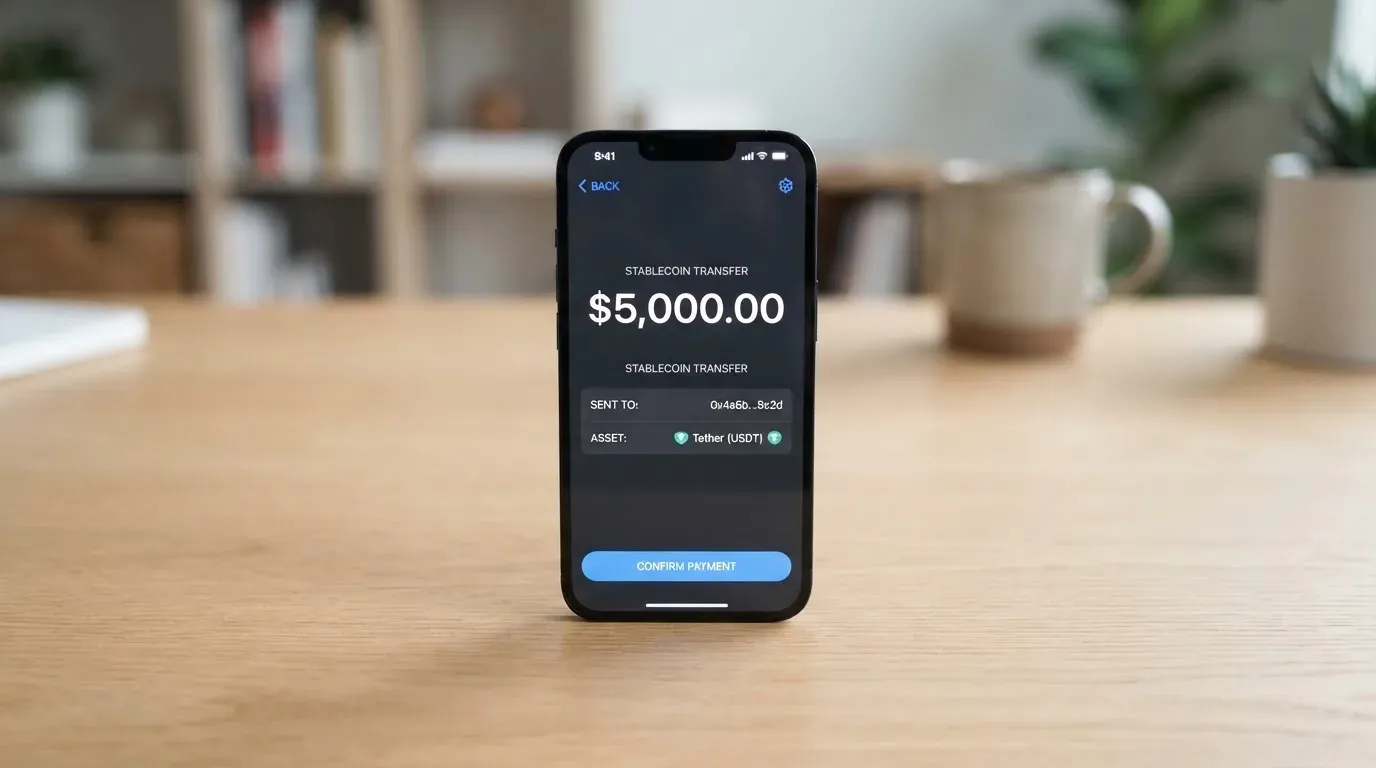
This sounds like a small detail and it is not. Getting the network wrong is the classic irreversible mistake in this category. Blockchain transfers are irreversible by design, so a deposit sent on a network the card provider does not support, or sent to an address belonging to a different network, can simply be lost, or need manual support recovery with no guarantee of success. The app shows the network it expects; that is the one to use, and it is not guessable from the outside.
A few network facts that explain why the list matters. USDT has been issued on networks including Ethereum, Tron, Solana, Polygon and Avalanche, and Tether describes it as a token built on multiple blockchains with reserves intended to back it 1:1. ERC-20 is the Ethereum token standard, proposed in November 2015, and its fees are paid only in ETH — so a wallet holding USDT and nothing else cannot send. Tron prices internally with bandwidth and energy, and fees there are often paid by burning TRX. USDC is a different story: Circle lists it as natively supported on 38 networks as of 16 September 2026, including Ethereum, Solana, Base, Polygon PoS, Avalanche, Arbitrum and Stellar, but Circle stopped supporting USDC on Tron in February 2024, so USDC over TRC20 is not a native option. And stablecoins are not censorship-proof: Tether says it disables tokens in wallets on the OFAC sanctions list and has frozen funds tied to illicit activity.
One more thing nobody mentions in the top-up section but everyone hits eventually: withdrawing is not explicitly covered. The card’s own FAQ advises moving any remaining balance off a card before cancelling it, and moving funds out of the card and the wallet before deleting the account. Fees for that are not stated. Treat it as the cost of leaving, and check it before you need it.
Paying with it every day
Day to day, this is a virtual card you add to Apple Pay or Google Pay. Which wallets work with which card is shown in the app. Blocked merchant categories are not stated, and no rewards, cashback or fee rebate is mentioned in the FAQ.
The app exists on iOS from version 15.6, on Google Play, and as a direct Android APK download. Its App Store rating is 5.0 from a single rating, read on 21 October 2026; the Google Play rating could not be obtained.
Adding a virtual card to a phone wallet is generally the smoothest route, and it is worth knowing why. Apple Pay replaces your card number with a device-specific account number stored in the Secure Element, never on Apple’s servers, and each payment uses a one-time dynamic security code. That is a real reduction in exposure compared with typing the number into sites. It also introduces a control you may not have thought about: the card issuer can restrict a tokenised number — for example block it on magnetic-stripe use, on phone purchases, or on website purchases — so the fact that it taps in a shop does not guarantee it works online.
The app is also your record. Its history lists payments, fees and merchant refunds. Whether you can formally dispute a charge through it is not stated, and that matters more than it sounds. A chargeback is a refund ordered by the card issuer to settle a dispute, with reason codes such as fraud, duplicate billing or goods not received. In the US, debit card reversal rights come from Regulation E and credit card rights from Regulation Z, but prepaid-card coverage varies and should not be assumed. Ask about this before you need it.
Two more everyday frictions to expect. Some merchants decline prepaid or foreign-issued cards, because the issuer lookup reveals the card type and issuer country. Address verification, which compares the numeric parts of the billing address you type with the issuer’s records, is mainly offered in the US, Canada and the UK and is generally unavailable for foreign-issued cards — a common cause of declines that looks like a problem with your card but is not. And a declined authorisation can leave a hold on your funds for several days, typically up to seven.
What can go wrong
Nothing dramatic has surfaced, which is worth stating plainly along with everything else. No official incidents were found. A search for MothCard reviews across Trustpilot and Reddit returned nothing about MothCard, and no Trustpilot or Reddit page was found. Neither is a guarantee.
The company behind the card is Hong Kong Yunmo Technology Co., Limited, in Tsim Sha Tsui, Hong Kong. The issuing bank or institution is not named, and no licences are named. For a card that holds your balance and issues the payment instrument, that is the single biggest thing missing from this picture. In the EU an electronic money institution can issue e-money, payment cards and e-wallets but cannot lend, and it must safeguard customer funds by segregating them in dedicated accounts or insuring them — and those safeguarded funds are not the same as bank deposits, so they may fall outside any deposit guarantee scheme. When a provider will not tell you which institution holds the money, that safeguard is one you cannot check.
The app’s version history shows a first release of 1.0.0 on 3 February, year not shown, and a recent version 2.1.0. I mention that not as a red flag but as context: a short public release history means less history to judge.
On custody, the card does not state its model, and this is the question to press on. Control of crypto belongs to whoever holds the private key or seed phrase. With a custodial wallet the provider holds the credentials and you must trust them completely. A seed phrase — typically 12 to 24 words — is an unencrypted form of the private key, and anyone who obtains it can restore the wallet and spend the funds. Transfers are typically irreversible, and a stolen key has no built-in recovery: the network cannot freeze or return the funds. With a self-custody-linked card the funds stay in your own wallet until the moment of payment, but you bear sole responsibility for key loss, phishing, and clipboard-hijacking malware that swaps an address after you copy it. Neither model is automatically safer; they trade a counterparty risk for an operational one.
That risk is not theoretical. Custodial platforms have failed: Mt. Gox with about US$350 million reported stolen across 2011–2014, Coincheck with about US$400 million in 2018, and the Ronin Network with US$625 million in 2022.
What can happen to a card programme itself is worth understanding too. Visa and Mastercard do not issue crypto cards to consumers themselves; they license issuers and can suspend a programme. Visa terminated its global agreements with FTX on 13 November 2022, and the FTX US debit card was wound down by its issuer. WaveCrest, a Visa issuer that supplied crypto card brands, was suspended by Visa in Europe in 2018, closing all WaveCrest-issued Visa programmes. The usual pattern in a closure is a notice period, then loading and spending stop, then users are asked to withdraw remaining balances. Combined with the unconfirmed withdrawal guidance above, that is the scenario to plan for: your money comes back in a hurry only if you have checked how.
Security features that are documented are ordinary and adequate: you can freeze and unfreeze the card in the app, the full card number and CVV are viewable after identity confirmation and then hidden, and sign-in is by email, Apple or Google with optional Face ID or fingerprint. Typical safeguards in this category include app-based two-factor authentication, instant card freeze, spending limits, 3-D Secure confirmation and tokenised mobile wallets — 3-D Secure being the identity check on online payments, branded Visa Secure at Visa and Identity Check at Mastercard, where the issuer assesses risk and either approves frictionlessly or challenges you with a one-time code or biometric.
Support runs through Contact Support in the app, a Telegram bot, and email at [email protected]. Hours are not stated. The site’s language menu carries 12 languages; the App Store listing is in English, Indonesian, Portuguese, Russian, Simplified Chinese, Spanish and Traditional Chinese.
And a note on stablecoin risk that sits underneath all of this: a stablecoin aims to hold a stable value against a fiat currency, but despite the name, stablecoins are not necessarily stable. The BIS put about 90% of stablecoin market capitalisation in Tether’s USDT and Circle’s USDC in July 2025, so most of the value you load sits in two tokens. TerraUSD collapsed in May 2022, and USDC temporarily lost its peg in March 2023 during the US banking crisis. Circle says USDC is redeemable 1:1 for US dollars and 100% backed by cash and cash equivalents, mostly in an SEC-registered government money market fund, with monthly reserve attestations — but that is a claim by the issuer, not a guarantee.
Tax sits outside the card, and I will not advise on it beyond flagging it. The IRS treats digital assets as property, so exchanging them for goods, services or dollars generally produces a taxable gain or loss, measured in local fiat currency at fair market value on the date of the transaction. Each card payment funded from crypto may therefore be a separate disposal. How that lands for you depends on where you live — talk to a professional about your own situation.
What to take instead
If the missing numbers are the dealbreaker, here is where MothCard sits against three alternatives I looked at. Scores are on the same ten-point basis.
| MothCard | Cardex | CardFlow | HyperCard | |
|---|---|---|---|---|
| Score | 5.4 / 10 | 5.6 / 10 | 4.9 / 10 | 4.7 / 10 |
| Who | Hong Kong start; accepted worldwide with possible country or regional restrictions; issuing region varies by card | “One crypto card, 200+ countries”; no country list or exclusions; App Store listing is Naira-focused | Aimed at Nigeria — “Nigeria’s smartest fintech card platform” — and “Nigerians and global users”; no exclusions stated | No country list on official pages; App Store says the card works in “more than 176 countries”, meaning acceptance, not eligibility |
| Card type | Virtual, Visa or Mastercard, USD settlement | Debit crypto card on VERVE, VISA, Mastercard and UnionPay; virtual and physical; currency Naira per listing | Virtual USD Mastercard, created in about 3 minutes | Prepaid; network not stated on the App Store page; balance in USD or EUR |
| Costs | Issuance and maintenance fees, amounts only in the app; transaction fees not stated | Not stated | “Creating a virtual card is completely free” (site FAQ); monthly fee not stated | Not stated; App Store page lists no fees |
| Conversion | Not stated | Real-time crypto-to-fiat conversion at the moment of payment; an “AI-Powered Conversion Rate” scans global exchange rates and picks the best one when you spend; no percentage stated | Not stated | Deposit crypto such as USDT, BTC or ETH, converted to USD or EUR on the card |
| Top-up | USDT per the App Store listing; other coins and networks in the app | USDT, USDC and BTC wallets; networks not stated | Bitcoin, USDT, ETH or Naira bank transfer; networks not stated | Crypto deposit in the app; networks not stated |
| Rewards | Not stated | Not stated | Not stated | Not stated |
Reading that table honestly: not one of these four publishes the number you most want, which is what a payment costs. Cardex is the only one that describes a conversion mechanism at all, and even there the fee percentage is missing. CardFlow is the only one that says anything about a fee, and what it says is that card creation is free — which is not the same as the card being free to keep. None of the four says anything about rewards.
The differences that do matter for a decision:
- If you are in Nigeria or transact mostly in naira, both Cardex and CardFlow are built around that market and may be more obviously usable to you than a Hong Kong-issued virtual card.
- If you want a physical card, Cardex lists both virtual and physical in its App Store listing. The others I could not confirm physical options for.
- If you want a Mastercard specifically in dollars, CardFlow’s virtual USD Mastercard is stated plainly, as is MothCard’s Visa-or-Mastercard arrangement. HyperCard’s network is not stated on the page I could read.
- If fees decide it, nobody wins. MothCard at least tells you fees exist and where to see them.
One category-wide point that applies to all four: ESMA keeps an interim register of authorised crypto-asset service providers, white papers and non-compliant entities, and users can check a provider there. A card authorised in one EU member state can serve the whole EU. If you are in the EU, that register is the first place to look — for these cards and for the provider behind them.
Who I would recommend it to
I would recommend MothCard to someone in a specific and fairly narrow position: you already hold USDT, you cannot get an ordinary bank card where you live, and your spending is online subscriptions and services priced in dollars. In that case the card does one thing, does it in the app you are already using, and does not require you to hold a physical card. The score of 5.4 out of 10 reflects a service that is functional and quiet rather than risky and loud — with the caveat that almost every number is one tap away inside the app.
I would not recommend it to you if any of these are true:
- You want to know the monthly cost before you commit. The amount is not published.
- You need cash from an ATM. That is not documented.
- You need a physical card in your hand.
- You are choosing on trust and want a named issuing bank, a licence, or a deposit guarantee. None is named.
- Your spending is in a currency other than the dollar and you care about the exchange rate. The FX terms are not stated.
- You plan to hold a large balance. The custody model is not stated, and safeguarded e-money funds are not bank deposits.
If you are in that last group, my honest advice is not to switch away from MothCard specifically but to wait: open the app, read the fee and limit screens, and check the custody model before you commit funds. Everything I could not verify on a public page is, by the card’s own design, visible to a prospective user in the app. That is unusual, and it cuts both ways — it is convenient for someone who wants to start now, and unhelpful for someone who wants to compare before they do.
Frequently asked questions
What is MothCard card?
MothCard is a virtual crypto payment card issued on Visa or Mastercard, settling in US dollars. You load a balance, usually from USDT, and spend from it online like a prepaid card. The company behind it is Hong Kong Yunmo Technology Co., Limited, in Tsim Sha Tsui, Hong Kong, and the Terms of Service section 3.1 name Hong Kong as the starting point. It is aimed at online payments funded from a crypto balance.
Is MothCard a bank?
No — and the card does not present itself as one. It is described as a virtual card that issues on a Visa or Mastercard network. The issuing bank or institution is not named, and no licences are named either. In this category the brand is often only a programme manager or front-end, while a licensed institution holds the card programme and the funds behind it.
Does MothCard card require KYC?
Yes, a one-time identity check for anti-money-laundering and sanctions purposes. The card’s own wording is “Just one valid personal ID”, with document types shown in-app and varying by country, and a face scan in some cases. Proof of address is not stated. The App Store age rating is 18+, though a minimum age for the card itself is not published.
Is MothCard card free?
Not entirely, and the card will not tell you the price publicly. It states that there are fees for issuing and maintaining a card, with amounts shown in the app only. Sending money carries a service fee and a minimum, both visible on the in-app confirmation page. Conversion, foreign exchange and ATM charges are not stated at all.
How do I top up MothCard card?
Top up the wallet in the app, then move funds from the wallet onto the card. The App Store listing names USDT; other coins and networks are whatever the app shows you, and that list is not published. Deposit fees and minimums are not stated. Send on the network the app specifies, because transfers are irreversible.
Where can I use MothCard card?
The site says accepted worldwide, but with the qualification that some countries or regions may have restrictions. Separate from that, the issuing region varies by card and is visible in the app. Note that acceptance where you shop is not the same as your own eligibility to open one, and some merchants decline foreign-issued or prepaid cards.
How do I add MothCard to Apple Wallet?
You can add it, because Apple Pay and Google Pay are both supported — which wallets work with which card is shown in the app. Tokenising the card into Apple Pay means the number is replaced by a device-specific account number in the Secure Element, never on Apple’s servers, with a one-time dynamic code per payment. Be aware the issuer can restrict a tokenised number to specific channels.
Is MothCard card safe?
That depends on a model the card does not state. If it is custodial, the provider holds the credentials and you must trust it completely; if self-custody-linked, the funds stay in your own wallet but you carry the risk of key loss and phishing. Documented safeguards include app-based freeze and unfreeze, hidden card details after identity confirmation, and sign-in by email, Apple or Google with optional biometrics.
How do I withdraw money from MothCard?
The public pages do not cover this explicitly. The FAQ advises moving any remaining balance off the card before cancelling it, and funds out of both card and wallet before deleting the account, and fees are not stated. Given that card programmes can be wound down by the network, check the withdrawal route before you need it rather than after.
Is MothCard worth it?
For someone with USDT who cannot get a bank card and pays online in dollars, possibly — it does one thing simply. Otherwise, I would not decide without opening the app first: issuance, maintenance, limits and the custody model are all visible there and nowhere else. My score is 5.4 out of 10, and the single biggest reason is that the costs are not published.
Virtual cards in the catalogue – cryptocardcatalog
Content created by the «cryptocardcatalog» team