
A virtual-only crypto card that skips ID checks and charges $1 to issue
 Available in US
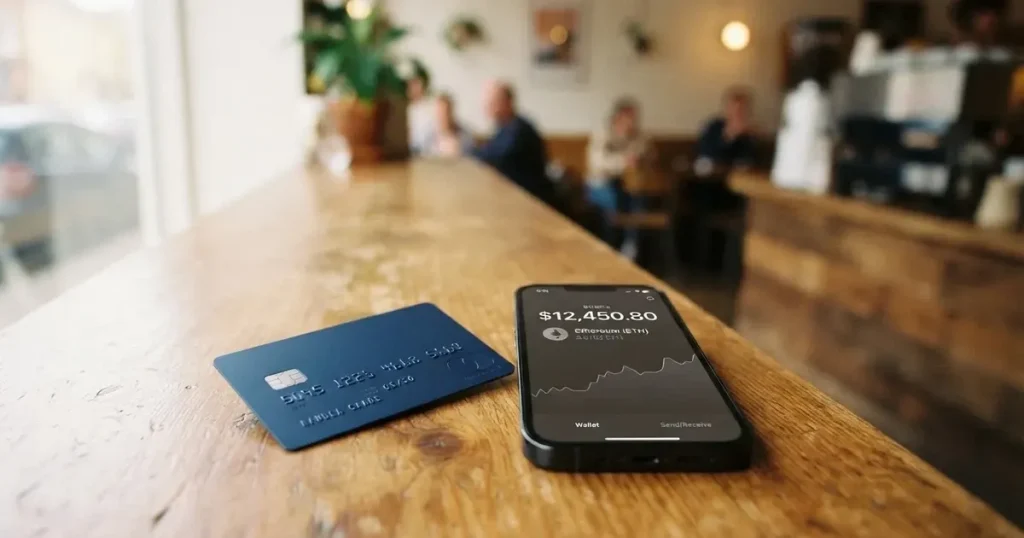
If you have been turned away by ordinary banks — because of your country, your documents, or your status — the pitch here is simple: a crypto card that asks for no ID, no selfie and no proof of address, issues you a virtual Visa or Mastercard in dollars, and costs one dollar to start. That is a real need, and Vyrion fills it in a way that is hard to dismiss.
But “hard to dismiss” and “well documented” are different things. The card’s own public pages describe it as “a technology provider and not a bank”, say it issues through “licensed partners” without naming them, and give no registration country and no licence numbers. The terms were last updated in April 2026. The balances are credited at “live Binance rates” and the foreign-exchange fee is not stated. I could not find a single review of the card anywhere. Those are not nitpicks — for anyone whose money this will hold, they are the whole question.
I scored it 7.1 out of 10. It is a genuinely cheap, genuinely convenient tool for a specific person: privacy-minded users who want dollar virtual cards and can live with self-custody risk. It is a poor choice for anyone who needs to know that a regulated, named institution stands behind their balance, and for anyone who needs a physical card.
The conditions described here are current as of October 28, 2026.
My score, criterion by criterion
The total is not an average of the marks below — the weak criterion pulls the whole card down harder than the arithmetic suggests.
| Criterion | Mark | Why |
|---|---|---|
| Who can get it | 9 / 10 | “190+ countries”, available worldwide subject to the restrictions in the terms, but no countries are listed, and there is no KYC |
| Cost | 9 / 10 | $1 per card issued, 0% monthly fee, 1% top-up, 0% decline fee, 0% withdrawal; balances credited at “live Binance rates”; the FX fee is not revealed |
| Top-up options | 8 / 10 | BTC, ETH, SOL, USDT, BNB, TRX, MATIC, LTC, AVAX, ARB; the FAQ names USDT ERC-20; credited after network confirmation, usually under 5 minutes; USDC is not named |
| Reliability and complaints | 3 / 10 | “A technology provider and not a bank”, issued by “licensed partners” who are not named, no country of registration or licences stated; the account is a seed phrase Vyrion does not store; no reviews found |
| Everyday use | 5 / 10 | Virtual Visa and Mastercard only (7 BINs), Apple Pay and Google Pay available; no plastic, ATM not disclosed, up to 20 cards per account |
| Total | 7.1 / 10 |
The pattern in that table is the whole review. The operational scores — who can get it, what it costs, how you fund it — are high because those pages are clear. The trust score is 3 because they are not.
Will they give you the card?
Here is the short answer: on paper, almost certainly yes, and that is genuinely unusual.
The card’s terms say “190+ countries” and describe the card as available worldwide “subject to the restrictions outlined in these terms”. The problem is that the terms do not list the countries. There is no country table to read, no exclusion list, no map. So the honest position is: you cannot confirm from the public pages whether your country is served. A card that says “worldwide, subject to restrictions” without naming either is asking you to take the restriction on trust.
Age is the one clear gate: 18 and over.
There is a second, subtler point about countries that applies even if you are eligible. Merchants can look up the issuing institution from the card’s first six or eight digits — the BIN — and see which institution and country issued it. If that issuer country differs from your billing address, some shops apply extra scrutiny. And some merchants decline prepaid or foreign-issued cards outright, because the BIN lookup reveals the card type. This is why a card issued in one country can look “foreign” to a shop in another. Nowhere does Vyrion state which country its issuing partners use, which means you cannot even know in advance which shops are likely to be awkward. I would plan on that, not treat it as a surprise.
How to get it
No documents. The card states it plainly: “No ID, no selfie, no proof of address”. There are no KYC levels to climb, because there is no KYC at all. The account is created with a seed phrase, and the flow is three steps — sign up, fund the wallet in crypto, issue a card.
What arrives is virtual only. There is no physical card; the card exists as a card number you add to a wallet or use online.
The networks are Visa and Mastercard, and there are seven BINs to choose between:
| Card | BIN | Per-transaction cap | Per-month cap |
|---|---|---|---|
| Visa Business | 471938 | $10,000 | $100,000 |
| Mastercard World | 553184 | $10,000 | $100,000 |
| Visa Classic | 491653 | $2,000 | $20,000 |
| Mastercard Prepaid | 528410 | $2,000 | $20,000 |
| Visa Platinum | 485291 | $5,000 | $50,000 |
| Mastercard Standard | 541263 | $5,000 | $50,000 |
| Visa Corporate | 493847 | $6,000 | $60,000 |
That table is more informative than it looks. A BIN is not just a number — it tells the merchant’s bank which institution issued the card, and sometimes exposes that it is prepaid. Choosing Visa Classic or Mastercard Prepaid gives you a lower ceiling but a BIN that reads “prepaid” to the payment processor; choosing Visa Business or Mastercard World gives you the headroom and a business-branded profile. Some merchants and some subscription services are fussier about one than the other. If you know you need to clear a large payment once, the $10,000/$100,000 pair is there; if it is everyday spending, the lower tier costs you nothing.
All cards are denominated in USD. Multi-currency is not stated. One account can hold up to 20 cards, which makes this closer to a small issuing tool for people with several spending profiles than to a single everyday card.
Fees: what it really costs
The headline numbers are excellent and I want to be fair about that: $1 to issue a card, 0% monthly, 1% to top up, 0% when a transaction is declined, 0% to withdraw. There are no tiers — the pricing page says “No tiers” — though an API is said to be available on “Business and Enterprise plans”, which are not defined anywhere I could read.

| Fee or limit | What the card states |
|---|---|
| Card issuance | $1 per card |
| Monthly fee | 0% |
| Top-up fee | 1% |
| Declined transaction | 0% |
| Withdrawal fee | 0% |
| Conversion | Balances credited “at live Binance rates” |
| Foreign exchange fee | Not stated |
| ATM | Not stated |
| Account limit | $10,000 per transaction, $100,000 per month |
| Tiers | “No tiers”; API on undefined Business and Enterprise plans |
Now the everyday part, because a fee table tells you what the card charges while a normal week tells you what it costs you.
Buying coffee in your own currency. You top up, the card spends dollars, and the merchant’s acquirer converts dollars to the shop’s currency at whatever rate the payment network gives that day. On the card’s side there is no disclosed fee for this, but “not stated” is not the same as “zero”, and I would watch a statement before assuming it. What you can predict is the Binance rate on the top-up: you convert at live Binance rates, so the spread between the exchange’s price and the rate your money actually landed at is the conversion cost you eat. That spread is not published as a percentage, which is the honest way to say it is not fixed.
A subscription in dollars from a merchant abroad. Same mechanics, plus the risk of an outright decline. Prepaid and foreign BINs are declined more often than ordinary cards, and address verification — which compares the numeric parts of the billing address you typed against the issuer’s records — is mostly a US, Canadian and UK mechanism and is generally unavailable for foreign-issued cards. If you are outside those markets, a decline on a card like this is not evidence of anything wrong with you.
Withdrawing cash. Here I have to tell you the card does not say. There is no ATM fee stated, no ATM number stated, and no physical card to insert anywhere. If cash matters to you, treat it as unavailable until you have seen it work.
Two other cost facts that bite later rather than sooner: the $1 issuance fee is non-refundable, and a declined transaction is not charged. On-chain network fees for your deposit are charged by the blockchain, not by Vyrion — so on Ethereum you need ETH in the wallet to move anything, even USDT, because gas is paid only in ETH.
Top up: which coins, and how long it takes
Ten networks are listed for funding: BTC, ETH, SOL, USDT, BNB, TRX, MATIC, LTC, AVAX and ARB. The FAQ page names BTC, ETH, SOL and USDT ERC-20. Credit arrives after the network confirms, typically in under five minutes.
The 1% top-up fee is confirmed, and the terms cap it at up to 1%. Three things are not stated and each of them can cost you money:
- Minimum deposit. The terms say a minimum “may apply” by coin, without naming figures.
- Who pays the network fee. If it comes out of your deposit, your credited amount is lower than you sent.
- Fiat top-up. None is stated. If you have no crypto to begin with, that is a hard stop, and it means this card is for people who already hold crypto.
The network mismatch risk deserves a paragraph of its own, because it is the single most common way people lose money on cards like this. Blockchain transfers are irreversible. If you send on a network Vyrion does not support, or to an address belonging to a different network, the funds can be lost or need manual support recovery with no guarantee. Note also that the list includes TRX but not USDC: Circle stopped supporting USDC on Tron in February 2024, so “USDC over TRC20” is not a native option, and USDC is not named among the funding coins at all. If you hold USDC — the dollar-pegged coin Circle says is redeemable 1:1 and backed by cash and cash equivalents — you will need to convert it to something on the list, or check with support first.
On withdrawal: 0% fee. Unused balances may be withdrawn or moved to new cards, subject to fees. A voluntary closure is refunded at Vyrion’s discretion minus fees, the balance may be forfeited on termination for policy violation, and the terms also say “Unused balance is always refundable”. Those two statements sit in mild tension, and I would read the discretion and forfeiture clauses as the operative ones.
Paying with it every day
Apple Pay and Google Pay are supported. There is no dedicated mobile app — you get a web dashboard and an API. That is a real trade: you cannot check a balance on a train without a browser, but you also can be phished, and the seed-phrase model means an attacker with your phrase takes everything.
What the pages do not state is just as relevant to daily use as what they do. Blocked merchant categories are not listed. Rewards are not mentioned. A merchant category code is the four-digit number classifying a business by its goods or services, assigned when a business starts accepting cards; codes such as 7995 for gambling are frequently blocked by issuer policy rather than by law, and the blocked list varies by issuer. With no published list, you learn your card’s policy by having a payment fail.
Two things are on your side. Declines can leave a hold on funds for several days — typically up to seven — so a failed online attempt can tie up money briefly even though you are not charged. And 3-D Secure 2.0 is claimed, which means online payments can be approved frictionlessly or challenged with a one-time code or biometric; Visa’s brand is Visa Secure, Mastercard’s is Identity Check.
If something goes wrong with a purchase, the dispute terms are clear and slightly harsh: merchant refunds are credited back to the card, but there are no refunds for exchange-rate moves, there is binding arbitration, and claims must be made within one year. So a payment that fails because the currency moved against you is not a dispute you can bring.
What can go wrong
This is the section where Vyrion is weakest, and I want to separate two different kinds of risk: what I could not verify, and what is actively stated.
The issuer is not named. Vyrion describes itself as “a technology provider and not a bank”, and says cards are “issued by licensed partners” — unnamed. No country of registration, no licence numbers. In this category that matters more than it might seem. A crypto card typically rests on two separate licences: the crypto side (custody, exchange, transfer) under markets-in-crypto regulation, and the card itself as a payment service under e-money or payment-services law. An electronic money institution in the EU can issue e-money, payment cards and wallets but cannot lend, and it must safeguard customer funds in dedicated accounts or by insurance — which are not the same as bank deposits and may not sit under a deposit guarantee scheme. Vyrion tells you none of this about its own arrangements. You are being asked to hold a dollar balance with an unnamed partner of an unnamed technology provider.
You hold the keys, so you hold the risk. The account is a seed phrase that Vyrion does not store. That is a real privacy and custody benefit: the provider cannot spend your money and cannot lose it in a bankruptcy. But a seed phrase is typically 12 to 24 words in unencrypted form, and anyone who obtains it can restore the wallet and spend the funds. Transfers are irreversible and a stolen key has no built-in recovery — the network cannot freeze or return anything. Lose the phrase and the balance is gone; there is no support desk that can regenerate it.
No track record and no reviews. I found no official incidents and no reviews at all — the search returned unrelated results, and there is no Trustpilot page. No complaints is not the same as good service; for a young product it usually means nobody has written anything yet. Support is an email form and a Telegram channel, available 24/7, with a stated email reply under six hours and a form fallback of within 24 hours.
The category has a scar tissue. In November 2022 Visa said it had “terminated our global agreements with FTX” and the FTX US debit card programme was wound down by its issuer. WaveCrest, a Visa issuer that supplied several crypto card brands, was suspended by Visa in Europe in 2018, closing all WaveCrest-issued Visa programmes. Closures follow a pattern: a notice period, then spending and loading stop, then users are asked to withdraw. If you hold a balance here, keep it small enough that you could move it in a day.
What is claimed for security. PCI DSS and 256-bit TLS are claimed, along with 3D Secure 2.0. Card freeze and spending controls are not stated. And two assumptions that are easy to get wrong: stablecoins are not censorship-proof — Tether states it disables tokens in wallets on the OFAC sanctions list and has frozen funds tied to illicit activity — and Apple Pay does not make a card untraceable, it replaces the number with a device-specific token in the Secure Element, with a fresh one-time code per payment.
What to take instead
I want to be careful here: none of the three cards below is a recommendation, and all three score lower than Vyrion does on my scale. They are the alternatives the market provides, and the honest comparison is that you would be trading Vyrion’s documentation gaps for different ones.
| Card | Score | What it is | What is missing |
|---|---|---|---|
| Vyrion | 7.1 / 10 | Virtual Visa and Mastercard, 7 BINs, no KYC, USD | Issuer unnamed, no reviews, FX fee unstated, virtual only |
| Cardex | 5.6 / 10 | Debit crypto card on VERVE, VISA, Mastercard and UnionPay; virtual and physical; no country list | Costs and fee percentages not stated; App Store listing is Naira-focused |
| CardFlow | 4.9 / 10 | Virtual USD Mastercard in about 3 minutes, aimed at Nigeria and global users | Fees not stated; no card cost beyond “creating a virtual card is completely free” |
| HyperCard | 4.7 / 10 | Prepaid card, USD or EUR balance; App Store says works in “more than 176 countries” | Network not stated; fees not stated on the pages I could read |
Reading across the row, you can see the shape of the comparison. Cardex has physical cards and a fourth network, and converts in real time using what its site calls an “AI-Powered Conversion Rate” that scans exchange rates and picks one — a claim no page backs with a figure. CardFlow is cheap to create and quick, and funded by Bitcoin, USDT, ETH or a Naira bank transfer, which is the only fiat route of the three. HyperCard is the vaguest: acceptance in “more than 176 countries” is about where the card is accepted, not who can hold it, and the network is not stated on the App Store page.
If you want a comparison on the substance rather than the paperwork, the useful question is: which of these can name its issuer and its licence? If that matters to you, none of the four is a comfortable answer, and the better move may be a regulated e-money institution with a published licence and a stated safeguarding policy — accepting the KYC, because that KYC is the thing that makes a claim checkable.
Who I would recommend it to
I would recommend it to someone who already holds crypto, is comfortable writing down a 12-to-24-word phrase and protecting it, does not need a physical card, and wants dollar virtual cards without handing over a passport. For that person, $1 to issue, no monthly fee and a 1% top-up is a genuinely good deal, and the range of coins and networks you can fund from is wider than most.
I would not recommend it to someone whose income arrives in fiat and who would need to buy crypto first; to anyone who cannot lose a balance they depend on; to anyone who needs a physical card or cash; or to anyone who is uneasy that the issuing institution, the country of registration and the licences are all absent from the public pages. For those people the missing issuer is not a footnote, it is the decision.
If you do go ahead, three habits and no more: keep the balance small, write the seed phrase on paper and store it somewhere physically safe rather than in a photo or a cloud note, and send a first small top-up on the network you have verified rather than the one you assume. And whatever you do, keep your own records — the IRS treats digital assets as property, so exchanging them for goods or dollars generally produces a taxable gain or loss measured in local currency at the value on the transaction date, which means each card payment funded from crypto can be a separate disposal. That is your bookkeeping to keep, not advice to take from me.
Frequently asked questions
What is the Vyrion card?
The Vyrion card is a virtual payment card issued in US dollars on the Visa and Mastercard networks, funded from crypto rather than from a bank account. You sign up without identity documents, receive a seed phrase for your wallet, deposit coins, and the balance is loaded as dollars you can spend. Vyrion describes itself as a technology provider, not a bank, and says the cards are issued by licensed partners.
Does the Vyrion card require KYC?
No — and this is the card’s main selling point. The pages state “No ID, no selfie, no proof of address”, and there are no verification levels because there is no verification. You need to be 18 or over. The trade is that you hold the seed phrase yourself, so losing it means losing the balance with no provider able to recover it.
Is Vyrion a bank, and who owns it?
No. Vyrion says it is “a technology provider and not a bank”, and that cards are “issued by licensed partners” without naming them. Its terms, last updated in April 2026, state no country of registration and no licence numbers. I could also find no independent reviews of the card, which leaves nothing to judge the operator on except its own marketing.
How much does a Vyrion card cost?
One dollar per card issued, 0% monthly, 1% to top up, 0% on a declined transaction and 0% to withdraw, with no tiers. Balances are credited at “live Binance rates”, so the spread between the exchange price and your credited amount is the conversion cost. The foreign-exchange fee is not stated, which is the number I would want before funding a large balance.
Which coins can I use to top up?
BTC, ETH, SOL, USDT, BNB, TRX, MATIC, LTC, AVAX and ARB, credited after network confirmation, usually within five minutes. The FAQ names USDT ERC-20. USDC is not listed, and it matters that you send on a network the card supports: transfers are irreversible, and a deposit on the wrong network can be lost with no guaranteed recovery.
Can I use the Vyrion card in my country?
The card says “190+ countries” and describes availability worldwide “subject to the restrictions outlined in these terms”, but no countries are actually listed. Separately, merchants can read the issuing country from the card’s BIN and may treat a foreign-issued or prepaid card with extra caution or decline it outright. So acceptance and eligibility are two different questions, and only the first is even partially answered.
Is Vyrion card safe?
The security claims are reasonable ones — PCI DSS, 256-bit TLS and 3D Secure 2.0 — and no public incidents came up. But the risks are concentrated rather than low: an unnamed issuer, a seed phrase you alone must protect, irreversible transfers, and a card type that gets declined more often than an ordinary bank card. Card freeze and spending controls are not stated, so you have fewer brakes than you might expect.
Is there a physical Vyrion card, and can I use Apple Pay?
No physical card exists — the card is virtual only — and no ATM arrangements are disclosed, so cash is effectively off the table. Apple Pay and Google Pay are both supported, and because the number lives in your wallet’s Secure Element with a fresh code per payment, paying by phone is the smoothest way to use it day to day.
How do I get money back off the card?
Withdrawal carries a 0% fee, and unused balances may be withdrawn or moved to new cards subject to fees. On closing your account voluntarily, a refund is at Vyrion’s discretion minus fees, and balances can be forfeited if the account is ended for policy violation — although the terms also say an unused balance is always refundable. Read those together before you rely on either sentence.
Is Vyrion worth it?
For someone already holding crypto who wants dollar virtual cards without a passport check, yes: $1 to issue, no monthly fee and a 1% top-up is cheap, and the coin list is wide. For anyone who needs a named regulated issuer, a physical card, cash, or reassurance that a real institution stands behind the balance, no — because none of that is in the public pages. My score, 7.1 out of 10, splits exactly along that line.
Virtual cards in the catalogue – cryptocardcatalog
Content created by the «cryptocardcatalog» team