
ValidVCC card review — a no-KYC virtual card paid from crypto
 Available in US

ValidVCC is a virtual Visa or Mastercard that you load with crypto and spend online. Sign-up needs only an email and a password, cards are issued in under a minute, and the platform advertises acceptance in 195 countries with no identity documents required. That pitch sounds friction-free, but it comes with a price tag most readers will want to understand before they deposit anything: a 5% fee to issue a card, 5% to fund it, 5% to withdraw leftover balance, and very little information about who is actually behind the service. In this review I go through how ValidVCC works, what it really costs, where the gaps are, and who I think the card is a reasonable fit for.
The card’s terms and conditions are current as of October 28, 2026.
Verdict
I score ValidVCC 5.2 out of 10. The card is unusually easy to get, accepts a wide range of crypto, and the standard price list is short and easy to read. What drags the score down is the cost of that simplicity: every step of the journey carries a percentage fee, and the platform gives almost no information about the company, its registration, the card issuer, or the licence it operates under. There is no mobile app, no public Trustpilot page, and no published statement about what happens to your balance if something goes wrong.

| Criterion | Score | Why |
|---|---|---|
| Who can get it | 9 / 10 | Accepted in 195 countries, no listed exclusions; only an email and password are needed |
| Cost | 2 / 10 | 5% to issue, 5% to top up, 5% to withdraw, plus a possible one-time activation fee |
| Top-up options | 9 / 10 | Eight coins and tokens supported, credited in 5–10 minutes after confirmation |
| Reliability and complaints | 3 / 10 | No legal entity, issuer or licence disclosed; no Trustpilot reviews found |
| Everyday use | 3 / 10 | Virtual only, no app, Apple Pay and Google Pay not addressed |
| Total | 5.2 / 10 |
Who the card suits. Someone who wants to make anonymous online payments with a virtual card funded by crypto, is comfortable holding a balance on a platform rather than in their own wallet, and is happy to absorb a 5% fee on each side of the transaction in exchange for that convenience. If you are buying a subscription, paying a freelancer, or topping up a service where privacy and speed matter more than the lowest possible cost, ValidVCC is built for that.
Who it does not suit. Anyone who plans to spend heavily, wants a physical card, needs a mobile app, expects cashback, or wants the protection of a regulated, identifiable issuer. The fee structure is too punishing for regular spending, and the missing company information makes it a poor choice for people who need to trust the platform with large balances.
Will they give you the card
ValidVCC advertises cards accepted in 195 countries, and I did not find a list of country exclusions anywhere on the public pages. The starting data states worldwide availability with an 18+ age requirement, although the actual sign-up page does not state an age threshold — I’ll come back to that in a moment.
What stands out most is the absence of identity checks. ValidVCC’s footer reads “No KYC. No banks. No waiting.” You do not provide identity documents, you do not give proof of address, and you do not hand over a phone number. An email address and a password are enough to create an account. There is no tiered verification: you are not asked for a basic ID first and a fuller check later. You are not asked at all.
That is unusual in the crypto-card world. Most competitors ask for at least a government ID, and many will only let you spend a few hundred dollars before they require proof of address or a selfie. The trade-off is straightforward: a much faster sign-up, but a much thinner compliance and safety net on the platform’s side.
A small note on the age question. The platform’s marketing text says the service is for users aged 18 and over, but the sign-up form itself does not ask for a date of birth and there is no public age-verification step. The stated 18+ rule is the only written position I can find.
How to get it
The process is short by design. You sign up with an email and a password, deposit at least USD 50 worth of crypto, and create a card. The card is virtual only — either a Visa or a Mastercard — and is generated in under 60 seconds after your deposit is credited. There is no plastic card, no shipping address, and no delivery step.
Because everything happens on the web dashboard, the whole journey from “I have never heard of ValidVCC” to “I have a card number I can paste into a checkout form” can be over in a few minutes. The card details are delivered inside your account, not by email or post, and you use them wherever online card payments are accepted.
A few things the platform does not say, and that I want to flag clearly. The card’s currency is not stated on the public pages. Whether a replacement card is offered (in the event of a charge or a dispute) is not stated either. The minimum age of 18 is mentioned in marketing but is not enforced through any visible check during sign-up. None of this is unusual for a no-KYC service, but it is part of the picture you should hold in mind before you commit funds.
What it really costs
ValidVCC’s pricing is simple to read, and that is part of the appeal — but the percentages add up quickly if you treat the card as a daily spending tool. There is a one-off card issuance fee of 5% per card, a deposit fee of 5% on each top-up, a 5% fee to withdraw unused balance, and a “one-time account activation fee may apply” that is shown in your dashboard rather than on the public pricing page. A standard monthly fee is not stated. An FX fee is not stated. ATM withdrawals are not stated — there is no mention of ATM access at all, which makes sense given the card is virtual.
There is a higher tier, called Elite VIP. To qualify you need a deposit of USD 300 or more, and in return the platform promises zero issuance fees, zero transaction fees, and “unlimited card creation”. That is a much more competitive cost profile if you actually plan to issue several cards, but it still does not change the 5% deposit fee on the way in. The minimum deposit is USD 50.
Let me put the standard tier through a few everyday payments so you can see how the numbers feel in practice. I am using the fees and limits that the public pages list. Where a fee is not stated, I say so plainly.
Issuing a single standard card and spending USD 100 online. Issuance costs 5% of the card’s loaded value, so a USD 100 balance carries a USD 5 issuance fee. The deposit fee is 5% on the way in, so loading USD 105 in crypto ends up as USD 100 on the card after the deduction. If the merchant charges in a currency other than the card’s (unstated) base, an FX fee may apply — but the platform does not publish one. The result is that about USD 10 of every USD 105 you move has been eaten by fees before you have bought anything.
Buying a USD 15 monthly subscription. Same logic at smaller scale. The deposit fee alone takes 5% of what you send, and the subscription renews monthly, so you pay the deposit fee again and again. For small recurring payments, the percentage fee hurts more, not less.
Trying to upgrade to Elite VIP. You would need to deposit at least USD 300 to qualify, and from that point the issuance and transaction fees disappear. The 5% deposit fee on the way in still applies, and you would want to issue multiple cards to make the most of the tier. The break-even depends entirely on how many cards you plan to create and how much you load onto each.
One more piece of the picture: a minimum deposit of USD 50 and a minimum withdrawal of USD 5. Spending limits are not stated. A published FX fee is not stated. ATM access is not stated. If any of those matter to you, that silence is itself a number to budget for.
| Fee or limit | Standard | Elite VIP |
|---|---|---|
| Card issuance | 5% once per card | 0 |
| Account activation | “May apply”, shown in dashboard | Not stated |
| Monthly fee | Not stated | Not stated |
| Deposit / top-up | 5% | 5% |
| FX | Not stated | Not stated |
| ATM | Not stated | Not stated |
| Spending limits | Not stated | Not stated |
| Balance withdrawal | 5% (USDT TRC20), min USD 5, 1–3 days | 5% (USDT TRC20), min USD 5, 1–3 days |
| Minimum deposit | USD 50 | USD 300 |
Top up: how to fund the card
Topping up starts with a transfer to the platform’s wallet. ValidVCC supports eight coins and tokens: BTC, ETH, USDT on TRC20, SOL, TRX, DOGE, LTC, and USDC. The FAQ section on the public site describes USDC as “USDC ERC20”, which is worth knowing because it tells you which network to send on. Funds are credited within 5 to 10 minutes of confirmation on the blockchain.
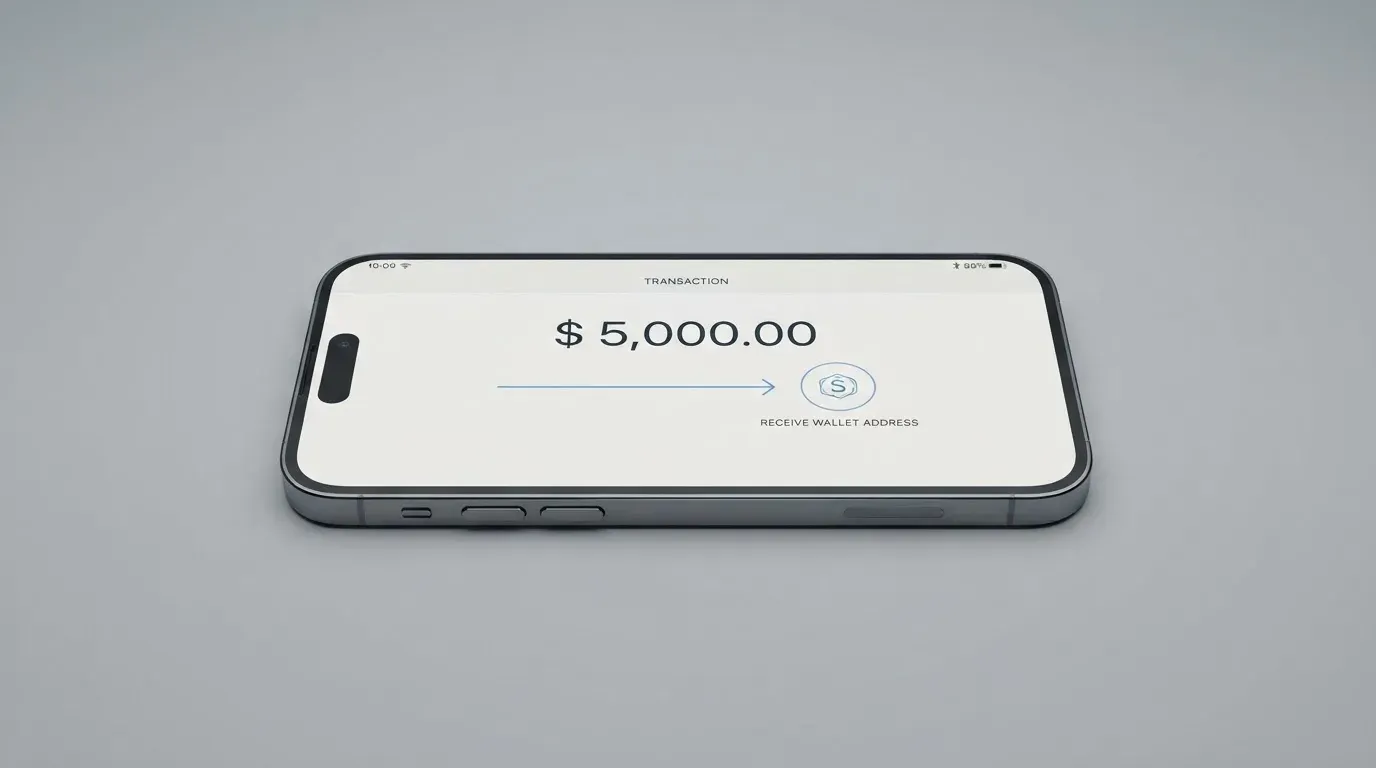
The deposit fee is 5% on every top-up, and the minimum deposit is USD 50. The platform does not state who pays the on-chain network fee — gas on Ethereum, bandwidth and energy on Tron, and so on. In practice, the network fee is usually deducted from the wallet you are sending from rather than added on top, but the public pages do not spell that out. Fiat top-up is not stated: there is no published way to load the card with a bank transfer or a card payment.
A few practical points worth holding in mind before your first transfer. The network you send on matters. If you choose USDT, you must use TRC20 — the FAQ makes that explicit. If you choose USDC, you must use ERC20. Sending on the wrong network is a common way to lose funds with any card provider, and blockchain transfers are irreversible, so a typo here is not something support can usually undo. The deposit fee, the 5–10 minute confirmation window, and the 5% balance-withdrawal fee on the way out are all costs you should add to the conversion spread your exchange already charges you.
Paying with it every day
The card is virtual only, so the everyday use case is online. ValidVCC’s own marketing lists Google Ads, Meta, Amazon, Netflix, Spotify, Stripe merchants and PayPal as places where the card works. That is a useful starting point, because it tells you which merchant categories the platform has actually tested.
What the platform does not cover is just as important. Apple Pay and Google Pay are not addressed on the public pages, and there is no mobile app, so the “tap to pay on a phone” experience is not available. ATM withdrawals are not mentioned at all, which again makes sense for a virtual card. Cashback, rewards or any kind of incentive on spending are not stated — there is no published cashback programme. Blocked merchant categories are not stated either, so if you are trying to use the card at a gambling site, a forex broker or a dating platform, you would only find out by trying.
Account management is also a thin experience. There is no native mobile app; you use the web dashboard from a browser. If you want to freeze the card, check your balance, or review transactions, you do it on the site. The platform’s pages do not describe 2FA, an instant card-freeze button, or any spending limit controls you can set yourself. Disputes and chargebacks are not described in the public terms — the platform does not say how to raise a complaint, how long it takes, or what evidence you would need to provide. For a card aimed at anonymous online payments, that silence is part of the product, but it is worth weighing against the protections most bank-issued cards give you by default.
The one operational detail I would watch is the card currency. ValidVCC does not state which currency the card is denominated in. If you spend in a currency different from the card’s base, your issuer — whoever that is — will apply an FX conversion, and the fee for that is not published. For a USD-denominated card, paying a European merchant in EUR, or a UK merchant in GBP, will trigger a conversion at an undisclosed rate.
What can go wrong
The most important risk on ValidVCC is also the one with the least information around it: the company behind the card. The public pages do not name a legal entity, a country of registration, a card issuer, or a licence. There is no “About” section that explains who you are depositing your crypto to, and no regulatory disclosure that I could find. That makes the platform a custodial service in everything but name — your balance sits in a platform wallet — and it means you have no clear counterparty to hold accountable if the service disappears or stops responding.
The platform’s support channels are listed as WhatsApp, Telegram and email at [email protected], with 24/7 availability. The languages supported by the support team are not stated. A 24/7 inbox is a positive signal, but it is not a substitute for a regulated issuer with a published complaints procedure and a financial-services ombudsman you can escalate to.
On the security side, the platform does not describe 2FA, account-freeze or card-freeze features. There is no public statement on what happens to customer balances in the event of a hack, an insolvency, or a regulatory action. The standard safeguard with a regulated e-money institution is that customer funds are segregated from the company’s own funds, sometimes insured, and never the same as bank deposits — and none of that is published here.
The trust signals that exist in other parts of the crypto-card world are also missing. There is no Trustpilot page for the service that I could find. A search for ValidVCC reviews on Trustpilot and Reddit returned no results. Similar-sounding virtual-card sellers on those platforms have non-delivery complaints, but those are different brands and I am not attributing them to ValidVCC. The point is the absence of evidence rather than the presence of bad reviews.
A few specific risks worth naming:
- A 5% fee on every step. If you deposit, then spend most of the card, then withdraw the leftover, the cumulative fee on the same money adds up quickly before you even account for the underlying crypto-to-fiat spread. That is high for everyday use.
- Network errors on deposits. Sending USDT on ERC20 instead of TRC20, or USDC on TRC20 instead of ERC20, can result in lost funds. The platform’s documentation is clear about the supported networks, but the risk is real and the loss is usually irreversible.
- No dispute path. With no published chargeback or complaints procedure, a bad transaction — a non-delivering merchant, a duplicate charge, a fraudulent site — leaves you reliant on support goodwill rather than a regulated process.
- A disappearing platform. A custodial wallet with no named custodian is exposed to the same kinds of failure that hit other crypto businesses in the past. The balance you see on the dashboard is a claim on a company you cannot name, in a jurisdiction you do not know.
What to take instead
If ValidVCC’s fee structure, the missing company information, or the lack of a mobile app put you off, there are other crypto-funded cards aimed at similar use cases. I have looked at three, scored them against the same kind of criteria, and noted where the public information is just as thin.
| Card | Score | What it offers |
|---|---|---|
| Cardex | 5.6 / 10 | One crypto card available in 200+ countries; debit card on the VERVE, Visa, Mastercard and UnionPay networks; virtual and physical cards per the App Store listing; card balance in Naira per the listing; deposits in USDT, USDC and BTC; the site describes an “AI-Powered Conversion Rate” that scans global exchanges at payment time. Issuance and FX fee percentages are not stated. |
| CardFlow | 4.9 / 10 | Aimed at Nigeria and “Nigerians and global users”; virtual USD Mastercard, created in under 60 seconds; creating a virtual card is free per the site’s FAQ; deposits in Bitcoin, USDT, ETH or Naira bank transfer. Monthly and FX fees are not stated. |
| HyperCard | 4.7 / 10 | Prepaid HyperCard, network not stated on the App Store page; balance in USD or EUR; works in “more than 176 countries” per the App Store listing (acceptance, not eligibility); deposits in USDT, BTC, ETH inside the app. The page lists no fees; I could not find published fee percentages either. |
A few takeaways from the alternatives. Cardex is the only one that publishes a country count higher than ValidVCC’s, and it is the only one that describes a specific conversion mechanism at the moment of payment — but it also does not publish its fees, and the App Store listing pegs the card to the Naira, which is a different target market. CardFlow is free to create a virtual card, which is a stronger starting offer than ValidVCC’s 5% issuance fee, and it accepts Naira bank transfers alongside crypto. HyperCard is a more limited proposition: no fees listed, no network named, and the eligibility is described as acceptance, not as “we will issue to you”.
None of the three alternatives scores much higher than ValidVCC. Each has gaps in the published information. The honest reading is that this corner of the market is generally short on transparency, and ValidVCC is one of the more honest entries in that respect — its 5% fees are visible, even if they are high.
Who I would recommend it to
ValidVCC is a reasonable choice for a narrow set of needs. If you want to make a one-off or low-volume online payment with crypto, do not want to send identity documents anywhere, and do not mind paying a flat 5% at each step, the card does what it says on the tin. It is also reasonable as a way to keep a small crypto-funded balance for subscriptions or ad spend, where the card is only occasionally reloaded.
The card is a poor choice for daily spending, for large balances, for anyone who needs a physical card or a mobile app, and for anyone whose decision hinges on the platform’s regulatory standing. If you would not keep a balance on a service that does not name its operator, this is not the card for you. If you would, and you treat it like a disposable payment tool rather than a long-term wallet, it may be a practical option.
Before you deposit, the three checks I would run are simple. First, confirm the deposit network for the token you plan to send (USDT goes on TRC20, USDC goes on ERC20, and so on). Second, decide how much of your balance you are willing to leave on a custodial platform with no named issuer. Third, do the math on the 5% deposit fee plus 5% issuance fee plus 5% withdrawal fee, and ask whether the convenience of no-KYC is worth that combined cost. If the answer is yes, ValidVCC will do the job. If it is no, the alternatives above are worth a closer look.
Frequently asked questions
What is ValidVCC card?
ValidVCC is a virtual Visa or Mastercard that you fund with crypto and use for online payments. Sign-up needs only an email and a password, and the card is generated inside a web dashboard in under a minute.
How does ValidVCC card work?
You create an account, deposit at least USD 50 in supported crypto, and the platform creates a virtual card you can use at any online merchant that accepts Visa or Mastercard. At the point of sale, the card draws on the balance you have loaded, and that balance is funded from the crypto you sent.
Is ValidVCC a bank?
The platform does not say so, and it does not name a bank or e-money institution as the card issuer. It markets itself as “No KYC. No banks. No waiting.” — so treat it as an unregulated virtual-card service rather than a bank.
Who owns ValidVCC?
The public pages do not state who owns or operates ValidVCC. There is no published legal entity name, no country of registration, and no named card issuer.
How do I get a ValidVCC card?
Sign up on the website with an email and a password, deposit at least USD 50 in a supported crypto, and create a card. The card details appear in your dashboard within about a minute of the deposit being credited.
Does ValidVCC card require KYC?
No. The platform’s stated position is “No KYC. No banks. No waiting.” You are not asked for identity documents, proof of address, or a phone number during sign-up.
How do I top up ValidVCC card?
Send one of the supported coins or tokens — BTC, ETH, USDT on TRC20, SOL, TRX, DOGE, LTC, or USDC on ERC20 — to the deposit address in your dashboard. Funds are credited within 5 to 10 minutes of confirmation. Each top-up carries a 5% deposit fee.
Can I add ValidVCC card to Apple Pay or Google Pay?
The public pages do not address Apple Pay or Google Pay, and there is no mobile app that would let you tokenise the card. If in-wallet support matters to you, the platform’s silence on this is something to weigh.
How do I withdraw money from ValidVCC?
You can withdraw unused balance to USDT on TRC20 at any time, with a 5% fee, a USD 5 minimum, and processing that takes 1 to 3 days.
Is ValidVCC card safe?
The platform does not publish information about 2FA, account-freeze, or how customer balances are safeguarded. There is no named issuer, no licence disclosure, and no public Trustpilot page. Treat the card as a custodial service with limited public accountability, and do not keep more on it than you can afford to lose.
Virtual cards in the catalogue – cryptocardcatalog
Content created by the «cryptocardcatalog» team