
YPT Card: Spending Crypto From a Virtual Card, With the Fees Written Down
 Available in US

The YPT card is a crypto payment card: you load it with BTC, ETH or stablecoins, it converts them into a spendable balance, and you pay with a virtual card number or a phone wallet. That is the whole idea, and it works. The parts worth reading before you sign up are the fee schedule, which is steeper than the marketing suggests, the physical card that does not exist yet, and the country list that names five places where your card will not be delivered. On balance I score it 7.4 out of 10. It suits people who already hold crypto, want to spend it like ordinary money, and have decided that a card is the interface they want. It does not suit someone hunting for a free everyday debit card, or someone who needs a physical card next week.
Conditions described here are current as of October 28, 2026.
Verdict: 7.4 out of 10
The score is not a rounding of the marketing page; it is a judgment about how the product holds up when you actually try to pay for something with it. Seven and a half out of ten sounds like a polite nod. It is not. It means the fundamentals are sound and the edges are unfinished. The card converts and spends your crypto reliably through a virtual card and a phone wallet, with no complaints found anywhere I looked. What pulls it down is what is missing: no physical card yet, an unnamed issuer, an undisclosed issuance price, a help-centre page that still says “IT WILL BE PUT INTO USE SOON” in caps, and a fee table where the small-amount charge quietly eats small purchases.
The intended user is stated plainly by the project itself: spending BTC, ETH and stablecoins via a virtual card. If that sentence describes you, the rest of this review is worth your time. If you are reading because you want a cheap way to pay for things locally and you happen to own some cryptocurrency, the fees below will tell you whether this is that.
| Criterion | Mark | Why |
|---|---|---|
| Who can get it | 9 / 10 | Only five places are excluded as a delivery address — Egypt, Tunisia, Palestine, Puerto Rico, Tanzania — and a billing address is supported |
| Cost | 7 / 10 | 1% in the card’s currency (USD), 2.2% in anything else; $0.20 per small authorisation, $0.5 per declined payment; the issuance price is not disclosed |
| Top-up options | 7 / 10 | USDT, USDC, BTC and ETH, converted at payment; networks not listed; anything over 1U |
| Reliability and complaints | 7 / 10 | Launched by YPT and RedotPay; assets sit with a licensed trust company carrying $50 million of insurance; issuer not named; no complaints found |
| Everyday use | 6 / 10 | A virtual card with Apple Pay and Google Pay; the physical card and its ATM are marked “IT WILL BE PUT INTO USE SOON” |
| Total | 7.4 / 10 | A working virtual card with an unfinished physical one |
Read the top two rows together and you have the shape of the product. Eligibility is unusually open — the help centre names only five countries where the card cannot be shipped, and even there a billing address is accepted, which widens the funnel considerably. Cost is where the friction lives. One per cent on a same-currency payment is honest for this category. Two point two per cent on anything else is a surcharge you pay for the privilege of not converting first. Neither is outrageous; both are higher than what a person who simply wants to spend dollars would accept.
Will they give you the card?
Almost certainly, unless you live in one of five named places. The help centre publishes a short list of countries and regions not supported as a mailing address: Egypt, Tunisia, Palestine, Puerto Rico and Tanzania. A billing address, by contrast, is supported. That distinction matters more than it first looks, because it means the restriction is tied to where a physical card would have to be posted, not to who you are as a customer. For a purely virtual card, a supported billing address is the relevant thing.
Beyond those five, the card’s own pages do not set out a wider eligibility test — no income requirement, no minimum balance, no employment or residency condition is stated. Absence of a stated rule is not a guarantee, of course; an issuer can decline any application for reasons it does not have to publish. But you will not be turned away for being from a particular continent, which is a rare thing to be able to write about a card in this category.
Two things the public pages leave open. The application process details are not stated beyond the identity check below, and the KYC tier system is not stated — there is no published ladder of verification levels, so you cannot tell in advance which documents will unlock the higher limits described later.
How to get it
The card is described as virtual, and that is the version you can actually obtain. A physical card is named in the site’s navigation without any detail: no network, no currency, no delivery time. It is marked “IT WILL BE PUT INTO USE SOON”, and the delivery terms are not stated at all. Read that as a product that intends to ship a physical card and has not yet said when.
Identity verification is done through Sumsub, described as eKYC. You supply your full legal name, your date of birth, and an identity document — an identity card, a passport or a driver’s licence. The card’s own wording leaves room: more information may be requested. In practice, that usually means a proof of address or a selfie at some stage, though the card’s pages do not spell that out. (Unofficial material from iq.wiki, May 2025, likewise states that identity verification is required for compliance — consistent with the official line, but not confirmed by the card.)
One thing worth checking yourself before you start. The site lists the card without stating whether it runs on Visa or Mastercard, and without stating its currency. That matters, because the network determines which shops will accept it and which ones will look at the card’s first digits and hesitate, and the currency determines which fee column you land in. Get this in writing from support rather than discovering it at the till.
So the short version of “how to get it”: sign up, complete Sumsub verification with your name, birth date and a photo ID, and you are issued a virtual card. There is no stated waiting period, no stated fee for the virtual card, and no stated requirement to receive mail anywhere.
Fees: what it really costs
Here is everything the card publishes about cost. Several rows are blank because the card’s pages genuinely do not say — I am not leaving them out to make the table look tidier than the truth.
| Fee or limit | Value |
|---|---|
| Issuance fee | Not stated |
| Monthly fee | Not stated |
| Conversion, payment in the default currency (USD) | 1% |
| Conversion, payment in a non-default currency | 2.2% |
| Small-amount authorisation | $0.20 per transaction between $0 and $1 — first 5 per card per month waived |
| Declined transaction | $0.5 — first 3 per card per month waived |
| ATM withdrawal | Feature listed but marked “It will be put into use soon”; fee not stated |
| Per-transaction limit (USD card) | $100,000 |
| Daily limit | Unlimited |
Three everyday payments, with the fees each one actually attracts. These are the cases that separate a card you use without thinking from one you check the app before swiping.
- A $4.40 coffee paid in USD. The 1% applies, so about $0.04. If your card balance happens to sit in a non-USD currency after a payment elsewhere, the 2.2% column applies instead and the same coffee costs about $0.10. Small change — which is why the currency fee only matters at volume, and why it is worth converting deliberately rather than letting it happen to you.
- A $0.75 app subscription. This is the case that hurts. The amount falls inside the $0-to-$1 band, so the $0.20 small-amount authorisation fee applies on top of the percentage. Five such payments a month are waived; the sixth costs you a significant portion of its value in fees. There is also a $0.5 fee if the authorisation is declined, waived for the first three per card per month. A declined payment is the one that costs you money without buying anything.
- A $180 flight. At 1% that is about $1.80, and the per-transaction limit of $100,000 on the USD card is nowhere near binding. The daily limit is unlimited, so nothing in the published table stops you booking several of these in a day.
What the table does not settle is the two blank rows that matter most long-term: the issuance fee and any monthly fee are not stated. If either exists, it will change the arithmetic on small and infrequent spending, and you should ask support before you commit. Set against this, a third-party listing (iq.wiki, May 2025, unofficial) mentions customisable spending limits without naming any amounts — I could not confirm that on the card’s own pages, so treat it as unverified.
The default settlement currency is USD. Anything else is charged at 2.2%. That single line explains most of the card’s cost structure: stay in dollars and you pay 1%, drift elsewhere and the rate doubles.
Top up: how to move money in
Topping up is the part the card does describe, and it works in four assets: USDT, USDC, BTC and ETH. Whatever you send is converted to fiat for spending, and the conversion happens at the moment of payment — not at the moment you deposit. That is worth understanding. Your deposit keeps its crypto identity after it arrives; the conversion and its cost land later, when you actually spend, and the rate you get is the rate at that later moment.
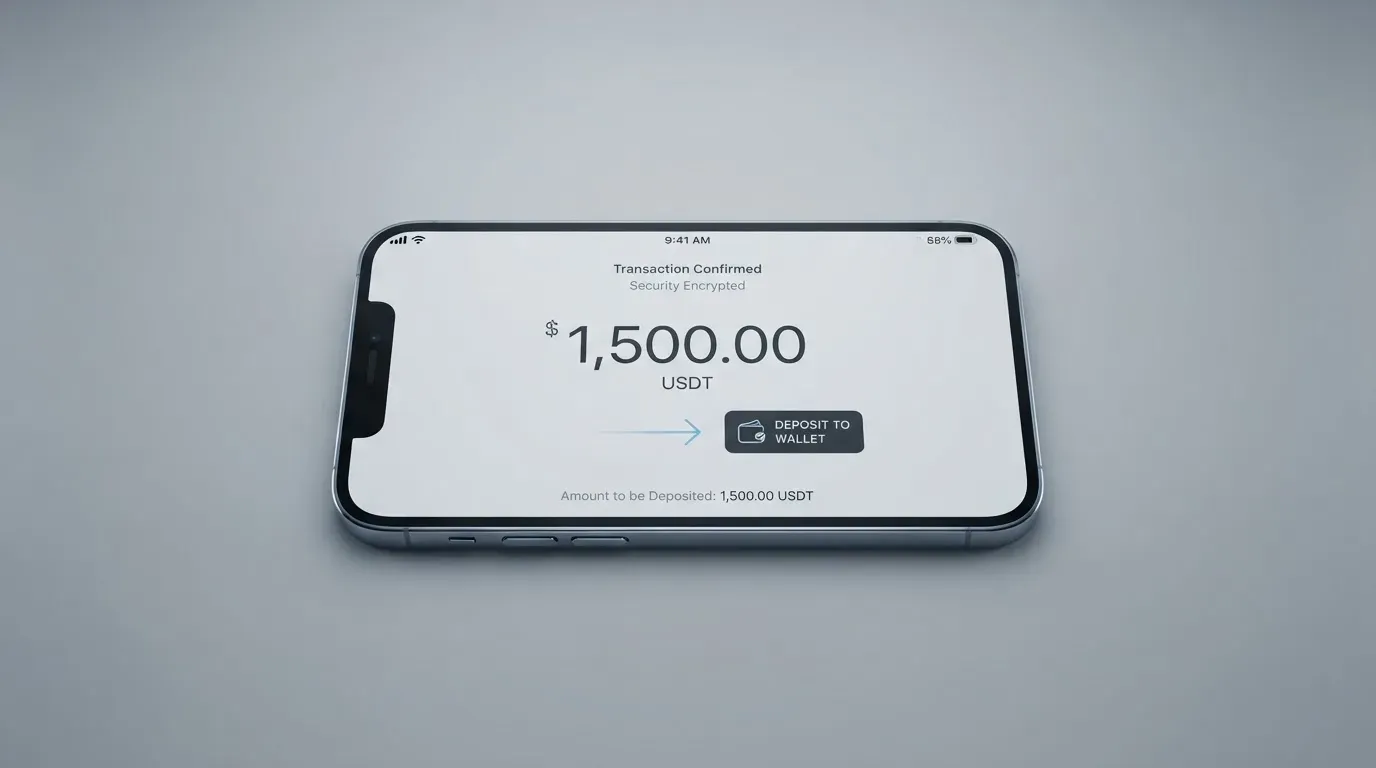
The mechanism in the app: you choose the currency and the network, then send to the shown address or QR code. The page does not specify which networks are supported. That is not a quibble. Transfers are irreversible on the blockchain, and a deposit sent on a network the provider does not support — or to an address belonging to a different network — can simply be lost, or need a manual support recovery with no guarantee of success. Before your first sizeable transfer, ask support which networks they honour for each coin, and read the answer against the network selector in the app.
There is one hard rule stated plainly: a recharge must be higher than 1U, or it is not credited and cannot be retrieved. Transfers must meet this threshold to be credited. There is a second rule stated just as plainly: unsupported coins or networks are lost. Both are on the card’s own page rather than buried in a help article, which is unusually honest and also unusually unforgiving.
Withdrawal is a different matter: not stated. I found no published description of taking money back out — no ATM, no bank transfer, no stated procedure. Given that this is a card for spending rather than a bank account, that may be by design. Do not assume you can cash out.
Paying with it every day
Day to day, the card behaves like any other payment card once money is on it. It can be bound to Apple Pay, Google Pay and what the card calls “multiple payment platforms”, which is a phrase that does not name anything. That is the practical daily-use picture: a virtual card number, plus your phone, which is how most people will actually pay.
A few realities about how card payments work, worth knowing because they explain the failures you will otherwise find puzzling. A merchant category code — the four-digit number a business is classified by — determines whether a payment is treated as gambling, fuel, travel or groceries. MCC 7995 covers gambling, and many issuers block that category on their cards by policy rather than by law, with the blocked list differing from issuer to issuer. YPT’s blocked categories are not stated, so you cannot tell in advance which merchants are closed to you. Some shops decline prepaid or foreign-issued cards simply because the card’s first six or eight digits reveal the issuer’s country — a routine lookup that can prompt extra scrutiny at a counter. Address verification, which compares the numeric parts of the billing address a buyer types against the issuer’s records, is mainly offered in the US, Canada and the UK and is generally unavailable for foreign-issued cards, which causes declines.
A declined authorisation is not free of consequences even when it costs nothing: it can leave a hold on funds lasting several days, typically up to seven. And a card payment that goes wrong is not resolved as fast as people expect. Refunds usually take 2 to 15 days, and sometimes longer than a month. The stated process is that YPT credits you after it receives the refund from the merchant — so you are not waiting on the card, you are waiting on the shop, and the shop’s timetable is the one that decides how long you are out of pocket.
Two things the public pages do not tell you. Whether the app is any good is not stated officially; a third-party listing (iq.wiki, May 2025, unofficial) describes a mobile app on iOS and Android for card applications, deposits and tracking, with no ratings read, so I have no evidence to weigh. And there is no rewards or cashback scheme stated — no points, no rebates, nothing to offset the 1% or 2.2%.
What can go wrong
I looked for complaints and found none, and no Trustpilot page for YPT Group either. Read that carefully: it is weak evidence, not strong. A young product with few users generates few complaints. Absence of noise is not a record of reliability.
The real exposures are structural, and you can see most of them from the public pages.
Nobody will tell you who the issuer is. The card was “jointly launched by YPT and RedotPay” and the issuer is not named. In this category that matters more than it might seem. A card runs on three layers: the network (Visa or Mastercard) routes the messages and sets the rules, the issuer holds the actual card programme and your balance, and the crypto brand is often only a front end that markets it. When something goes wrong, the entity that can actually reverse a payment, freeze a card or make you whole is the issuer. If the card’s pages do not name theirs, you are trusting a front end on their behalf. Ask, and see whether you get a specific answer.
Programmes do get shut down. It is not a theoretical worry. Visa terminated its global agreements with FTX on 13 November 2022 and the FTX US debit card programme was wound down. In 2018 Visa suspended WaveCrest in Europe, closing all WaveCrest-issued Visa programmes. When that happens, the usual sequence is a notice period, then spending and loading stop, then users are asked to withdraw what remains. The pattern is well established, and the fact that a well-known network can end a crypto card programme with a public announcement is the single most useful thing to internalise before you hold a meaningful balance.
Holding the funds is not the same as holding them safely. The card states that digital assets are held by a licensed trust company with $50 million in insurance, and that each user gets a unique blockchain address. That is a real safeguard and better than many cards in this category offer. It is also custody: the provider holds the credentials, so you must trust them completely, and the same applies to your fiat balance. And transfers are irreversible — the network cannot freeze or return a stolen or misdirected transfer the way a bank can reverse a payment. That is why a wrong network is a loss rather than a delay.
The protection you may assume is not automatic. Under 3-D Secure, liability for a fraudulent online payment can shift from the merchant to the cardholder’s bank, or in the view of critics to the cardholder. US debit card reversal rights come from Regulation E and credit card rights from Regulation Z; prepaid-card coverage varies and should not be assumed. If the card is prepaid in substance — which a crypto card that spends a loaded balance effectively is — do not assume the protection scheme you have heard about applies to you.
Blocked or declined, with little recourse. If gambling or another category is blocked, or a shop declines the foreign BIN, you are left holding a declined authorisation fee and possibly a multi-day hold. The $0.50 declined-transaction fee is waived three times a month per card; after that, a bad month of failed payments costs real money.
The regulatory picture is unsettled and moves underneath you. The card’s pages do not discuss it, so here is the frame. Under MiCA, Regulation (EU) 2023/1114, rules on asset-referenced tokens and e-money tokens applied from 30 June 2024, with the remaining provisions including crypto-asset service provider rules from 30 December 2024; e-money tokens may be issued only by a credit institution or an electronic money institution. The transitional period runs until 1 July 2026 or until a provider receives or is refused a MiCA authorisation, whichever comes first — so a provider operating on an old national licence is, by definition, on a countdown. ESMA keeps an interim register of authorised providers and non-compliant entities that you can check. Note also that a card is regulated separately from the crypto side: a crypto card often depends on two licences, one for the money and one for the crypto. In the US, FinCEN guidance treats administrators and exchangers of convertible virtual currency as money transmitters. What this means for you: a product can be lawful in one country and restricted in another, and that can change without notice.
A note on KYC and who is checked. Your nationality is recorded and screened separately from your residence, because sanctions screening and issuer risk policy are often applied to citizenship and country of birth as well as address. This is not optional anywhere — regulated businesses must verify customers and monitor transactions under anti-money-laundering law, and if due diligence cannot be completed, the rules require the institution to refrain from the transaction or end the relationship. That is why accounts close or freeze pending documents, and it is worth internalising before it happens rather than after. Prepaid and debit cards are generally available to adults 18 and over.
Support exists, on paper. The card lists email [email protected], Telegram @ypt_official, X @ypt_official, and an English GitBook help centre. A Telegram channel is not a substitute for a regulated complaints process, and none is described.
What to take instead
I want to be fair to the alternatives: all three below are also young crypto cards, and I score them lower. I include them because for some readers one of their limitations is a deal-breaker where YPT’s is not.
If the physical card is what you actually need — for a till that rejects phone wallets, for cash — then YPT’s “IT WILL BE PUT INTO USE SOON” is a hard stop, and every alternative is also thin here. Cardex is a debit crypto card on the networks VERVE, VISA, Mastercard and UnionPay, with both virtual and physical cards listed in its App Store entry, and it claims one card across 200+ countries with no exclusions published. Its conversion happens in real time at the moment of payment, using what the site calls an “AI-Powered Conversion Rate” that scans global exchange rates and picks the best one — though no fee percentage is stated on the page I read. It tops up from USDT, USDC and BTC wallets, with networks not stated, and its App Store listing is Naira-focused. Score: 5.6 / 10.
If cost is the whole question, CardFlow states that creating a virtual card is completely free — the only explicit “no issuance fee” claim in this comparison — and it is a virtual USD Mastercard created in minutes, aimed at Nigeria (“Nigeria’s smartest fintech card platform”) and at “Nigerians and global users”. You can fund it with Bitcoin, USDT, ETH or a Naira bank transfer. But its fees are not stated, and no country list or exclusions are given. Score: 4.9 / 10.
If you want the simplest possible USD or EUR wallet card, HyperCard is a prepaid card with a balance in USD or EUR, funding by depositing crypto such as USDT, BTC or ETH in the app and converting on the card. Its App Store entry says it works in more than 176 countries — though that is a statement about acceptance, not eligibility, and no country list appears on the official pages. The network is not stated on that page, and the listing lists no fees at all. Score: 4.7 / 10.
The pattern across all three is the same as YPT’s: a young card that converts crypto and spends it, with the fine print thin. YPT scores higher because its fee percentages are at least published, because its exclusion list is short and specific, and because its custodial arrangement is described rather than implied.
Who I would recommend it to
I would recommend YPT if you already hold BTC, ETH or stablecoins, you want to spend them rather than sell them somewhere and move fiat, you are comfortable paying 1% in dollars or 2.2% elsewhere for that convenience, and you can live with a virtual card and your phone as the entire payment interface. If you want the flexibility of a loadable balance that cannot overdraw — crypto converted and loaded as fiat, so the card simply stops when the balance is empty — this is exactly the model, and the missing physical card does not matter if you pay by phone anyway.
I would think twice if you need cash, because the ATM and the physical card are both marked as coming soon. I would also pause if you are planning to hold a large balance on it, because the issuer is not named and programme closures are a documented fact of this category rather than a hypothetical. And if you pay in small amounts often — subscriptions, transit, small shops — do the arithmetic on the $0.20 authorisation fee before you settle in.
I would not recommend it as a primary everyday bank card. It is a spending tool for a crypto balance, and it is honest about being one.
Before you commit, put four questions to [email protected] in writing and keep the answers: which card network and currency is this; which issuer holds the card programme; which networks are supported for each of USDT, USDC, BTC and ETH; and what are the issuance fee and any monthly fee. If you get specific answers to all four, this is a reasonable card. If you get evasion on the issuer question, that is your answer too.
Frequently asked questions
What is the YPT card?
The YPT card is a crypto payment card. You load it with USDT, USDC, BTC or ETH, and it converts that balance to fiat at the moment you pay, so you can spend crypto through a virtual card number and your phone wallet. The card describes itself as virtual, with a physical card named in its navigation and marked “IT WILL BE PUT INTO USE SOON”. Its default settlement currency is USD.
How does the YPT card work?
You deposit crypto, it sits on your balance, and each payment triggers a conversion at that moment rather than at deposit. Fees are 1% for transactions in the default currency, USD, and 2.2% for transactions in any other currency. You can bind the card to Apple Pay, Google Pay, and what the card calls “multiple payment platforms”. Your balance is loaded, so the card cannot overdraw.
Is YPT a bank?
No — and the distinction matters. A card number starts with an issuer identification number of six or eight digits that names the institution that issued it, and that institution is a bank or licensed e-money provider, not the crypto brand. The card does not name its issuer. It says only that YPT was jointly launched by YPT and RedotPay, and that assets are held by a licensed trust company carrying $50 million in insurance.
Who owns YPT?
The card states it was jointly launched by YPT and RedotPay. It does not name the bank or e-money institution that issues the card, which is a separate and important question — that issuer, not the brand, holds your balance and is the party that can reverse a payment or freeze a card. Support lists email [email protected], Telegram and X @ypt_official.
Which countries is the YPT card available in?
The card’s help centre names only five places as not supported as a mailing address: Egypt, Tunisia, Palestine, Puerto Rico and Tanzania. A billing address is supported. No wider eligibility test — income, residency, minimum balance — is stated on the public pages, and the application and KYC-level details are not stated either. Absence of a published rule is not a guarantee of approval.
How do I get the YPT card, and does it need KYC?
Sign up and complete identity verification through Sumsub, described as eKYC. You supply your full legal name, your date of birth, and an identity card, passport or driver’s licence; more information may be requested. The card you get is virtual. A physical card is listed in the navigation but marked “IT WILL BE PUT INTO USE SOON”, and delivery terms are not stated.
How much does the YPT card cost?
Payments in the default currency, USD, cost 1%; payments in any other currency cost 2.2%. A small-amount authorisation fee of $0.20 applies per transaction between $0 and $1, with the first five per card per month waived. A declined transaction costs $0.5, with the first three per card per month waived. The issuance fee and any monthly fee are not stated on the card’s public pages.
How do I top up the YPT card?
In the app you choose a currency and network, then send to the address or QR code shown. Supported assets are USDT, USDC, BTC and ETH, and the conversion to fiat happens at payment rather than at deposit. The networks are not specified on the page, so confirm them with support first. A recharge must be above 1U or it is not credited and cannot be retrieved, and unsupported coins or networks are lost.
Is the YPT card safe?
It states that digital assets are held by a licensed trust company with $50 million in insurance, each user gets a unique blockchain address, verification runs through Sumsub, and there are PIN and anti-misuse protections. Counterweight that: the issuer is not named, blockchain transfers are irreversible, and card programmes in this category have been wound down before — Visa ended its FTX agreements on 13 November 2022, and WaveCrest’s Visa programmes closed in 2018.
Can I withdraw money from a YPT card?
Withdrawal is not stated anywhere on the card’s public pages. An “ATM offline withdrawal” appears in the feature list, but with a note that it will be put into use soon, and the physical card’s ATM function is marked “IT WILL BE PUT INTO USE SOON”. Treat this as a card for spending, not for cashing out, and ask support before you need it.
Virtual cards in the catalogue – cryptocardcatalog
Content created by the «cryptocardcatalog» team