
What the BitFree card promises, and what its own pages leave out
 Available in US
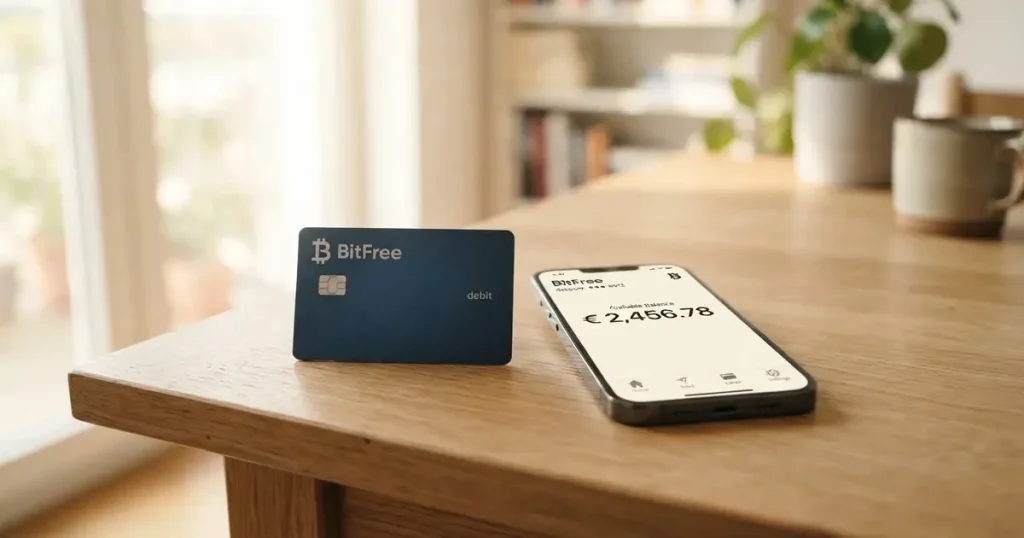
The BitFree card is a virtual prepaid card that lives inside an app. You verify your identity, load it with digital assets, and then spend the resulting balance the way you would spend a stored-value card. That is the entire product description the company’s public pages support, and it is more or less what you get: a card number in an app, funded by crypto, converted by an unnamed partner.
I have gone through the card’s own App Store listings, its site and its store descriptions, and I have compared that with what comparable crypto cards publish. My score is 5.2 out of 10. That is not a scolding; it is a description of a product whose public footprint is thin. BitFree passes the identity checks it says it runs, it is available in supported App Store regions, and the conversion rate is shown before you confirm a top-up. What it does not do is publish a single fee, a single limit, the name of its card network, or the name of the bank that issues it. If you are choosing a card because you cannot open an ordinary bank account, those blanks are the deciding factor, not a footnote.
This review is for you if you are anywhere in the world, have crypto you want to spend, and have had a bank decline you, or you simply want a card that does not tie you to one bank’s idea of a customer. It is written against the conditions shown on October 28, 2026.
| Criterion | Mark | Why |
|---|---|---|
| Who can get it | 7 / 10 | Supported App Store regions, excluding mainland China, and not Hong Kong, Macau or the US |
| Cost | 5 / 10 | No fees published; a partner does the conversion and the reference rate is visible before you confirm a top-up |
| Top-up options | 4 / 10 | Digital assets are for prepaid top-up only; no coins or networks are named |
| Reliability and complaints | 5 / 10 | Bitfree Limited / BITFREE INC., issuer is an unnamed licensed partner; no third-party reviews found; KYC with AML monitoring |
| Everyday use | 4 / 10 | Virtual prepaid card in the app only; wallets and ATM not disclosed |
| Total | 5.2 / 10 | A workable idea published far too thinly |
Who will they actually issue this card to
The card is offered in supported App Store regions, excluding mainland China, and it is also not available in Hong Kong, Macau or the US. That is the entire eligibility statement I can find. There is no country list beyond those exclusions, and the availability depends on issuing partner terms and local regulations — which means the same app in the same store can produce different answers in different countries.
The version history is also thin: one release note mentions improvements to the KYC document upload flow, and there are no stated tiers or limit levels. So eligibility is not a country list you can check against; it is a per-store, per-partner decision.
For you, the practical consequence is that you cannot tell in advance from the public pages whether you qualify. The one thing you can do before installing anything is check whether your country is one of the three named exclusions, and then read the app’s own eligibility screen as the only authoritative answer. If your country is not excluded but you still cannot find the card, the partner terms are the likely reason — and those are not published.
How to get it
Signing up means going through KYC before use: a government-issued ID and a liveness check, meaning a live camera check that you are holding the document. Proof of address and age requirements are not stated. KYC levels, if the provider has different tiers, are also not stated.
What you get at the end is a virtual prepaid card managed in the BitFree app, issued by an unnamed licensed partner. The card network and the currency are not stated. Delivery times are not applicable because there is nothing to ship — you do not receive plastic.
Before I say anything else about the process: there is nothing here worth speeding up. Identity verification exists because the issuer is regulated, and the sensible way through it is to submit genuine documents and to answer the questions honestly. Any provider promising to skip liveness checks for you is either lying about being regulated or is not the regulated party.
The one friction point you should expect is document upload. The version note about improving that flow suggests it has been a rough edge, and a rejected or blurry ID photo is the most common reason a KYC application stalls.
Fees: what it really costs you
Here is the honest position: the BitFree public pages do not state the cost of the card, the fees, the ATM terms, the limits, the tiers, or the currency. Not a single number. That is the section a reviewer would fill with figures, and I cannot, because the company has not published them.
What is stated is narrower and more useful than it first looks. Conversion is performed by the partner, and the amounts are not stated, but the App Store text says the reference rate can be reviewed before you confirm a top-up. In practice that gives you one specific protection: you see the rate the app is using before the money moves. Use it. Look at that number every time, because it is the only part of the cost structure you can actually observe.
| Fee or limit | What BitFree states |
|---|---|
| Issuance | Not stated |
| Monthly fee | Not stated |
| Conversion | Done by the partner; amount not stated; reference rate visible before confirming a top-up |
| FX (foreign exchange) | Not stated |
| ATM | Not stated |
| Daily limits | Not stated |
| Monthly limits | Not stated |
| Tiers | Not stated |
| Card currency | Not stated |
Limits are described only as “determined by the issuing partner and applicable network rules”. So even if you asked support, the answer would point outward, not inward.
Now let me take a few everyday payments and walk you through which fees apply, because this is where the missing numbers actually bite.
Buying coffee in a shop where you are standing. You tap the card number in your wallet app or enter it at the terminal. Whether the shop accepts it at all is a separate matter — some merchants decline prepaid or foreign-issued card numbers, because the merchant’s system can look up the issuer country and the card type from the card number itself. Your unknown currency means I cannot tell you whether a foreign-currency fee will apply on top of the conversion; the page does not say. What you can watch is the rate preview.
A subscription or an online order. Two things can happen here that are not about fees at all. The payment may be challenged by an extra identity check, which is normal for online card payments and can pass without a code or ask you for one. And the merchant’s billing address check — where the numbers in the address you typed are compared against the issuer’s records — is mainly offered in the US, Canada and the UK and is generally unavailable for cards issued outside those places, which can cause declines. Neither is a BitFree-specific defect, but both bite harder on a prepaid card from an unnamed issuer.
A declined payment. A declined authorisation can leave a hold on your funds that stays for several days, typically up to 7. On a prepaid balance you were planning to spend, a frozen amount feels like a fee. This is standard card-network behaviour, not something BitFree does.
The blunt summary: you cannot compute your cost per purchase from the published material. What you can do is treat the rate preview as the thing to check, keep your spending small while you learn the card, and accept that the monthly fee and the issuance fee may exist without being advertised.
Top up: how the card gets funded
The rule the card states is precise and narrow: supported digital assets may be used only for prepaid card top-up requests. That is the whole funding story. Coins and networks are not named, so I cannot tell you whether USDT on Tron, USDC on Base or anything else works, and I would not guess.
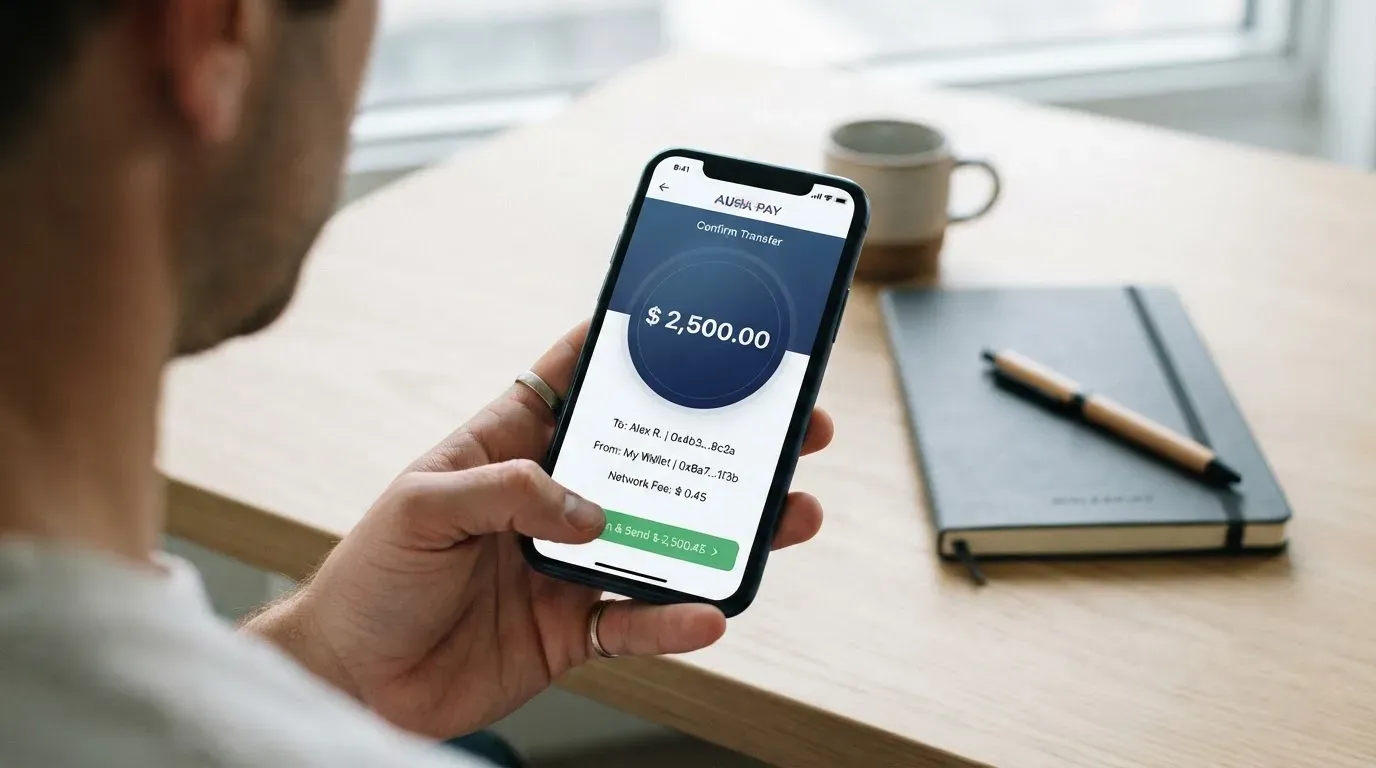
Why the “only” matters: it is not a debit card linked to a bank account, and it is not a wallet you can receive funds into directly. Crypto goes in as a top-up, becomes a card balance, and that balance is what pays. The card cannot overdraw, because there is no credit line — if the balance is empty, there is nothing to take.
Practical steps, in order:
- Open the app and complete KYC, since it is required before use.
- Choose the top-up request for the prepaid card.
- Check the reference rate the app shows before you confirm — this is the moment you still have a choice.
- Confirm, and wait for the balance to appear on the card.
What is not stated: the minimum or maximum top-up, how long a top-up takes, the coins and networks accepted, and whether a fee is deducted from the amount or added on top.
One background point that matters more than it looks. Blockchain transfers are irreversible. If you send on a network the provider does not support, or to an address belonging to a different network, the funds can be lost or need manual recovery with no guarantee. So the missing network list is not pedantry — it is the difference between a deposit that arrives and one that vanishes. Until you have confirmed which networks are supported inside the app itself, keep the first deposit small.
Paying with it every day
This is where the card is at its thinnest, and it scored 4 out of 10 for good reason. It is a virtual prepaid card inside the app. There is no physical card mentioned anywhere. Card wallets — Apple Pay, Google Pay — are not stated. Cash-point and ATM access is not stated. Rewards are not stated. How disputes and chargebacks are handled is not stated.
That is four unstated answers in a row, and each one matters at a different moment. Whether it can go into your phone’s wallet decides whether you can tap at a terminal at all, or whether you will be typing a card number into checkout forms. Whether ATMs work decides whether you can get cash. Whether rewards exist decides whether paying with it costs you anything extra or gives something back. Whether chargebacks work decides what happens when a shop takes the money and does not deliver.
One published signal does exist, and I would not lean on it. The iOS app (Bitfree Limited, id1453815920) sits at 3.3 from 99 ratings on the Japan App Store. The Google Play listing has the id com.yykj.bitfree.en, and its rating was not read. Three point three on 99 ratings in one country is thin and not something to build a decision on — but for a card that has almost no third-party coverage anywhere, a mediocre app rating in a single market is at least a signal, and it is the only one offered.
Where can you use it? The app store text says the card works in supported App Store regions, which is about issuance, not acceptance. Acceptance is a separate question with no published answer. Your realistic expectation should be ordinary merchants wherever virtual prepaid cards are accepted, with the usual decline risk at unfamiliar merchants and on the kinds of transaction card issuers restrict.
What can go wrong
There is no track record to examine. I found no official incident reports, and no third-party reviews of BitFree at all — no Trustpilot page was found either. That cuts both ways. It may mean there is nothing to complain about; it more likely means the card is too small to have generated coverage, so you have no independent read on how it behaves when something goes wrong.
The company behind it is Bitfree Limited as the iOS publisher and BITFREE INC. on Android, per the starting data. The issuer is described only as an unnamed licensed card issuing partner operating under its own financial licenses; registration details are not stated. The site is available in Russian. Support is at [email protected], with [email protected] for media and regulatory inquiries; languages and hours are not stated. News and further developments: not stated.
Safeguards that are stated: KYC with AML monitoring and device checks. That is real, and it is more than a card with no checks at all. What is not stated is the custody model — who holds the assets during the conversion, and what happens to your funds if the partner fails.
That last point deserves a paragraph of background, because it is the category’s central risk and this card publishes nothing about it. Custodial platforms have a history: Mt. Gox (about US$350 million reported stolen, 2011–2014), Coincheck (about US$400 million, 2018), Ronin Network (US$625 million, 2022). Whoever holds your credentials holds your money, and a stolen private key has no recovery built into the network — blockchain transfers are typically irreversible.
And programmes do close. Visa terminated its global agreements with FTX on 13 November 2022 and the FTX US debit card was wound down. WaveCrest, a Visa issuer that supplied crypto card brands, was suspended by Visa in Europe in 2018 and all its Visa programmes closed. Closures typically follow a pattern: notice, then loading and spending stop, then a request that you withdraw remaining balances.
A 2026 closure was reported by a secondary source, with new loads ending 8 July 2026 and spending stopping 8 August 2026 — single source, unconfirmed, and I include it only because it shows the timetable is short when it comes.
Then there are the tax and legal edges, which I will not advise on, only flag. The IRS treats digital assets as property, so exchanging them for goods, services, dollars or other digital assets generally produces a taxable gain or loss, measured in local fiat currency at the fair market value on the date of the transaction — which means each card payment funded from crypto can be a separate disposal. Rules elsewhere differ; decide that with a professional in your own country, not with a card review.
What to take instead
I am not going to rank these as better, because that is not the evidence. Here is what each of the three alternatives publishes, next to what BitFree publishes, so you can see the difference in transparency rather than take my word for a verdict.
| Card | Score | Card itself | Funding | Cost transparency |
|---|---|---|---|---|
| BitFree | 5.2 / 10 | Virtual prepaid, network and currency not stated | Digital assets, top-up only, coins and networks not named | No fees stated; rate preview before confirming |
| Cardex | 5.6 / 10 | Debit crypto card on VERVE, VISA, Mastercard and UnionPay; virtual and physical; currency Naira per listing | USDT, USDC and BTC wallets; networks not stated | Real-time conversion at payment, “AI-Powered Conversion Rate”; no fee percentage stated |
| CardFlow | 4.9 / 10 | Virtual USD Mastercard, created in about 3 minutes | Bitcoin, USDT, ETH or Naira bank transfer; networks not stated | Creating a virtual card is completely free; monthly fee not stated |
| HyperCard | 4.7 / 10 | Prepaid, network not stated on the App Store page; balance in USD or EUR | Deposit crypto such as USDT, BTC, ETH in the app, converted to USD or EUR; networks not stated | Not stated; the App Store page lists no fees |
What the comparison shows me is that this is a thin field. Every one of these cards names coins while withholding networks. CardFlow at least tells you the card creation is free and that the card is a virtual USD Mastercard, which is more than BitFree says about its network. Cardex names four networks and both card forms. HyperCard at least names two balance currencies. BitFree names none of it.
On eligibility, the picture is worse. Cardex says “one crypto card, 200+ countries” with no list and no exclusions; its store listing is Naira-focused. CardFlow aims at Nigeria. HyperCard’s App Store says the card works in “more than 176 countries” — but that is acceptance, not eligibility, and I would not read it as “anyone can sign up”. None of the three publishes the country-and-citizenship screening that decides your case, and neither does BitFree.
The reason I still rank Cardex and CardFlow above BitFree is not feature count; it is that a named network and a named currency give you something to test, complain about and check your statement against. BitFree gives you an app and an unnamed partner.
Who I would recommend it to
I would recommend BitFree to you if all of the following are true: you have crypto you want to convert into spendable balance without a bank account, you are comfortable being the first line of support for your own funds because there is no independent track record to lean on, you live outside mainland China, Hong Kong, Macau and the US, and you are willing to make your first top-up small until you have seen which networks the app actually accepts.
I would not recommend it if any of these apply: you need to know your monthly fee before you commit; you plan to use ATMs; you need a physical card; you want to add the card to Apple Pay or Google Wallet and cannot accept that it might not be supported; or you need chargeback rights you can rely on — prepaid-card coverage varies by jurisdiction and should not be assumed.
The neutral path, if you are undecided, is to install it, read the in-app fee and limit screens yourself, and compare those numbers against a card with a published schedule. You will learn more in ten minutes of the app than from any page the company has written, because the app is where the facts you need actually live.
And a closing caution about the biggest unknown. If the card network is not named on the public pages, then features you may be quietly expecting — tokenised payments in a phone wallet, 3-D Secure handling for online payments, merchant-category blocks on gambling (MCC 7995, commonly blocked by issuer policy rather than by law, and the blocked list varies by issuer) — are all things the issuing partner decides, not things you can read in advance. That is the gap I would want closed before I put meaningful money on it, and it is why my mark sits where it does.
Frequently asked questions
What is the BitFree card?
It is a virtual prepaid payment card managed inside the BitFree app and issued by an unnamed licensed partner. You load it with digital assets, the balance converts, and you spend that balance. The card network and the card currency are not stated on the public pages, and there is no physical version.
How does BitFree card work in practice?
You install the app, complete identity verification, then request a prepaid top-up with supported digital assets. Before you confirm, the app shows the reference rate the partner will use. The converted amount becomes your card balance, and the card spends that balance only — it cannot go negative.
Is BitFree a bank?
The public pages do not say it is. Bitfree Limited is listed as the iOS publisher and BITFREE INC. on Android, while the card is issued by an unnamed licensed card issuing partner operating under its own financial licenses. Registration details for that partner are not stated, so I would not describe this as a bank.
Who owns BitFree, and is it regulated?
Ownership is given only through those two company names in the store listings; no registration details are stated. The issuer is described as a licensed partner under its own financial licenses. KYC with AML monitoring and device checks is in place, and the site is available in Russian.
Who can get the card, and where is it not available?
It is offered in supported App Store regions, excluding mainland China, and it is also not available in Hong Kong, Macau or the US. Beyond those exclusions no country list exists, and availability depends on issuing partner terms and local regulations — so the app’s own eligibility screen is the only reliable answer.
Does BitFree card require KYC, and how do I apply?
Yes. Identity verification is required before use: a government-issued ID and a liveness check. Proof of address and age requirements are not stated, and there are no stated KYC tiers. Apply through the app; one release note mentions improvements to the document upload flow.
What does it cost, and is it free?
The card’s own pages state no fees at all — not issuance, not a monthly fee, not ATM, not foreign exchange. Conversion is done by the partner and the amounts are not published, though the reference rate is visible before you confirm a top-up. I would not treat this card as free; treat it as unpriced.
How do I top up, and can I withdraw?
Top-ups are the only stated use of supported digital assets, and neither the coins nor the networks are named, so I cannot tell you what to send. Withdrawal is not stated either. Because transfers are irreversible, confirm the supported network inside the app and keep your first deposit small.
Is BitFree card safe, and is it worth it?
Safety is not something I can answer from public material. KYC with AML monitoring and device checks are stated, but the custody model is not, and I found no third-party reviews of BitFree at all — no independent view exists to lean on. Whether it is worth it depends on whether you are comfortable with that thinness.
Can I add the BitFree card to Apple Wallet?
Apple Pay support is not stated anywhere in the card’s public pages, so I would not plan around it. Apple Pay works by replacing the card number with a device-specific number stored in the Secure Element and a different one-time code per payment — but whether BitFree’s issuer supports tokenisation of its card is a decision you would have to see inside the app.
Virtual cards in the catalogue – cryptocardcatalog
Content created by the «cryptocardcatalog» team