
Tarjeta Cripto Fluyez review: a virtual Visa paid from crypto, still finding its feet
 Available in US

The Tarjeta Cripto Fluyez is a virtual Visa card linked to a Peruvian crypto platform of the same name, intended for people in Latin America who want to pay at any Visa-accepting merchant using a balance funded from Bitcoin, USDT or ETH. It is built around a regulated Peruvian virtual-asset business rather than a bank, and the public information about the card is unusually thin for a payment product of this kind. This review goes through what is actually known about the card, where the picture is incomplete, and what a reader who can choose a different crypto card may want to weigh before signing up.
Conditions on this page are current as of October 28, 2026.
Verdict
My overall score is 5.5 out of 10, with a clearer sense of where the points come from once the table below is laid out.
| Criterion | Mark | Short reason |
|---|---|---|
| Who can get it | 4 / 10 | Latin America only, no clear list of excluded countries |
| Cost | 6 / 10 | No stated fee for meeting a (unstated) minimum, but card fees are not published |
| Top-up options | 6 / 10 | BTC, USDT and ETH are named, networks and minimums are not |
| Reliability and complaints | 6 / 10 | A regulated Peruvian company with a Bit2Me stake; card programme details not on the page |
| Everyday use | 6 / 10 | Apple Pay and Google Wallet work, but no physical card is confirmed and ATM use is not described |
The audience the card seems aimed at is a Peruvian or Latin American crypto holder who wants a Visa to spend at shops and online. For someone in Europe or the US, the card is not the right starting point at all, because the offering is regional and the documentation is in Spanish. For someone in Latin America comparing options, the Fluyez card is a credible local choice on paper, but the missing figures around ATM use, conversion fees and limits mean you are signing up on the strength of the platform rather than a fully transparent card.
Will they give you the card
The Tarjeta Cripto Fluyez is positioned for Latin America. The public page says the card is “Disponible en Latinoamérica” and “Funciona en Perú y toda Latinoamérica sin restricciones”. In other words, the same product is sold across the region, with Peru as the home market and the rest of Latin America described as unrestricted. The card works wherever Visa is accepted, because it sits on the Visa network, so the geographic question is really about who can apply, not about who can be paid.
There is no published list of excluded countries within Latin America, and the public page does not say how the platform treats non-Latin American applicants, dual citizens, or people resident in one country holding a passport of another. If you are unsure whether your situation fits, the practical route is to start the in-app sign-up, which will tell you at the KYC step whether the platform is willing to onboard you, before you commit time or money.
How to get it
The on-page flow is short: download the Fluyez app, upload an identity document, complete a facial verification, and registration is described as taking “menos de 2 minutos”. Once the account is open, the next step is to request the virtual card from inside the account and activate it, with activation quoted as “Inmediata (menos de 10 min)”. The page also has a comparison-table reference to a “Visa Virtual” product; the same page’s structured data mentions both a physical and a virtual card, but a physical card is not confirmed in the visible text, and there is no delivery detail because the product being marketed is the virtual one.
What the page does not say is just as important for setting expectations. The public material does not state a minimum age, does not require proof of address in the visible flow, and does not describe different KYC levels, processing times for unusual cases, or the reasons an application might be rejected. If you are an existing Fluyez platform user, the path is the same: the card is a feature of the account rather than a separate application. If you have used other crypto cards, you will find the wording lighter here than on cards that publish tiered KYC tables and a country-by-country eligibility grid.
The KYC step is a hard gate, not a formality. To use the card you have to pass the identity check, which means a government-issued ID and a working camera, and you have to be willing to have your data screened against sanctions lists and PEP databases. The reviewer’s view is that this is the same KYC any regulated card programme applies, and that there is no way around it on a card like this: if you want a Visa that draws on a crypto balance, the issuer (whether or not it is named here) will run the same checks.
Fees: what it really costs
The clearest thing the card’s own page says about cost is that there are “Sin costos ni mantenimiento si llegas al monto mínimo de uso”. The minimum use threshold itself is not stated on the public page, and the issuance fee is not stated either, so the headline “no cost” only kicks in once you cross a usage line that the page does not draw. The card’s own fees are described in the general sense as “Las comisiones dependen del tipo de operación” without the values being published. Outside the card product, the Fluyez platform charges a 1% commission per operation.
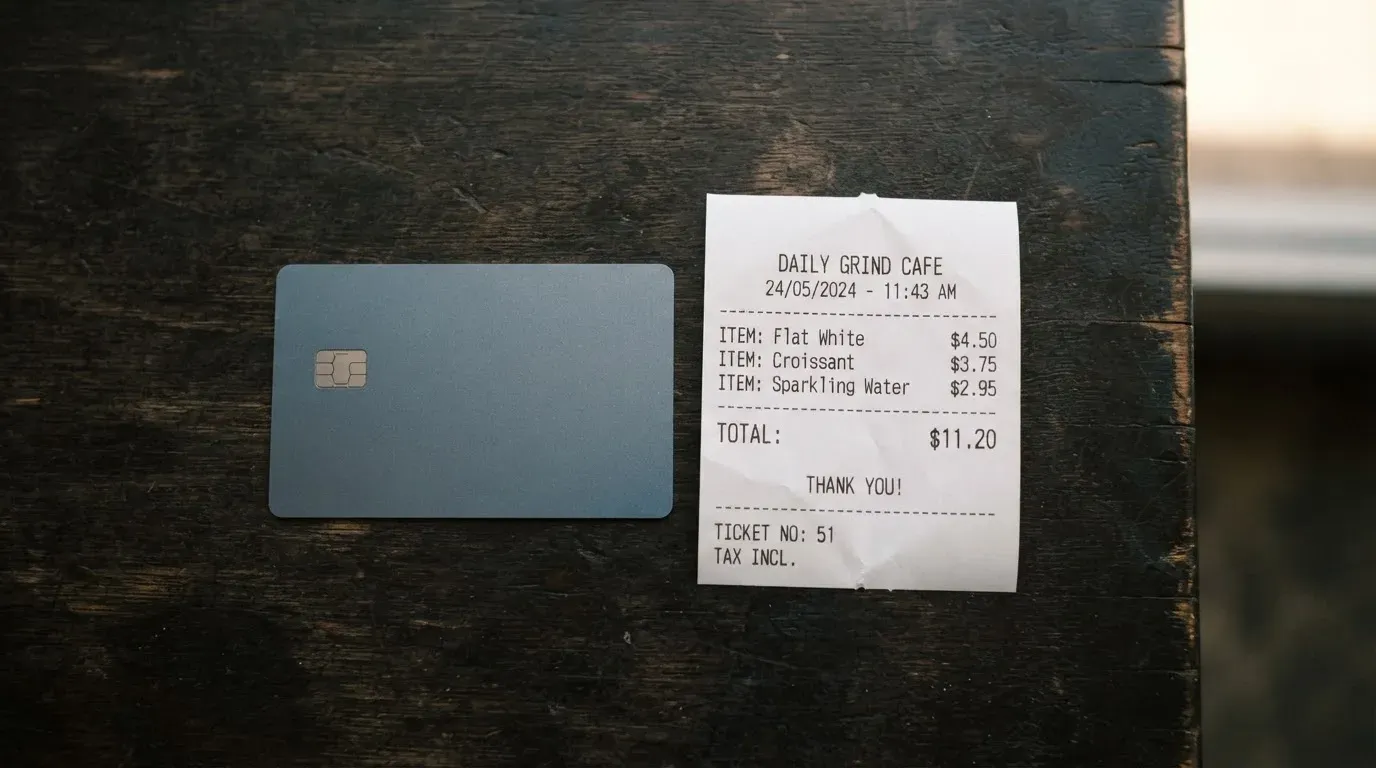
| Fee or limit | Value as stated |
|---|---|
| Card issuance | not stated |
| Monthly maintenance | none if a minimum use is met (minimum not stated) |
| Conversion fee on card spend | not stated for the card; 1% platform commission per operation |
| Foreign-exchange (FX) fee | not stated |
| ATM fee | not stated |
| Daily spend limit | not stated |
| Monthly spend limit | not stated |
To make the picture more useful, here is what three everyday payments look like under the published information:
- A coffee in Lima paid in PEN from a USDT balance: the platform takes its 1% commission per operation on the underlying conversion, the card’s own conversion fee is not published, and the network rate is what the platform uses; the reader pays the platform commission and an unknown card-side markup.
- An online subscription in EUR paid from a BTC balance: the same 1% platform commission applies at the crypto-to-fiat step, the card’s FX fee is not stated, and the network is Visa, so the card is treated as a foreign-issued card by the merchant’s bank.
- A bank-account deposit of $100 in local currency: the platform says bank deposits are free with a $1 minimum, so this part is cheap, but the platform’s own withdrawal rule of $5 flat under $500 (and 1% from $500, minimum $6) applies if you want to move money back out to a bank.
The honest summary is that you can know what the platform charges you and what the network costs, but the card-specific numbers that decide the cost of a coffee or a subscription are not on the page. That is unusual, because most crypto card providers publish at least an issuance fee, an FX margin and an ATM fee. The reviewer would treat the gap as a real cost, not a marketing choice.
Top up: how to fund the card
The card is spent from a balance that the user funds with crypto. The page lists Bitcoin, USDT and ETH and adds “u otras criptomonedas disponibles”, so other coins may be added over time, but the networks on which those tokens are accepted are not stated. At payment, the equivalent in crypto is converted to fiat and debited from the card balance. Because the card sits on a Peruvian platform, the platform handles PEN and USD on the bank side, which is the practical context for the top-up flow.

The fees and limits at the platform level are partly published:
- Bank deposits onto the platform: free, with a $1 minimum.
- Buying crypto with a card on the platform: 4.65% per purchase, with a $5,000 daily cap.
- Crypto-to-card top-up: no fee stated for the card product itself.
- Withdrawing in PEN or USD to a bank: $5 flat under $500, 1% from $500, minimum $6, taking up to 24 hours.
What is not stated is just as relevant:
- The blockchain networks accepted for each coin (ERC-20, TRC-20, native Bitcoin, etc.).
- The minimum top-up for the card.
- The card’s own reload and balance caps.
- The procedure to move a card balance back into crypto, if any.
A reader who only has USDT on Tron, for example, will want to confirm that network is supported before sending anything, because an unsupported network or a wrong destination address usually means a manual recovery request with no guarantee of success. The platform publishes its Spanish-language support channels (24/7 chat in Spanish, a Peru phone/WhatsApp number and an email address) precisely because these are the situations where a real human at the other end makes a difference.
Paying with it every day
The card works with Apple Pay and Google Wallet, which is the easiest way to use a virtual Visa in a physical store: add the card to the phone’s wallet and pay at any contactless terminal. Online, the card behaves like any other Visa, with the usual mix of 3-D Secure challenges depending on the merchant and the issuer’s risk model. The page does not list blocked merchant categories, so gambling, adult content and other commonly restricted categories are not stated either way; treat the card as a general-spend Visa unless you are told otherwise.
There is no rewards, cashback or points programme. The page makes no mention of any benefit on top of the conversion, so each payment costs the platform commission plus any card-side fee, and gives back nothing. The iOS app has a 3.7 rating from a small number of ratings in the App Store (read on 2026-10-21), and the Google Play listing is described as “Próximamente” on the platform’s site, so the Android experience is not yet publicly available.
A physical card is not confirmed in the visible material, even though structured data on the page mentions one. The ATM story is not stated either, and the 2% figure that sometimes shows up in the comparison table belongs to other cards (Binance Card, Lemon Card), not to Fluyez. For a reader who relies on ATM withdrawals, the honest position is that the card cannot be relied on for that use until the platform publishes ATM fees, daily limits and the issuing bank’s terms.
Disputes and chargebacks are not described on the public page. A chargeback is a refund ordered by the card issuer, and on any Visa card the cardholder’s first route is the issuer; if the issuer is not named, that route is harder to find. Real-time notifications and the ability to block and unblock the card from the app are mentioned, along with biometrics for transaction approval, which at least makes the operational side of the card manageable day to day.
What can go wrong
A few specific risks are worth keeping in mind before signing up.
First, the card issuer is not named on the public page. The page talks about a Visa partnership and the platform, but it does not say which bank or e-money institution actually issues the card. For a regulated Visa programme, that issuer holds the BIN, runs KYC, fights chargebacks and is the legal counterparty. If the issuer is in a different country from the cardholder, the card can look “foreign” to a merchant’s BIN lookup and trigger extra checks; if the issuer is the platform itself under an e-money licence, the platform is the one the cardholder deals with for refunds. The reader cannot tell from the page which model applies.
Second, the company behind the card is a Peruvian virtual-asset business, not a bank. Fluyez Digital Investments S.A.C. is registered with Peru’s banking and insurance regulator (SBS) as a virtual asset service provider under Resolución N° 02568-2021, and Bit2Me, a Spanish crypto exchange, bought a stake (the platform’s site says one million euros, with the deal reported in July 2022). The company is regulated for the crypto side of the business, not as a bank, and that distinction is what decides whether your balance is treated as e-money (with safeguarding rules) or as a crypto receivable (with a different risk profile). On a 2026-01-20 news item, the platform was described as preparing the public launch of the card with its Visa alliance, which means the product was still bedding in at the time of writing.
Third, the public complaint record is thin. Trustpilot shows 4.3 out of 5 from 9 reviews, all five stars and all dated August 2021, with no reviews in the last 12 months. That is not a sample you can draw a strong conclusion from, but it is also not a long string of complaints. A reader should treat the absence of complaints as a low signal, not as a positive one, given the small volume.
Fourth, custody and sanctions exposure are real for any crypto card. Funds held with a custodian carry counterparty and hack risk, and stablecoins can be frozen by the issuer against wallets on sanctions lists. The page says custody is handled by the platform but does not describe the custody model in detail, and the practical effect is that the user is trusting the platform with the crypto between top-up and spend. For a reader who prefers to keep control of their private key until the moment of payment, a self-custody-linked card is a more natural fit, but the trade-off there is full responsibility for the seed phrase and for sending on the right network.
Fifth, the documentation gap. The minimum usage for the no-fee promise is not published, card-specific fees are not published, ATM use is not published, and limits are not published. A reader who values transparency on costs will find more of it in competitor cards that publish issuance, FX and ATM fees in a single table.
What to take instead
A short list of alternatives, with the same general shape of product, helps frame the choice. The cards below are not direct substitutes — they target different regions and different needs — but they are useful reference points.
| Card | Score | Region | Standout feature |
|---|---|---|---|
| Young Card | 5.7 / 10 | not stated officially | Cashback paid in YNG tokens, rate by Club tier (Essential 0.1%, Gold 1.8%, Platinum 3.6%) |
| MSX | 6.4 / 10 | not stated on a public page | Mid-range score with no specific rewards detail published |
| Bybit Card | 6.0 / 10 | Argentina, AIFC, Georgia, Kazakhstan, Australia, Mexico, Brazil, Peru, Asia Pacific | Tiered cashback (Base 2% to Infinite 10%), multiple card types per region, broad crypto support |
A short note on each, told to the reader rather than to the writer:
- Young Card. The hook is token cashback, not fee transparency, and the rate depends on the tier you sit in. If you are drawn to the YNG token economy, the card is built for that; if you want a low-fee flat card, look elsewhere.
- MSX. A mid-pack option that does not publish a lot of detail. A reader choosing between Fluyez and MSX will end up reading both pages carefully and deciding which set of unknowns they prefer to live with.
- Bybit Card. The strongest alternative if you live in one of its listed regions, including Peru, because it spells out the cashback tiers, the FX fees and the conversion fees in a way the Fluyez page does not. Note that Bybit is explicit that the card is not for European Economic Area customers, and that some fiat services are restricted in Belarus, Russia, Serbia, China and the US — the card itself has its own country rules, and a reader outside the supported regions cannot apply.
Who I would recommend it to
The card fits a fairly narrow reader. If you are in Peru or elsewhere in Latin America, if you already use the Fluyez platform to buy and hold crypto, if you want a Visa you can put into Apple Pay or Google Wallet to spend a small balance at shops and online, and if you are comfortable with the platform’s published terms even where they leave the card-specific numbers blank, the Tarjeta Cripto Fluyez is a reasonable option. For that reader, the day-to-day experience is a virtual card activated in under ten minutes, contactless payments from a crypto balance, and a Spanish-language support line you can call if anything goes wrong.
If you fall outside that profile, the recommendation is to look elsewhere. A reader who needs an ATM-accessible card, who wants the full fee schedule before signing up, who expects a rewards programme, who is outside Latin America, or who needs a physical card in hand will be better served by a different product. The honest summary is that the Tarjeta Cripto Fluyez is a regional, platform-led card for crypto holders who want to spend what they already hold, and a reader should treat the missing card-side numbers as a real cost until the platform publishes them.
Frequently asked questions
What is the Tarjeta Cripto Fluyez card?
It is a virtual Visa card linked to a crypto balance held on the Fluyez platform, a Peruvian virtual-asset service provider. The card is sold across Latin America and accepted wherever Visa is taken, and the balance is funded from Bitcoin, USDT, ETH or other listed cryptocurrencies that the platform supports at the time of use.
How does the Tarjeta Cripto Fluyez card work?
You hold crypto on the Fluyez platform, the card draws on a converted fiat balance at the moment of payment, and the equivalent in crypto is debited from your holding. The platform charges a 1% commission per operation; the card’s own conversion and FX fees are not stated on the public page, so the total cost of a payment is partly unknown until you try it.
Is Tarjeta Cripto Fluyez a bank?
No. Fluyez Digital Investments S.A.C. is registered with Peru’s SBS as a virtual asset service provider under Resolución N° 02568-2021, not as a bank. The platform handles the crypto side of the product; the card itself sits on a Visa programme, but the issuing bank or e-money institution is not named on the public page.
Who owns Tarjeta Cripto Fluyez?
The company behind the platform is Fluyez Digital Investments S.A.C., based in Peru. The Spanish crypto exchange Bit2Me acquired a stake, reported in July 2022, and the platform’s own materials describe that investment. The company is not publicly listed and the full ownership structure is not detailed on the public page.
How do I apply for the Tarjeta Cripto Fluyez card?
The on-page flow is to download the Fluyez app, upload an identity document, complete a facial verification check, then request and activate the virtual card from the account. The platform quotes registration in under two minutes and card activation in under ten minutes for straightforward cases.
Does the card require KYC?
Yes. Identity verification is part of the sign-up flow and you cannot use the card without passing it. The page does not describe different KYC levels, processing time for unusual cases, or rejection reasons, so the practical experience is that you submit your documents and the platform tells you what happens next.
How do I add the card to Apple Pay or Google Wallet?
The card is described as working with both wallets, and the usual route is to open the wallet app, choose to add a card, and authenticate the addition through the Fluyez app. Once added, payments are tokenised, meaning the wallet uses a device-specific number rather than the card number itself, which is the standard behaviour for tokenised mobile payments.
Where can I use the Tarjeta Cripto Fluyez card?
The card is accepted wherever Visa is taken, both in physical shops via contactless and online. The page does not list blocked merchant categories, so specific restrictions on gambling, adult content or other commonly limited categories are not stated; a reader who needs to know in advance should ask support before relying on a particular merchant.
How do I top up the card?
You deposit supported crypto onto the Fluyez platform and the card draws on the converted fiat balance. The page names Bitcoin, USDT and ETH and adds that other cryptocurrencies may be available, but the blockchain networks accepted for each token are not stated, and the minimum top-up for the card is not stated either.
Is the Tarjeta Cripto Fluyez card worth it?
For a reader in Latin America who already uses the Fluyez platform, the card is a reasonable way to spend a crypto balance at Visa merchants, and the everyday use is straightforward via mobile wallets. For a reader who needs transparent card fees, ATM access, a physical card or a rewards programme, the missing information on the public page makes the card harder to justify, and one of the alternatives in the comparison section is likely to be a better fit.
Exchange cards in the catalogue – cryptocardcatalog
Content created by the «cryptocardcatalog» team