
A Hong Kong Visa card that publishes very little about its own costs
 Available in US

If you have been searching for a plain Visa card that you can load with USDT or USDC and then spend like an ordinary card, WebitPay does the basics well. It issues a physical and a virtual Visa card, the virtual one loads into Apple Pay and Google Pay, the physical one works at ATMs, and identity checks are done through a recognised automated provider. That is the short version of the good news, and it is a real part of the product.
The longer version is that almost everything you would want to know before signing up is not published. The list of countries that can get the card is not shown. The fee schedule is described as something that “will be made available on our website” without being available on it. The daily and monthly spending limits are not stated, the currency of the card is not stated, the networks you can send USDT or USDC over are not stated, and how long delivery takes is not stated. This is not a card I would call unsafe, and I found no incidents or user complaints against it. It is a card I would call opaque, and those are different problems.
My score for it is 6.0 out of 10. The reasoning is in the verdict below, criterion by criterion.
The conditions described here are current as of October 28, 2026.
The score, and who this card suits
WebitPay comes from Webit Information Technology Limited in Hong Kong, with the card programme issued by Reap Technologies Limited. It is built for one clear use case: a person who already holds stablecoins and wants a Visa card that reads off that balance. If that is you, the daily mechanics are close to ideal — 9 out of 10 in my scoring, the highest mark on the card, because the physical-plus-virtual Visa combination with Apple Pay and Google Pay is the whole job done properly.
Where it loses points is everything around that core. Who can get it scores 5. What it costs scores 5. Top-up options score 5. Reliability and complaints scores 7, which is the second-highest, mostly because I found nothing bad.
| Criterion | Mark | Why |
|---|---|---|
| Who can get it | 5 / 10 | The list of eligible countries is not published. The terms ban sanctioned persons; the FAQ refers to a prohibited-country list without showing it. |
| Cost | 5 / 10 | No fee schedule is published — it says fees “will be made available on our website”. Only the ATM currency conversion fee of 1% is stated, plus an unquantified separate ATM fee. |
| Top-up options | 5 / 10 | USDT or USDC straight from a wallet. Networks, minimums and any top-up fee are not stated. |
| Reliability and complaints | 7 / 10 | Webit Information Technology Limited, Hong Kong; issuer Reap Technologies Limited, no licences named. Two-factor authentication via Google Authenticator. No incidents and no user complaints found. App Store 5.0 from two ratings. |
| Everyday use | 9 / 10 | Physical and virtual Visa cards, virtual card works with Apple Pay and Google Pay, physical card works at ATMs. |
| Total | 6.0 / 10 | A good card for one job, wrapped in the thinnest disclosure I have seen in this category. |
So who should consider it, and who should not? If you hold USDT or USDC, you want a Visa number rather than a chain-native payment, you are comfortable supplying documents to an automated check, and you are the kind of person who will read the app carefully before sending funds to an address, this card is a reasonable fit. If instead you are choosing on the basis of a published fee table, a published limit, or knowing exactly which country you are eligible from — those three things are the reason to look elsewhere. The comparisons at the end of this page are written for exactly that decision.
Will they give you the card
The published answer is: nobody knows from the public pages, because the list of countries is not stated.
What the terms do say is that users must not be subject to sanctions. The FAQ mentions a list of prohibited countries and regions, but it does not show that list. So the two things a reader in a specific country actually needs — “is my country on the allowed side” and “is my country on the blocked side” — are both unanswerable from what the company publishes. The restrictions that do exist are framed around sanctioned persons rather than around geography, which is a different test and leaves more uncertainty rather than less.
This matters more than it might look. Sanctions screening is not the same as a country list, and neither is nationality. Across this category, nationality tends to be recorded and screened separately from residence, because issuer risk policy and sanctions rules often apply to citizenship and country of birth as well as to the address on the application. A Hong Kong-registered provider can apply its own risk policy over and above the legal minimum, and the only public statement here is a prohibition on sanctioned persons.
There is one firm thing to say about who can open the account at all: it is adults, since prepaid and debit cards in this category are generally issued to people aged 18 and over. Some issuers set higher minimums, and this one does not say that it does.
How to get it
The signup is a standard identity check, done by an automated third-party provider rather than by a person reading your forms.
Verification runs through Shufti Pro, using facial recognition plus a data match against records, with the possibility of a manual review afterwards. The company’s own terms say that documents, proof of address and age requirements are not stated — that is the state of the public information, not my shorthand for “it’s easy”. Refusing the identity check can lead to your account being suspended, which is normal for this category: regulated businesses have to verify customers and assess risk under anti-money-laundering law, and where due diligence cannot be completed they are expected to refrain from the relationship. That is why accounts close or freeze pending documents rather than stay pending forever.
What you get at the end is two cards. There is a physical card and a virtual card, both Visa — the app store listing refers to millions of Visa-supported merchants. The currency of the card itself is not stated, which is a genuine unknown rather than a minor detail: it decides what your balance is denominated in and what happens when you spend abroad. The virtual card, which is the one you would normally use day to day, supports Apple Pay and Google Pay.
Two things about the process itself are simply absent from the public pages: how long the physical card takes to arrive, and how long verification takes or why an application might be refused. There are no published verification tiers either, no bronze or silver level, so I cannot tell you what unlocks at what point. If you need the physical card quickly, that is a question to ask support before you start, not after.
Fees: what it really costs
Here is the honest position: WebitPay does not publish its fee schedule on its public pages. There is a “WebitPay Card Service Fees” FAQ page, and its contents are not shown. The terms say the fee schedule “will be made available on our website”. So the table below is not the card’s price list, because the card does not publish one — it is everything that is actually stated, with the gaps left as gaps.

| Fee or limit | What is published |
|---|---|
| Card issuance | not stated |
| Monthly or maintenance fee | not stated |
| Crypto conversion fee | not stated |
| Foreign exchange fee | not stated |
| ATM fee | A separate fee applies; the amount is not stated |
| ATM currency conversion | 1% |
| Free ATM allowance | not stated |
| Daily spending limit | not stated |
| Monthly spending limit | not stated |
| Card currency | not stated |
| Tiers or paid plans | not stated — physical and virtual card only |
Three everyday payments, worked through against what is known:
A coffee bought in your own country. If the card holds a balance in the currency of the coffee, the only thing standing between you and a clean purchase is whatever conversion fee applies when USDT or USDC is turned into spendable money — and that fee is not published. If the balance is not in the currency of the coffee, you also hit an FX fee whose amount is likewise not published. I cannot tell you what this coffee costs. That is the finding, not a hedge.
A subscription bought in a currency other than the card’s. This is the case where the missing FX number hurts most. The general FX fee is not stated, so a frequent traveller or anyone paying for software, hosting or a foreign service has no way to estimate the cost of the card’s own margin. You can only assume there is one; the category almost always has some.
A cash withdrawal at an ATM. This is the one line where the card gives a real number: 1% currency conversion fee, plus a separate ATM fee whose amount is not shown. Whether there is a free allowance is not stated, so I would not assume the first withdrawal is free. One detail worth knowing for a crypto deposit in the background: on-chain network fees when you send USDT or USDC to the card are charged by the blockchain, not by WebitPay, so that cost is invisible in the card’s own pricing.
For contrast, this is where crypto cards sit generally. A card is a spending wrapper over a balance, so the costs that matter are the conversion from crypto to fiat, the FX margin on non-local spending, and any per-transaction or monthly fee. A card that publishes none of these is asking you to find out after the fact.
How to Top up
Topping up is the simplest part of the whole flow, and it is also the part with the most unanswered questions around it.
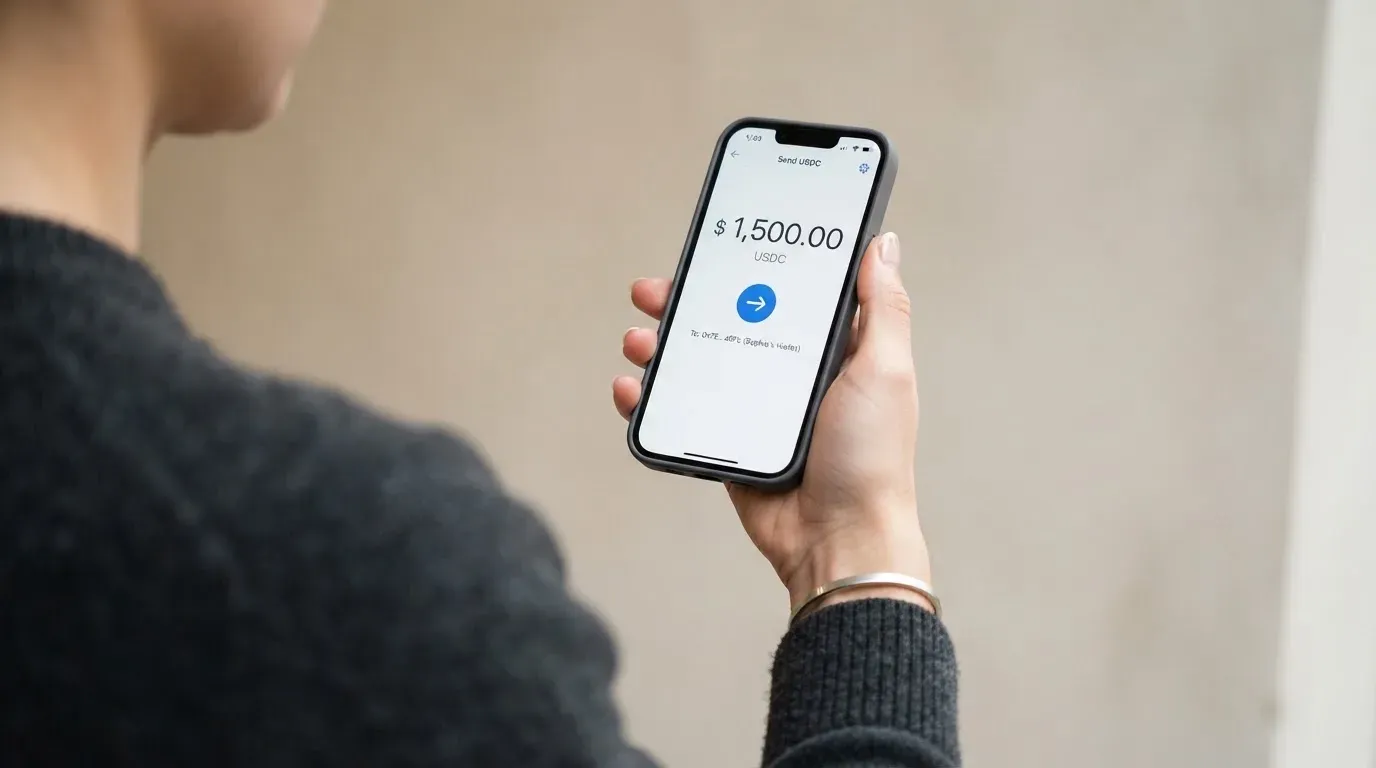
You fund the card with stablecoins — USDT or USDC — sent directly from your own wallet. That is the mechanism, and for someone already holding stablecoins it is short and direct: no bank transfer, no card-to-card step, no waiting for an intermediary bank.
What is not stated: which networks are supported, what the minimum top-up is, and whether any top-up fee is charged. Those three missing answers are the practical problem. Networks in particular are not a detail you can shrug off. Blockchain transfers are irreversible, and a deposit sent on a network the provider does not support, or to an address belonging to a different network, can simply be lost or need a manual support recovery with no guarantee. Stablecoins that appear identical are not the same asset on different chains — USDC, for example, is natively supported on 38 networks as Circle lists them, and Circle stopped supporting USDC on Tron in February 2024, so “USDC over TRC20” is not a native option. On Ethereum, sending a token requires ETH for gas, so a wallet holding USDT and nothing else cannot send it. If your funds sit on a network the card does not take, you are relying on support to recover a mistake.
The terms also say top-ups must originate from legitimate sources. On the other side, withdrawals are not stated at all: there is no published withdrawal process, and the terms only say that on closure remaining funds “may be returned under applicable law”. Nor is any fiat deposit option listed.
Paying with it every day
This is where the card is genuinely good, and it is worth saying so plainly.
You get a physical and a virtual Visa card. The virtual card is the everyday tool: add it to Apple Pay or Google Pay and pay by phone. For Google Pay, the card states there is no extra Webit fee, though network, third-party and Reap charges may apply. Apple Pay works the standard way — the card number is replaced by a device-specific number held in the phone’s secure hardware, never on Apple’s servers, with a fresh one-time security code for each payment. At a terminal the physical card behaves like any other Visa.
For a crypto card that is exactly the right shape. A tokenised mobile wallet plus a virtual card is how you avoid typing a card number into a shop’s website, and it is the configuration most people in this category actually want day to day.
The app is iOS, version 1.4.5, rated 5.0 — but from only two ratings, which is not a signal I would lean on. I did not check the Google Play rating. The release history shows steady small work: 1.1.3 in May 2025 improved statement download and ATM behaviour, 1.2.1 in January added WhatsApp one-time codes and an Anti-Phishing Code, 1.2.3 in March added balance alerts, and 1.4.5 in September is the current version. That is a team shipping maintenance rather than features, which for a spending card is arguably the right priority.
If something goes wrong with a payment, the stated route is: contact the merchant first; if that does not resolve it, raise a claim with Webit, which liaises with Reap and the card networks, subject to eligibility and timelines. A reversal is not guaranteed. In the background, a declined authorisation can leave a hold on your funds for several days, typically up to seven — so a payment that fails at a till is not always money you have lost, and it is not always money you still have either.
Two absences worth naming: which merchant categories are blocked is not stated, and there are no rewards of any kind published — no cashback, no points, nothing.
What can go wrong
Nothing bad that I could find. That is a genuine finding and I want to give it its weight: I found no official incidents and no user reports about WebitPay. I also found no Trustpilot page for it, which cuts both ways — a company with no complaints page has not necessarily done nothing wrong, and it also has not built a public complaint record.
The real exposures here are structural, and they are the same ones this category carries.
Whose money is it, and who is behind the card. Webit Information Technology Limited is at Room 2706, 27/F, Everbright Centre, 108 Gloucester Road, Wan Chai, Hong Kong, and the terms are governed by Hong Kong law. The card is issued by Reap Technologies Limited, and Webit is the programme provider rather than the issuer. That structure is completely normal — in this category the crypto brand is often just the front end, while a licensed issuer holds the programme and a network like Visa or Mastercard routes the payments. The site says Webit holds the “necessary financial licenses” but names none. For comparison, an electronic money institution in the EU must be licensed in a member state and safeguarded, but it is not a bank: it cannot lend, and its safeguarded funds sit in dedicated accounts and are not bank deposits, so they do not carry deposit-guarantee cover. Nobody should tell you that a card like this is insured like a current account, and this one says nothing that would let me tell you otherwise.
Whose crypto it is. The account is described as an electronic money account, and how the crypto is held — safeguarded, custodied elsewhere, or otherwise — is not stated. If you are sending USDT or USDC to the provider, you are trusting a Hong Kong company with the transfer. That is the trade this category makes, and it is why the closed-country history matters: custodial platforms have failed before, with Mt. Gox losing a reported US$350 million between 2011 and 2014, Coincheck about US$400 million in 2018, and Ronin Network US$625 million in 2022. Stablecoins are not censorship-proof either — Tether says it disables tokens in wallets on the OFAC sanctions list and has frozen funds tied to illicit activity.
Programmes get closed. Card programmes do end. Visa terminated its global agreements with FTX on 13 November 2022 and the FTX US debit card was wound down; WaveCrest, a Visa issuer that supplied crypto card brands, was suspended by Visa in Europe in 2018, closing all WaveCrest-issued Visa programmes. The usual pattern is a notice period, then loading and spending stop, then users are asked to withdraw. When that happens with an unpublished withdrawal process, you are in a weaker position than you would be with a card that has told you how to get your money out.
Being declined at the till. The card number’s first six or eight digits identify the issuing institution, and merchants can look that up and apply extra scrutiny when the issuer’s country differs from the billing address — which is precisely the situation with a Hong Kong-issued card. Some merchants decline prepaid or foreign-issued cards for that reason. Address verification, which compares numbers in your billing address against issuer records, is mainly available in the US, Canada and the UK and is generally unavailable for foreign-issued cards, which can cause declines on online payments.
Security practices that are fine but not exceptional. Two-factor authentication through Google Authenticator, an Anti-Phishing Code and WhatsApp one-time codes added in version 1.2.1, and a card freeze for a lost physical card. That is a reasonable list. What is missing from the public pages is any statement on how customer funds are safeguarded.
Support is by email at [email protected] and phone on +852-96958088, Monday to Saturday, 8:00 to 18:00, with a help centre on Zendesk. That is a real, published, human schedule, which is more than many cards in this category offer.
What to take instead
If the missing fee table is the thing that stops you, three alternatives I looked at each publish more of what matters. None of them is perfect, and two of them have their own large gaps — I am comparing them on disclosure, not recommending.
| WebitPay | International Visa Card | UNi Card | Whop Cards | |
|---|---|---|---|---|
| Score | 6.0 / 10 | 6.7 / 10 | 6.1 / 10 | 5.2 / 10 |
| Network | Visa | Visa | Mastercard | Visa |
| Card type | Physical and virtual | Virtual; physical “Coming soon” | not stated | not stated |
| Cost published | No | $5 issuance; plans Classic free, Pro $9.00/month, Max $19.00/month | No annual fee; issuance not stated | “No extra fees”; no amounts listed |
| FX / conversion | ATM conversion 1%; others not stated | Visa exchange rate plus 2% FX fee; USD use free | Live OTC rates; no foreign transaction fee | not stated |
| Funding | USDT or USDC from wallet; networks not stated | USDC or USDT into the USD account, plus USD, EUR, SEPA, SWIFT, FedNow | not stated | Whop balance backed by stablecoin collateral from a linked wallet |
| Who can get it | not stated | Long published exclusion list, applied by residence or registration | not stated | 31 US states for consumers, 41 for businesses; unsupported-country list published |
| Rewards | not stated | none stated | Spend-to-Earn up to 3% | 5% cashback at select merchants |
International Visa Card is the one to look at first if your priority is knowing the price. It publishes a $5 one-time issuance fee on the virtual card, no maintenance fee, three named plans, free card use in USD on every plan, and a clearly stated foreign-currency margin: Visa’s exchange rate plus a 2% FX fee. Deposits of any kind carry no fee, and it takes USD, EUR, SEPA, SWIFT and FedNow as well as USDC and USDT. It also publishes who is excluded — residents and registrants of Belarus, mainland China, North Korea, Cuba, India, Iraq, Iran, Israel, Myanmar, Nepal, Nicaragua, Russia, Syria, Turkey, Ukraine, Venezuela and Vietnam, with FATF grey-list countries reviewed case by case — and where purchases are blocked, including North Korea, Cuba, Iran, Russia, Syria, Ukraine and Venezuela. Its catch is that it is virtual only, with the physical card listed as “Coming soon”, and the rule is by residence or registration rather than citizenship.
UNi Card is a multicurrency Mastercard spending from the UNi.Global account balance, with no annual fee, no foreign transaction fee, conversion at live over-the-counter rates and, in its own words, no hidden exchange fees. It offers Spend-to-Earn rewards up to 3%. What it does not publish is the funding route, whether the card is physical or virtual, or who is eligible — so it trades one gap for another.
Whop Cards are the most geographically explicit and the least complete financially. Consumers in 31 US states and businesses in 41 are supported, with a named unsupported-country list that includes Belarus, mainland China, Cuba, Hong Kong, India, Iran, Iraq, Israel, Myanmar, Nepal, Nicaragua, North Korea, Russia, Syria, Turkey, Ukraine, Venezuela and Vietnam — and it does not state whether that test is citizenship or residence. On money, the page says “No extra fees” without listing a single amount, and no conversion or FX figures at all. In its favour: it works anywhere Visa is accepted online and in stores, a pending balance is usable as soon as a payment arrives while standard withdrawals use settled funds, and there is 5% cashback at select merchants, currently Uber, with more planned.
The pattern across all four is worth stating plainly. The cards that publish their exclusions are usually US- or EU-regulated and geographically narrow. The cards that are open to many countries are usually the ones that publish neither their fees nor their limits. WebitPay sits on the open-and-quiet side, and that is the trade you are making.
Who I would recommend it to
I would recommend WebitPay to someone specific: a person who already holds USDT or USDC on a chain they know well, who wants a Visa card rather than a chain-native payment, who will read the app before sending a deposit, and who is not planning to compare conversion costs across providers because there is nothing to compare yet. For that person, a virtual Visa in Apple Pay and Google Pay, topped up straight from a wallet, with identity verification handled by an automated provider and two-factor authentication through Google Authenticator, is a clean and usable product. The 9 out of 10 I gave everyday use reflects that.
I would not recommend it as a first card, and I would not recommend it to anyone for whom the published numbers are the deciding factor. There is no fee schedule, no limit, no card currency, no network list, no delivery time, no withdrawal process and no rewards — and a card whose issuer is a separate entity from the company you signed up with, under Hong Kong law, with no licence names published, is asking for a level of trust that the disclosure does not earn back. That is not a warning about anything I found; it is a reading of what is absent.
If you want a card where you can read the FX margin before you commit, take the alternative that publishes one. If you want the simplest stablecoin-to-Visa path and will do your own checking, this one works. Just know which of those two you are choosing, because the card will not tell you the difference.
Frequently asked questions
What is the WebitPay card?
It is a Visa payment card that spends from a stablecoin balance rather than from a bank account. WebitPay, a Hong Kong company, offers both a physical and a virtual version; the virtual one is designed for Apple Pay and Google Pay, and the physical one works in shops and at ATMs. You load it by sending USDT or USDC from your own wallet, and the balance converts into ordinary card spending.
How does the WebitPay card work?
You send USDT or USDC from a wallet to the provider, the amount becomes spendable balance, and the card behaves like a prepaid Visa wherever Visa is accepted. In the background, a card number’s first digits identify the issuing institution, and a card issued in Hong Kong can be treated as foreign by some merchants. Card payments also involve several parties: the network routes them, the issuer holds the programme, and Webit is the programme provider.
Is WebitPay a bank?
No — it is not described as a bank. Webit Information Technology Limited is a Hong Kong technology company and the card is issued by Reap Technologies Limited, with Webit acting as programme provider. The site says it holds “necessary financial licenses” but names none. Terms are governed by Hong Kong law, so you are contracting with a Hong Kong company, not with a deposit-taking bank.
Does the WebitPay card require KYC?
Yes. Identity verification is required, carried out by the automated third-party provider Shufti Pro using facial recognition and a data match, with possible manual review. The published pages do not state which documents, proof of address or age requirements apply. Refusing the check can lead to suspension, which follows the general rule that regulated firms must complete due diligence or decline the relationship.
Which countries can get the WebitPay card?
The public pages do not say. The eligible-country list is not published, and the FAQ refers to a list of prohibited countries and regions without showing it. What is stated is that users must not be subject to sanctions. So there is no way to check eligibility from the published information alone — you would have to ask support before applying.
How do I top up the WebitPay card?
You send USDT or USDC directly from your own wallet. Networks are not stated, and neither is the minimum or any top-up fee, which is why you should confirm the deposit address and network in the app before sending anything. Transfers on the blockchain are irreversible, so a deposit on an unsupported network can be lost or need manual recovery with no guarantee.
What does it cost to use the WebitPay card?
The fee schedule is not published — the terms say it “will be made available on our website”, and a “WebitPay Card Service Fees” FAQ page exists without its contents being shown. The only stated figure is a 1% currency conversion fee on ATM withdrawals, plus a separate ATM fee of unstated amount. Card issuance, monthly fees, crypto conversion fees and the general FX fee are all not stated.
Is the WebitPay card safe?
I found no official incidents and no user reports, and the app uses two-factor authentication via Google Authenticator, an Anti-Phishing Code, WhatsApp one-time codes and a card freeze for a lost physical card. But safety and transparency are different: the account is described as an electronic money account and how funds are safeguarded is not stated, so I would not treat this as bank-grade custody.
Can I use the WebitPay virtual card with Apple Pay?
Yes — the virtual Visa card supports both Apple Pay and Google Pay. For Google Pay, WebitPay states there is no extra WebitPay fee, though network, third-party and Reap charges may apply. Apple Pay stores a device-specific number in the phone’s secure hardware rather than your actual card number, with a one-time code for each payment.
Is the WebitPay card worth it?
For someone holding USDT or USDC who wants a plain Visa for everyday spending, the mechanism is good and I scored everyday use at 9 out of 10. Against that, none of the numbers are published: no fees, no limits, no card currency, no rewards, no delivery time, no withdrawal process. I scored the card 6.0 out of 10 overall — worth it if you already know what you are buying, not worth choosing on price.
App and neobank cards in the catalogue – cryptocardcatalog
Content created by the «cryptocardcatalog» team