
Grey is a virtual-only Visa card that spends straight from your crypto wallet — no ATM, a $5 creation fee, and thin support when things go wrong
 Available in US
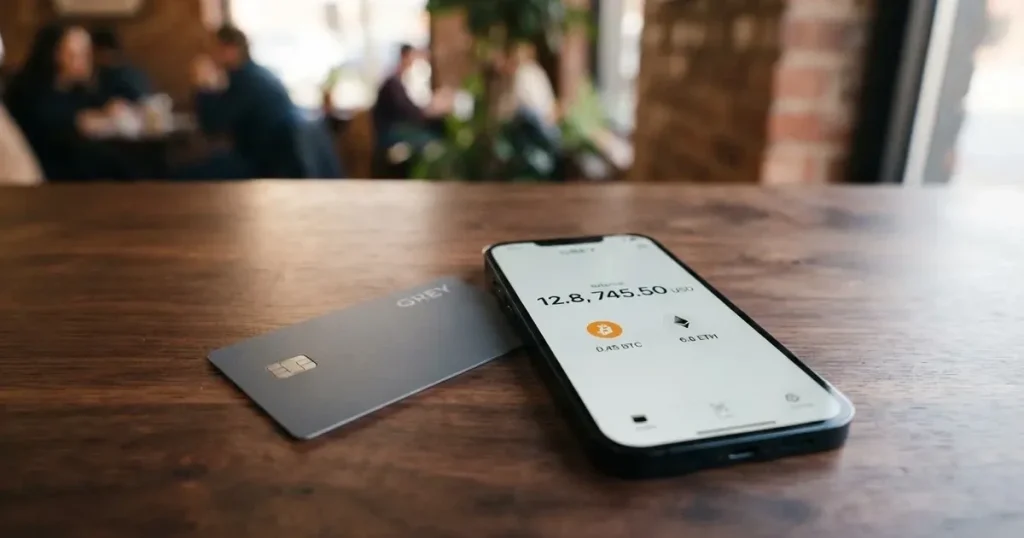
Grey is not really a “card account” in the way a bank is. It is a virtual Visa card number inside an app that draws directly on your crypto wallet balance, in a set order, every time you pay. That single design choice explains almost everything you will like and almost everything you will not: it is quick to set up and needs no bank account in your own name, but it will not let you take money out at an ATM, it charges you for spending abroad, and it disappears if the app’s banking partner does.
Conditions are current as of October 28, 2026.
My score for it is 4.9 out of 10. That is not a rejection — it is a card with real virtues in a narrow lane, judged against how well it does everything a payment card is supposed to do. If your problem is specifically “I cannot get an ordinary bank card”, the narrowness stops being a flaw. If your problem is “I want a cheap everyday card”, it is the wrong tool.
Everything below reflects the card’s own published pages as they stood when I checked them on 2026-10-20.
The score at a glance
| Criterion | Mark | Why |
|---|---|---|
| Who can get it | 5 / 10 | Visa is supported in 25 countries — Argentina, Australia, Brazil, Colombia, Ghana, Kenya, Nigeria, South Africa, Hong Kong, Singapore, UAE, the US and others; spending is blocked in Cuba, Iran, North Korea, Russia, Syria, Ukraine and Venezuela |
| Cost | 6 / 10 | $5 to create the Visa, no monthly fee; but up to 2% + $0.50 on cross-border payments, a conversion fee when the wallet is not in USD, and $30 to file a chargeback |
| Top-up options | 5 / 10 | The card cannot be topped up at all — it spends from wallets, USD first, then USDC/T, then any other balance; networks are not named |
| Reliability and complaints | 4 / 10 | Not a bank, issuer unnamed; Trustpilot shows 3.8 from 4,452 reviews, with fees, KYC failures, reversed incoming payments and slow support |
| Everyday use | 4 / 10 | Virtual only, created instantly; Apple Pay and Google Pay work; no ATM, “payments only” |
| Total | 4.9 / 10 | A narrow tool that works well for one job |
Read that table as five separate questions rather than one verdict. Grey answers “can I pay online from crypto I already hold” quite well. It answers “can I live on this card” quite badly. The audience it is genuinely built for is freelancers in Africa, Latin America and Asia who get paid in dollars and need a card number that shops will accept.
Who will they give the card to
Short answer: to people in 25 named countries who can pass identity verification and who are willing to treat the card as an online payment tool rather than a physical wallet.
The Visa card is supported in Argentina, Australia, Brazil, Colombia, Cote d’Ivoire, Ghana, Kenya, Morocco, New Zealand, Nigeria, Senegal, South Africa, Uganda, Zambia, Bangladesh, Hong Kong, Malaysia, Mexico, Peru, the Philippines, Singapore, Thailand, the United Arab Emirates, the United States and Uruguay. Spending is not possible in Cuba, Iran, North Korea, Russia, Syria, Ukraine or Venezuela.
Two things you will notice if you are in one of those places, and I want to be plain about both. First, the card does not say whether these rules follow your residence or your citizenship — that is not stated on the public pages, and if it matters to you, ask. Second, a blocked country list is not the whole picture. Issuers also screen nationality and country of birth separately from your address, because sanctions rules are applied to people and places, not just to where a card is posted to.
If you are in the supported set but your country is not on the list at all, the honest answer is that I cannot tell you from what the card publishes.
Fees, and what they add up to on a normal purchase
The headline is friendly: one $5 fee to create the Visa card, and no monthly or maintenance fee at all. What follows is where the money goes.
| Fee or limit | What the card says |
|---|---|
| Visa card creation | $5 one-time |
| Monthly fee | None |
| Transaction fee | None |
| Cross-border payment | Up to 2% + $0.50 on non-US websites, charged by the merchant or processor |
| Currency conversion | Applies when the card is linked to a non-USD wallet; rate not stated, and it is not refundable |
| ATM | Not available — withdrawals and transfers are not supported, the card is for payments only |
| Daily limit | Up to $10,000 per day (the page also says the card “has no limit”) |
| Monthly limit | Not stated |
| Chargeback | $30 paid upfront |
Two or three everyday payments show where that bites.
- A $30 subscription paid on a US website from a non-USD wallet. You have no transaction fee, but you have the conversion fee at an unstated rate, and the cross-border charge of up to 2% + $0.50 may also apply. The card’s own cross-border figure is the number to plan around; the conversion rate is the one you cannot plan around, because it is not published.
- A $4.99 coffee in your own city from a USD balance. Nothing to pay beyond the currency of the wallet you spend from, if that wallet holds USD. This is the case Grey handles most cleanly.
- A €40 hotel booking in Europe. Cross-border plus conversion, on the same payment. The 2% + $0.50 is charged by the merchant or processor and the conversion fee is separate — they are not the same charge and one does not replace the other.
The daily limit deserves a second look because the card contradicts itself: one page says up to $10,000 per day, another says the card “has no limit”. Treat $10,000 as the documented figure and ask if it matters to you. The monthly limit is not stated at all.
On the other side of the same ledger, you need $5 of balance to create the card in the first place.
Top up: why the word does not really apply here
There is no top-up function on the card, because the card holds no money. It spends from your wallets, and it draws in a fixed order: USD first, then USDC/T, then any other balance that has funds in it. You fund the wallets; the card simply follows.
That has a practical consequence worth sitting with. The card’s pages do not name the networks you can deposit on, and blockchain transfers are irreversible — send on a network the provider does not support, or to an address belonging to a different network, and the funds can be gone or need manual recovery with no guarantee. So the exact deposit route is something to confirm in the app before you send anything large.
There is no funding fee charged on the card itself. Deposit fees on the wallet side and the fiat options available for buying crypto are not stated on these pages.
One deletion detail that catches people out: deleting the Visa card returns nothing, because the card only ever drew from wallets. The Mastercard variant behaves differently — its balance is refunded to your Grey USD balance. If you hold funds on the card rather than in a wallet, read that part twice.
Paying with it every day
This is where the design is clearest. The card is virtual, created instantly in the app, and there is no physical or metal version. You add it to Apple Pay or Google Pay for supported online and in-app payments, with a PIN set in the app and an OTP for transactions. The apps run on iOS and Android; the US App Store listing shows 4.59 from 5,754 ratings.
What is missing is as informative as what is there:
- No ATM, no transfers. “Withdrawals and transfers are not supported. The card is for payments only.”
- No cashback in the ordinary sense. No regular cashback is stated, though cashback campaigns exist and their terms are not published on these pages.
- No blocked-category list available to me. The help centre has an article on where you cannot use the Visa card, but its contents are not published — so I cannot tell you whether gambling, for instance, is declined.
- No multi-tier structure. There is one tier, and that is the tier.
The two-wallet detail is worth understanding: the USD card spends from USD, EUR, GBP and local-currency balances, and non-USD balances are converted to USD at the moment of payment. Refunds go back to the USD balance.
So the honest summary of daily life: paying online and in apps works well and starts immediately. Getting cash, or handling anything that needs a card physically in a terminal slot, does not.
What can go wrong
I went looking for the failure modes, and the complaints section of the app store and review sites is the most informative thing here.
The recurring themes in Trustpilot reviews through September and October 2026 are fees, KYC and verification failures, incoming payments being reversed, and slow or missing support. Trustpilot shows 3.8 from 4,452 reviews. App Store reviews mention a deposit fee of at least £2 on deposits under £250. Trustpilot and app-store reviews are user reports, not findings — but they are the pattern users describe.
Then the structural risks:
- It is a fintech, not a bank. Grey Finance Inc. in Vancouver, British Columbia is registered with FINTRAC; Grey Inc. in Middletown, Delaware appears in FinCEN records. Banking runs through licensed partners, but the issuer is not named on the page — and the issuer is the entity that ultimately stands behind your card.
- Balances are not bank deposits. Card funds are usually safeguarded in separate accounts or insured, which is not the same as a deposit guarantee scheme.
- Who holds your keys. If you use a custodial wallet, the provider holds the credentials and you trust them completely. Self-custody puts the funds in your wallet until the payment moment and puts the entire burden of key loss, phishing and malware on you. Grey does not state custody arrangements on these pages.
- Card programmes do close. Visa terminated its global agreements with FTX in November 2022, and the FTX US debit card was wound down by its issuer. WaveCrest, a Visa issuer that supplied crypto card brands, was suspended by Visa in Europe in 2018, closing every WaveCrest-issued Visa programme. Closes are ordinary, not exotic.
- Chargebacks are slow and cost money. $30 upfront, only after settlement, a Visa investigation of 30–60 business days, a reversal up to 30 days after approval — and if it is denied, the fee is kept.
- A decline can leave a hold on your funds for several days, typically up to seven.
Support is offered 24/7 through a help centre and [email protected]. Grey is a fintech; card issuers are usually not, and that gap between a fast chat agent and a slow bank is where disputes get stuck.
What to take instead
If one of Grey’s specific gaps is the thing stopping you, these are the alternatives worth looking at, with the same honesty about what I could and could not confirm.
| Alternative | Score | Card and fees | Funding and catch |
|---|---|---|---|
| International Visa Card | 6.7 / 10 | U.S.-issued Platinum Visa, virtual, pays in USD; $5 issuance, no maintenance fee; plans Classic free, Pro $9.00/month, Max $19.00/month; card use in USD free on all plans; foreign currency at the Visa exchange rate + 2% FX fee; deposits of any kind free | Deposits of USDC or USDT 1:1 into the USD account, plus USD, EUR, SEPA, SWIFT, FedNow; networks not stated; physical card “coming soon” |
| UNi Card | 6.1 / 10 | Multicurrency Mastercard card spending from the UNi.Global balance; “no annual fee” and no foreign transaction fee; assets converted at live OTC rates with “no hidden exchange fees”; issuance fee not stated | Spend-to-Earn rewards up to 3%; who is eligible is not stated; funding not stated |
| Whop Cards | 5.2 / 10 | Visa accepted online and in stores; page says “No extra fees” but lists no issuance or monthly amounts; conversion and FX amounts not stated | Spends from a Whop balance, backed by stablecoin collateral from a linked wallet; coins and networks not stated; 5% cashback at select merchants, currently Uber; consumer coverage is 31 US states, businesses 41 states |
A note on the eligibility column, because these lists differ in ways that matter. The International Visa Card is unavailable to residents or legal registrants of Belarus, mainland China, North Korea, Cuba, India, Iraq, Iran, Israel, Myanmar, Nepal, Nicaragua, Russia, Syria, Turkey, Ukraine, Venezuela and Vietnam, and purchases are blocked in North Korea, Cuba, Iran, Russia, Syria, Ukraine and Venezuela — that last group is narrower than the first. Whop Cards excludes most of the same set but includes Hong Kong and Taiwan-adjacent entries differently, and only covers US states for consumers. None of them states whether the rule follows citizenship or residence.
The comparison in one line: International Visa Card is the most transparent on fees and funding and the most expensive on tiers, UNi Card is the quietest on costs and the vaguest on who can have one, Whop Cards is the most US-shaped and the least specific about its own pricing.
Who I would recommend it to
I would recommend Grey to a freelancer in Africa, Latin America or Asia who is paid in dollars, already holds crypto, has no usable bank card, and wants to pay for software, hosting and online services this week. In that situation it is genuinely useful: instant, cheap to open, and it converts at the moment of payment rather than asking you to time a market.
I would not recommend it as your only card. It is virtual only, it is payments only, its cross-border fee is not small, its conversion rate is not published, its issuer is not named, and the complaints pattern points at support and verification — the two things you need most when money is involved.
Before you commit, check four things yourself: that your country is on the supported list, that the deposit network you intend to use is the one the app expects, what the conversion rate actually is at the moment you pay, and what the chargeback terms are if a payment goes wrong. Then start with a small balance rather than your whole month.
Frequently asked questions
What is Grey?
Grey is a fintech app that pairs crypto wallets with a virtual Visa card. The card draws directly on your wallet balances in a fixed order — USD, then USDC/T, then anything else with funds in it — rather than on a bank account you hold. It is virtual only, created instantly, and Grey is a fintech rather than a bank.
Does Grey give me a physical card?
No. The card is virtual and created instantly in the app, and the pages mention no physical or metal version. That means it works for online and in-app payments, including through Apple Pay and Google Pay, but not anywhere you need to hand a plastic card over or read a magnetic stripe.
Is Grey a bank, and who is behind it?
No, Grey is a fintech. Grey Finance Inc. in Vancouver, British Columbia is registered with FINTRAC, and Grey Inc. in Middletown, Delaware appears in FinCEN records. Banking runs through licensed partners, but the card issuer is not named on the page — which is the entity you would actually hold a claim against.
Which countries can use the Grey card?
The Visa card is supported in 25 countries including Argentina, Australia, Brazil, Colombia, Ghana, Kenya, Nigeria, South Africa, Hong Kong, Singapore, the UAE and the US. Spending is blocked in Cuba, Iran, North Korea, Russia, Syria, Ukraine and Venezuela. The pages do not state whether these rules follow residence or citizenship.
How do I top up the Grey card?
You cannot, and that is by design rather than a gap in the documentation. The card holds no money of its own; it spends from your wallets in the order USD, then USDC/T, then any other funded balance. You deposit into the wallet, and the networks supported are not named on the card’s pages — so confirm the route in the app before sending.
How much does the Grey card cost to use?
Creating the Visa card costs $5 once, with no monthly fee and no transaction fee. The costs to watch are cross-border payments at up to 2% + $0.50 on non-US websites, and a currency conversion fee that applies when the wallet is not in USD — its rate is not stated and it is not refundable.
Can I withdraw cash or use an ATM with the Grey card?
No. The card is for payments only: withdrawals and transfers are not supported. If you need physical cash, you need a card with ATM access, and this is not one. For everyday spending, Apple Pay and Google Pay are supported for online and in-app payments.
Is the Grey card safe?
It carries the usual risks of a custodial setup plus the risks of a fintech card programme. Trustpilot shows 3.8 from 4,452 reviews, with reports of fees, KYC failures, reversed incoming payments and slow support. Card programmes do close — Visa ended its FTX agreements in November 2022 — so treat it as a tool, not as storage.
What happens if I want my money back from a payment dispute?
A Visa chargeback requires $30 paid upfront, and only after settlement. The Visa investigation takes 30–60 business days, and a reversal can take up to 30 more days after approval. If the claim is denied, the $30 fee is kept — which makes chargebacks a genuine cost, not a free safety net.
Is the Grey card worth it?
For one specific situation, yes: you have crypto, no usable bank card, and you pay for things online. As a primary everyday card, no — it is virtual only, payments only, it charges for cross-border use, its conversion rate is unpublished, and support complaints cluster around exactly the situations where you would need help.
App and neobank cards in the catalogue – cryptocardcatalog
Content created by the «cryptocardcatalog» team