
A USDC card that publishes less than you would need to decide
 Available in US

I went through the Kontigo card’s public pages — the home page, the terms, the help centre, the developer notes — and then compared what is written there against what a person like you actually needs in order to decide whether to try it. My honest summary is this: Kontigo is a real, functioning product with a clear idea of who it is for, and at the same time it is one of the least transparent card pages I have read. Almost every number a shopper would want — the fee schedule, the countries that can actually hold the card, the daily limits, the ATM, the card network — is simply not published. That absence is not a scandal, and it is not evidence of anything bad. It is just the central fact about this review, and it shapes everything below.
If you are in a hurry, the short version is in the verdict. If you are weighing whether to spend an afternoon reading terms yourself, the verdict is also the right place to stop. I have written the rest for the reader who has already decided to look closer.
The conditions described here are current as of October 28, 2026.
Verdict: 4.7 out of 10, and the reason is missing information rather than bad information
Kontigo scores 4.7 out of 10 in my assessment. The mark is not a punishment for anything I found wrong; it is mostly a measure of how much of the decision-relevant detail is absent from the pages a prospective cardholder is given. Where the company does speak, it speaks reasonably: the identity requirements are described, the custody model is stated, the terms about what happens to assets if you close the account are written out. The silence sits exactly where money would otherwise change hands.
The card is aimed, by its own framing, at Latin American users who want to save and spend in USDC. If that is you — if you already hold dollars in a stablecoin form, if you want an ordinary-looking payment card that spends that balance, and if you are comfortable with an interface that keeps the fine print inside the app rather than on the website — then the concept fits your situation. If you are outside that audience, or if you need a specific country to be listed before you can act, this page will not get you there, because the company does not list any.
| Criterion | Mark | Why |
|---|---|---|
| Who can get it | 5 / 10 | Countries of issuance are not named; availability depends on country of residence, and sanctioned or high-risk jurisdictions are not permitted. The footer lists Argentina, Bolivia, Brasil, Chile, Colombia, El Salvador, Espana, Estados Unidos, Mexico, Peru under “Paises”, but not tied to the card itself. |
| Cost | 5 / 10 | Not disclosed: fees and spreads are shown in the app; the site says sending, receiving and topping up in USDC is “without commissions”. |
| Top-up options | 4 / 10 | Purchases draw on the USDC balance, and the app runs on Base. Other coins and networks are not named. |
| Reliability and complaints | 4 / 10 | Kontigo, Inc. (Delaware); issuer and licences are not named, assets are in self-custody. Unofficial: a hack, with 340,905.28 USDC withdrawn from 1,005 accounts, the company stated refunds were processed. |
| Everyday use | 5 / 10 | Not disclosed: form factor, wallets and ATM are not named; the site speaks of hybrid, credit and debit cards. |
| Total | 4.7 / 10 |
Three things push the mark up in my eyes. The product exists and is not vaporware: apps on Google Play and the App Store, a help centre with a WhatsApp channel, and a site that cites “over 10,000” user reviews. The terms are written in the language a lawyer would use and cover the awkward cases — what happens to a balance after you close the account, how long the dispute negotiation can take, who the courts are. And the custody model is stated rather than buried.
Two things push it down. The first is the disclosure gap described above, which for a card means a reader cannot compute the cost of a single purchase. The second is the fact that I found no meaningful independent user record: a search of the complaint channels turned up no Kontigo card complaints at all, and the results belonged to an unrelated brand. That cuts both ways. No complaints can mean a young product, a small one, or a good one — but it means a reader has no external account of how this card behaves when something goes wrong.
Will they give you the card?
The short answer: the card’s countries of issuance are not stated. That is the single most important fact on this page, and I want to state it plainly rather than bury it, because for anyone outside the intended market it is a hard stop.
What the terms do say is that availability depends on your country of residence, and that sanctioned and high-risk jurisdictions are not permitted. That is a residence test, not a citizenship test, and it is the kind of sentence that does a lot of quiet work: it means the same person with two addresses in two countries could have two different answers.
The site’s footer lists ten countries under the label “Paises”: Argentina, Bolivia, Brasil, Chile, Colombia, El Salvador, Espana, Estados Unidos, Mexico, Peru. That list is the company’s own market footprint, and it includes one European country and the United States alongside Latin American ones. But the footer does not tie the list to the card. Read plainly, it tells you where Kontigo operates or intends to operate — not where the card can be issued to you.
So if you are in Lima or Madrid or Mexico City, the picture is genuinely uncertain from public information, and only the app or support will tell you. If you are in a sanctioned jurisdiction, the answer is no, and no. If you are somewhere else entirely, you are asking a question the public pages do not answer.
One more thing worth knowing before you start: identity verification is required before you can use the services, and the terms allow for one account per user. Details in the signup section.
What identity verification means in practice
The terms say identity must be verified before using the services. They list what that can involve: name, date of birth, address, nationality, ID documents, and in some cases financial information. Sanctions checks and credit checks are mentioned as part of the process. This is a standard, unremarkable list — it is what regulated financial services are required to do, and it is a reasonable expectation for anyone handling a card.
The card-specific side of verification is not described. There are no tiers in the terms: the developer documentation mentions that deposit methods depend on the KYC level, but gives no amounts, no documents list, no expected duration. Processing time is not stated. The reasons an application could be refused are not listed. If being turned down is a scenario you would want to plan for, you will be planning without a map.
One practical note that costs nothing to keep in mind: nationality is recorded and screened separately from residence, because sanctions screening is usually applied to citizenship and country of birth as well as to your address. Having a compliant address is therefore not by itself the whole test.
Who you would be dealing with
Kontigo, Inc. is a Delaware corporation. The footer states that Kontigo does not provide financial services and does not take deposits, and that assets are held in user custody. That is a coherent and fairly common structure for this category: the brand runs the app and the programme, and a licensed institution sits behind the card.
The card issuer and BIN sponsor are not named, and no licences are named on the pages I read. That is a real gap, not a formality. Under the usual structure of these products, the entity that actually issues your card is the party your deposit or balance protection, your complaint rights and your regulator are attached to — and here that entity is not identified. You can still use the service; you just cannot check it against a register.
How to get it
There is no published application walkthrough, so I am going to describe the shape of it rather than invent steps. Based on the terms and the site’s own description, expect the following order of things: create an account, complete identity verification, and then obtain the card from inside the app. The terms’ requirement to verify identity before using services, combined with the site’s claim of being “the first international credit and debit card in USDC that earns yield”, implies the card lives inside the Kontigo app rather than in a separate application process. Card-specific steps are not stated, and neither is how long any of it takes.
The footer describes three card types — hybrid, credit and debit. The site positions Kontigo as a single international card that is available in these forms. Which of the three you would actually be offered, on what terms, and whether they differ at all in fees or limits, is not published. Treat any assumption that you can choose between them as an assumption, not a plan.
What the card is, physically and on paper
Unknown, and it matters more here than it would for an ordinary bank card. The card network — Visa or Mastercard — is not stated. Whether you receive a physical card, a virtual one, or both is not stated. Whether the card is prepaid, credit, or debit in the regulatory sense is not stated. The card currency is not stated.
A one-line promotional claim also circulates in Spanish-language material that is not from the company: a piece describes a stablecoin card with Bitcoin cashback and a 10% USDC yield. I am labelling that as promotional and unverified, and it contradicts nothing on the official pages — the official site claims yield without a figure — but you should not treat a number from an unofficial source as the card’s terms.
Fees and what a payment really costs
Here is the honest answer to “what does it cost”: the card’s fee schedule is not published. The terms state that fees, commissions and spreads are shown in the app and may change. That is a legitimate design choice — many apps do it — but it means the cost of a Kontigo payment is something you can only learn by opening the app and reading a screen that can change without notice.
What the home page does say is that sending, receiving and topping up in USDC happens “without commissions”. Taken at face value, that covers the crypto side of moving your own money in and out. It says nothing about what happens when the balance is converted at the moment of purchase, and it says nothing about a foreign purchase.
The issuer, monthly fee, ATM, daily and monthly limits are all not stated. The help centre lists topics including “Niveles Kontigo” (levels), Kontigo Cash, Kochinitos and Kontigo Credit, but I did not read the content of those pages, and the existence of a topic is not the same as a published number.
| Item | What is published |
|---|---|
| Issuance fee | not stated |
| Monthly or maintenance fee | not stated |
| Conversion fee or spread | not stated; terms say fees and spreads are shown in the app and may change |
| Foreign exchange | not stated; fiat accepted includes USD and other local currencies shown in the platform; a liquidated balance may be held in a fiat currency Kontigo chooses, for example USD |
| ATM | not stated |
| Daily and monthly limits | not stated; developer docs say deposit methods depend on KYC level, with no amounts |
| Sending, receiving, topping up USDC | “without commissions” per the home page |
| Card tiers | not stated for the card |
Three ordinary payments, and which fees touch them
Because the schedule is unpublished, the most useful thing I can do is walk through the mechanics and show you where a fee would attach if one exists. I am not estimating amounts — nobody can, from public information.
Buying coffee in your own country with dollars you already hold as USDC. This is the cleanest case and the one the product is built around: card purchases are paid directly from your USDC balance. Where a cost can still appear is the conversion itself. If the balance is converted into local currency to pay the merchant, the terms say fees and spreads are shown in the app. The currency your balance settles in is not stated, and liquidated balances may be held in a currency of the company’s choosing, for example USD — which means a conversion may sit between you and the coffee even if you never asked for one.
Buying something priced in dollars while you are in a country with a different currency. Now two things could apply: the conversion from USDC, and the exchange rate your card issuer applies. Neither figure is published, and the card currency is not stated, so I cannot tell you whether you would face one cost or two. This is the single most useful thing to check yourself in the app before you rely on the card abroad.
Paying a subscription or a recurring bill. Same conversion questions, plus the ordinary risk that a merchant treats a card as foreign. A BIN lookup tells the merchant which institution and country issued the card, and some shops apply extra scrutiny or decline when the issuer country differs from the billing address. A card issued in one country can look foreign in another. Add to that the fact that a declined authorisation can leave a hold on funds for several days. None of this is specific to Kontigo; all of it is more likely to be noticed by a merchant than it would be with a domestic card.
How to Top up the card
Topping up, in the way the company describes it, means adding USDC. The home page says top-ups in USDC happen “without commissions”. The terms for the card specifically are not stated, and the supported coins and networks are not named either.
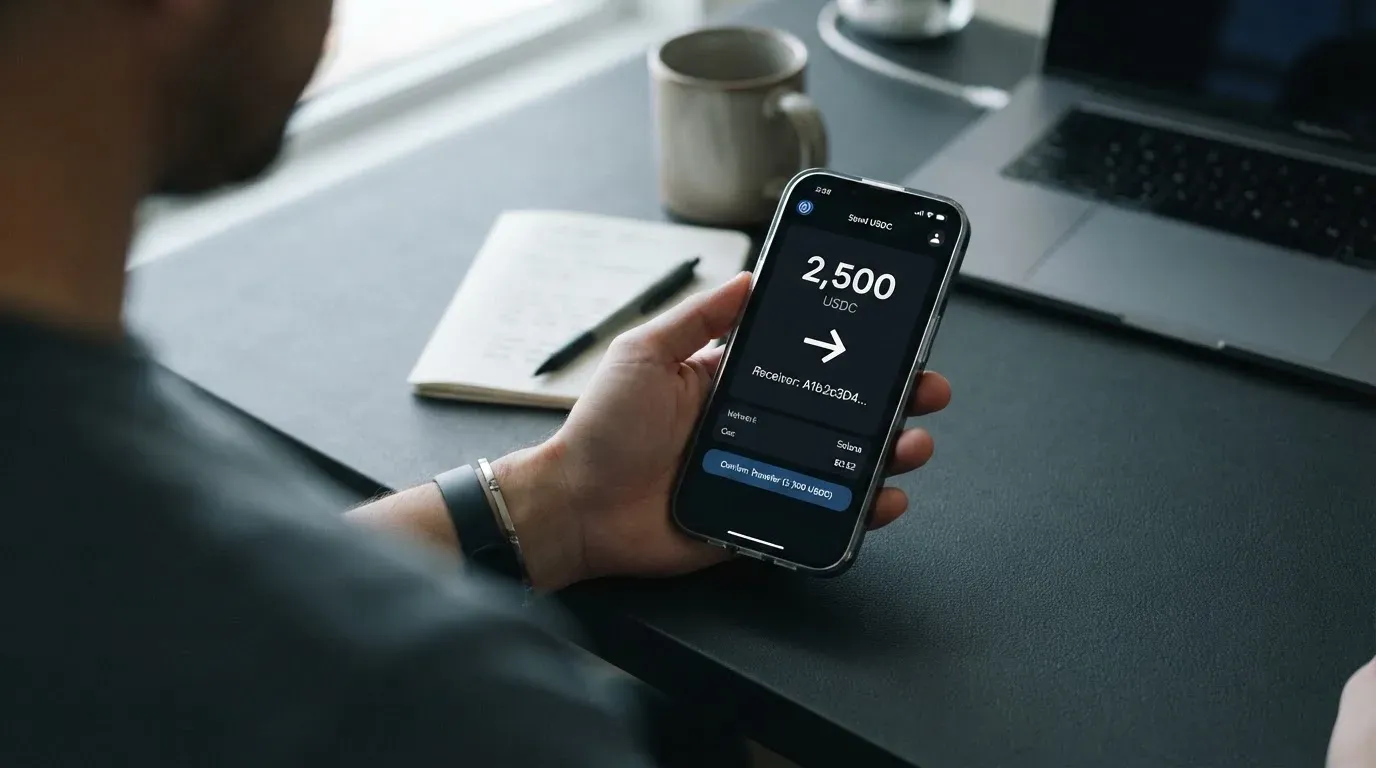
The one concrete network fact I can give you comes from a Kontigo article: the app runs on Base. That is where the company’s own material places it, and it is worth knowing because network choice is not a detail you can fix later.
So the practical sequence, as far as the public pages support it, is: have USDC, send it to the app on Base, and spend from the balance. Anything beyond that — whether other networks are accepted, whether there is an internal transfer between accounts, whether a fiat on-ramp exists inside the app — is not published.
Two general points about crypto top-ups apply to every card in this category and are worth more than any product-specific guess. The first is that blockchain transfers are irreversible. A deposit sent on a network the provider does not support, or to an address belonging to another network, can be lost or need manual recovery with no guarantee of success. The second is that the deposit is only cheap if the network is the one the app expects. On-chain network fees are charged by the blockchain, not by the card company, so sending on an expensive chain costs you more regardless of what the card promises.
Getting money back out
The terms say digital assets can be transferred to external wallets “when that feature is available”. That conditional is doing real work: the feature is gated, not guaranteed. If you are considering this card, ask support directly whether withdrawal is available for your account and on which networks, because a card you cannot exit is a different product from one you can.
The closure terms are, to their credit, unusually explicit. Closing requires no pending obligations and no positive balance, or that you have already instructed a withdrawal. After closure you have a reasonable period — for example 30 days — to instruct the withdrawal. If you do not, Kontigo may sell the assets and hold the proceeds in a fiat currency it chooses, with no interest. That is the single most consequential paragraph in the whole terms document for anyone treating the balance as money they intend to keep.
Paying with it every day
What the product is meant to do day to day is simple: you hold USDC, you tap or use the card, and the balance pays for it. Card purchases are paid directly from your USDC balance, per the company’s own wording. Beyond that, the everyday details are thin.
Apple Pay and Google Pay. Not stated. This is the question I would ask first if you were me, because in much of Latin America a phone wallet is how people pay more often than with the plastic. Whether the card can be tokenised into a phone wallet is not published.
ATMs. Not stated. No fee, no network, no count.
Rewards and yield. The card is marketed as one “that earns yield” — returns. The rate is not stated, the payout form is not stated, and there is no cashback figure anywhere official. That is a genuine promotional claim with no number attached, and I would treat it as a reason to ask a question rather than as a reason to count on income.
The app. Available on Google Play and the App Store. The site cites “over 10,000” user reviews. The store rating itself is not stated on those pages, which is a small oddity for a product with that volume of feedback — check the listing yourself.
Blocked purchases. Not stated. Some issuers block specific merchant categories by policy rather than by law, and the list varies by issuer, so this is a real question rather than a technicality. Gambling and betting is the category people ask about most often. Ask.
If something goes wrong with a payment
The terms have a complaints process and it is worth reading closely, because it tells you what kind of company this is. In good faith, they will negotiate for up to 15 business days after written notice. If that fails, the matter goes to the courts of Delaware. Local consumer-protection authorities remain available to you. Chargebacks are not mentioned anywhere in what I read, which is a meaningful omission: a chargeback is the standard mechanism by which a card issuer orders a refund over a disputed transaction, and its absence from the terms leaves you relying on negotiation and then on litigation.
The practical instruction the terms do give is sound and worth following: report unrecognised transactions as soon as possible. Under EU rules on due diligence, that obligation is symmetrical — if the checks cannot be completed, the institution is required to refrain from the transaction and, where necessary, end the relationship.
What can go wrong
Let me separate the things I verified from the things circulating elsewhere, because they deserve different weight.
The custody model is the first thing to understand. The footer says users hold assets in their own custody. The terms add that assets may sit in a self-custodied wallet or with third-party custodians, that Kontigo cannot access or recover your private keys, and that you are solely responsible for your credentials. They also say transactions are generally final. That last clause is the one to sit with. There is no built-in reversal for a blockchain transfer, and a stolen key has no recovery path because the network cannot freeze or return funds. A seed phrase — typically 12 to 24 words — is the unencrypted form of the key; anyone who obtains it can restore the wallet and spend everything in it. Self-custody is the right default for many people, but it is a transfer of risk from the company to you, and it should be a decision rather than a discovery.
Two-factor authentication, card freeze, insurance: not stated. For a card product in 2026 that is a thin spot. The standard safeguards in this category are app-based 2FA, instant freeze, spending limits, 3-D Secure confirmation and tokenised mobile wallets; whether Kontigo offers them is not published.
A hack is reported, officially unverified. A third-party source, with dates not verified, reports a hack that drained 340,905.28 USDC from 1,005 user accounts, and that the company says refunds were processed. I have not confirmed this against the company’s own account. But it is exactly the scenario self-custody is supposed to make survivable, and it is worth checking how the company communicated it before you decide the model is comfortable for you.
Funding. A US$20M seed round is reported for December 2025 by a third party.
Support. There is a support centre with a WhatsApp contact channel, and the terms describe communication through in-app messages, push, email, SMS and messaging apps. No direct phone, chat or email address is listed. Help centre pages are in Spanish, with English article pages existing at /en/article. If you do not read Spanish, that is a real friction point before you even start.
Complaints: nothing found. I searched the usual complaint channels and found no Kontigo card complaints — the results were for an unrelated brand, and there is no Trustpilot page for kontigo to read. No reports found means no independent evidence of good behaviour, and I would rather say that plainly than present an absence of complaints as a recommendation.
The category risks you inherit
A few things apply to any card in this space, and they are worth a paragraph because they change how a single declined payment should be read.
Merchant category codes classify businesses, and several issuers block categories by policy. A four-digit code is assigned when a business starts accepting cards. Address verification — comparing the numeric parts of the billing address against issuer records — is mainly offered in the US, Canada and the UK and is generally unavailable for foreign-issued cards, which can cause declines. Online payments may also involve a 3-D Secure identity check, where the issuer either approves frictionlessly or challenges you with a one-time code or a biometric.
None of this is specific to Kontigo. All of it lands harder on a card that a merchant’s systems may read as foreign or prepaid — and the card’s issuer country, network and currency are precisely the things not published.
Programme risk. Card programmes do close. Visa terminated its global agreements with FTX on 13 November 2022 and the FTX US debit card was wound down by its issuer. WaveCrest, a Visa issuer that supplied crypto card brands, was suspended by Visa in Europe in 2018, closing all WaveCrest-issued Visa programmes. Closures typically give notice, then stop spending and loading, then ask users to withdraw remaining balances. One 2026 closure reported by a single unconfirmed source ended new loads on 8 July 2026 and spending on 8 August 2026. That is why the withdrawal terms I described earlier matter more than they look.
Regulation. A card is a payment service regulated separately from the crypto side, so a product like this often depends on two licences. In the EU, MiCA took legal effect in June 2023, with rules on stablecoins applying from 30 June 2024 and the remaining provisions from 30 December 2024; e-money tokens may be issued only by a credit institution or an electronic money institution. The transitional period runs until 1 July 2026 or until a provider receives or is refused authorisation, whichever comes first. Electronic money institutions must safeguard customer funds by segregating them or insuring them, and such funds are not bank deposits. In the US, FinCEN treats administrators and exchangers of convertible virtual currency as money transmitters. I am not telling you what this means for your tax position — speak to someone qualified — but the IRS treats digital assets as property, so each payment funded from crypto may be a separate disposal.
What to take instead
I want to be fair to the alternatives here: none of them is a like-for-like replacement for spending a USDC balance directly, and each has its own disclosure gaps. I am comparing them on the things that are published.
| Kontigo | International Visa Card | UNi Card | Whop Cards | |
|---|---|---|---|---|
| Score | 4.7 / 10 | 6.7 / 10 | 6.1 / 10 | 5.2 / 10 |
| Card | Not stated which network; hybrid, credit and debit named | U.S.-issued Platinum Visa, virtual, pays in USD; physical “Coming soon” | Multicurrency, Mastercard network, spends from account balance | Visa; works anywhere Visa is accepted |
| Cost | Not stated | $5 issuance one-time, no maintenance; plans Classic free, Pro $9.00/month, Max $19.00/month | No annual fee; issuance not stated | “No extra fees”; no amounts listed |
| Fees | Not stated; USDC send/receive/top up “without commissions” | Card use in USD free on all plans; foreign currency “Visa exchange rate + 2% FX fee”; deposits of any kind no fee | No annual or foreign transaction fee; converted at live OTC rates, “no hidden exchange fees” | Not stated |
| Who | Card countries not stated; residence-dependent | Not available to residents or registrants of a long restricted list; purchases blocked in seven countries | Not stated | 31 US states for consumers, 41 for businesses; unsupported consumer countries listed |
| Rewards | “Earns yield”, no rate stated | No cashback stated | Spend-to-Earn up to 3% | 5% cashback at select merchants, currently Uber |
| Top-up | USDC; app runs on Base | USDC or USDT into the USD account, free at 1:1; also USD, EUR, SEPA, SWIFT, FedNow | Not stated | Whop balance, backed by stablecoin collateral from a linked wallet |
International Visa Card is the most transparent of the four by a distance, and it is where I would send anyone whose priority is knowing the price in advance: a stated issuance fee, stated plan prices, a stated 2% FX fee, and stated deposit routes. Its costs are its restriction — an explicit list of excluded countries for residence and registration, and purchases blocked in North Korea, Cuba, Iran, Russia, Syria, Ukraine and Venezuela, which is a blunt instrument compared with Kontigo’s residence-dependent language. It also gives up the central thing Kontigo offers: it does not spend a USDC balance natively.
UNi Card publishes its two most-asked fees — no annual fee, no foreign transaction fee — and converts at live OTC rates, plus a stated rewards rate of up to 3%. But its eligibility, its top-up routes and its card form are all unstated, so you trade one set of unknowns for another.
Whop Cards are aimed at a US footprint rather than a Latin American one, and the 5% cashback at select merchants is currently limited to Uber. Its eligibility rules are detailed by state, but whether the test is citizenship or residence is not stated.
The honest summary: if the thing you need is spending a USDC balance you already hold, none of these replaces Kontigo and Kontigo is the only one that names Base. If the thing you need is knowing exactly what a payment will cost, the International Visa Card publishes that and Kontigo does not.
Who I would recommend it to
I would recommend this card to three kinds of person. First, someone in Kontigo’s intended Latin American market who already holds USDC, wants to convert it into everyday spending without a traditional banking relationship, and is content to learn the fee schedule inside the app. Second, someone who specifically wants self-custody — who understands what a private key is, has backed up a seed phrase properly, and treats “transactions are generally final” as a condition rather than a footnote. Third, someone who reads Spanish, because that is where the help centre actually is.
I would not recommend it to someone who needs to know the fee before the first purchase, to someone who needs a specific country to be on the list before committing, to someone who needs cash from an ATM, or to someone who needs Apple Pay or Google Pay on day one. I would also be cautious for anyone whose priority is chargeback protection: the terms describe negotiation and then Delaware courts, and do not mention chargebacks at all.
The question I would put to anyone still deciding is simple and I would put it to support before depositing anything: what is the total cost of one purchase, in my own currency, including conversion — and what happens to my balance on the day I want to close the account. Both answers exist. Neither is on the website. Getting them is worth an afternoon of your attention.
Frequently asked questions
What is the Kontigo card?
Kontigo describes itself as the first international credit and debit card in USDC that earns yield, with hybrid, credit and debit forms mentioned in its site footer. In practice it is a payment card that draws directly on a USDC balance you hold. The card’s network, its physical or virtual form, its currency and the actual yield rate are not stated on the public pages I read.
How does the Kontigo card work?
Card purchases are paid straight from your USDC balance, so the card behaves much like a prepaid card rather than a bank debit card. The app runs on Base. Spending sits against a pre-loaded balance, which means the card cannot overdraw in the way a credit card can. Conversions and any fees are shown in the app rather than published on the site.
Is Kontigo a bank?
No, and the company says so itself. The footer states that Kontigo does not provide financial services and does not take deposits, and that assets are held in user custody. Kontigo, Inc. is a Delaware corporation. The entity that actually issues the card and holds the relevant licences is not named on the pages I reviewed.
Who owns Kontigo?
Kontigo, Inc., a Delaware corporation. A US$20M seed round is reported for December 2025 by a third party, with dates not verified against the company. I found no evidence of a parent company, and no information on investor or ownership structure beyond that.
Which countries can get the Kontigo card?
The card’s countries of issuance are not stated. The terms say availability depends on your country of residence and that sanctioned or high-risk jurisdictions are not permitted. The site footer lists ten countries under “Paises” — Argentina, Bolivia, Brasil, Chile, Colombia, El Salvador, Espana, Estados Unidos, Mexico, Peru — but does not tie that list to the card itself.
Does the Kontigo card require KYC?
Yes. The terms require identity verification before you can use the services, covering name, date of birth, address, nationality, ID documents and possibly financial information, with sanctions and credit checks. One account per user is allowed. No verification tiers, processing times or refusal reasons are published.
Is the Kontigo card free?
Partly, as far as the public pages go. The home page says sending, receiving and topping up in USDC is “without commissions”. Issuance, monthly, conversion, foreign exchange and ATM fees are all not stated, and the terms say fees and spreads are shown in the app and may change. You cannot cost a purchase from the website.
How do I top up the Kontigo card?
By adding USDC. The app runs on Base, according to a Kontigo article, and top-ups in USDC are described as commission-free. Other coins and networks are not named. Send only on the network the app expects: transfers are irreversible, and a deposit on the wrong network can be lost or need manual recovery with no guarantee.
Is the Kontigo card safe?
It depends on what you mean, and on one point the terms make clear: assets are in self-custody, Kontigo cannot access your private keys, you are responsible for your credentials, and transactions are generally final. Two-factor authentication, card freeze and insurance are not stated. A third-party source, dates unverified, reports a hack that drained 340,905.28 USDC from 1,005 accounts with refunds said to be processed.
Where can I use the Kontigo card, and can I add it to Apple Wallet?
The card’s network, form and currency are not stated, so I cannot tell you where it is accepted beyond the obvious — wherever its network is accepted. Apple Pay and Google Pay support is not stated either, which I would treat as a real gap given how many people pay by phone. ATM availability is also not published, so assume none until the app says otherwise.
App and neobank cards in the catalogue – cryptocardcatalog
Content created by the «cryptocardcatalog» team