
A payroll-only card built for stablecoin salaries, and most readers will never see it
 Available in US
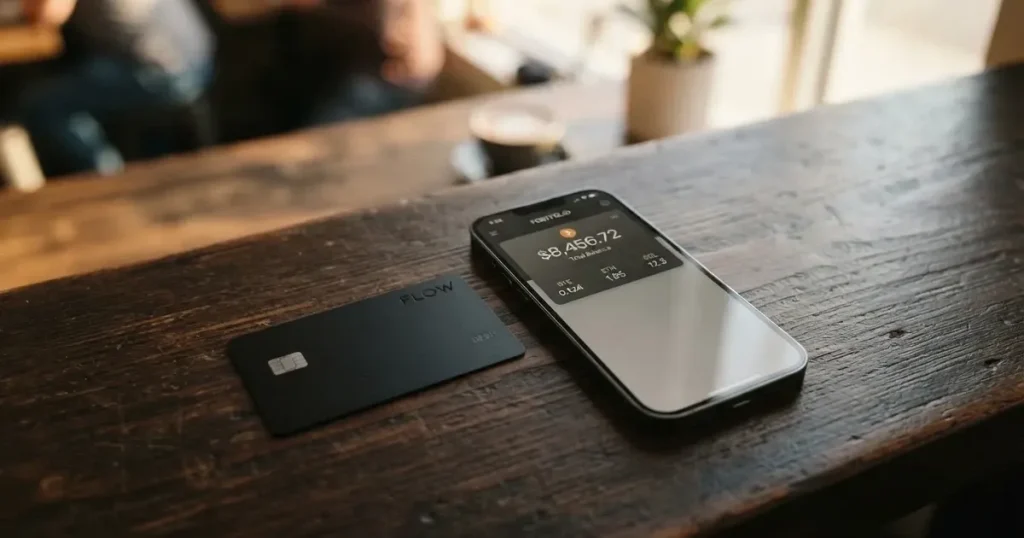
Toku is a payroll and compliance company that has teamed up with Rain, a crypto on-ramp, to issue a Visa debit card to people who are paid in stablecoins by companies already using Toku for payroll. That single sentence explains most of what makes this card different from the run of crypto cards on the market: it is not something you sign up for as an individual, top up with your own crypto, and spend in shops. It is a product that arrives in your life because your employer is paying you through a specific pipeline, and the card sits at the end of that pipeline so the stablecoin salary becomes something you can actually tap at a terminal. That makes the review useful, but it also makes the audience very small, and it shapes almost every answer below.
The conditions described here are current as of October 28, 2026.
Verdict
Toku scores 5.2 out of 10. The reasoning behind the score breaks down criterion by criterion in the table below; the short version is that the card does the one job it is built for competently, but it is not really a retail product, the costs and limits are not published, and the day-to-day quality of the experience rests almost entirely on Rain, a partner the reader has to take on trust.
| Criterion | Mark | Why |
|---|---|---|
| Who can get it | 5 / 10 | Issuance is live in the US and parts of Latin America (Mexico, Colombia, Brazil are named); APAC is listed as Q2 2026, with the rest of the world not addressed |
| Cost | 5 / 10 | Issuance fee, monthly fee, conversion, FX and ATM charges are not stated on the public pages |
| Top-up options | 4 / 10 | You do not top the card up yourself; payroll settles in stablecoins into a connected Rain wallet, and the card spends that balance; Rain supports USDG, USDC and RLUSD |
| Reliability and complaints | 6 / 10 | The card is issued by a partner under a Visa licence; Rain’s own footer says its Visa debit cards are issued by Cross River Bank, Member FDIC, and whether that extends to the Toku card is not stated; Trustpilot shows 3.2 from a single review |
| Everyday use | 6 / 10 | A virtual card is available immediately, the physical card is sent “where applicable”; Apple Pay, Google Pay and ATM support are not stated |
The audience this card actually fits is narrow: contractors and employees who are paid in stablecoins by companies that have already signed up with Toku for payroll. If you are paid by a Toku customer, the card turns that salary into a Visa you can use, which is genuinely useful. If you are anyone else, an individual looking for a crypto-linked card for your own money, this is not a product you can buy into today, and the parts that would matter to a retail user (fees, limits, support channels, mobile wallet support) are not in the public materials.
The interesting question is whether, as a recipient, you would know enough to trust the card before your first salary lands. I will come back to that in the risks section, because that is where this review has to be honest about the gaps.
Who will they give you the card to
The short answer is that Toku issues the card to people who are already on its payroll, in the regions it already covers. Issuance is described as “available now” for recipients in the US and Latin America, and Mexico, Colombia and Brazil are named specifically. The Asia-Pacific region is listed for “Q2 2026”, which on the page is forward-looking rather than live. There is no published list that adds up to “the card is available everywhere else”, and there is no general sign-up form for individuals: the audience is the people on the receiving end of a Toku payroll run.
For someone reading this outside those regions, the practical effect is that Toku is not a card you can apply for, regardless of how the marketing page might read. A friend who freelances for a US company paid through Toku, and lives in, say, Portugal, is in an in-between situation: the company is a Toku customer, the recipient is in a region the page does not list as live, and the answer is not given. The card simply does not name what happens there. That is worth knowing before you tell anyone in that position to expect a card.
The same single sentence covers age, address and document requirements: “Standard KYC process at issuance”. The public pages do not say which documents are needed, what the age threshold is, whether a proof of address is required, or what falls outside “standard”. The card’s general audience note says it is built for contractors paid in stablecoins by Toku customers, and the verification is run once at issuance.
A couple of regional points matter because they tend to be where crypto cards get into trouble. Citizenship and country of birth are not addressed separately from residence, which is the area where sanctions screening and issuer risk policy typically bite. Dual citizens and people with an ID document from one country living in another are not told how they will be treated, and the pages do not name a restricted-country list. For a card whose availability is regional to begin with, that silence is the kind of gap you should ask Toku about directly before relying on it.
How to get it
There is no public “apply” button. The page describes the card as part of the payroll flow: your employer is a Toku customer, the salary is paid in stablecoins, those stablecoins are settled into a connected Rain wallet, and the card draws on that settled balance. Identity verification is the “standard KYC process at issuance”, which runs once at the moment the card is created.
The card itself is a Toku-branded Visa. The pages refer to Visa only, and Mastercard is not mentioned, so the assumption is that the programme is Visa-only. The currency the card settles in is not stated, and neither is whether you can choose a card currency or whether it is fixed. What the page is clear about is the order of operations: a virtual card is available immediately, and a physical card is sent “where applicable” in supported regions. The cost of the physical card, the time it takes, and the countries it ships to are not stated, and “where applicable” is doing a lot of quiet work in that sentence.
A practical walk-through of what you, the recipient, do, looks like this. Your employer enrols you in Toku’s payroll, you go through the KYC step once, the virtual card appears in your Rain-connected flow straight away, and a physical card arrives in the post if your region and your profile are covered. There is no activation step described in the public materials, no second KYC, and no in-app card management that I could find.
What is missing is a description of what recipients do when something goes wrong during this flow. If the virtual card does not appear, if the physical card is held at a regional blocker, if the KYC step needs a second document, the contact path described is to reach the Toku team through a demo call or a general support link, with no card-specific channel, no language list and no hours.
What it really costs: the fees picture
This is the section I would want to be most concrete in, and it is the section the public materials are most silent on. The costs table below reproduces what the card’s own pages say. Where the table says “not stated”, that is the page’s own position, not a missing row.

| Fee or limit | Value |
|---|---|
| Card issuance | Not stated |
| Monthly / annual fee | Not stated |
| Conversion (crypto to fiat at spend) | Not stated |
| FX (non-card-currency spend) | Not stated |
| ATM withdrawal | Not stated |
| Daily spending limit | Not stated |
| Monthly spending limit | Not stated |
The honest reading is that you cannot answer the question “what does it really cost” from the published material. The card sits on top of a Rain wallet, and Rain does publish a fee structure for its own products, but whether those same rates apply to the Toku card is not stated. The Trustpilot page for Toku is essentially empty (3.2 from a single review, read 2026-10-21), so there is no pattern of complaints about specific fees either.
What that means in practice is that a recipient cannot predict what a given shop purchase, an ATM withdrawal or a foreign-currency transaction will cost before they make it. For a payroll product, that is a serious gap. Most employers who pay through Toku are paying a fixed salary, and the recipient is going to spend that salary on rent, food and bills; the difference between a 0.5% conversion fee and a 1.5% conversion fee on those purchases is real money, and a recipient should not have to find it out by surprise.
Three everyday situations, walked through:
- Paying for groceries in card currency, online. The card runs as a Visa debit; whether the merchant is charged a conversion fee, what the FX margin is, and whether there is a per-transaction service fee are not stated. You will see the amount on your statement, but you will not know what slice of that amount is fee.
- Buying something in a different currency while travelling. The page does not state the FX margin, the ATM fee, or the daily limit that would apply, so you cannot tell in advance what a €40 dinner in a country outside your base currency will actually cost you.
- Withdrawing cash from an ATM. ATM support is not stated. The card currency is not stated, so the question of whether the ATM will treat the withdrawal as a local-currency cash advance or as a cross-currency transaction is also unanswerable from the page.
A practical step before you spend is to ask Toku or your employer, in writing, for the fee table that applies to your card. If they will not give you one, that is information worth weighing against the convenience of having the card at all.
How to top the card up
The unusual thing about this card is that the top-up question does not really apply to you, the user. There is no “deposit crypto, spend fiat” flow, because the card is funded by your employer through Toku’s payroll. The model is: your salary is paid in stablecoins, the stablecoins settle into a connected Rain wallet, the card draws on that settled balance, and at the point of sale the conversion happens.
The stablecoins the Rain side supports are USDG, USDC and RLUSD. Those three cover a useful spread: USDC is the largest by market share, RLUSD is Ripple’s enterprise-focused stablecoin, and USDG is the Global Dollar Network’s. The network on which those tokens arrive at Rain is not stated in the Toku materials; Rain’s own documentation names supported networks, but the Toku card page does not cross-reference them. That matters because sending USDC on the wrong network is the classic way to lose a deposit, even when the receiving address is correct.
The more important point is that the funding direction is one-way. There is no public mention of a user-driven deposit, no instruction for topping up from a self-custody wallet, and no “buy crypto, add to card” path. The card is, in effect, an outflow from a payroll product. If you are the kind of reader who has crypto in your own wallet and wants a card that spends from it, this is not that product, and the funding section is short for that reason.
A second practical point: because the funding runs through Rain, anything Rain flags in its own materials (sanctions screening, supported jurisdictions, minimum and maximum payroll amounts) is part of the picture, even though the Toku page does not link to them. The card’s reliability is, in a real sense, a function of Rain’s reliability, and that is worth keeping in mind when you look at the alternatives below.
Paying with the card every day
The card is, in the public materials, a Visa debit that draws on a connected wallet. A virtual card is available immediately, and a physical card is sent “where applicable” in supported regions. Beyond that, the daily-use details are thin.
There is no dedicated card app mentioned. Rain has a wallet product, and the card is described as a spending layer on the connected Rain wallet, but the Toku pages do not describe a single app where you see transactions, freeze the card, set a PIN or change a limit. That is a meaningful gap for a debit card, because almost every modern card product expects to compete on the quality of the app experience. Two-factor authentication, card freeze, spending limits, merchant category restrictions, and online management: none of these are stated for the Toku card. In practice they may exist inside the Rain wallet, but they are not described on the Toku side, and a recipient reading only the Toku materials will not know what controls they have.
Mobile wallet support is not stated either. Apple Pay and Google Pay are common on Visa debit cards from fintech issuers, but the Toku page does not say whether the card tokenises into a device wallet. For a recipient who is used to paying with a phone, that is a real question, and it is the kind of thing that is awkward to find out only at the shop door.
Rewards are not stated. There is no cashback rate, no points programme, no sign-up bonus, and no mention of merchant-category boosts. For a payroll product that may be reasonable, because the value to the user is the salary itself, but it is also the reason a recipient should not expect a Toku card to compete with a cashback card on net spend.
Disputes and chargebacks are not stated. If a transaction is wrong, if a merchant does not deliver, or if the card is used without your permission, the process for raising that dispute, the time limits, and the documentation required are not in the public materials. US debit card rights come from Regulation E, and prepaid card coverage varies; on a card where the funding model is “balance loaded by employer”, the question of which set of rules applies is itself not stated. A practical pre-step is to ask, in writing, how a dispute is raised, who fields it (Toku, Rain, or the issuing bank), and what the time limit is.
The day-to-day reality for most recipients is probably going to be: the salary lands, the card works in shops, the virtual card covers online, and a physical card arrives in the post for in-person use. That is enough for the basic case. The edge cases (a declined transaction, a foreign-currency purchase, a lost card, a disputed charge) are where the gaps show up.
What can go wrong
A review of a card this new has to weight three kinds of risk: the company’s risk, the product’s risk, and the category’s risk. On all three the public material is thin, and the responsible thing is to be specific about where.
The company. Toku is the payroll and compliance partner; the card is described as “Card issued by partner under Visa license”. The specific issuer is not named on the Toku pages. Rain’s general footer, which is not Toku-specific, says that Visa debit cards are issued by Cross River Bank, Member FDIC, under a Visa U.S.A. Inc. licence, and that Rain Products, Inc. is the programme manager rather than a bank. Whether that structure extends to the Toku card is not stated. The reasonable reading is that the card is part of the same Visa programme Rain uses, but the Toku pages do not confirm that, and a recipient who needs to know who their issuer is (for a dispute, for a regulatory question, for a complaint) has to ask. In June 2025, Rain and Toku announced a stablecoin payroll partnership covering USDC, RLUSD and USDG and described as serving more than 100 jurisdictions for payroll, so the relationship is established and recent.
The product. No official incidents have been published. A search of public forums and review sites for complaints about the Toku card did not turn up a pattern, partly because there is essentially no public footprint to draw on: Trustpilot shows 3.2/5 from a single review, which is too few for themes. The single review on file, from a business applicant in January 2026, reported being told “we are not right fit for you business at this time” after a KYB inquiry. That is one data point, and it does not generalise, but it is consistent with the card being narrow in audience: a business applying for a card it was not designed for was turned away. For an individual recipient on a Toku payroll, that is not a worrying sign; for someone trying to use the card outside its intended use, it is.
The category. Crypto cards in general have a history of programme closures that retail users get hurt by. The 2018 WaveCrest suspension by Visa in Europe is the canonical example, and the 2022 wind-down of the FTX US debit card by its issuer, after Visa terminated its global agreements with FTX, is the most recent major one. The pattern is the same in both: a notice period, then loading stops, then spending stops, and a window to withdraw the remaining balance. Programme closures are usually a network-level decision rather than a card-issuer decision, and a card on a partner’s licence inherits that risk. For a card whose issuer is not publicly named, that is worth keeping in mind.
A few specific risks for the recipient to check before relying on the card:
- Who is the named issuer, and what is their regulator? Not stated on the Toku page.
- Are balances held in a segregated account, and are they covered by any deposit guarantee? Not stated; Rain says it is not a bank, exchange or asset custodian, which is the more cautious framing.
- What happens to the card if the employer stops using Toku for payroll? Not stated.
- What is the dispute process, and what is the time limit? Not stated.
- Is there a card freeze, a spending cap, an app-based 2FA, and is the card tokenised into Apple Pay and Google Pay? Not stated.
- Is the card currency disclosed, and is there an FX margin? Not stated.
None of these are reasons not to use the card if you are a Toku payroll recipient and the salary is genuinely useful to you. They are reasons to go in with your eyes open, and to ask the questions before the first salary lands rather than after.
What to take instead
If you are reading this review because you are a Toku payroll recipient, the alternatives are not really competing for the same use case. If you are reading this because you want a crypto-linked card for your own funds, the alternatives below are the products that actually work for that. Three of them are worth a closer look; I have compared them on the same axes the verdict uses, so the comparison is fair but it is not a head-to-head.
TokenPocket (TP Card) — 5.8 / 10. A Visa and Mastercard debit programme that runs on Arbitrum and is available in a list of European countries for Visa and a separate list that includes Australia, Canada, Hong Kong, Japan, Singapore, South Korea and the UK for Mastercard; the Americas are listed as planned for Q2 2025. The cards are virtual, balances are in EUR24 and USD24 (TokenPocket’s euro- and dollar-denominated tokens), and the headline cost is a 1% deposit fee that the programme says is later refunded through rewards or reduced transaction fees. FX fees are not stated, and extra charges can come from inter-institution settlement.
MetaMask Card — 7.1 / 10. A Mastercard programme run through Monovate as issuer and Crypto Life as card provider, with sign-up open in 45 listed countries and other regions joining a waitlist; US and UK sign-ups are temporarily closed per the FAQ. The virtual card is free with no annual or maintenance fee; the Metal tier is $199 a year. The card spends directly from the connected wallet on Linea, Base, Monad and Solana, with a token list that includes mUSD, wETH, EURe, GBPe, USDC and USDT. Cashback is paid in mUSD into the Money Account at 1% on Virtual and a headline 3% on Metal, with the Metal 3% limited by footnote to the first $10,000 of spend and 1% thereafter. MetaMask does not charge additional fees and there is no foreign transaction fee, with the Mastercard rate used. The catch is that Solana-only wallets cannot withdraw credit.
KAST — 6.1 / 10. A Visa programme with virtual and physical cards, up to 10 cards per user, in three tiers (Standard $0/year, Premium $1,000/year, Private $10,000/year) and a wide design range that includes Pengu, Solana and Bitcoin. Country availability is residence-based and shown at KYC; the public country list is not published. The card balance is in USD, and stablecoin deposits are converted 1:1 with a 0% spread; stablecoin top-up is 0% and card spend in USD is 0%. Non-USD FX is 0.5%–1.75% depending on residence country, transaction country and card programme, and there is a $0.10 fee on non-USD transactions under $25 and a $0.50 declined-transaction fee. Cashback in USD is 1.5% on Standard (up to $2,000/month), 2% on Premium (up to $10,000/month) and 3% on Private (up to $40,000/month), paid when the transaction is authorised.
| Card | Score | Issuer / network | Top-up model | Cost picture | Cashback |
|---|---|---|---|---|---|
| Toku | 5.2 | Partner under Visa licence (issuer not stated) | Employer payroll in stablecoins (USDG, USDC, RLUSD) to connected Rain wallet | Not stated | Not stated |
| TokenPocket | 5.8 | Visa / Mastercard | Crypto deposit from TokenPocket wallet on Arbitrum | 1% deposit fee (refunded later); FX not stated | None stated |
| MetaMask | 7.1 | Mastercard (Monovate / Crypto Life) | Direct from connected wallet (Linea, Base, Monad, Solana) | Virtual free, Metal $199/year, no FX fee, no MetaMask fee | 1% Virtual; 3% Metal (to $10,000), then 1% |
| KAST | 6.1 | Visa (Standard, Premium, Private) | Stablecoin deposit (USDT, USDC, PYUSD, RLUSD on multiple networks) | $0 to $10,000/year by tier; non-USD FX 0.5%–1.75% | 1.5% / 2% / 3% by tier, paid in USD |
A note on what this table is not telling you. Toku is a payroll card, the others are personal cards. The audiences barely overlap. If your employer pays you through Toku, the right comparison is “do I want this card or do I want to convert my stablecoin salary to local currency by another route”, and the answer depends on Rain’s fees, which the Toku page does not publish. If you are choosing a card for your own money, Toku is not in the running at all, because you cannot top it up yourself, and MetaMask and KAST are the more directly useful comparisons.
Who I would recommend this to
The honest answer is that this card is for a specific reader, and the rest of the readership will be better served by one of the alternatives above. The reader this card is for is a contractor or employee who is being paid in stablecoins by a company that is already a Toku customer, who is in the US, Mexico, Colombia or Brazil today (or in an APAC country once Q2 2026 lands), and who values having a Visa debit that draws on that salary over the inconvenience of not knowing the fee structure in advance. If that is you, the card removes a real friction: you get paid in stablecoins, and the card turns those stablecoins into something you can use at a shop or online, without you having to set up a manual off-ramp each month. The day-to-day quality of that experience, judging from what is published, is probably fine.
If you are not that reader, this is not a card for you. If you are an individual looking for a crypto-linked card you control, top up with your own funds, and use in multiple currencies, the Toku card is not the product you are looking for, and you will be better served by MetaMask Card or KAST, depending on your country and your priorities. If you are a business outside the payroll flow, the January 2026 KYB rejection is a signal that this is not your product either. If you are in a country the page does not name, the silence is the answer.
The single piece of advice I would give the audience the card is built for is to ask, before the first salary lands, for the fee table that applies to your card, the name of the issuing bank, the dispute process, and the mobile wallet support. If the answers are good, the card is a useful complement to a stablecoin salary. If the answers are vague, you have at least made the choice with your eyes open.
Frequently asked questions
What is the Toku card?
The Toku card is a Visa debit card issued through a partner to recipients of stablecoin salaries paid by companies that use Toku for payroll. The salary settles in stablecoins into a connected Rain wallet and the card spends from that settled balance; the card itself is the spending layer on top of that wallet.
How does the Toku card work?
An employer pays your salary in stablecoins through Toku’s payroll flow, the stablecoins settle into your connected Rain wallet, and the Toku card draws on that balance when you pay. A virtual card is available immediately, and a physical card is sent where applicable in supported regions.
Is Toku a bank?
No. Toku is a payroll and compliance company, and Rain, which the card connects to, says it is not a bank, exchange or asset custodian. The card pages say it is issued by a partner under a Visa licence; the specific issuer is not named on the Toku materials, and Rain’s own footer names Cross River Bank, Member FDIC, as the issuer of its Visa debit cards, although whether that extends to the Toku card is not stated.
Who owns Toku?
Toku is identified in the starting data as WorkCo Inc, and operates as a payroll and compliance infrastructure company. The card pages do not give a corporate structure or ownership breakdown beyond the company name.
Is the Toku card available in my country?
The card is described as available now in the US and parts of Latin America, with Mexico, Colombia and Brazil named specifically. The Asia-Pacific region is listed for Q2 2026, and the rest of the world is not addressed. If your country is not on that list, the public materials do not say whether you can get the card.
How do I get a Toku card?
You do not apply in the usual sense. Your employer has to be a Toku payroll customer, and your salary has to be paid through Toku. Once you are on the payroll, you go through the standard KYC step at issuance, the virtual card appears, and a physical card is sent where applicable.
Does the Toku card require KYC?
Yes. The card pages describe a “standard KYC process at issuance” that runs once when the card is created. The specific documents, age threshold, and proof of address are not stated.
How do I top up the Toku card?
You do not top it up yourself. The card is funded by your employer’s payroll settlement in stablecoins, which lands in a connected Rain wallet. Rain supports USDG, USDC and RLUSD; the network those tokens arrive on is not stated in the Toku materials.
Is the Toku card free?
The public materials do not state an issuance fee, monthly fee, conversion fee, FX fee, ATM fee or spending limit. The page is silent on costs, and the only way to find out what a given transaction will cost is to ask Toku or your employer directly.
How do I add the Toku card to Apple Wallet or Google Pay?
The Toku pages do not say whether the card tokenises into Apple Pay or Google Pay. Mobile wallet support is a common feature on Visa debit cards, but it is not stated here, and the only way to confirm it for your card is to ask Toku before relying on it.
Wallet cards in the catalogue – cryptocardcatalog
Content created by the «cryptocardcatalog» team