
Prive card review: a self-custody Visa with a Hong Kong shape and a thin published paper trail
 Available in US

Prive is a Visa Platinum card whose balance is filled from your own self-custody wallet, so the USDC or USDT you already hold in a wallet you control is what pays for your coffee, your subscription or a flight. The pitch is “Your Wallet. Your Keys.” and the company behind it, Prive Technologies Limited, leans hard into that idea. The trouble is that the public paperwork is thin, the country story is contradictory, and the fees add up faster than the homepage suggests. I went through the fee schedule, the terms of service, the help centre, the iOS app listing and what users and third-party catalogues have said, and I have scored it 5.1 out of 10 for general readers.
If you have crypto in your own wallet and you specifically want a card that draws on that wallet without first depositing at a custodian, Prive is one of the small number of options that does this. If you are an ordinary cardholder weighing Prive against a regular bank card or a more established crypto card, you should read the cost section carefully before deciding. The headline numbers look reasonable; the details are where the score comes from.
The conditions described here are current as of October 28, 2026, the date the card’s public pages and the fee schedule effective 12 April 2026 were checked for this review.
Verdict: 5.1 out of 10
Prive sits in the middle of the pack. It does some things well, it does others poorly, and a lot of the points scored down reflect missing information rather than active problems.
Here is how the score breaks down:
| Criterion | Mark | Why it scored there |
|---|---|---|
| Who can get it | 5 / 10 | The card’s own site does not publish a country list, the terms say they are aimed at Hong Kong residents, and third-party catalogues disagree. Off-ramps to bank accounts are advertised in 80+ countries, but that is the back end, not the front. Unofficial reports describe an early-access phase that runs by invitation. |
| Cost | 3 / 10 | The metal card is $99.00, the virtual card is $10.00 (often shown at $5.00), every top-up is hit with a 0.50% fee plus a $0.05 network charge, and foreign-currency spending carries a 2.00% markup. The more you spend in non-base currency, the more the fees add up. |
| Top-up options | 7 / 10 | USDC, USDT, EURC and PYUSD straight from a non-custodial wallet, plus fiat in via FPS, ACH and SEPA. The networks are not named, which is a real gap. |
| Reliability and complaints | 5 / 10 | Prive Technologies Limited says it is “not a bank” and the actual card issuer is not named. The FCA register does not show an authorisation number for Prive itself. App Store rating is 4.3 out of 5 across 20 ratings, which is thin. |
| Everyday use | 7 / 10 | Virtual or premium metal, ATM withdrawals with a 1.00% markup, a Google Pay terms page exists. Unofficial sources say neither Apple Pay nor Google Pay is actually supported, which contradicts the legal page. |
| Total | 5.1 / 10 | A workable self-custody card for someone already holding USDC or USDT, undercut by a weak public paper trail and steady, small fees that compound. |
Who it suits: people who self-custody USDC and USDT, who want to spend that balance without first depositing at a custodian, and who are willing to live with a thin support footprint and an FX markup.
Who it does not suit: anyone who wants a clear, regulator-backed answer to “is this safe to keep a balance on?”, anyone whose everyday spending is mostly in non-USD currencies, and anyone outside a small, unstated set of countries who needs certainty that they can sign up before installing the app.
Who they will give you the card
Prive’s own site does not publish a list of supported countries. The help centre, terms and the fee schedule all leave the question open. What the card does say is that you can off-ramp to bank accounts “in 80+ countries” — that is the cash-out side, not the sign-up side, and it is a different question from “can I open an account here”.
The terms of service are written for Hong Kong residents. Section 21 says the content is “intended exclusively for Hong Kong residents”, which is a strong hint about who the issuer expects to onboard, even if it does not technically say non-Hong-Kong residents are rejected. At the same time, a third-party crypto-cards catalogue, dated 2026, lists Prive as “not available in Hong Kong”. Those two sources point in opposite directions, and the card’s own pages do not resolve the conflict.
Unofficial reports add a third layer: the catalogue describes Prive as being in an early-access phase that runs by invitation, with new users being added in waves. The card’s official pages do not mention an early-access phase, so I am taking this as unconfirmed. If you are considering Prive, the safest assumption is that sign-up is gated in some way that the public paperwork does not describe, and the only way to find out whether your country is covered is to install the app and start onboarding.
Prive runs identity verification through two well-known third-party providers, Sumsub and Bridge. The help centre has eight KYC articles, but the specific documents asked for are not listed in the public pages I read. Unofficial reporting says an email, a phone number and an identity document are required, and that proof of address and a selfie are not. I have not confirmed that against the live KYC flow, so treat it as unofficial.
The two practical takeaways are these. First, do not assume the card is available in your country just because you have a wallet full of USDC and USDT — the official site does not commit to a country list, and the two sources I found on availability contradict each other. Second, if sign-up does open for you, the document set is the standard identity-document-plus-selfie pattern that almost every regulated card uses, with the rest of the check happening on the provider’s side.
How to get it
If the app lets you in, the steps laid out in Prive’s help centre are straightforward: install the app, onboard and verify your identity, order a virtual card, and request a metal card from inside the app if you want one. The verification process is at Prive’s discretion, and the help centre does not say how long it takes or what causes a rejection.
The KYC flow has at least two verification tiers, and the tier you reach sets your card limits. The names of the tiers, what each tier unlocks, and the time it takes to move between them are not stated on the public pages. The third-party catalogue lists a single tier called “ID Verification” and mentions complaints about slow KYC review, but again, I cannot confirm this against the live flow. If you need a card urgently, plan for the verification to take longer than you would expect from a larger issuer.
The cards themselves are a Prive Visa Platinum. You can get a virtual card or a physical “premium metal” card. The card currency is not stated on the published fee schedule, even though the app supports fiat balances in GBP, USD, EUR, NGN, KES, MXN and BRL. The metal card is shipped with $60.00 of the $99.00 fee accounted for as shipping, but the countries Prive ships to and the time it takes are not published. Replacing a lost, stolen or damaged metal card costs another $99.00.
In short, the onboarding story Prive tells is “install, verify, order”, and the parts of that story that the card actually publishes are missing detail. If you are a person who likes to read the terms before signing up, you will not find most of what you want to know on the card’s pages.
Fees: what it really costs
Prive’s fee schedule is short and published, which is good. The numbers are also meaningfully higher than they look on the homepage, which is less good. Here is the schedule that took effect on 12 April 2026:

| Fee or limit | Amount |
|---|---|
| Metal card, one-off | $99.00 ($39.00 card + $60.00 shipping) |
| Virtual card | $10.00, shown discounted 50% to $5.00 |
| Card closure | Free |
| Top-up fee | 0.50% ($0.50 minimum, $999,999 maximum) plus $0.05 network fee for USDT/USDC |
| FX markup on non-base-currency spending | 2.00% |
| Domestic spending (same currency as the balance) | No extra fee |
| Declined authorisation | $0.50, only if your decline rate is over 5% across 10+ attempts |
| ATM withdrawal | 1.00% markup on top of any ATM-owner fee |
| Single transaction | Up to $100,000 per transaction |
| Card limits | Set by your verification tier; daily and monthly figures not stated |
| Lost/stolen/damaged metal card replacement | $99.00 |
There is no monthly fee and no annual fee listed. There is also no cashback stated, and no free ATM allowance. The third-party catalogue lists daily, monthly and ATM limits as unlimited and every fee as free, which flatly contradicts the official schedule, so I have ignored it. Unofficial numbers that disagree with the company’s own pages are not a sound basis for a decision.
To make the schedule concrete, here are three everyday payments and what the fees look like in each case. The point is not to do your maths for you; the point is to show where the fees land.
- You top up $500 of USDC to the card, then spend it in a shop that settles in USDC. The cost is the 0.50% top-up fee ($2.50) plus the $0.05 network fee, and the spend itself is free. Total: about $2.55.
- The same $500 top-up, then you spend it at a restaurant in Europe that settles in EUR. You still pay the 0.50% + $0.05 to load the card, and on top of that the 2.00% FX markup applies to the converted amount. On €450 of spending, that is roughly €9 of markup before the network fee. Total: about $11–12 of fees for what was, at the till, a single €450 dinner.
- You withdraw $200 of local currency from an ATM while travelling. The ATM owner typically charges its own fee, and Prive adds 1.00% ($2.00). The 0.50% top-up fee is already paid. If your home bank also charges a foreign ATM fee, the total is $2 from Prive plus whatever the ATM owner takes.
Two things stand out. First, the 2.00% FX markup is the fee that matters most for anyone who travels or buys from foreign-currency sites. It is not hidden, but it is easy to miss on a page that leads with “0% card fees”. Second, the top-up fee is small per transaction but compounds if you top up frequently.
If your spending is mostly in the same currency as the balance you top up, and you top up in larger lumps, the fees shrink to a level that is competitive with most crypto cards. If your spending is mixed-currency or you top up often, the costs stack up.
Top up: how to fund the card
Prive supports two top-up routes, and they cover the cases most people actually need. The first is crypto from a non-custodial wallet. The app supports USDC, USDT, EURC and PYUSD held in your own wallet, and the top-up is instant from the wallet balance. There is a 0.50% fee with a $0.50 minimum, plus a $0.05 network fee on USDT/USDC transfers. The specific blockchain networks the card supports are not named in the public pages I read, which is a real omission: if you send USDC on a network the card does not support, the funds can be lost or stuck in manual recovery with no guarantee. Before you top up, check inside the app which network to send on; do not assume the address format alone is enough to tell you.
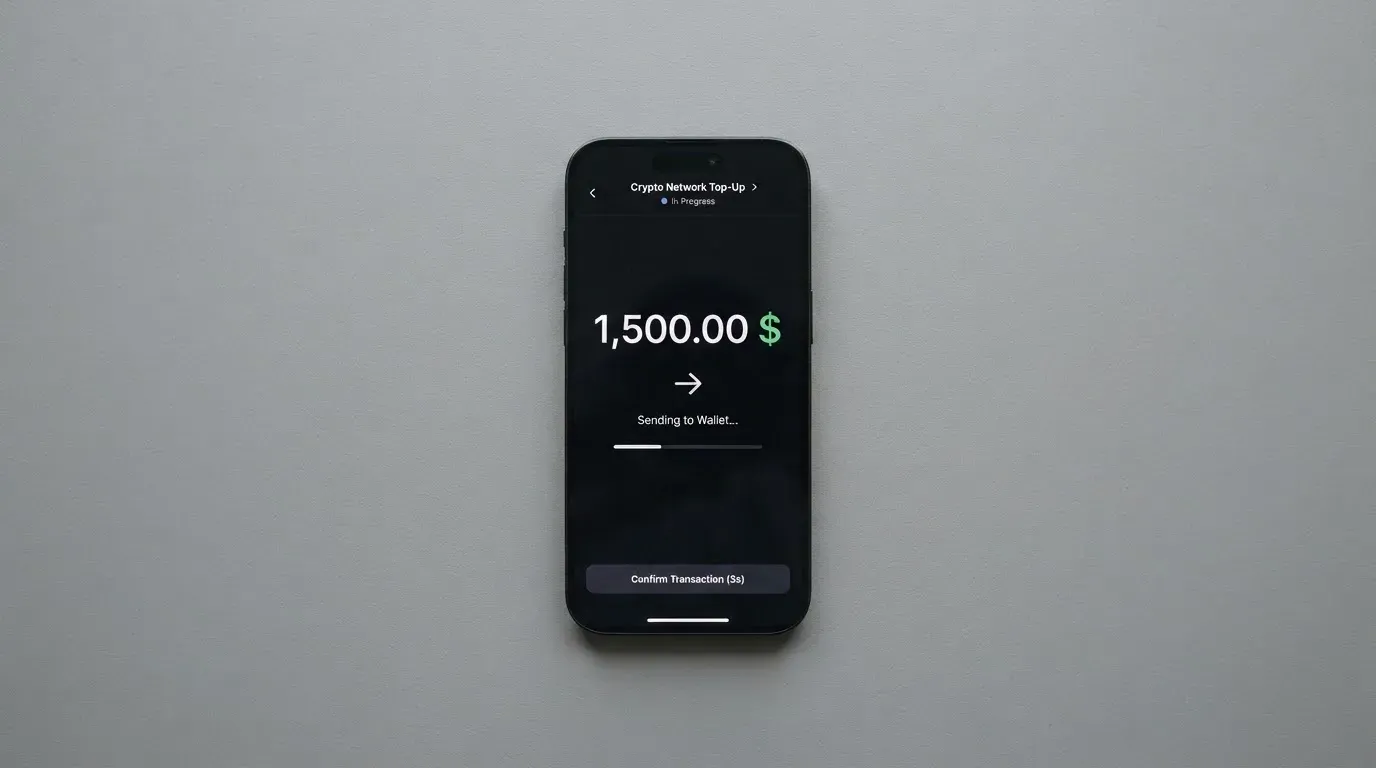
The second route is fiat, in the currencies the app supports: GBP, USD, EUR, NGN, KES, MXN and BRL. The rails are FPS in the UK, ACH in the US and SEPA in the eurozone. The fees for fiat top-ups are not stated in the fee schedule; the minimum top-up is also not stated apart from the fee minimum. If you fund the card with fiat, you are paying on the rails, and the bank on your side may charge its own fee.
Pulling money back off the card is cheaper than putting it on. The withdrawal fee is 0.00% with a $0.01 minimum, plus the same $0.05 network fee for USDT/USDC. Prive advertises off-ramps to local bank accounts in 80+ countries. The terms say any outstanding balance becomes due on termination, and the site has an account-closure disclosure page; the process is not described in detail on the public pages.
A practical note on the off-ramp side: “80+ countries” is about the cash-out coverage, not the sign-up coverage. The two are not the same, and a reader who needs to fund the card in a country Prive does not list is in a different position from a reader who only needs to cash out into a bank there.
The honest summary is that Prive’s top-up story is one of its stronger points in design — non-custodial stablecoins, multiple fiat rails, instant in-app loading — and one of its weaker points in documentation, because the networks and the fiat top-up fees are not published. If you are comfortable with stablecoins and your own wallet, the top-up flow is the main reason to consider this card.
Paying with it every day
Once the card is loaded, spending works like any other Visa Platinum. You tap, insert or hand the card over; the balance is deducted in the card’s currency; if the merchant settles in another currency, the 2.00% FX markup applies. Online payments go through 3-D Secure, and the network rules around merchant blocks (for example, gambling merchants, MCC 7995) apply as the issuer has set them. Prive’s blocked merchant list is not published.
Mobile wallet support is where the picture gets fuzzy. Prive has a Google Pay terms page at /legal/prive-googletnc, which suggests Google Pay is at least intended to work. At the same time, a third-party catalogue from 2026 says neither Apple Pay nor Google Pay is supported, and the iOS app listing does not mention wallet integration. With those two sources in conflict, the only way to know is to test in the app. Do not assume you can add the card to Apple Wallet or Google Wallet on day one; assume you might need to carry the physical card as a fallback.
The rewards scheme is a points system earned on top-ups, payments, withdrawals and referrals. Points are usable only in the app and cannot be taken as cashback. There is no cashback rate published in the fee schedule, and no signup bonus or spend tier that pays in fiat. If you are comparing cards on rewards alone, Prive is a thin offering.
The iOS app sits at 4.3 out of 5 from 20 ratings as of 21 October 2026, which is a small sample but a positive signal. A Google Play listing exists under the package name life.prive; its rating could not be read at the time of writing. The app supports English and 10 other languages; Russian is not confirmed.
Support runs 24/7 through the help centre and a [email protected] inbox. Unofficial reports flag slow, vague support and login failures after an app update. The catalogue also notes that some payment links require the payer to register and pass KYC before paying, which is a friction point for splitting bills or accepting transfers from people who are not already Prive users.
For dispute handling, the terms specify arbitration in Hong Kong through the HKIAC. The card agreement page exists but the section that should describe chargeback rights and time frames is shown as “content not yet available”. If you rely on chargebacks to resolve merchant disputes, that gap matters.
What can go wrong
The biggest risk on Prive is not a specific failure I can point to; it is the absence of a clear paper trail around who actually issues the card and under what licence.
Prive Technologies Limited says it is “not a bank”. The card programme is run through unnamed “licensed card programme partners”, and the actual card issuer is not named on the public pages. KYC is handled by Sumsub and Bridge, both of which are real and well-known compliance vendors, but they are not the issuer. The terms are governed by Hong Kong law, and the FCA register does not show an authorisation number for Prive itself. The Prive FCA page says FSCS protection does not apply, which is the correct answer for an e-money or card programme that is not a UK bank — but the underlying issuer is not stated, so a reader cannot check a different regulator’s register to confirm coverage.
In practice, that means the funds you hold on the card sit with an unnamed regulated partner, and Prive’s own materials are the only description of how that custody works. The non-custodial framing — “Your Wallet. Your Keys.” — applies to the crypto in your wallet, not to the fiat balance you load onto the card. The fiat balance is a prepaid balance held by a partner, and prepaid balances are not bank deposits.
On the operational side, user reports collected by the third-party catalogue describe login failures after an app update, slow and vague support, and payment links that require the payer to register and pass KYC. I did not find a Trustpilot page for Prive Money, and Reddit and Trustpilot searches returned only unrelated “Privé” shopping sites, so the user-report signal is thin. App Store and Google Play are the best live signal of how the app is performing day to day.
A few risks are category risks rather than Prive-specific. Crypto transfers are irreversible: a stablecoin sent to the wrong address or on a network Prive does not support can be lost, and even manual recovery is not guaranteed. Stablecoins themselves are not perfectly stable, although USDC and USDT have held their peg through most periods and are the two stablecoins the BIS put at about 90% of stablecoin market capitalisation in July 2025. Tether reserves the right to freeze tokens in wallets on sanctions lists, so stablecoins are not censorship-proof at the issuer level.
A final point on sanctions and country rules. Prive’s terms include standard sanctions and restricted-country language, and the company does not publish which jurisdictions it serves. The right way to handle this is to be honest about your citizenship and your country of residence when you onboard; trying to use a VPN or borrowed documents to get around the rules is a route to a closed account and frozen funds, not a route to a working card.
What to take instead
If Prive’s mix of self-custody focus, missing country list and steady fees is not quite right for you, here is how the alternatives stack up. I have read each card’s public pages and scored them on the same scale; the numbers are for context, not a directive.
| Card | Score | Headline difference from Prive |
|---|---|---|
| MetaMask Card | 7.1 / 10 | Mastercard issued by Monovate, available in 45 listed countries (others on a waitlist), spends directly from a connected self-custody wallet on Linea, Base, Monad or Solana. Virtual card free; Metal $199/year; cashback 1% on Virtual, headline 3% on Metal (foot of the page reduces 3% to the first $10,000 of spend, then 1%). No FX fee, Mastercard rate used. |
| KAST | 6.1 / 10 | Stablecoin-funded Visa with three tiers: Standard (free), Premium ($1,000/year), Private ($10,000/year). Stablecoin top-up 0% and card spend 0% in USD, FX 0.5%–1.75%, USD cashback 1.5%/2%/3% on the first $2,000/$10,000/$40,000 a month. Country list is shown at KYC; ID-based eligibility rules are stricter than Prive’s. |
| TokenPocket (Fiat24) | 5.8 / 10 | Mastercard/Visa debit card running on Arbitrum, with balances in EUR24 and USD24. Available in a published list of European countries for Visa, and in Australia, Canada, Hong Kong, Japan, Singapore and others for Mastercard. A 1% deposit fee is advertised, intended to be refunded later in rewards or fee reductions. |
What this comparison tells you is that Prive is not the cheapest self-custody card and not the most transparent, but it is one of the few that holds your crypto in your own wallet until the moment of payment. MetaMask Card sits closer to that brief and has a larger published country list; KAST is the better fit if you want cashback and are happy to live inside a stablecoin balance; TokenPocket is the option if you are based in the specific European or Asia-Pacific countries it serves.
If you do not need self-custody and a normal bank card or an established fiat-funded prepaid card would do the job, a crypto card is the wrong tool. Prive is a niche product for a specific kind of user, and the rest of the market serves other niches better.
Final: who I would recommend it to
I would recommend Prive to a reader who already holds USDC or USDT in a self-custodial wallet, who lives in a country the card does serve (which is something you cannot confirm from the public pages — install the app and find out), who is willing to read the fee schedule before each top-up, and whose everyday spending is mostly in the same currency as the balance they load. For that reader, the card does what it says: it converts your own stablecoins into a Visa balance and lets you spend them, and the non-custodial framing is a real feature, not a marketing slogan.
I would not recommend Prive to a reader who wants a clear answer to “which bank holds my money, under which licence, in which country?” — because the card does not name the issuer, and the public pages do not let you answer that. I would not recommend it to a reader who travels often and pays in non-base currencies, because the 2.00% FX markup will quietly add up to more than the card’s other fees combined. I would not recommend it to a reader who is comparing cards on cashback or rewards, because Prive’s points are app-bound and cannot be redeemed as cash. And I would not recommend it to a reader who is not comfortable with the fact that some payment links require the payer to register and pass KYC before they can pay you.
If you are still on the fence, install the app, go through onboarding to the KYC step, and see which country and tier the card offers you. The published paperwork cannot tell you whether you can actually use the card where you live; only the onboarding flow can.
Frequently asked questions
What is the Prive card?
The Prive card is a Visa Platinum issued by Prive Technologies Limited, available as a virtual card or a premium metal card. Its balance is funded from your own non-custodial wallet, so the USDC, USDT, EURC or PYUSD you hold in a wallet you control is what pays at the till.
How does the Prive card work?
You install the Prive app, pass identity verification, and order a card. You top up the card’s balance from your own wallet in USDC, USDT, EURC or PYUSD, or with fiat via FPS, ACH or SEPA. When you pay, Prive converts the balance and the merchant is paid in fiat; the FX markup is 2.00% on non-base-currency spending.
Is Prive a bank?
No. Prive Technologies Limited says it is “not a bank”. The card is run through “licensed card programme partners”, and the actual issuer is not named on the public pages. The FCA register does not show an authorisation number for Prive itself, and the FCA page on Prive confirms FSCS protection does not apply.
Who owns Prive?
Prive Technologies Limited is the company behind the card. Public ownership details, investors and leadership are not stated on the card’s own pages. Treat the issuer side as an unknown until Prive publishes more.
Is the Prive card available in my country?
The card’s site does not publish a country list. The terms are written for Hong Kong residents, and a third-party catalogue says the card is “not available in Hong Kong”, so the public sources disagree. The only way to find out whether you can sign up is to install the app and start onboarding.
How do I apply for the Prive card?
Install the Prive app, complete onboarding and identity verification, then order a virtual card from inside the app. If you want the metal card, you can request it from the app after verification.
Does the Prive card require KYC?
Yes. The card runs verification through Sumsub and Bridge and has at least two verification tiers. The exact documents and processing time are not published; unofficial reports say an email, a phone number and an identity document are required.
How do I top up the Prive card?
You can top up from your own non-custodial wallet in USDC, USDT, EURC or PYUSD, with the top-up appearing instantly in your card balance. You can also top up in fiat in GBP, USD, EUR, NGN, KES, MXN or BRL via FPS, ACH or SEPA. The blockchain networks for stablecoin top-ups are not published, so check inside the app before sending.
How do I add the Prive card to Apple Wallet or Google Pay?
Prive has a Google Pay terms page, but unofficial sources say neither Apple Pay nor Google Pay is currently supported. The public paperwork is contradictory on this point, so test inside the app before relying on mobile wallet payments.
Is the Prive card worth it?
It depends on what you are comparing it to. If you self-custody USDC and USDT and want a card that draws on your own wallet, the design is competitive and the score is 5.1 out of 10 in this review. If you want cashback, a clear issuer, or low FX cost, a different card — MetaMask Card at 7.1/10 or KAST at 6.1/10 — is probably a better fit.
Wallet cards in the catalogue – cryptocardcatalog
Content created by the «cryptocardcatalog» team