
A no-fee virtual Visa that spends USDC — and the parts that give me pause
 Available in US

VaultLeap is a virtual Visa debit card that spends a balance you load with USDC. The fee structure is unusually clean: no monthly charge, no annual charge, no per-purchase charge, no international transaction fee and no currency markup. What you give up for that is a card you cannot hold, cash you cannot take out at an ATM, and a support record that has not been uniformly good. My score for the card as it stands is 6.0 out of 10.
The conditions described on this page are current as of October 28, 2026.
Verdict: 6.0 out of 10
Let me start with what the card is good at, because the honest case for it is narrower than the marketing suggests and still real. If you live in the United States or Latin America, you hold USDC, and you mostly pay for things online, this is a clean way to spend it: the card loads in minutes, costs nothing to keep, and does not add a foreign exchange penalty when you pay in a currency other than dollars. There is no plastic to wait for, no monthly fee to remember, and no exchange-rate markup on the merchant’s side.
Against that, three things hold it back. Top-ups are manual and limited to one coin. There is no way to get cash out. And the complaints filed by users are not about fees — they are about accounts being suspended without a clear reason and funds not being credited. That is the part I would weigh most heavily if I were about to move real money in.
If you need a physical card, an ATM, several ways to fund the account, or a support desk that answers, this is not the card for you. I have listed alternatives further down.
| Criterion | Mark | Why |
|---|---|---|
| Who can get it | 5 / 10 | Advertised for 27 countries, starting with the United States, Latin America and Ghana; the cardholder agreement says it is issued under U.S. law and “not directly marketed outside the U.S.” |
| Cost | 9 / 10 | Month $0, year $0, per purchase $0, closure free, international commission 0%, no currency markup; conversion still carries about 0.5% partner pass-through fees, and the issuance fee is not stated |
| Top-up options | 5 / 10 | USDC only, moved by hand from the VaultLeap balance via Dashboard → Card → Add Funds; other coins and networks are not stated, and gas is paid by the user |
| Reliability and complaints | 5 / 10 | Issuer Lead Bank, programme manager Bridge Ventures LLC; Trustpilot 3.4 out of 34 reviews, with reports of account blocks in 2026 and funds not credited |
| Everyday use | 5 / 10 | Virtual Visa in minutes, Apple Pay and Google Pay supported; no plastic card, no ATM |
| Total | 6.0 / 10 | A cheap, simple way to spend USDC online, held back by one-asset funding, no cash access and a mixed user record |
Who will they give the card to
VaultLeap advertises the card for “27 countries”, but the list is not printed on the page. The starting points given are the United States, Latin America — Argentina, Colombia, Mexico, Brazil, Peru, Bolivia, Guatemala, Dominican Republic, Ecuador, Costa Rica, El Salvador, Honduras, Panama, Paraguay, Uruguay — and Ghana.
That is the headline. The cardholder agreement is more careful: the card is issued under U.S. law and, in the agreement’s own words, “not directly marketed outside the U.S.” So if you are reading this from somewhere outside the Americas or Ghana, the more useful thing to ask is not whether your country is on the marketing list but whether the platform will open an account for you at all. Age of majority applies.
There is no stated list of blocked countries, which cuts both ways: I cannot tell you that your country is excluded, and the page does not promise that it is included.
How to get it
The path is short. You must be 18 or over. Identity verification is required, and the card is requested from the dashboard “once your account is verified” — that is the wording on the page, so verification comes before the card, not after it. Which documents are needed and whether proof of address is required: not stated. Nor is the verification tier structure.
What arrives is a virtual Visa debit card, described in the legal text as a “Prepaid Debit Visa Card”, issued in minutes and denominated in USD. It is virtual only. Replacement is free — “There is no fee for replacing your Card” — which matters more than it sounds when the card exists only inside an app and a lost phone means a lost card.
Fees: what it really costs
Here is the part of the review I can be most concrete about, because the numbers are simple and, for once, they are the good numbers.

| Fee or limit | Value |
|---|---|
| Monthly fee | $0 |
| Annual fee | $0 |
| Per purchase | $0 |
| Closure | Free |
| International transaction fee | 0% |
| Currency markup | None |
| Conversion | About 0.5% partner pass-through fees |
| Issuance fee | Not stated |
| ATM withdrawals | n/a |
| ATM balance inquiries | n/a |
| Maximum per-transaction load | $2,000.00 |
Other limits may be set by the bank. Note also that the plans here are account plans, not card tiers: Standard, Pro at $14.99/month or $144/year, and a Zero tier for transfer fees. There is one card product. And while the card is USD, the account types are USD, EUR and MXN, with foreign purchases priced at the Visa network rate.
Now the everyday arithmetic, because a zero-fee card is only as good as the transaction it is attached to.
Paying 40 USD for a subscription in dollars costs 40 USD in USDC. No fee anywhere.
Paying a 40 USD invoice from a European shop is the same at the Visa network rate with no markup on the card’s side — but the conversion itself carries about 0.5% partner pass-through fees, and that is the number to hold on to.
Trying to take 100 USD out as cash at an airport is not possible. ATM withdrawals are unavailable, and so are ATM balance inquiries. There is no workaround built into the card; the fee table lists these as n/a, not as charged.
The pattern to notice: VaultLeap charges you nothing for holding the card and for spending it, and passes on real costs in three places — the conversion, the blockchain network for your deposit, and nothing at all for cash access.
Top up: USDC, moved by hand
This is the most important limitation on the card, and I would not skip it. USDC is moved manually from your VaultLeap balance through Dashboard → Card → Add Funds into a Bridge-powered card wallet. Other coins and networks are not stated.
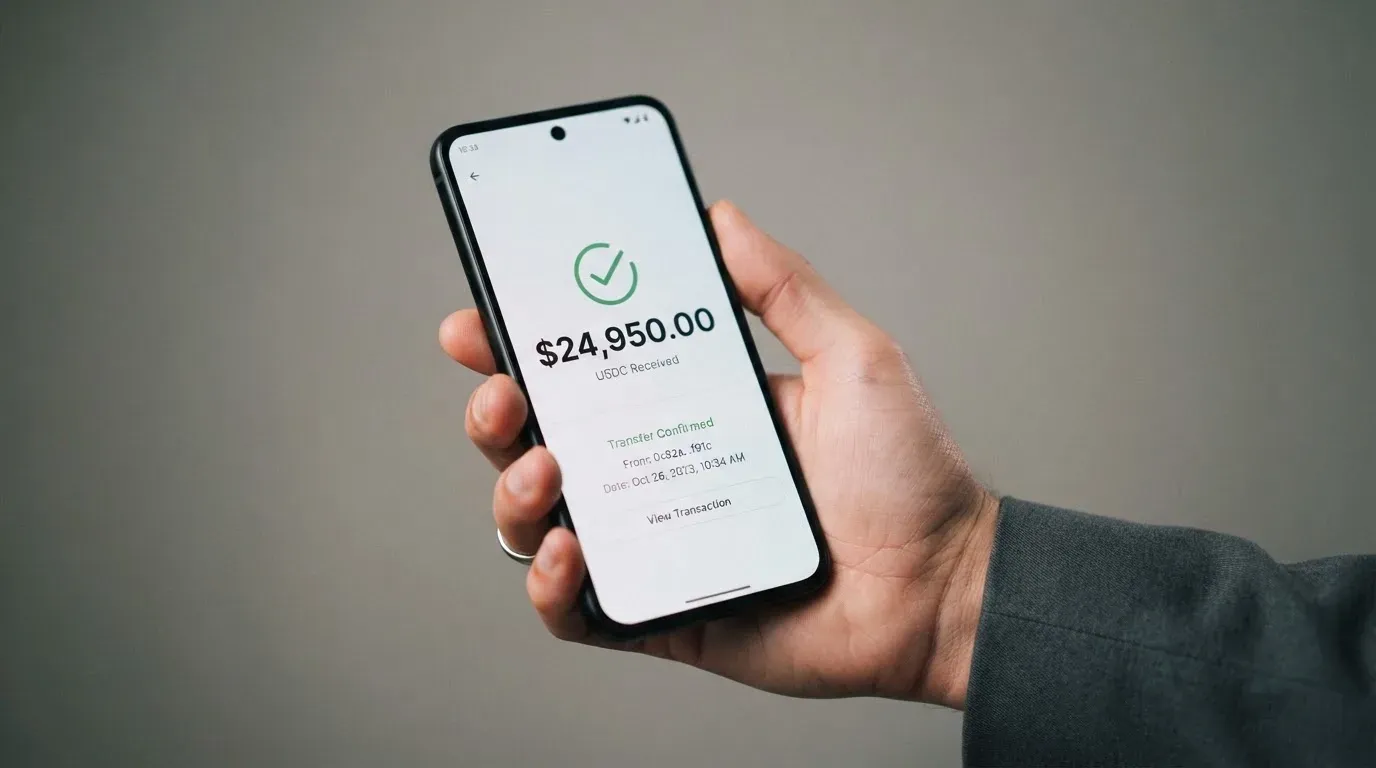
The deposit fee and the minimum deposit: not stated. What is stated is that blockchain fees for the transfer are yours to pay. That is normal for this category — the network, not the card provider, charges for a deposit (see the wider background below) — but on a small deposit it can eat a noticeable slice.
Maximum per-transaction load is $2,000.00. Larger balances can be moved, but not in one transaction.
One thing worth planning for before you ever close the account: on closure, any remaining fiat balance goes to the platform wallet as stablecoins. The bank may refuse balances under $1.00. Withdrawal from the account goes to any supported USD or EUR bank account.
Paying with it every day
Both mobile wallets are supported — Apple Pay and Google Pay — which is the practical reason a card with no plastic still works day to day. The apps are on the App Store and Google Play; I have not read the store ratings.
Rewards are thin. No cashback is stated. There is a “Points & Rewards” section in the help centre, but I did not read its contents, so I will not guess at what is in it.
Blocked merchant categories: not stated. In this category that matters more than it sounds — gambling, for instance, is a category many issuers block by policy rather than by law, and the list varies by issuer. If gambling or similar spending matters to you, ask before you load anything.
Disputes go through Dashboard → Support → File a Ticket → Dispute a Charge. The clock is real: report errors within 60 days. The bank decides within 10 business days, stretching to 45 days, and to 90 days for new cards, point-of-sale purchases or foreign transactions. Report unauthorized transactions within 2 business days and liability is capped at $50; later, it can go up to $500. That sequence is worth reading twice — the early-reporting cap is the difference between a bad week and a bad year.
What can go wrong
The structural risks come first. VaultLeap’s own terms say it does not hold customer funds, and the wallet is self-custodial; you hold the keys, which means you hold the loss if you lose them. A seed phrase — typically 12 to 24 words — is the unencrypted form of the private key, and anyone who obtains it can restore the wallet and spend from it. Blockchain transfers are irreversible. Tether also disables tokens in wallets on the OFAC sanctions list and has frozen funds tied to illicit activity, so stablecoins are not censorship-proof in either direction. And the funds are not FDIC insured.
There is a freeze control in the app, at Dashboard → Card → Freeze, which is the safeguard you would reach for first. App-based 2FA, spending limits and 3-D Secure confirmation are the other standard protections — but note that protections are only as good as the compliance decisions behind them.
Which brings me to the user record. No official incident was found. On Trustpilot the card sits at 3.4 out of 5 from 34 reviews, read on 21 October 2026. These are user reports, not verified findings, but they are consistent and they are about the things that hurt most: accounts suspended or blocked without a clear reason (January 2026, and June to August 2026), funds not credited or not returned (October 2025, June 2026), and unclear support. A review dated 12 October 2026 acknowledges problems with card issuance.
Behind the card sits a three-company structure. Klydo Inc., a California S corporation, operates VaultLeap. Bridge Ventures LLC, a Delaware company and a licensed money transmitter, is the programme manager. Lead Bank, a Missouri state-chartered bank, is the issuer.
Why does that matter to you? Because the crypto brand you deal with is often a front end and a programme manager, not the institution that actually issues the card and holds the programme. If something goes wrong, the bank is the one that decides — and the bank decides under U.S. law, under the cardholder agreement that says this card is not directly marketed outside the U.S.
Support is email in English and Spanish, plus a Support tab and tickets. Nothing else is stated. No news page content is stated.
What to take instead
I am not going to rank these against VaultLeap on a single scale, because they are built for different people. What I can do is walk you through what changes if the VaultLeap limitation that bothers you most is something else.
If your problem is funding flexibility. International Visa Card scores 6.7 out of 10. It is a U.S.-issued Platinum Visa, virtual, paying in USD, with the physical card listed as “Coming soon” — so it shares the no-plastic trait. It is stricter about where you live: the account and card are not available to residents or legal registrants of Belarus, mainland China, North Korea, Cuba, India, Iraq, Iran, Israel, Myanmar, Nepal, Nicaragua, Russia, Syria, Turkey, Ukraine, Venezuela and Vietnam, with FATF grey-list countries reviewed case by case with compliance approval, and purchases blocked in North Korea, Cuba, Iran, Russia, Syria, Ukraine and Venezuela. The rule follows residence or registration, not citizenship. Its cost shape: $5 one-time virtual card issuance, no maintenance fee, plans Classic free, Pro $9.00/month and Max $19.00/month; card use in USD free on all plans; foreign currency at “Visa exchange rate + 2% FX fee”; deposits of any kind free. You can fund with USDC or USDT into the USD account free at 1:1 as per an earlier check, and there are also USD, EUR, SEPA, SWIFT and FedNow rails. No cashback stated. The two-FX-fee line is real money on every foreign purchase — that is what you trade for a broader funding menu and a longer country exclusion list.
If your problem is the cost of conversion. UNi Card scores 6.1 out of 10. A multicurrency card on the Mastercard network, spending from the UNi.Global account balance, with “No annual fee or foreign transaction fee” and assets converted at “live OTC (Over-the-Counter) rates” with “No hidden exchange fees”. Issuance fee not stated, physical or virtual not stated, who can get it not stated, and how you fund it not stated. It also has the only rewards offer in this group: “Spend-to-Earn rewards” up to 3%. If you transact across several currencies, a card with no FX fee and no conversion spread is a meaningfully different proposition — you just have to accept that the card’s own details are thin.
If your problem is cashback in the United States. Whop Cards score 5.2 out of 10. Visa, working anywhere Visa is accepted online and in stores, spending from a Whop balance, with pending balance usable as soon as a payment arrives and standard withdrawals using settled funds. Starting data: the balance is backed by stablecoin collateral from a linked wallet; which coins and networks is not stated. Five percent cashback at select merchants, currently Uber, more planned — payout currency and conditions not stated. Consumer coverage is 31 U.S. states and business coverage 41 states, with unsupported consumer countries including Belarus, China (Mainland), Cuba, Hong Kong, India, Iran, Iraq, Israel, Myanmar, Nepal, Nicaragua, North Korea, Russia, Syria, Turkey, Ukraine, Venezuela and Vietnam; unsupported corporate countries include Russia and Belarus. Whether coverage follows citizenship or residence is not stated. And the page says “No extra fees” without listing any issuance or monthly amounts — for a card whose currency type is not stated either.
| VaultLeap | International Visa Card | UNi Card | Whop Cards | |
|---|---|---|---|---|
| Score | 6.0 / 10 | 6.7 / 10 | 6.1 / 10 | 5.2 / 10 |
| Network | Visa | Visa | Mastercard | Visa |
| Form | Virtual only | Virtual, physical “coming soon” | Not stated | Not stated |
| Monthly fee | $0 | None; plans up to $19.00/month | No annual fee | “No extra fees” listed |
| Foreign currency | Visa rate, no markup, ~0.5% partner fees on conversion | Visa rate + 2% FX fee | No FX fee, live OTC rates | Not stated |
| Funding | USDC only, manual | USDC, USDT, USD, EUR, SEPA, SWIFT, FedNow | Not stated | Stablecoin collateral from a linked wallet |
| Rewards | None stated | No cashback stated | Spend-to-Earn up to 3% | 5% cashback at select merchants |
One more thing to hold onto while comparing. Crypto cards are not issued by Visa or Mastercard to consumers — the networks license issuers and can suspend a programme. Visa said in November 2022 that it had “terminated our global agreements with FTX”, and the FTX US debit card programme was wound down by its issuer. WaveCrest, a Visa issuer that supplied crypto card brands, was suspended by Visa in Europe in 2018, closing all WaveCrest-issued Visa programmes. A closure typically means a notice period, then loading and spending stop, then you are asked to withdraw. That is not a prediction about VaultLeap; it is the shape of this category’s history.
Who I would recommend it to
I would recommend VaultLeap to someone specific: a resident of the United States or Latin America who already holds USDC, pays mostly online, does not need cash, and has decided that a self-custodial wallet is a trade they want. For that person this card does its job at no recurring cost, and the 9 out of 10 I gave cost is a fair score.
I would not recommend it to someone whose first question is whether their country is supported, because the agreement’s own line about not being directly marketed outside the U.S. makes that a support question rather than a page question. I would not recommend it to anyone planning around ATM access. And I would hesitate before recommending it to a person who intends to hold a large idle balance for long, given what users report about blocks and uncredited funds, and the fact that the platform itself says it does not hold customer funds.
If your money is on a self-custodial wallet, that is a deliberate choice with real consequences: you own the key loss, the phishing and the clipboard malware that swaps a pasted address. Transfers are irreversible, and a deposit sent on a network the provider does not support, or to an address belonging to another network, can be lost or need manual recovery with no guarantee. Circle stopped supporting USDC on Tron in February 2024, so “USDC over TRC20” is not a native option — and ERC-20 fees are paid only in ETH, so a wallet holding USDT with no ETH cannot send it. If any of that is new to you, read the funding section again before you move anything.
I would also separate two questions that get merged. Whether a card is safe to use is not the same as whether a crypto balance is taxable. The IRS treats digital assets as property, so spending them on goods and services generally produces a taxable gain or loss, measured in local currency at fair market value on the date of the transaction — which can make each card payment its own disposal. I am not giving tax advice here; I am telling you to raise it with someone who can. The same applies to regulation: a card is a payment service under e-money and payments law, while the crypto side falls under MiCA in the EU, which is why a crypto card often rests on two licences. ESMA keeps an interim register of authorised crypto-asset service providers and non-compliant entities, and a CASP authorised in one member state can serve the whole EU.
Frequently asked questions
What is the VaultLeap card?
VaultLeap is a virtual Visa debit card that spends a balance you load yourself, primarily with USDC. The legal text calls it a “Prepaid Debit Visa Card”, it is denominated in USD, and it is issued in minutes once your account is verified. It is virtual only, with no physical card, and the company operating it is Klydo Inc. with Bridge Ventures LLC as programme manager and Lead Bank as issuer.
Does VaultLeap charge any fees?
Monthly, annual and per-purchase fees are all $0, closure is free, the international transaction fee is 0% and there is no currency markup. Two costs survive: conversion carries about 0.5% partner pass-through fees, and the issuance fee is not stated. Blockchain network fees for your deposit are also yours to pay, charged by the network rather than by the card.
Can I use the VaultLeap card in my country?
The card is advertised for 27 countries, with the United States, Latin America and Ghana named as starting points, but the full list is not printed. The cardholder agreement says it is issued under U.S. law and “not directly marketed outside the U.S.”, so the reliable test is whether the platform will open an account for you, not whether your country appears in marketing.
Does VaultLeap require KYC or identity verification?
Yes. Age 18 or over and identity verification are required, and the card is requested from the dashboard only “once your account is verified”. The page does not state which documents are needed, whether proof of address is required, or how the verification levels are tiered — so budget for a document check without knowing the list in advance.
How do I top up the VaultLeap card?
You move USDC manually from your VaultLeap balance through Dashboard → Card → Add Funds into a Bridge-powered card wallet. Other coins and networks are not stated, the deposit fee and minimum are not stated, and you pay the blockchain network fee yourself. The maximum single load is $2,000.00, though larger balances can be moved across several transactions.
Is the VaultLeap card free, and is it worth it?
The card itself costs nothing to hold: $0 monthly, $0 annually, $0 per purchase. Whether that is worth it depends on your situation. If you pay online in dollars with USDC you already hold, it is a clean free option. If you need cash, a physical card, several funding coins or strong support responsiveness, the free part is offset by what you give up elsewhere.
Can I withdraw cash or use an ATM with VaultLeap?
No. ATM withdrawals and ATM balance inquiries are listed as n/a, which is different from being charged a fee — the function is simply unavailable. If cash access matters to you, this card does not provide it, and there is no fee tier that adds it. Closing the account sends any remaining fiat balance to the platform wallet as stablecoins.
Is VaultLeap a bank, and who owns it?
No, VaultLeap is not a bank. Klydo Inc., a California S corporation, operates the platform; Bridge Ventures LLC, a Delaware company and licensed money transmitter, is the programme manager; Lead Bank, a Missouri state-chartered bank, is the card issuer. That structure is normal for this category and it matters: the bank decides disputes, and the card sits under U.S. law.
Is VaultLeap safe and are the funds protected?
The terms say VaultLeap does not hold customer funds, the wallet is self-custodial, and the balance is not FDIC insured. A freeze control exists at Dashboard → Card → Freeze. But user reports on Trustpilot — where the card sits at 3.4 out of 34 reviews, read on 21 October 2026 — describe accounts suspended without clear reason in 2026 and funds not credited or returned.
How do I add VaultLeap to Apple Wallet and use it day to day?
Apple Pay and Google Pay are both supported, and since there is no physical card, adding the virtual card to a mobile wallet is the normal way to pay in person. The apps are on the App Store and Google Play. No cashback is stated, and the list of blocked merchant categories is not stated either — worth asking about if any particular spending matters to you.
App and neobank cards in the catalogue – cryptocardcatalog
Content created by the «cryptocardcatalog» team