
El Dorado: a virtual Visa paid from a USDT balance, with a soft spot in the fine print
 Available in US
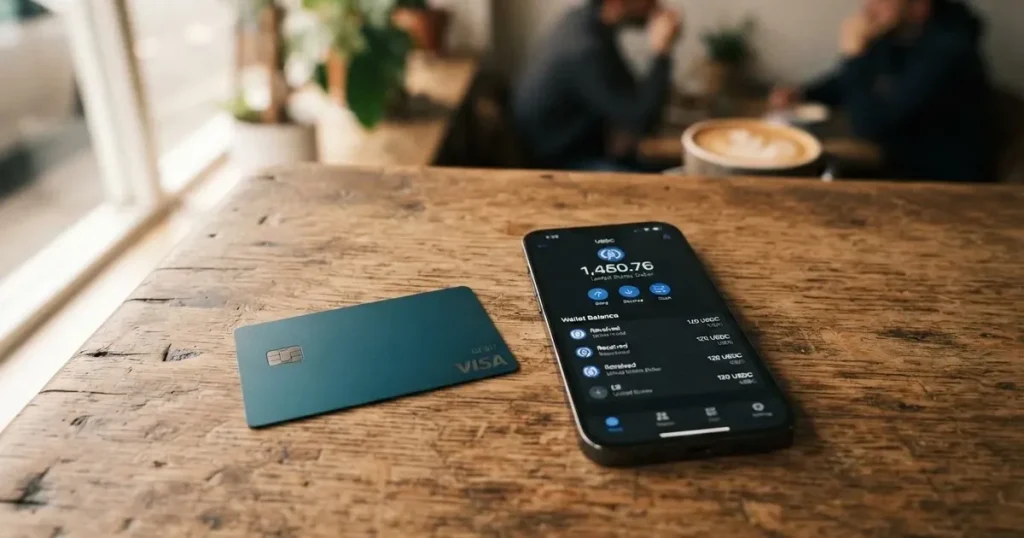
If you live in Latin America or the Caribbean, hold dollars or stablecoins, and want something that behaves like an ordinary bank card online, the El Dorado card is worth putting on your shortlist. If you are in the United States, or you want a physical piece of plastic, or you need to take money out of an ATM, you can stop reading — the card does not do any of those things. Between those two extremes sits a product that is genuinely cheap to hold and clear about its central promise, and unusually vague about several details that would otherwise matter. My score for it is 6.6 out of 10, and the reason is not that anything here is wrong; it is that a lot of what you would want to know simply is not published.
The conditions described in this review are current as of October 28, 2026.
Let me start with the number and the reasoning behind it, because a score without reasons is just a mood. The table below breaks the card down into the six criteria I score every card on, each with its mark and my reasoning in plain words.
| Criterion | Mark | Why |
|---|---|---|
| Who can get it | 4 / 10 | The card is offered in 11 Latin American and Caribbean countries, and the United States is excluded |
| Cost | 8 / 10 | Issuance is 3.99 USDT once, the monthly fee is free, and topping up with USDT is free — but the card’s own conversion fee is not disclosed |
| Top-up options | 8 / 10 | USDT on Arbitrum and Tron, dollars over ACH or wire, and 80+ local methods through the peer-to-peer desk |
| Reliability and complaints | 8 / 10 | Issued by Lead Bank under a Visa U.S.A. licence, registered as a VASP in Argentina, backed by Multicoin, Coinbase Ventures and Paradigm; the low Trustpilot score is about the platform, not the card |
| Everyday use | 5 / 10 | A virtual Visa with Apple Pay and Google Pay, but no plastic and no ATM withdrawals |
| Total | 6.6 / 10 |
Two things pull this score up and one pulls it down hard. The eligibility mark is the problem: eleven countries is a small map, and the country you live in decides everything. The cost mark is the surprise, and I will walk through it in detail later — three dollars and ninety-nine cents once, nothing a month, free USDT deposits is not a bad deal. The everyday-use mark is what keeps it from being a simple recommendation: the card is a number, a CVV and an expiry date in an app, which is fine for online spending and payments in a phone wallet and much less fine if you want to hand something to a shopkeeper.
Who this suits, then. Latin Americans who want to fund a USD card with USDT, who already have some relationship with the platform, and who spend most of their money online or through a mobile wallet. Who it does not suit: anyone in the United States, anyone who needs a physical card in their hand, anyone who needs cash from a machine, and anyone who wants a published conversion rate before committing money — because the single most important number on this card, what it charges you to convert, is not stated anywhere I could find.
Will they give you the card?
The card is available in Bolivia, Brazil, Argentina, Colombia, Costa Rica, Ecuador, Guatemala, Honduras, Paraguay, Peru, and Trinidad and Tobago. That is eleven countries, all in Latin America and the Caribbean. It is not available to residents of the United States. Eligibility is based on where you reside, not on citizenship — that distinction matters more here than it usually does, and I will come back to it in the risks section.
That is the whole eligibility list. There is no tier structure, no premium version, no invitation class. Either you reside in one of those eleven countries or you do not.
What I want to flag, because it trips people up constantly, is how this kind of restriction normally works. Residence-based means the address you live at. Some services additionally screen citizenship and country of birth, because sanctions screening and internal issuer risk policy are usually applied to all three. Nothing in this card’s public material says El Dorado screens nationality. I am telling you the rule as the card states it — residence-based — and I am telling you separately that the broader category has a second mechanism you cannot see. If your situation is unusual on that axis, the honest answer is that you will only find out at verification.
If you are outside the eleven listed countries, there is no application to try. That is worth saying plainly rather than dressing it up: this is not a card you can find a workaround for, and if you are reading this from anywhere else on the map, the answer is simply no.
How to get it
Two conditions are stated, and they are both straightforward. You must be eighteen or older, and you must complete Level 2 verification inside the El Dorado app plus one additional verification step. The terms put the refusal angle plainly too: if you decline to provide the KYC data they ask for, that is a ground for cancelling the card, and El Dorado may ask you for more information at any time.
What is not stated is as important as what is. The card’s own pages do not say which documents you need or what proof of address looks like. They do not say what is inside Level 1 and Level 2, how long processing takes, or why an application might be rejected. If you are someone who needs to know that a rejection can be appealed, or that your documents will not be held indefinitely, you will not find it here — I would put that question to support before you start, not after.
The mechanical steps are short: a “Get your card” button on the site or in the app takes you through. In practice the sequence reads as: sign up, finish Level 2, complete the extra in-app check, and the card appears.
And what appears is a prepaid debit Visa denominated in US dollars. You get a card number, a CVV and an expiry date, described as usable for online payments worldwide. No physical card is described anywhere, and a September 2026 help article confirms the card is virtual.
That September 2026 article is worth pausing on, because it tells you the card you sign up for today is not the one people used earlier this year. Existing cards were being replaced by a new virtual card with a new number, CVV and expiry date, with no issuance fee, and with your balance, your verification and your two-thousand-dollar daily limit unchanged. The catch is that the date on which the old card stops working appears in the article as an unfilled placeholder. If you have an old El Dorado card, that placeholder is the first thing you should check, because it is the one date that decides whether your current number still works tomorrow.
Fees: what it really costs
Here is where the card is unusually attractive and unusually silent. Let me put the published numbers in front of you first.
| Item | What is published |
|---|---|
| Issuance | 3.99 USDT, one time, taken from the El Dorado balance |
| Monthly fee | Free |
| Opening a USD account | Free |
| Card conversion / FX fee | Not stated |
| Cash withdrawal at an ATM | Not permitted with the card |
| Card spending limit | Up to USD 2,000 per day, total of the day’s transactions |
| Monthly spending limit | None |
| USDT deposit to the account | Free |
| ACH or wire deposit to the account | 1.49% |
| USDT withdrawal under 200 | 0.99 USDT plus the network fee |
| USDT withdrawal of 200 or more | 0.5% plus the network fee |
Read the top of that table first, because it is genuinely good news: three dollars and ninety-nine in USDT once, nothing a month, no charge to open the dollar account, and no charge to deposit USDT. The terms also note that El Dorado may set other costs, and that there have been zero-dollar promotions, so the three-ninety-nine is not a hard floor in the abstract — it is simply what is charged.
Then read the fourth row, which is the one that should make you pause. The conversion fee the card charges on your own spending is not stated. The public pages say there are “no extra charges” on subscriptions and international purchases and, in the same breath, that “fees may apply”. Both statements are true of a card whose conversion cost is unpublished.
Now let me put that gap next to real money, because that is the only way to size it.
Buying a coffee worth four dollars with a card that costs three dollars and ninety-nine to issue is a bad deal if you only ever make one purchase. Someone spending a thousand dollars a month is in a completely different position, and that is where a three-ninety-nine issuance fee looks like nothing. The comparison that matters is not the coffee; it is the monthly volume. If your card spending is meaningful, the one-off issuance cost is close to irrelevant and the missing conversion rate is the whole game.
So the honest answer to “what does it really cost” is: the visible costs are low and clearly stated, and the single cost that would vary month to month with your spending is not stated at all. If the conversion fee turns out to be anything meaningful, it will dominate every other number on this page.
Three everyday payments, then, to make that concrete.
A subscription at four dollars a month. You are paying in USD from a USD balance, and the FAQ says USD payments involve no currency conversion. So you are paying the retailer’s price, plus nothing in currency terms, plus whatever the undisclosed card conversion fee turns out to be. On a published basis this is the cleanest possible purchase.
A purchase priced in euros or pesos. The fee for paying in another currency is not stated, and that is exactly the case where a hidden percentage does the damage, because it multiplies against the whole amount every single time. You can buy the card without ever learning this number.
Cash from an ATM. This one has an answer, and the answer is no. You cannot withdraw cash with the card and you cannot use it for person-to-person transfers. The terms are explicit, so nobody will mislead you here; the risk is only that you find out at the machine.
The account layer has its own fees, and they are published. Depositing USDT is free. Depositing dollars by ACH or wire costs 1.49%. Withdrawing USDT below 200 costs 0.99 USDT plus the network fee; at 200 or more it is 0.5% plus the network fee. The peer-to-peer desk charges the buyer from a flat 0.49 US dollars, with the rate falling to 0.24% by transaction size, and the minimum there is 1 USDT.
How to top it up
The card is funded from the El Dorado main wallet. Inside the app you go to the Card section, press the “Depositar” button, and confirm with your PIN or biometrics. It is described as instant, with a note that it can take up to a couple of minutes, and there is no limit on how many top-ups you may make. What is not stated is the card top-up fee or a minimum top-up amount.
Underneath the card there are three ways to get money into the main account, and they serve different purposes.
USDT on Arbitrum or on Tron. No fee on deposit. This is the route most people in the audience for this card will use.
Dollars by ACH or wire, at 1.49%.
More than eighty local payment methods through the El Dorado P2P desk, where the buyer’s fee starts at a flat 0.49 US dollars and scales down to 0.24% by size, with a minimum of 1 USDT.
One thing you should know about these rails before you use them, because it is a property of the technology rather than of this card: blockchain transfers cannot be reversed. Sending on a network the provider does not support, or to an address belonging to a different network, can mean the money is gone or needs manual recovery with no guarantee. Choosing between Arbitrum and Tron on the card’s terms, and then sending on exactly that, is the whole job.
There is also the question of what the balance becomes when you spend it. The card is in USD, and the terms say balances are automatically converted from USDT to USDC for card use, with the result shown in USD. That is worth reading twice, because it means the USDT you deposit is not the USD you spend — something happens in between, and the published fee for the card side of it is the one that is not stated.
If you close the card rather than the account, the route is: ask Customer Service, pass an identity check, and the cancellation is processed within fifteen business days. There must be no pending transactions, pre-authorisations or chargebacks in the way, and any outstanding obligations can be deducted from your balance. How the remaining card balance gets back to you is not explained. If you are closing a card with money on it, ask that question in writing before you cancel anything.
Paying with it every day
Apple Pay and Google Pay both work. That is the practical centre of this card: a virtual Visa number, added to a phone wallet, paying at a counter in a way that feels ordinary. Tokenised numbers in Apple Pay work differently from the raw card number — the device-specific number lives in the phone’s secure hardware rather than on a server, and each payment carries a one-time code — which is a better arrangement than typing your card number into a shop’s site.
Where the card goes is wide: the card number, CVV and expiry are described as usable for online payments worldwide. What is not stated is any list of blocked merchant categories. That gap matters more than it sounds, because gambling is handled by category code — a four-digit code that classifies the merchant, with a specific code covering casinos, betting and lotteries, which many issuers block by policy rather than by law. The blocked list varies by issuer, and this card does not publish one. If gambling is something you need blocked, you should assume you have to ask.
There is another category of decline that is not the card’s fault. The first six or eight digits of any card number identify the institution and country that issued it, and merchants can look that up and apply extra scrutiny when the issuer country differs from the billing address. A card issued in one country can therefore look foreign to a shop in another. Address verification, which compares the numeric parts of a billing address against issuer records, is mainly offered in the US, Canada and the UK and is generally unavailable for foreign-issued cards, which is a common cause of declines at checkout. If a payment fails online, that category of explanation is worth considering before you assume the balance is wrong.
Rewards are not stated. There is no published cashback, no points scheme, no partner merchant list for this card. Compare that with the alternatives further down, where one of them advertises up to 3% back and another 5% at selected merchants.
If a payment goes wrong, the dispute route is Visa’s. Transactions, refunds and chargebacks follow Visa rules. You report an unrecognised charge to Customer Service, who may suggest a temporary freeze; a formal dispute goes to the issuing bank or programme administrator and may carry a thirty-dollar charge; claims are answered within up to fifteen business days; and the direct settlement period is thirty calendar days. El Dorado may also deduct funds automatically to cover a chargeback. No refund policy of its own is stated.
Support is in-app chat under Profile, plus email at [email protected], a phone number for card disputes, and a help centre in Spanish and English. The site runs in Spanish, English and Portuguese, but the hours and the language you will actually reach are not stated.
One practical note on the app itself, read from the Colombian storefront: the iOS app “El Dorado P2P” showed 4.9 from 777 ratings, requires iOS 15 or later, and offers Spanish, English and Portuguese. A Google Play listing exists but its rating was not retrieved. The company claims more than a million users and over a million Google Play downloads. Those are the company’s own figures, and store ratings depend heavily on which country’s storefront you are looking at.
What can go wrong
The biggest risk here is not fraud. It is dependence on a company that is not a bank and that can stop your card when it decides to.
El Dorado Labs PY Inc is the platform provider and Bridge Ventures LLC is the programme manager — explicitly not a bank. The card itself is issued by Lead Bank under a Visa U.S.A. licence. El Dorado Labs S.R.L. is a registered virtual asset service provider (PSAV No. 63, registered 5 August 2024 with the Argentine securities regulator), and EL DORADO MT LLC is registered in Florida. Investors named include Multicoin, Coinbase Ventures and Paradigm; a Paradigm-led round of nine million US dollars was reported by The Block in June 2026.
That structure is normal for this category and it comes with a specific risk. Your balance is custodial — it is held by El Dorado, not by you. Control of crypto belongs to whoever holds the private key or seed phrase, and with a custodial wallet the provider holds the credentials, so you must trust them completely. Transfers on the networks are irreversible, and a stolen key has no built-in recovery: the network cannot freeze or return funds. This is not a theoretical worry about El Dorado. Custodial platforms have a documented history of it: Mt. Gox, about 350 million US dollars reported stolen between 2011 and 2014; Coincheck, about 400 million in 2018; and Ronin Network, 625 million in 2022.
Then there is the less dramatic risk, which is the one I would actually worry about on this card: cards get stopped. The terms say El Dorado and its partners monitor transactions and may block, suspend or cancel the card. Card programmes have been wound down before — Visa terminated its global agreements with FTX on 13 November 2022, and WaveCrest, a Visa issuer that supplied crypto card brands, was suspended in Europe in 2018, closing all WaveCrest-issued Visa programmes. The usual sequence in a closure is a notice period, then spending and loading stop, then users are asked to withdraw remaining balances. If the balance sits on the card and the card dies, you are negotiating your way out at exactly the wrong moment.
Your recourse is thinner than with a bank. There is no deposit guarantee scheme here, and funds held by an e-money-style provider are not the same as bank deposits. There is also no insurance stated on this card.
What is reassuring is the fraud-handling posture. Top-ups need a PIN or biometrics. El Dorado states it will never ask for your card number, CVV, password or codes, and a freeze can be applied fast. A security PIN for the card is announced as “coming soon”, which is a small thing to be aware of — one described safeguard is not yet live.
Finally, the reputation question, because you will search for it before I tell you. A Trustpilot page for eldorado.io showed 2.7 out of 5 from 62 reviews, of which 6 were in the last twelve months, with 61% five-star and 28% one-star. Read that carefully, because the distribution tells you what kind of page it is: a large camp of very happy customers and a stubborn group of very unhappy ones. Recent one-star themes include accusations of scams by peer-to-peer sellers and missing refunds (December 2025), slow delivery and unhelpful support (July 2026), and seller verification rejected without a reason (March 2025). One reviewer claims the company moved from .io to .gg, which the company denies.
Two caveats on that number, both important. It is not about the card: no card-specific complaints were found, and a separate search across review sites and forums found no reviews or news about the El Dorado card at all, with results pointing to unrelated pages. So the complaints tell you something real about the platform and its peer-to-peer desk, and nothing in particular about how the card behaves. If you are reading this because you are deciding whether to use the card, that Trustpilot figure should give you pause about the platform you are depositing into, not about the plastic-shaped question.
What to take instead
None of these is a clear winner; they are the alternatives a person in your position would actually compare. Scores are mine, on the same scale as the table at the top.
| Card | Score | Who it’s for | Cost structure |
|---|---|---|---|
| El Dorado | 6.6 / 10 | Residents of 11 Latin American and Caribbean countries funding a USD card with USDT | 3.99 USDT once, no monthly fee, card conversion fee not stated |
| International Visa Card | 6.7 / 10 | Broad international reach, with a published 2% FX fee | $5 virtual issuance, free Classic plan, Pro $9.00/month, Max $19.00/month |
| UNi Card | 6.1 / 10 | Multicurrency spending on Mastercard with rewards | No annual fee, no foreign transaction fee, conversion at live OTC rates |
| Whop Cards | 5.2 / 10 | US residents in a long list of states, spending from a platform balance | Page says “No extra fees”; no amounts published |
A few of the differences are worth spelling out, because they are the reason the comparison is not obvious.
The International Visa Card scores just above this one, and the reason is transparency rather than price. Its FX cost is published — the Visa exchange rate plus 2% — so you can actually calculate what a purchase in another currency costs before you make it. On that one point, a known 2% beats an unknown anything. It is also more restricted in geography in a way that will catch you out: the account and card are not available to residents or legal registrants of Belarus, mainland China, North Korea, Cuba, India, Iraq, Iran, Israel, Myanmar, Nepal, Nicaragua, Russia, Syria, Turkey, Ukraine, Venezuela or Vietnam, FATF grey-list countries are reviewed case by case, and purchases are blocked outright in North Korea, Cuba, Iran, Russia, Syria, Ukraine and Venezuela. Those rules run on residence or registration, not citizenship. It is a U.S.-issued Platinum Visa, virtual, paying in USD, with a physical card marked “coming soon”. Deposits of any kind are free, and it takes USDC or USDT into the USD account as well as USD, EUR, SEPA, SWIFT and FedNow. No cashback is stated.
The UNi Card is the one with the most attractive fee sentence: no annual fee, no foreign transaction fee, assets converted at live over-the-counter rates, and “no hidden exchange fees”. It is a multicurrency card on the Mastercard network spending from a UNi.Global account balance, and it offers spend-to-earn rewards up to 3%. Its eligibility is not stated, and neither is its funding route, which is exactly why it sits a little below El Dorado for me — I am not going to recommend what I cannot place.
Whop Cards is the most different of the four. It is a Visa working anywhere Visa is accepted, spending from a Whop balance, with 5% cashback at select merchants, currently Uber. It is also the most geographically bounded: thirty-one US states for consumers, listed by name, and forty-one for businesses, with a long unsupported-country list that includes Belarus, mainland China, Cuba, Hong Kong, India, Iran, Iraq, Israel, Myanmar, Nepal, Nicaragua, North Korea, Russia, Turkey, Ukraine, Venezuela and Vietnam. Whether the basis is citizenship or residence is not stated, and neither are the virtual/physical type, the card currency, or the conversion and FX fees. It wins on rewards and loses on disclosure.
One point of context for all four, and it explains a lot of the awkwardness. Visa and Mastercard do not issue crypto cards to consumers themselves; they license issuers, and they can suspend a programme. That is why you see a crypto brand on the front and a bank you have never heard of in the terms. A crypto card also often rests on two licences at once — the card is a payment service regulated separately, while the crypto side is covered by markets-in-crypto regulation such as MiCA in the EU, where e-money tokens may be issued only by a credit institution or an electronic money institution.
Who I would recommend it to
I would recommend this card to someone living in one of the eleven listed countries who already has USDT on Arbitrum or Tron, spends most of their money online or in a phone wallet, and is comfortable with a custodial balance and with a provider that can freeze the card if its monitoring flags something. For that person, three dollars and ninety-nine once, nothing a month, and free USDT deposits is a genuinely good deal, and the two phone wallets mean it will not feel like a strange object in daily life.
I would not recommend it, and would look at the International Visa Card instead, to anyone who needs to know what the card charges to convert currency; to anyone who needs a physical card; to anyone who needs cash from an ATM or person-to-peer transfers; to anyone in the United States; and to anyone who is uneasy about a custodial balance sitting with a platform that is not a bank.
And before recommending it to anyone, I would want two things answered. What does the card charge to convert, since that number is not published and it scales with everything you buy. And on what date does an old card stop working, since the September 2026 replacement article leaves that as a blank placeholder.
Frequently asked questions
What is El Dorado card?
El Dorado is a prepaid debit Visa card in US dollars that you fund from a crypto platform account. It is virtual: you get a card number, CVV and expiry date inside the app, and no physical card is described. It works for online payments worldwide and can be added to Apple Pay and Google Pay. It cannot be used for cash withdrawals or person-to-peer transfers, and it is issued by Lead Bank under a Visa U.S.A. licence.
How does the El Dorado card work?
You hold money in the El Dorado main account, then move it onto the card using the Card section and its “Depositar” button, confirmed with a PIN or biometrics. The top-up is described as instant. When you spend, balances are automatically converted from USDT to USDC for card use, with the result shown in dollars. The card draws only on that stored balance, so it cannot overdraw the way an ordinary credit card can.
Is El Dorado a bank?
No. El Dorado Labs PY Inc is the platform provider and Bridge Ventures LLC is the programme manager, which the terms state explicitly is not a bank. The card is issued by Lead Bank under a Visa U.S.A. licence. El Dorado Labs S.R.L. is registered as a virtual asset service provider in Argentina (PSAV No. 63, 5 August 2024). Your balance is custodial, held by El Dorado rather than by you.
Who owns El Dorado?
It is a private company with investors including Multicoin, Coinbase Ventures and Paradigm. A Paradigm-led round of nine million US dollars was reported by The Block in June 2026. Corporate entities include EL DORADO MT LLC, registered in Florida. A review on Trustpilot showed 2.7 out of 5 from 62 reviews, with recent complaints focused on the peer-to-peer desk rather than the card itself.
Is the El Dorado card available in my country?
It is available in Bolivia, Brazil, Argentina, Colombia, Costa Rica, Ecuador, Guatemala, Honduras, Paraguay, Peru and Trinidad and Tobago. It is not available to US residents. Eligibility is based on residence rather than citizenship, and the card’s public pages do not describe any additional screening by nationality. Outside those eleven countries there is no application to attempt.
How do I get the El Dorado card?
You must be eighteen or older, and you must complete Level 2 verification in the El Dorado app plus an additional verification step. A “Get your card” button on the site or in the app takes you through the process. Which documents you need, what proof of address looks like, how long processing takes, and the grounds for rejection are all not stated in the card’s public pages, so ask support directly if any of those matter to you.
Does the El Dorado card require KYC?
Yes, and the terms are explicit that the card needs Level 2 verification plus a short additional in-app check. El Dorado may ask for more information at any time, and refusing to provide the KYC data it asks for is a stated ground for cancelling the card. The contents of Level 1 and Level 2, the processing time and the rejection reasons are not stated.
How do I top up the El Dorado card?
From the El Dorado main wallet: open the Card section, press “Depositar” and confirm with a PIN or biometrics. It is described as instant, sometimes up to a couple of minutes, with no limit on the number of top-ups. The card top-up fee and any minimum are not stated. The account underneath can be funded with USDT on Arbitrum or Tron for free, dollars by ACH or wire at 1.49%, or 80+ local methods via the peer-to-peer desk.
Is the El Dorado card free to use?
Not quite free. Issuance costs 3.99 USDT once and the monthly fee is free, as are USDT deposits. But the card’s own conversion and foreign currency fee is not stated, and that is the cost that scales with everything you buy. The public pages say there are no extra charges on subscriptions and international purchases while also saying fees may apply. Ask for the conversion rate before you commit money.
Is the El Dorado card safe?
Treat it with ordinary custodial-platform caution. Top-ups require a PIN or biometrics, El Dorado states it will never ask for your card number, CVV, password or codes, and a temporary freeze can be applied to an unrecognised charge. But the balance is held by El Dorado, which monitors transactions and may block, suspend or cancel the card, and no insurance is stated. A security PIN for the card is announced as “coming soon”.
App and neobank cards in the catalogue – cryptocardcatalog
Content created by the «cryptocardcatalog» team