
Gleec card review: an honest look at a crypto-funded Visa for people who can't easily get a bank card
 Available in US
The Gleec card is a Visa debit card that you load with cryptocurrency. The company behind it, Gleec-BTC OÜ, is registered in Estonia, and the card has been pitched mainly at people who hold Gleec Coin or Bitcoin and want to spend those coins anywhere Visa is accepted. If you have been wondering whether this card is a real option for you, this review walks through who can get it, what it actually costs, how you top it up, and what could go wrong, and then compares it to a few alternatives.
Conditions are current as of October 28, 2026.
Verdict
Gleec scores 6.9 out of 10 in our review. The card is built on a real Visa network, accepts both plastic and virtual cards, and is openly available for crypto payments worldwide, subject to standard sanctions and prohibited-jurisdiction rules. The app is straightforward, top-ups are advertised as taking “in seconds,” and the iOS app rating is high based on a small number of ratings. On the other hand, the card’s own pages publish almost no numbers: no issuance fee, no monthly fee, no FX percentage, no ATM allowance, no daily limit, no minimum top-up, and no stated issuing bank or licence. If you like clean, transparent pricing, that silence is itself a finding. For holders of Gleec Coin or Bitcoin who already trust the Gleec ecosystem and want a no-fuss Visa prepaid experience, the card can do the job. For anyone else, the lack of disclosed figures and a public complaints footprint mean you should expect to do some extra checking before you commit meaningful money.
Score breakdown
| Criterion | Mark | Reason |
|---|---|---|
| Who can get it | 8 / 10 | Marketed as worldwide for payments; sanctions and Prohibited Jurisdictions rules bar residents of Prohibited Jurisdictions; no specific country list published. |
| Cost | 7 / 10 | Public pages promise “no hidden fees” and “convenience without abusive fees,” but publish no numbers; unofficial sources (2022) say the card is free apart from plastic delivery and that FX fees are zero. |
| Top-up options | 6 / 10 | Gleec Coin, BTC, ETH and USDT are named; conversion happens in the app; networks, fees and minimums are not disclosed. |
| Reliability and complaints | 6 / 10 | Gleec-BTC OÜ is a real Estonian company; issuing bank and licences are not named; no public complaints or Trustpilot page found; iOS app scored 4 out of 4 ratings. |
| Everyday use | 7 / 10 | Real Visa plastic and virtual card; ATM withdrawals supported; virtual card works with Apple Pay; Google Pay is not mentioned. |
| Total | 6.9 / 10 | A workable crypto Visa for existing Gleec or BTC holders, held back by missing numbers and a quiet public footprint. |
In short, the Gleec card suits you if you already hold Gleec Coin or Bitcoin, want a simple prepaid Visa, and are comfortable with an Estonian programme that publishes little about its pricing or licence stack. It does not suit you if you need a card from a fully disclosed bank, want every fee in writing before you sign up, or live in one of the Prohibited Jurisdictions the terms list.
Who will they give you the card
The card’s public pages describe the payment reach as “worldwide,” but they do not publish a list of countries where the card programme itself is offered. Instead, the terms bar residents of what the company calls Prohibited Jurisdictions: Afghanistan, Cuba, Iran, Iraq, Libya, North Korea, Syria, Yemen, Zimbabwe, and many other countries. Gleec also says it can restrict other regions at its own discretion. If you live somewhere not on that list, you are not automatically in: the company does not say who is in either, so eligibility is decided case by case during sign-up.
The terms do not give a country list for the card specifically. That matters because “worldwide payments” and “worldwide eligibility” are two different things. You can pay a merchant in almost any country with a Visa, but the company that issues the card to you may only do so in a subset of those countries. Until you complete sign-up, you will not know for sure whether your country is supported.
There is one other important qualifier. The card is described as available for payments “worldwide,” but the underlying programme is run by an Estonian company. The card you end up with will look, to any merchant that checks the BIN, like a card issued from Estonia. Some foreign merchants and payment systems treat non-domestic cards with more suspicion, especially at checkout, and that is a property of the card’s issuer country rather than anything Gleec does wrong. If that matters for the merchants you use, plan on occasional extra prompts.
Age and sanctions are the two hard rules the terms do state: you must be 18 or older, and you must not appear on any sanctions list the company checks against.
How to get it
The public pages do not lay out the sign-up steps in detail, so the best you can do before starting is the broad shape. Sign-up runs through the Gleec iOS app (the listing is titled “Gleec Card Crypto-powered card”), and the terms refer to a separate KYC/AML policy that governs identity verification. An unofficial 2022 article from crypto.news described the onboarding as “a short onboarding process that includes identity verification.” Treat that as a general description rather than today’s process, since it dates from when the card was in beta.
What that means in practice: expect to download the app, create an account, prove who you are with an ID document and probably a proof of address, and then wait for approval before you can order a card. The card itself is a Visa, and you can pick between a physical plastic card or a virtual card, and the App Store listing specifically describes the virtual card as usable in Apple Pay. The card’s currency is not stated in the public materials I could read.
Delivery time for the physical card is not stated on the official pages. A virtual card is typically issued quickly inside the app, since there is nothing to ship, and that is the path that lets you start spending fastest. If you want Apple Pay specifically, the virtual card is the documented route.
The terms do not say what level of identity verification is required, how long approval takes, or whether the same person can hold multiple cards. Those are points where you should expect the in-app flow to be the only source of truth, because the public pages simply do not cover them.
What it really costs: Fees
This is where the Gleec card review gets a little uncomfortable, because the company talks a lot about pricing and publishes very little of it. The marketing pages say “Convenience without abusive fees” and the App Store listing says “no hidden fees,” but neither statement comes with the numbers a careful buyer would expect.
What we can say with confidence:
- Issuance: unofficial 2022 reporting says the card is free to get apart from a delivery fee for the physical card. There is no official current number.
- Monthly fee: none published; the same unofficial source describes “monthly fees are low,” which is not a number.
- Conversion (crypto to fiat): happens inside the app at the moment of payment. The percentage taken, if any, is not stated.
- FX / foreign transaction fee: unofficial 2022 reporting says zero. There is no official current confirmation.
- ATM withdrawals: the App Store listing confirms that ATM withdrawals are supported, but says nothing about the fee or monthly allowance.
- Spending limits: the App Store listing says “high spending limits”; unofficial 2022 reporting put the monthly ceiling at €10,000. There is no official current figure.
- Daily limit, monthly limit, minimum top-up: not stated officially.
Costs at a glance
| Fee or limit | Amount | Source |
|---|---|---|
| Card issuance | Free apart from plastic delivery (possibly outdated) | Unofficial, 2022 |
| Monthly fee | “Low” (no figure) | Unofficial, 2022 |
| FX / foreign transaction fee | 0 (possibly outdated) | Unofficial, 2022 |
| Conversion fee (crypto to fiat) | Not stated | Official, none |
| ATM withdrawal fee | Not stated | Official, none |
| ATM allowance | Not stated | Official, none |
| Daily spending limit | Not stated | Official, none |
| Monthly spending limit | Up to €10,000 (possibly outdated) | Unofficial, 2022 |
| Minimum top-up | Not stated | Official, none |
A practical rule of thumb: assume the worst, ask in-app support, and treat the unofficial numbers as a guess until you have seen them confirmed in the app or on a statement.
Three everyday payments
To make this concrete, here is what paying with the Gleec card looks like in three everyday situations, using the disclosed and unofficial figures above.
Coffee in a foreign currency. You buy an amount in Tokyo and the merchant charges you in Japanese yen. Your crypto balance converts to JPY inside the app and the Visa network routes the payment. If the unofficial 2022 reporting is right, there is no FX markup on top of the conversion rate, but you also don’t have a current number from the company, and the spread inside the crypto-to-fiat conversion is the place where the cost most likely lives. Total unknown cost: the conversion spread.
Online subscription billed in dollars. You subscribe to a service priced in USD, paid from a USDT balance. The crypto converts to USD inside the app, the subscription is charged, and again the only fee is whatever sits inside the conversion. With a stablecoin pegged to the dollar, that spread should be small, but it is not zero, and again the company does not publish it.
ATM withdrawal abroad. You take out cash at an overseas ATM. The withdrawal itself is supported, but the fee the card charges on top of any ATM-operator fee is not stated, and the monthly allowance is not stated. This is the use case where the missing numbers hurt most, because ATM costs can compound quickly when you travel.
The honest summary is that the card is probably not expensive, and the company clearly wants to be known as a “no hidden fees” product, but you cannot confirm that from the public materials alone. If you only plan to spend small amounts and re-check the in-app pricing once, the gap is manageable. If you plan to live on the card, the gap is the reason to hesitate.
How to top it up: Top up
Top-up is the one part of the Gleec card where the public pages give a clear shape, even if they withhold the details. The card is topped up with digital currencies, and the App Store listing names Gleec, BTC, ETH and USDT as supported assets. You send crypto from a wallet you control (or from an exchange) to a card address in the app, and the app converts the crypto to fiat on the card.
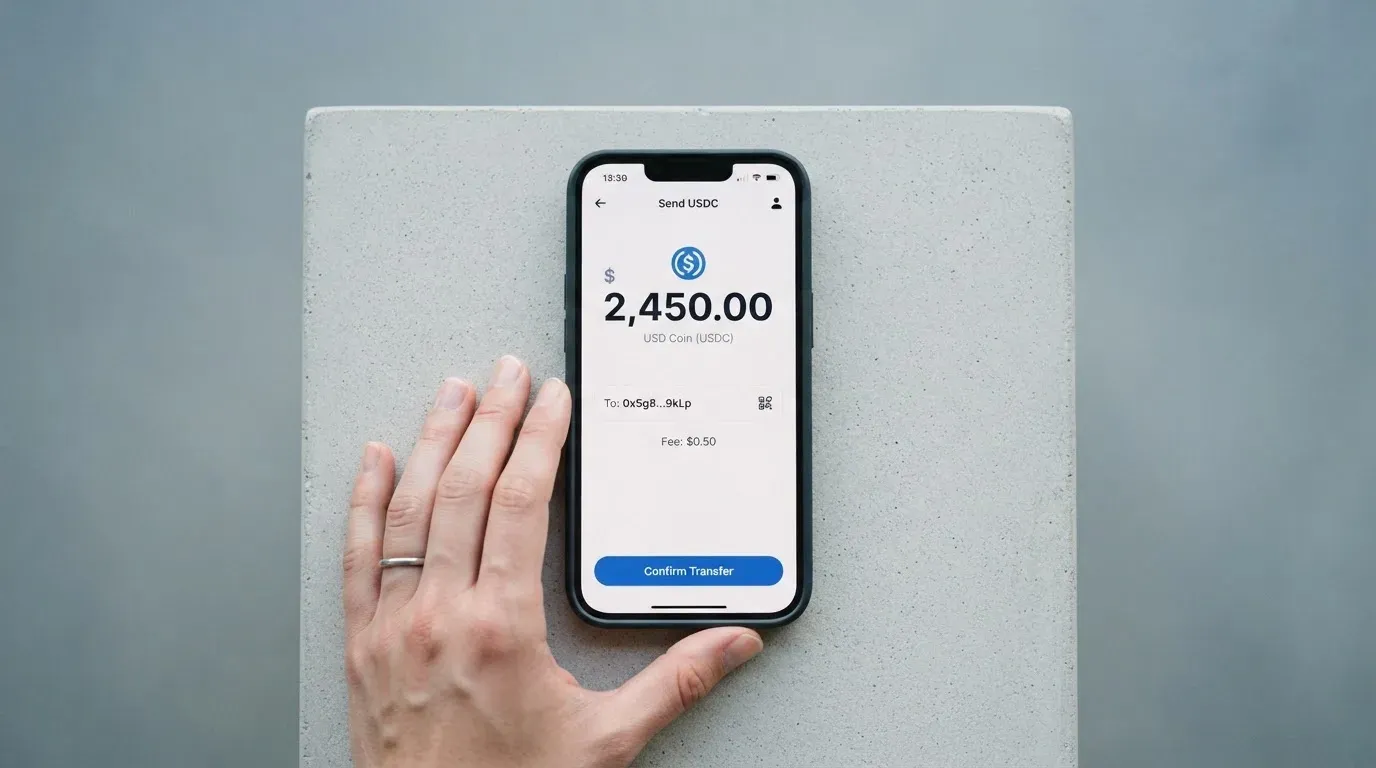
The page advertises the conversion as taking “in seconds,” which is fast for a card top-up, and the same wording appears in the description of cashing out: crypto can be sent to a bank “in seconds.” Neither speed claim is paired with a published fee, minimum or network list, and that is where the practical risks live.
A few things to think about before you send anything:
- Network matters. When you send USDT, the network you choose (Ethereum, Tron, Solana, and so on) determines who can ever see the funds. A deposit sent on a network Gleec does not support, or to an address for a different network, can be lost, and the company warns, in general terms, that blockchain transfers are irreversible. There is no public list of supported networks, so the only safe path is to use the network the app shows in its deposit screen, every single time.
- Gas is on you. On-chain network fees, often called gas, are charged by the blockchain itself, not by the card provider, and they are paid in the native token of that network. If you are sending USDT on Ethereum and you have no ETH for gas, the transaction will not go through, so keep a small native-token balance in whatever wallet you are sending from.
- Minimums are not published. The app may impose a minimum top-up that you will only learn about at the deposit screen, and rounding or minimums can leave small balances stranded.
- Stablecoin choice changes your risk. USDT and USDC are both US-dollar-pegged, but they have different track records, different networks, and different reserve disclosures. Sending USDT is not the same decision as sending USDC, even though both look like “a dollar.”
There is also a cash-out direction. The App Store listing says crypto can be cashed out at any time, with funds sent to a bank “in seconds.” The fees for that direction are not stated, and the supported destination countries are not stated, so if you need to move money off the card and into a bank account, that is another area where the in-app flow is the only current source of truth.
Paying with it every day
In daily use, the Gleec card behaves like a prepaid Visa. You have a plastic card, a virtual card, and access to ATMs, and the virtual card slots into Apple Pay. Google Pay is not mentioned anywhere in the public materials I could read, so if Android tap-to-pay matters to you, treat that as a question for support before you sign up.
Blocked merchant categories are not stated. That is normal for this kind of card: the issuer maintains a list of merchant category codes it will not allow, but the list is rarely published. If a particular category matters to you (gambling is the most common one, and many issuers block it by policy), the only way to confirm is in the app or by emailing [email protected].
There is no rewards or cashback programme described on the public pages, and no sign of a points scheme. The app itself is the centre of the experience: the iOS app is called “Gleec Card Crypto-powered card,” version 34.8 dated 19 May 2026, free, and rated 4 out of 4 from 4 ratings at the time of reading. That is a perfect score on a very small number of ratings, so it tells you the small group of users who have reviewed it are happy, but it does not tell you anything about long-term reliability.
Dispute handling is not described publicly. If a charge is wrong, or a merchant does not deliver, the standard Visa chargeback process should in principle apply, but the company does not publish its dispute workflow, timeframes, or required documents. That is one of the quieter costs of choosing a card with a thin public footprint: when something goes wrong, you are more dependent on support responsiveness than on a documented policy.
What can go wrong
Three kinds of risk are worth weighing before you load the card with anything you cannot afford to lose.
Regulatory and disclosure risk. The card is run by Gleec-BTC OÜ, a real Estonian company (registration number 14477970, registered office Tornimäe 5, 2nd floor, 10145 Tallinn), but the issuing bank and the licences behind the card programme are not named on the public pages. That does not mean the programme is unlicensed, but it does mean the public materials do not let you confirm the licence for yourself. In a market where card programmes have been suspended by networks (Visa ended its global agreement with FTX in November 2022, and WaveCrest was suspended in Europe in 2018), the identity of the issuer is a real question.
Price and platform risk. Crypto-funded cards convert volatile assets at the moment of payment. If the price of your crypto moves sharply between the time you top up and the time you actually spend, you can end up with more or less purchasing power than you expected. Stablecoins reduce that swing but do not eliminate it: stablecoins can and have depegged, and they are not all equally liquid across all networks. On top of that, the network fee for your deposit is on you, and a deposit sent to the wrong network is, in practical terms, gone.
Operational and support risk. The support email is [email protected], the help pages are at gleec.com/support, and the App Store listing advertises 24/7 chat support. In practice, the quality of that support is something only users can really judge, and a public complaints footprint would help. Searches on 2026-10-21 and 2026-10-22 did not find Gleec card reviews on Trustpilot or Reddit, and there is no Trustpilot page for Gleec at all. That can mean the user base is small, or it can mean people have not been moved to write reviews, and there is no way to tell from the outside which it is.
One related note on security: the GleecDEX wallet is a separate non-custodial product, and the card and the wallet are not the same thing. Unofficial 2022 reporting says the wallet uses two-factor authentication and encryption, but that description is from a beta-era article and may not reflect the current state of the card app. Treat it as background, not as a current feature list.
What to take instead
If the gaps above make the Gleec card feel like the wrong fit, here are three alternatives in roughly the same space, each with its own trade-offs.
Cardex — 5.6 / 10. A debit crypto card that runs over the VERVE, Visa, Mastercard and UnionPay networks and offers virtual and physical cards. Cardex says it serves “200+ countries” but does not publish a country list or sanctions exclusions, and its App Store listing is Naira-focused, which suggests the product is built with Nigeria in mind. The standout claim is an “AI-Powered Conversion Rate” that scans exchanges at the moment of payment, which is more interesting than the Gleec card’s “we convert in the app.” No fee percentage is published.
CardFlow — 4.9 / 10. A virtual USD Mastercard aimed at Nigeria and “Nigerians and global users,” with a free virtual card you can create in a few minutes. The site says creating a virtual card is “completely free” but does not publish a monthly fee or any other charges. Funding is via Bitcoin, USDT, ETH or a Naira bank transfer, with no networks stated. Cheaper on the face of it than Gleec for a US-dollar virtual card, but narrower in scope and even quieter on the numbers.
HyperCard — 4.7 / 10. A prepaid card that the App Store says works in “more than 176 countries” (acceptance, not eligibility), with a balance in USD or EUR. The App Store page lists no fees, the cost is not stated on the public pages, and funding is via deposits of USDT, BTC or ETH in the app. If you want a clean USD or EUR balance, HyperCard is closer to that model than Gleec, but again the missing numbers are the trade-off.
None of these alternatives is a clean win over Gleec. They all share the same “no published fees” problem, and the scores reflect that. The honest reason to choose one over the other is which crypto you hold, where you live, and which of the in-app flows you find most usable.
Who I would recommend it to
The Gleec card is a fit for a specific kind of user, and a poor fit for almost everyone else. If you hold Gleec Coin or Bitcoin, want a simple prepaid Visa to spend those coins without first cashing out to a bank, are comfortable with an Estonian programme, and can live with a pricing page that promises “no hidden fees” without backing it up with numbers, this card is worth a look. The virtual card and Apple Pay support are real conveniences, the iOS app is recent and stable, and the company behind it is a real registered entity.
If, on the other hand, you need a card from a fully disclosed bank, want every fee in writing before you commit, live in a country where local card programmes are easy to get, or need a large ATM allowance, the Gleec card is not the right tool. The same is true if you are not yet confident in the difference between sending USDT on Ethereum and sending USDT on Tron, because top-up mistakes on the wrong network are not recoverable.
A reasonable way to try the card is to load it with a small amount you can afford to lose, walk through KYC, request a virtual card first, and confirm the fees on your own statement before you scale up. That gives you the real numbers without exposing meaningful funds.
Frequently asked questions
What is the Gleec card?
The Gleec card is a Visa debit card issued under a programme run by Gleec-BTC OÜ, an Estonian company, that you top up with cryptocurrency such as Gleec Coin, Bitcoin, Ether or USDT. The crypto is converted to fiat inside the Gleec app, and the resulting balance is spent through the Visa network.
How does the Gleec card work?
You create an account in the Gleec iOS app, complete identity verification, send supported crypto to the deposit address shown in the app, and the app credits your card balance in fiat. The card then behaves like a prepaid Visa: you can pay in shops and online, withdraw at ATMs, and add the virtual card to Apple Pay.
Is Gleec a bank?
No. Gleec is not described as a bank in its own public materials. The company behind the card is Gleec-BTC OÜ, registered in Estonia, and the card is run as a card programme on top of the Visa network. The issuing bank and the licences behind the programme are not named publicly.
Who owns Gleec?
The card programme is operated by Gleec-BTC OÜ, a private limited company registered in Estonia under registration number 14477970, with its registered office at Tornimäe 5, 2nd floor, 10145 Tallinn. The terms were last updated on 6 June 2023.
How do I get the Gleec card?
Sign-up is through the Gleec iOS app. The terms require you to be at least 18 and not on a sanctions list, and refer to a separate KYC/AML policy for identity verification. The card is offered as both a physical plastic card and a virtual card, with the virtual card usable in Apple Pay.
Does the Gleec card require KYC?
Yes, in the sense that the terms reference a separate KYC/AML policy that applies to the card, and an unofficial 2022 description of onboarding described it as “a short onboarding process that includes identity verification.” The exact documents required, the verification level, and the time to approval are not stated on the public pages.
How do I top up the Gleec card?
You send supported crypto (Gleec, BTC, ETH or USDT, per the App Store listing) from your wallet to the deposit address the app shows you. The app converts the crypto to fiat on the card. The supported networks, minimums and fees for top-up are not published.
Is the Gleec card free?
The card’s public materials promise “no hidden fees” and “convenience without abusive fees” without publishing numbers. Unofficial 2022 reporting said the card is free to get apart from a delivery fee for the physical card, that monthly fees are “low,” and that the foreign-transaction fee is zero. None of those figures is confirmed by current official sources.
How do I add the Gleec card to Apple Wallet?
The App Store listing for the Gleec iOS app describes the virtual card as usable in Apple Pay. In practice you add the virtual card through the Wallet app using the card details shown in the Gleec app; Google Pay is not mentioned in the public materials.
Is the Gleec card worth it?
For a holder of Gleec Coin or Bitcoin who wants a simple prepaid Visa, the card is workable, and the iOS app is recent and well-rated. For anyone who needs a fully disclosed card programme with every fee published, the missing numbers and the unstated issuing bank are reasons to look at other options or to try the card with a small balance first.
Virtual cards in the catalogue – cryptocardcatalog
Content created by the «cryptocardcatalog» team