
A virtual Visa card for spending stablecoin balances, with no FX markup and no cash withdrawal
 Available in US
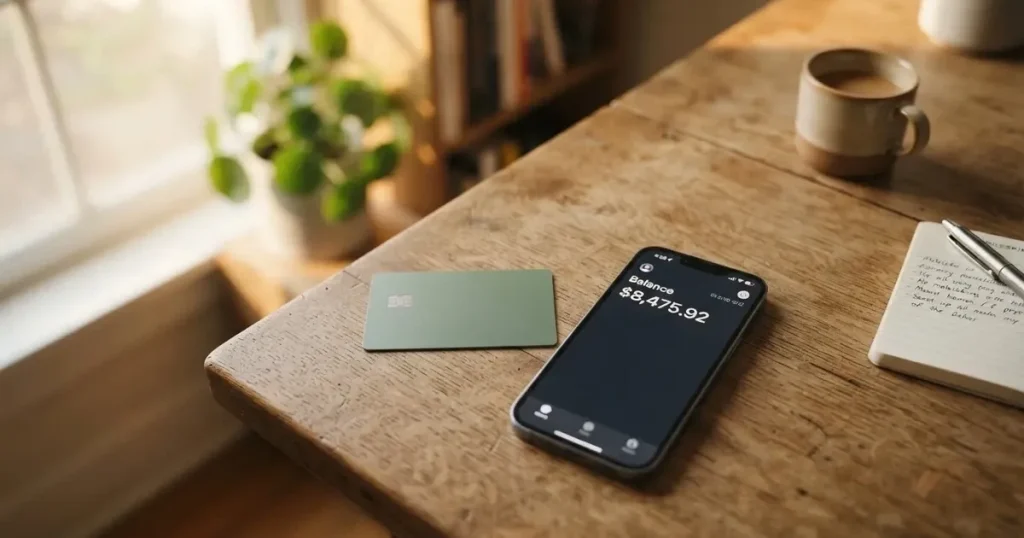
Morse is a virtual Visa prepaid card that spends whatever balance you hold on the platform, and it is built around one promise: no markup on the currency conversion. That promise is real, and it is the reason this kind of card exists. But everything around it — who can open an account, what it costs to keep, what you can actually pay for, and what happens if the company disappears — is thinner than the marketing usually suggests. My score for the card is 7.5 out of 10, and the distance between those two facts is the whole review.
The conditions described below are current as of October 28, 2026.
Verdict: 7.5 out of 10, mostly about costs and reach
Morse earns 7.5 out of 10. It is a good fit if your situation is specific: you hold stablecoins, you spend them abroad or on foreign websites, and the absence of a foreign-exchange markup is worth more to you than the flexibility of an ordinary bank account. It is a poor fit if you need cash, if you need a card that works everywhere, or if you want to see the fees before you commit — because the card’s own public pages do not give you one.
The card suits a person already inside the crypto system, comfortable leaving a balance with someone else, and travelling or buying from foreign merchants where most cards add a percentage. It does not suit a person whose main problem is that a bank will not open an account for them: the identity checks here are the standard ones and they vary by country rather than being waived. It also does not suit anyone who needs banknotes, because there is no ATM support at all.
| Criterion | Mark | Why |
|---|---|---|
| Who can get it | 7 / 10 | App in 140+ countries, local add and withdraw in 70+; the card itself only in some countries, list inside the app; sanctioned countries closed |
| Cost | 8 / 10 | Issuance and servicing not disclosed (“Fees may apply”); conversion with no markup, card payments free, zero currency fee |
| Top-up options | 8 / 10 | USDC, USDG and EURC deposits via Solana are free; Bitcoin, USDT, Ethereum and other tokens accepted; the wallet is self-custodial |
| Reliability and complaints | 8 / 10 | Issuer Lead Bank, platform Avian Labs (US MSB), AFM authorisation in the Netherlands under MiCAR; no official incidents found, no reviews found |
| Everyday use | 6 / 10 | Apple Pay and Google Pay supported; the card is virtual only; no ATM withdrawals |
| Total | 7.5 / 10 | Strong on cost and plumbing, weaker on everyday convenience and disclosure |
Two things are worth pulling out of that table before we go further. First, the reliability mark is high but thin: I found no official incidents and no reviews at all, which makes the mark a clean record rather than a well-tested one. Second, everyday use is the lowest mark, and it is the one you feel every trip — no cash, no physical card, and a merchant-category question the card’s pages do not answer.
Will they give you the card?
Yes, but residency is what counts, not citizenship, and the card is a narrower thing than the app.
The stated requirement is that you are at least 18 years old and “a resident in a supported country”. The app itself is available in over 140 countries, and local deposits and withdrawals work in more than 70. That is not the same as being able to hold the card: the card is “available only in certain countries”, and the list is not published on the card’s page — you open the app and look.
“Residence, not citizenship” does real work here, and it is worth understanding why before you assume your nationality settles the question. Sanctions and issuer risk policy are applied to citizenship and country of birth as well as to the country of address, so someone who lives in a supported country but holds a passport from a restricted one may still be refused. That is normal in this industry, not a quirk of this card.
Sanctioned customers are out entirely. Morse “cannot serve customers subject to sanctions issued by the United States”, and the same applies to UK, EU and UN sanctions. There is no way around that, and I am not going to describe one.
Then there is the closed-beta group — countries where you need an invite code before you can proceed:
- American Samoa
- Australia
- Cape Verde
- Guernsey
- Hong Kong SAR China
- Isle of Man
- Japan
- Jersey
- New Zealand
- Serbia
- Singapore
- Switzerland
- Thailand
- Türkiye
- United Kingdom
- Western Sahara
Check that list against where you live first, because in those countries the question is not whether you qualify but whether you have a code. If you are not on it and not sanctioned, the app is where you confirm your country gets the card and not just the app.
How to get it
The process is short and entirely inside the app: install it, verify your identity, fund your Morse balance, then add the virtual card. There is no physical card in the pipeline.
Identity verification is the part to prepare for. Depending on your country it may ask for your name, phone number, date of birth, residential address, “a selfie” and “a picture of a photo ID card” — the card’s own wording, with the caveat that “requirements vary by country”. A separate proof-of-address document is not stated, so do not assume you will not need one; what a given country asks for is exactly the sort of thing that changes.
There is one tier of verification as far as the card publishes, and it tells you little. The page does note that “We may review larger deposits for compliance”, which in practice means a large first deposit can bring extra questions. If you are moving significant money, expect the conversation at the deposit stage rather than at sign-up.
The card itself: “Morse Card is fully virtual for now”, a Visa prepaid debit spending from your Morse Balance “in any currency”. Fully virtual also means no plastic is coming in the post as a separate step, so there is nothing to wait for and nothing to activate by mail — if you need a card that satisfies a shop terminal expecting something in your hand, this is not it.
Fees: conversion is free, the rest is not disclosed
Here is the honest position: the part that matters most is well advertised, and the part most providers would put in a table is missing. The card’s page says “Fees may apply. See Cardholder Agreement” and publishes neither an issuance fee nor a monthly fee. I will not fill those gaps with an estimate, because an estimate is exactly the kind of number that turns into a surprise later.

What is stated is genuinely attractive for a traveller:
- “Zero foreign exchange fees or markups”, at the real-time Visa exchange rate.
- Conversions from crypto into the balance use the real exchange rate “with no markup”.
- “Paying with the Morse Card, online and contactless, is free”
| Fee or limit | What the card states |
|---|---|
| Card issuance | Not stated — “Fees may apply. See Cardholder Agreement” |
| Monthly or servicing fee | Not stated |
| Conversion (crypto to balance) | Real exchange rate, no markup |
| Foreign exchange | Zero FX fees or markups, real-time Visa rate |
| Paying with the card, online and contactless | Free |
| Currency fee | Zero |
| ATM withdrawal | Not available — “Morse Card does not currently support ATM withdrawals” |
| Card spending limit | 2,000 USD per day in the first 30 days, rising automatically to 5,000 USD per day after 30 days |
| Money-transfer services cap | 500 USD per week |
| Weekly and monthly deposit and withdrawal limits | Shown in the app’s Limits screen; amounts not stated |
Three everyday payments, so you can feel what that table means.
Coffee in a foreign city. You tap, or pay with the phone. The card payment is free and there is no FX markup, so what leaves your balance is the local amount at the real rate. This is where Morse is at its best — the whole reason the product exists.
A subscription billed in dollars. Free to pay. The practical question is not the fee but whether the merchant accepts a prepaid card at all, and whether the amount fits your daily limit. In your first month that ceiling is 2,000 USD a day, so this is not the constraint people expect; the constraint usually arrives later, as a merchant declining a prepaid or foreign card number.
Cash abroad. Not possible. There is no ATM support, which is the single most disruptive fact on this page if your travel involves actual banknotes. Plan on carrying a second card for cash.
One note on how a foreign card number behaves at checkout, because it explains declines that have nothing to do with fees. The first six or eight digits of a card number identify the issuing institution, and any shop can look that up. If the issuing country differs from the billing address on file, some merchants apply extra scrutiny or refuse the card outright. This is why a card issued in one country can look “foreign” in another, and it is a property of prepaid card numbers in general rather than something Morse does differently.
Top up: free over Solana, and cheaper paths exist
Deposits are the strongest part of the product, and the cheapest route is specific rather than general.
You can deposit by debit card, stablecoin transfer, or account details (USD, EUR, MXN, COP — BRL needs a Brazilian CPF). USDC, USDG and EURC over Solana are free. Other tokens and other blockchains carry a fee. Bitcoin, USDT, Ethereum and other tokens can be deposited, but they are not the free path.
| Option | Fee as stated |
|---|---|
| USDC, USDG, EURC via Solana | Free |
| Other tokens or other blockchains | Fee applies |
| Domestic deposits | Free in most countries |
| First three international transactions with linked payment methods | Free, then US$0.50 flat |
| Further international deposits via linked bank/card/mobile money | Fee applies |
| International deposits to Account Details | 0.1% |
| Blockchain network fees | Charged by the network separately, not by the card |
“Morse shows any fee before you confirm” is the line to rely on, and it is a genuinely good one: whatever the route, the number appears before you commit.
Two warnings on sending money in. Blockchain transfers are irreversible, so a deposit sent on a network the provider does not support, or to an address belonging to a different network, can be lost or need manual support recovery with no guarantee. Check the network and the address before you confirm, because there is no chargeback here. And a minimum top-up is not stated, so I cannot tell you whether a small first deposit is accepted.
On the way out: withdrawals to a bank account, a debit card, or a stablecoin transfer. Domestic withdrawals are free in most countries, USDC, USDG and EURC over Solana are free, and international withdrawals plus other tokens or chains carry a fee.
That last point deserves emphasis. If you close the account you must “Withdraw any money from your Morse Balance” first, the closure is permanent, and what happens to a balance you did not withdraw is not stated. Treat the balance as money you have to move out yourself before doing anything irreversible.
Paying with it every day
Apple Pay and Google Pay both work. This is the answer for a virtual-only card, and it is why the card is usable in daily life at all. What does not work is any merchant that accepts only a physical debit card — in practice a shrinking but real set of terminals, parking machines and vending situations. Which merchant categories are blocked is not stated on the card’s pages, so I cannot tell you whether gambling or other restricted categories are switched off; treat that as unknown until you see it in the app.
Currency handling is more generous than the name suggests. The card spends from your balance “in any currency”, your crypto converts to USDC (or digital euros in Europe) based on the starting data you entered, and your account itself can be held in USD, EUR, MXN, COP or BRL.
Rewards are not stated on the card pages. There is an “Earn rewards” collection in the help centre that I have not read, so treat any cashback claim as unconfirmed until you see it in your own app.
On the app: iOS and Android, and it used to be called Sling Money. I can tell you that an unofficial snapshot from App Pricing Lab, read on 2026-10-21, showed 4.5 stars from 400 reviews — but that is the App Store rating under the old Sling Money name, an undated third-party snapshot, and it is not confirmed by the card itself. I could not obtain a current store rating directly.
Dispute handling is not stated either; the help centre has a “Make a complaint” article I have not read. That matters more than it sounds. A chargeback is the mechanism by which a payment is refunded after a dispute, with reason codes such as fraud, duplicate billing or goods not received, and prepaid-card coverage varies and should not be assumed. Do not treat a payment from this card as automatically protected the way a credit card purchase might be.
What can go wrong
Four things, roughly in order of how likely they are to hurt you.
Getting the money back out, or not. No ATM, permanent closure, undefined treatment of an unwithdrawn balance. If your plan is to leave a balance idle and close the account, that plan has a hole in it.
Sending crypto down a wrong path. Irreversible transfers, unsupported networks, addresses belonging to a different chain. This is the most common way people lose money on cards like this, and it happens before any fee is charged.
The card number in the wrong shop. Prepaid and foreign-issued numbers are declined by some merchants because the issuer lookup reveals the type and country. Not a Morse fault, but it will eventually happen to you and calling the card will not fix it.
The provider. Morse is a front end over a licence stack rather than a bank holding your balance in a savings account. The platform provider is Avian Labs: Avian Labs, Inc. in Delaware, a registered US Money Services Business (NMLS ID 2639252, FinCEN MSB registration 31000315485256), and Avian Netherlands B.V. (company registration 91273323) authorised by the Dutch AFM (registration 41000005) as a crypto-asset service provider under MiCAR. The card is issued by Lead Bank under a Visa U.S.A. licence, and the programme manager is Bridge Ventures LLC, which “operates as an agent of Lead Bank”. That is a properly licensed chain rather than an offshore operation, and it is the strongest part of the risk picture.
I searched for complaints and found none — no official incidents, and no reviews of this product under searches for reviews and forum discussion (only an unrelated business surfaced). That is not a good track record; it is an absence of data, made more ambiguous by the fact that the company rebranded from Sling Money to Morse. No Trustpilot page for Morse was found in a complaints search dated 2026-10-21. I would not call that a clean bill of health.
On the wallet side, the Morse Wallet is self-custodial and the private key can be exported — a real improvement over cards where you cannot get your crypto out, and it moves key-loss risk onto you rather than a provider. Safeguarding of funds is not described, and two-factor authentication on the account is not stated, so I cannot tell you what stands between your balance and someone holding your phone.
Support is in-app chat (profile, Support, Chat), email, an AI assistant described as “24/7/365”, and human chat support — with no hours published.
Two habits cover most of this: export and store your key offline before you fund the account, and read the fee screen and the limits screen in the app before you confirm anything, because those are the two places the public pages leave you in the dark.
What to take instead
Three alternatives, each weaker or narrower in some way, so the comparison is about which weakness you can live with.
| Morse | International Visa Card | UNi Card | Whop Cards | |
|---|---|---|---|---|
| Score | 7.5 / 10 | 6.7 / 10 | 6.1 / 10 | 5.2 / 10 |
| Card | Virtual Visa prepaid | U.S.-issued Platinum Visa, virtual; physical “Coming soon” | Multicurrency on Mastercard network | Visa |
| Cost | Issuance and monthly fee not stated | $5 one-time virtual card, no maintenance fee; plans Classic free, Pro $9.00/month, Max $19.00/month | “No annual fee”; issuance fee not stated | “No extra fees”; no amounts listed |
| FX | Zero FX fees or markups | “Visa exchange rate + 2% FX fee” | “No annual fee or foreign transaction fee”; live OTC rates | Not stated |
| Rewards | Not stated | No cashback stated | Spend-to-Earn up to 3% | 5% cashback at select merchants, currently Uber |
International Visa Card is the one to weigh most seriously, being the closest thing to a conventional alternative. Its weakness is geographic: the account and card are not available to residents or legal registrants of Belarus, mainland China, North Korea, Cuba, India, Iraq, Iran, Israel, Myanmar, Nepal, Nicaragua, Russia, Syria, Turkey, Ukraine, Venezuela or Vietnam, FATF grey-list countries are reviewed case by case with compliance approval, and purchases are blocked in North Korea, Cuba, Iran, Russia, Syria, Ukraine and Venezuela. That list is longer and more disruptive than Morse’s. But it charges 2% on foreign currency where Morse charges nothing, and it needs a US issuing footprint to match.
UNi Card is cheapest on paper for FX — no annual fee, no foreign transaction fee, assets converted at live OTC rates with “No hidden exchange fees” — and it pays up to 3% back. The problem is how little else is published: who can get it is not stated, how you fund it is not stated, whether the card is physical or virtual is not stated. I would not open an account on that little information.
Whop Cards are for a specific US audience: consumers in 31 states, businesses in 41. They spend from a Whop balance and give 5% cashback at select merchants, currently Uber. Fees are not stated at all — the page says “No extra fees” without a single number — and the coin and network backing the balance are not stated either.
My read: if you are eligible for one of these and the 2% foreign-currency fee does not apply to how you spend, the International Visa Card is the more conventional, more legible choice. If your priority is purely the rate at which your money converts, Morse wins that comparison outright and nothing else here beats it.
Who I would recommend it to
I would recommend Morse to someone who already holds USDC or another stablecoin, spends most of their balance rather than saving it, and would otherwise be paying a foreign-exchange markup on every foreign purchase. For that person it is a good product with a clear reason to exist.
I would not recommend it as a first crypto product, as a primary everyday bank card, or to anyone who needs cash. I would also pause if you are in one of the invite-code countries, or if undisclosed issuance and servicing fees matter to you — go into the app and read the Cardholder Agreement and the Limits screen before deciding, because the public pages genuinely do not contain those numbers.
Frequently asked questions
What is the Morse card?
Morse is a virtual Visa prepaid debit card that spends from a balance you hold on the Morse platform. You install the app, verify your identity, fund the balance — by debit card, account details or stablecoin transfer — and add the card to your phone’s wallet. It is virtual for now, so there is no plastic version, and it is not a bank account with an IBAN.
Is Morse a bank?
No. The platform provider is Avian Labs, registered in the United States as a money services business and authorised in the Netherlands as a crypto-asset service provider under MiCAR. The card itself is issued by Lead Bank under a Visa U.S.A. licence, with Bridge Ventures LLC as programme manager acting as an agent of Lead Bank. Your balance sits with a licensed platform operator, not with a bank in your own name.
How do I get the Morse card, and how do I activate it?
Download the app for iOS or Android, complete identity verification, fund your Morse balance, then add the virtual card. Verification may ask for your name, phone number, date of birth, residential address, a selfie and a photo of an ID card, with requirements varying by country. There is no separate activation step and no card to wait for, because the card is fully virtual.
Does Morse require KYC?
Yes, standard identity verification: you must be at least 18 and a resident in a supported country, and you should expect to submit identity documents and a selfie. Larger deposits may be reviewed for compliance, which means extra questions at the funding stage rather than at sign-up. Sanctioned customers cannot be served at all.
How much does the Morse card cost?
The conversion is free — no markup on crypto-to-balance conversion, no foreign-exchange fee, and paying with the card online or contactless is free. Issuance and any monthly servicing fee are not published; the card’s page says only “Fees may apply. See Cardholder Agreement”. There is also no ATM support, so cash is not an option at any price.
What are the limits on spending and transfers?
The card’s daily spending limit is 2,000 USD in your first 30 days, rising automatically to 5,000 USD per day after 30 days. Money-transfer services have a weekly cap of 500 USD. Weekly and monthly deposit and withdrawal limits are shown in the app’s Limits screen, but the amounts themselves are not published.
How do I top up, and which method is cheapest?
Deposits by debit card, stablecoin transfer or account details (USD, EUR, MXN, COP; BRL needs a Brazilian CPF) all work, and USDC, USDG and EURC over Solana are free. Other tokens and other blockchains carry a fee, as do most international deposits via linked payment methods after three free ones. The app shows any fee before you confirm.
Can I use the card in Apple Pay or Google Pay?
Yes, both are supported, and with a virtual-only card that is the main way you would pay day to day. What you cannot do is pay merchants that accept only a physical debit card, since no plastic version exists. No ATM withdrawals are supported at all, so you need another card for cash.
Is the Morse card safe, and what about withdrawals?
The wallet is self-custodial, so you can export the private key, which means a provider collapse would not lock you out of your crypto — but key loss, phishing and wrong-network transfers become your problem, and blockchain transfers cannot be reversed. Withdrawals go to a bank account, debit card or stablecoin transfer; domestic ones are free in most countries. Closing the account requires withdrawing first, and closure is permanent.
Is the Morse card worth it, and who should avoid it?
It is worth it if your main cost today is a foreign-exchange markup on stablecoin spending abroad, since Morse charges none and that is its strongest feature. Skip it if you need cash, need a card accepted everywhere, want a physical card, or want to see the full fee schedule before committing. If you live in an invite-code country, check the app first.
App and neobank cards in the catalogue – cryptocardcatalog
Content created by the «cryptocardcatalog» team