
A Telegram-only virtual card built for subscriptions, with a 4.5 out of 10
 Available in US
Chocopay is a virtual Visa card sold through a Telegram bot, aimed squarely at users who need to pay for AI tools and subscriptions. It is cheap to issue, it takes rubles or crypto, and it skips the document checks most cards demand. What it does not give you is a named bank, a named licence, or a clear answer on limits. I scored it 4.5 out of 10, and the reasoning matters more than the number, because this card is not bad at the one thing it is built for and thin everywhere else.
The conditions described below are current as of October 28, 2026.
Verdict: 4.5 out of 10, built for one narrow job
The score is not a verdict on whether the card works. For paying an AI subscription from a crypto balance, it is a cheap and workable instrument. It is a verdict on how much the card leaves unanswered: who issues it, what the limits are, what a declined payment costs, and what happens if the operator stops.
| Criterion | Mark | Why |
|---|---|---|
| Who can get it | 5 / 10 | Terms set no citizenship or residency criteria; payments to sellers in listed restricted countries are prohibited |
| Cost | 3 / 10 | Issue $6, $10 or $15 depending on card; crypto top-up commission 3–9% |
| Top-up options | 6 / 10 | Russian cards, SBP and more than 100 coins; specific coins and networks not named |
| Reliability and complaints | 4 / 10 | CYPHER GOODS WHOLESALERS LLC, Dubai; issuer and licences not named; rating 3.8 from 25 reviews; no refund after a payment |
| Everyday use | 5 / 10 | Virtual Visa only; Apple Pay and Google Pay on Universal and Travel; unofficial: ATM not supported |
Read that table as a shape rather than a ranking. The top-up line is the strongest because three funding routes is genuinely more than many cards in this category offer. Everything else is dragged down by the same underlying problem: the public pages leave out information a card user would normally rely on.
So who is it for? The card’s own marketing is aimed at users paying for AI and subscriptions via a Telegram bot, and that is the use case it fits best — a fixed monthly price, a USD balance, and a merchant in a country where an ordinary bank card would not work. Who is it not for? Anyone spending large amounts, anyone who needs a physical card, anyone who needs cash from an ATM, and anyone who cannot accept that their money sits with an unnamed Dubai company with no published financial licence.
Will they give you the card?
Yes, in the sense that almost nobody is turned away at the door — and that is both its appeal and its problem. The terms set no residency or citizenship criteria at all. There is no statement about which citizenship you must hold or where you must live.
What the terms do require is that you are at least 18, that you confirm you are not on the UN, OFAC, EU or UAE sanctions lists, and that you are not politically exposed. Those are declarations, not checks the card describes performing.
Then come the restrictions, and these bite hardest:
- Cards may not pay sellers linked to listed restricted countries. Russia appears in that list, in Section 6.3.
- Payments in RUB and UAH are prohibited outright.
- The service “does not guarantee” payments on accounts with a history of Russia linkage.
That last line is worth reading twice. It is not a rule you can comply with; it is a disclaimer that some payments simply may not go through. If your paying history involves Russia-linked accounts, you are in the zone where the card’s own terms decline to promise you an outcome.
Service and support are in Russian throughout. If that is not your language, you are reading a translated experience of a product whose contract only exists in one language.
How to get it
The signup pitch is speed and absence of paperwork: cards are marketed as issued “without documents and verification,” and issued in the Telegram bot in a couple of minutes. The sequence the card describes is short: open the bot, read the rules, choose a tariff, issue, top up.
The terms add a wrinkle that the marketing does not. Section 8 says information must be provided within 2 calendar days when requested. So the absence of verification at signup is not the absence of verification altogether — it is verification that may arrive later.
The timing, when checks do happen:
- Automated checks: up to 5 minutes.
- Complex cases: 3 to 10 working days.
- Refunds from a web account require KYC.
- Age 18+.
What you get is a virtual Visa with a balance in USD. Three cards exist, each sold for a defined lifetime:
| Card | Issue price | Stated lifetime |
|---|---|---|
| Subscriptions and AI | $6 | 3 months |
| Travel | $10 | 6 months |
| Universal | $15 | 18 months (“$0.83/month”) |
Only Universal and Travel list Apple Pay and Google Pay. That is a real difference, not a formality — if you pay by phone wallet, the cheapest card is the one you cannot use with Apple Pay or Google Pay.
Two more things to know. Delivery is not applicable because the card is virtual only; replacement is “possible but not in all cases” — a card blocked by a service, not accepted somewhere, or hit by a technical problem — and no replacement price is stated. And there are no published tiers: no set of KYC levels to climb, and no published list of reasons a person might be refused.
One discrepancy to hold in mind. The portal lists $6, $10 and $15, while the terms-of-operation page gives issue at $2, $6 or $9 depending on tariff, and $6 or $9 when paid in crypto. Two official pages, two different prices. Confirm what you are actually paying in the bot before you pay it.
Fees and the real cost of a payment
There is no monthly fee in the terms. The costs are the issue price, the top-up commission, and whatever the card does not tell you.
| Item | What the card states |
|---|---|
| Issue price | $6 (3 months), $10 (6 months), $15 (18 months); a separate page gives $2, $6 or $9, and $6 or $9 in crypto |
| Monthly fee | None stated in the terms |
| Crypto top-up commission | 3–9% |
| Ruble top-up | Calculated in the bot at the service rate |
| Conversion / FX fee on card spending | Not stated officially |
| Declined transaction | Unofficial: $0.75 per declined transaction on all tiers |
| Payments not in USD | Unofficial: 2–3% markup |
| ATM withdrawal | Not stated officially; unofficial: ATM cash withdrawal not supported |
| Daily and monthly limits | Not stated |
The unofficial figures come from a review site, not from Chocopay, and they are dated June 2026. I would not treat them as reliable. But their existence is the point: a declined-payment charge and a non-USD markup are the two fees that decide whether this card is cheap or expensive, and the card’s own pages do not confirm either.
Three ordinary payments, to make it concrete:
A $10 monthly AI subscription, paid from a crypto top-up. You pay the issue price once for the term, then 3–9% on the top-up each time you reload, plus whatever the card does in currency conversion — which is the figure nobody publishes. On a $10 spend, a 9% top-up commission is 90 cents before any conversion. Reload monthly and the top-up fee alone can exceed the price of a month of the subscription you are paying for.
A $120 subscription paid in EUR from a USD balance. The card says it accepts payments in more than 140 currencies and lists USD, JPY, EUR, KZT, TRY, ILS, GBP, THB and GEL among them, with the balance held in USD. The conversion fee on that payment is not stated officially; the unofficial figure is a 2–3% markup on payments not in USD, which on $120 would be $2.40 to $3.60. Note that RUB and UAH payments are prohibited, so a euro payment is a realistic route and a ruble payment is not.
A failed payment. A declined transaction may cost $0.75 on every tier, unofficial as that is. Declines are not rare in general card use — a foreign BIN, an address check that cannot be run, a merchant that refuses prepaid cards — and a card that charges for each one punishes you for trying.
Also worth knowing: on-chain network fees for your deposit are charged by the blockchain, not by the card provider, and who pays them is not stated.
Top up: rubles, SBP or crypto
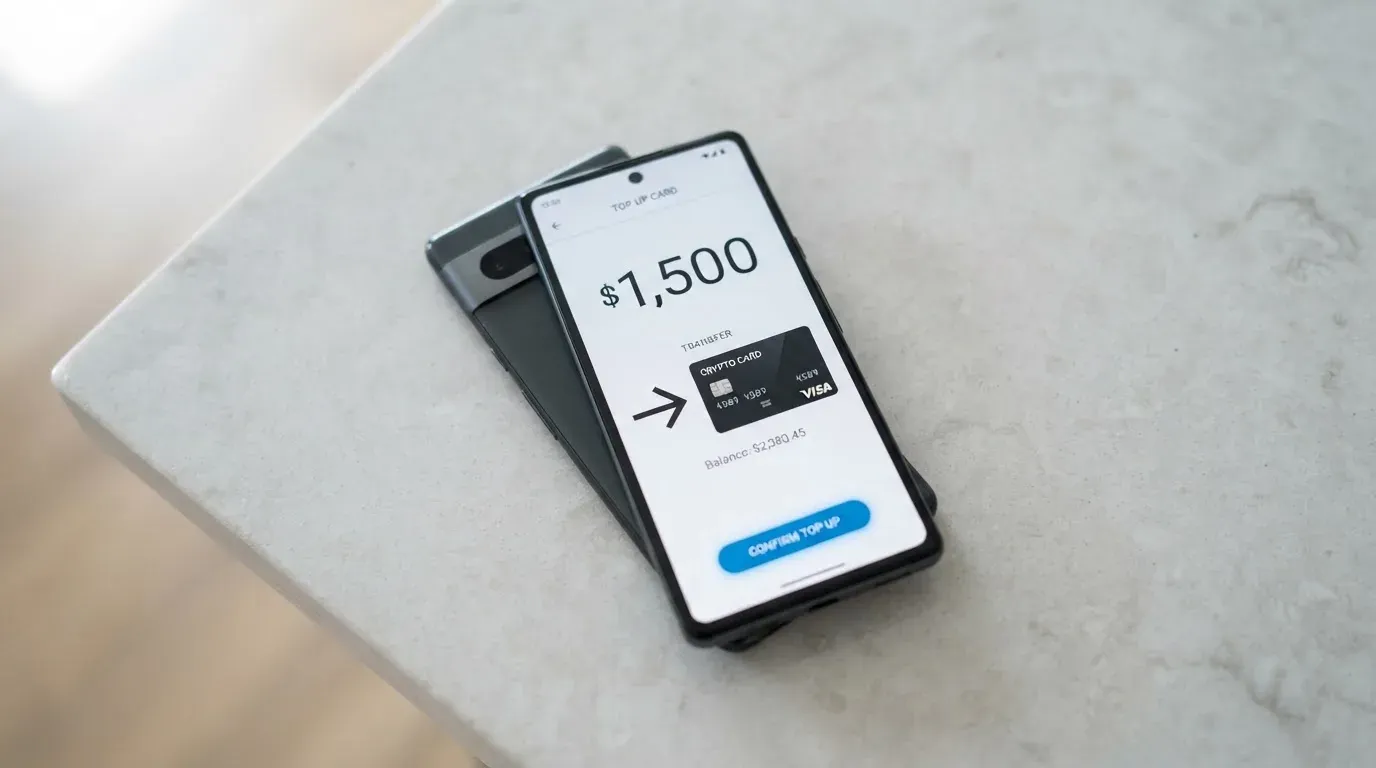
Three routes: Russian bank cards, SBP in rubles, and cryptocurrency (“more than 100 coins”). Card-to-card transfers are not supported.
The specifics matter more than the marketing here:
- Minimum top-up from $15 by rubles, through SBP or a Russian card.
- Minimum top-up from $30 by crypto.
- Crypto top-up commission 3–9%.
- Ruble amounts are calculated inside the bot at the service rate.
- Only your own funds — third-party or company cards are not allowed, per an unofficial source.
What the card does not give you is the single most important thing for a crypto top-up: which coins and which networks. “More than 100 coins” tells you nothing at the moment of transfer. This is where crypto card deposits get lost. Blockchain transfers are irreversible, and a deposit sent on a network the provider does not support, or to an address belonging to a different network, can be gone or reduced to a manual support ticket with no guarantee of recovery. Before you send, get the coin and network confirmed in writing.
On refunds, the bot route and the web-account route differ sharply. For bot users, the balance comes back only if the card was issued within 30 days, has no completed transactions, and is not working or accepted; any successful payment blocks a return, the issuance fee and commissions are excluded, there is no refund if the card was issued and first topped up with crypto, and the payout lands within 14 working days — though it can be held for up to 30 working days on suspicion of fraud. For web-account users, the refund goes back to the original wallet minus network fees and requires KYC.
So: if you are experimenting, get the smallest top-up you can. The first crypto load locks the balance.
Paying with it every day
Everyday use is where the narrowness shows. It is a virtual Visa with a USD balance, and that is all.
Apple Pay and Google Pay are listed on Universal and Travel. Binding to your phone needs a confirmation code from a manager during working hours — so it is a human step, not a self-service one. There is no standalone app; everything runs through the Telegram bot, and there are no store ratings to consult because there is nothing to rate.
What you cannot do, per the card’s own list of banned activity: pay services linked to Russia, Belarus, Ukraine and other countries restricted by Visa and Mastercard; pay in rubles or hryvnias; use adult services rated 18+; gamble or bet. Violations may lead to the card being blocked “without refund” — without refund. That last clause is the one to internalise: breaking the list can cost you the balance.
On rewards, there is no cashback stated. The portal hero carries a referral bonus of +$2 per referral, which is a referral payment rather than a spending reward.
If something goes wrong, support runs through the official Telegram channel or [email protected]. A manager replies within up to 5 minutes, support hours are 09:00–21:00 MSK, and the bot runs at any time. Refunds are within 14 working days, but can be held up to 30 working days while a suspected fraud or a bank review runs, and there is no refund for a successful payment. The chargeback process — the formal mechanism your card network offers when a merchant does not deliver — is not stated. Unofficial: $5 charged for a refund.
What can go wrong
Start with the thing you cannot verify. The operator is CYPHER GOODS WHOLESALERS LLC, registration number 1049902, Office No. 301A, Dubai Investment Properties (LLC), Al Raqqa, Dubai. The cards are described as “of foreign banks”. The issuing bank is not named, and no licences are named. Unofficial, from a review site in June 2026: no public financial licence. ESMA maintains an interim register of authorised crypto-asset service providers, and that is where I would look before funding any card I intend to keep using.
Whether a licence matters depends on what you are doing, and this is the context the card itself never provides. A card is a payment service regulated separately from the crypto side — one licence for custody, exchange and transfer, another for issuing card and e-money. In the EU, an electronic money institution can issue e-money and payment cards but cannot lend, and must safeguard customer funds in segregated accounts or insured ones; those funds are not bank deposits and are not covered by deposit guarantee schemes. So even a properly licensed version of this product is not a bank account.
Second, custody. Chocopay describes itself as custodial — a “virtual card for international purchases for a set period” — not a bank account. That means the provider holds the credentials and you trust it completely. The category history is not encouraging: Mt. Gox (about US$350 million reported stolen, 2011–2014), Coincheck (about US$400 million, 2018) and Ronin Network (US$625 million, 2022). 2FA and self-custody options are not stated for this card.
Third, the card’s own behaviours. Cards freeze after expiry, or after many declines at zero balance, and can be unfrozen in the bot; they may be cancelled after 30 days of inactivity. Liability for losses is capped at the last month’s commission, with a maximum of $100. Then there are the failures you cannot switch off. Stablecoins can depeg — TerraUSD collapsed in May 2022, USDC briefly lost its peg in March 2023 — and Tether says it disables tokens in wallets on the OFAC sanctions list and has frozen funds tied to illicit activity, so stablecoins are not censorship-proof. A blocked or frozen address is a dead balance.
Fourth, merchant-side refusal, which is the everyday one. A card number starts with a 6- or 8-digit issuer identification number, and merchants can look it up to see which institution and country issued the card, then apply extra scrutiny if the issuer country differs from your billing address. That is exactly what a foreign BIN looks like. Address verification is mainly offered in the US, Canada and the UK and is generally unavailable for foreign-issued cards, which can cause declines. Some merchants decline prepaid or foreign BINs outright. Gambling is classified under merchant category code 7995, and many issuers block it by policy rather than by law, with the list varying by issuer. Declined authorisations may also leave a hold on your funds for several days, typically up to 7 — and here a decline apparently also costs you $0.75 (unofficial).
Fifth, closures. Card programmes do end. Visa terminated its global agreements with FTX on 13 November 2022 and the FTX US debit card was wound down by its issuer; WaveCrest, a Visa issuer that supplied crypto card brands, was suspended by Visa in Europe in 2018, closing all WaveCrest-issued Visa programmes. Closures typically give notice, then stop spending and loading, then ask you to withdraw remaining balances. I found no dated events for Chocopay itself and none on the public record of official incidents — but “nothing found” is not the same as a track record.
Finally, complaints. There is no Trustpilot page. A review-site rating is 3.8 from 25 reviews, which the site itself calls insufficient data, with no themes identified. A 2026 vc.ru ranking notes no confirmation that Chocopay works for Claude subscription payment. That single data point matters if Claude is your use case.
I am not going to tell you what to do about taxes, because that depends on where you live and it is not advice I am qualified to give. What you should know is the shape of it: the IRS treats digital assets as property, so exchanging them for goods or services generally produces a taxable gain or loss, measured in your local currency at fair market value on the date of the transaction. Each card payment funded from crypto can be a separate disposal. Ask a professional in your own country.
What to take instead
If Chocopay’s gaps are the problem, these are the cards I compared it against — each with the same questions asked and unanswered.
| Card | Score | Card type | Issue or monthly cost | Fees stated | Top-up |
|---|---|---|---|---|---|
| Chocopay | 4.5 / 10 | Virtual Visa, USD | $6 / $10 / $15 by term; no monthly fee stated | Crypto top-up 3–9%; conversion not stated | Russian cards, SBP, more than 100 coins |
| Azul Card | 5.3 / 10 | Virtual Mastercard, USD balance | $20 creation, refunded after $2,000 in spending; $5 monthly | 4% crypto top-up; $0.25 per transaction; FX not stated | Crypto sent to the card in Telegram |
| Telecard | 6.1 / 10 | Virtual Mastercard, USD | $5 standard one-time; VIP $49 then $19/month; $99 minimum deposit, stated as not a fee | 1.5% conversion; 0.5 USDT per successful transaction; FX and cross-border up to 3% each | USDT on Tron or Ethereum, USDC on Ethereum; Polygon not supported |
| OnCards | 4.6 / 10 | Virtual Mastercard / Visa, network not fixed | Not stated | Not stated | USDT BEP20 only; no bank transfers |
Azul Card is the nearest thing to a straightforward comparison. It is virtual only, works wherever Mastercard is accepted, and holds a USD balance. Its country rules are the strictest in this group: unavailable worldwide except Russia, Belarus, North Korea, Iran, Syria, Cuba, Sudan, Venezuela, Ukraine and the Crimea, Donetsk, Luhansk, Zaporizhzhia and Kherson regions — and “the restrictions apply regardless of the user’s nationality”, so those places are out for everyone. The $20 creation fee is refunded after $2,000 in spending, which only helps if you spend that much. $5 a month plus $0.25 a transaction adds up fast for light use. Coins and networks are not named either. First top-up up to 10 minutes, later ones 1 to 5 minutes. Referral pays “up to 40% of our fees from every transaction made by your referrals”.
Telecard scores highest here, at 6.1, and it is the only one of the four with its networks named. Usable in over 150 countries wherever Mastercard is accepted, identity check “available in most major regions”, and the terms bar only users “blocked or sanctioned by the United States Government, including OFAC”. It is virtual, instant, USD. But the cost structure is heavier: $5 one-time on the standard plan, or VIP at $49 setup and then $19 a month, plus a $99 minimum deposit to activate which the company insists is “NOT a fee” and stays in your wallet. The fee stack is the densest — 1.5% conversion on non-USD payments, 0.5 USDT gas per successful card transaction, and FX and cross-border fees “up to 3% each”. Bank transfers are “coming soon”.
OnCards scores 4.6. It is the least documented of the four: no country list, no mention of Russian or Belarusian citizens or residents, no fees stated under a heading that promises “simple and clear fees — no hidden charges” without amounts, and a network that is not fixed. What it does specify is one route: “fund your card using USDT BEP20”. Bank transfers are not accepted.
My read: pick Chocopay if you want the lowest issue price, ruble funding by SBP, and you are paying one recurring subscription. Pick Telecard if knowing the exact network matters more to you than the monthly cost. Pick Azul if you spend enough to earn back the $20 and you are not in a restricted country. Do not pick OnCards expecting published terms.
Who I would recommend it to
I would recommend this card to one person: a user paying a small, fixed monthly bill for an AI tool or a subscription, paying from a balance they top up in small amounts, who understands that this is a temporary payment instrument with a defined lifetime rather than a financial account. For that person it is $6 for three months and it does the job.
I would not recommend it if you need cash, a physical card, Apple Pay on the cheapest tier, published spending limits, or a named institution behind the card. I would not recommend it for anything you would be upset to lose, because the operator’s liability cap is the last month’s commission capped at $100, refunds are excluded after any successful payment, and there is no published chargeback process.
The honest summary is that this card’s costs are not mainly the 3–9% top-up commission. They are the unstated ones — conversion, declines, limits, issuer, licence — that you cannot price until they happen.
Frequently asked questions
What is the Chocopay card?
Chocopay is a virtual Visa card sold through a Telegram bot rather than a website or app. You choose one of three tariffs — Subscriptions and AI, Travel or Universal — pay a one-time issue price, and the card is issued in a couple of minutes. The balance is held in USD and the card is aimed at paying subscriptions and AI services. There is no physical card and no standalone application; everything happens inside the bot.
Is Chocopay a bank, and who owns it?
No, Chocopay is not a bank. The company behind it is CYPHER GOODS WHOLESALERS LLC, registration number 1049902, Office No. 301A, Dubai Investment Properties (LLC), Al Raqqa, Dubai. The cards are described as “of foreign banks”, but neither the issuing bank nor any licence is named in the public pages. An unofficial June 2026 source states there is no public financial licence.
Do I need KYC to get a Chocopay card?
Not at signup, which is its main selling point — cards are marketed as issued “without documents and verification.” But Section 8 of the terms requires you to provide information within 2 calendar days if asked, automated checks take up to 5 minutes and complex cases 3 to 10 working days, and refunds from a web account require KYC. Proof of address is not stated either way.
Which countries can use the Chocopay card?
The terms set no residency or citizenship criteria, so there is no country list of who is eligible. What is restricted is where the card can pay: sellers linked to listed restricted countries are prohibited, Russia appears in that list under Section 6.3, and payments in RUB and UAH are banned outright. The service also does not guarantee payments on accounts with a history of Russia linkage.
What does a Chocopay card cost to issue and to use?
Issue is $6 for Subscriptions and AI (3 months), $10 for Travel (6 months) or $15 for Universal (18 months, stated as “$0.83/month”), with no monthly fee in the terms. Crypto top-up costs 3–9% and ruble top-ups are calculated in the bot. Unofficial June 2026 figures add $0.75 per declined transaction and a 2–3% markup on non-USD payments. Note a separate official page lists $2, $6 or $9 instead.
How do I top up a Chocopay card?
Three ways: Russian bank cards, SBP in rubles, or cryptocurrency across “more than 100 coins”. The minimum is $15 by rubles and $30 by crypto, card-to-card transfers are not supported, and only your own funds are allowed per an unofficial source. The coins and networks are not listed publicly, so confirm both in writing before sending — an unsupported network transfer can be lost, since blockchain transfers cannot be reversed.
Can I add the Chocopay card to Apple Pay or Google Pay?
Only on the Universal and Travel cards, not on the cheapest Subscriptions and AI card. Binding requires a confirmation code from a manager during working hours, so it is a manual step rather than something you do yourself. Visa and Mastercard do not issue crypto cards directly; they license issuers, which is why this feature depends on the unnamed bank behind the card.
Is the Chocopay card safe for storing money?
I would not treat it as a place to hold money. It is custodial rather than self-custody, 2FA is not stated, and liability is capped at the last month’s commission with a maximum of $100. Stablecoins themselves can depeg and can be frozen by issuers. Cards freeze after expiry or many declines at zero balance and may be cancelled after 30 days of inactivity, so keep only what you intend to spend soon.
What happens if I need a refund or a chargeback?
It depends on the route. Bot users can get the balance back only if the card was issued within 30 days, no transactions completed and the card never worked; any successful payment blocks the return, the issuance fee and commissions are excluded, and there is no refund if the card was issued and first topped up with crypto. Payouts land within 14 working days but can be held up to 30 on suspected fraud. The formal chargeback process is not stated, and unofficial sources mention a $5 refund charge.
Can I use Chocopay at an ATM or in a shop?
Not at an ATM, according to an unofficial June 2026 source — ATM cash withdrawal is not supported, and the card itself does not address it either way. In shops it works wherever Visa is accepted, but it is a foreign BIN, which means merchants can see the issuing country and may decline the card or apply extra checks. Address verification services are generally unavailable for foreign-issued cards, and gambling merchants (MCC 7995) are commonly blocked by policy.
Virtual cards in the catalogue – cryptocardcatalog
Content created by the «cryptocardcatalog» team