
A USD Visa card funded by stablecoins, with a 2% foreign-exchange fee and one bank-free catch
 Available in US
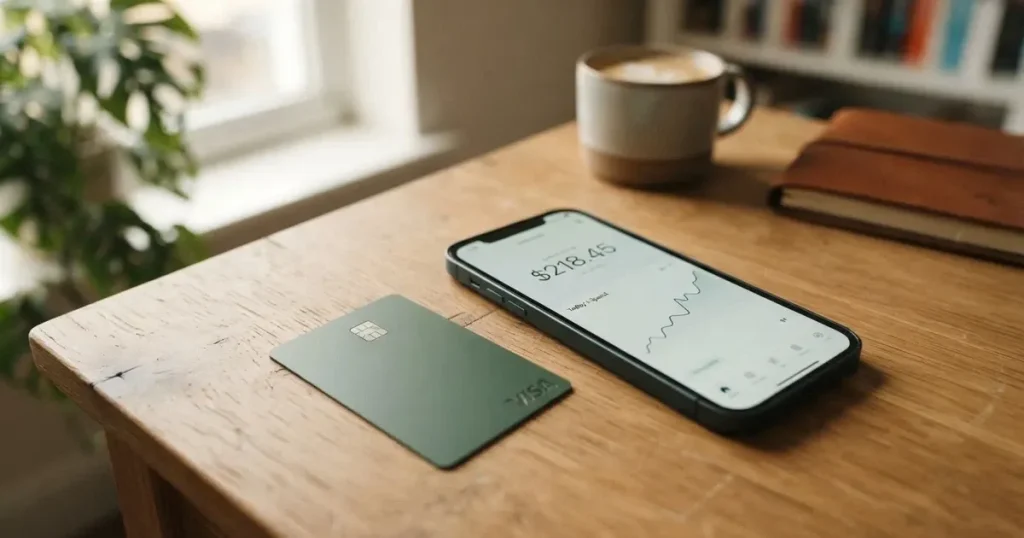
The Wallbit card is a virtual, US-issued Platinum Visa that pays out of a USD balance you fund yourself — most often with USDC or USDT. Spending that balance in dollars is free. Spending it anywhere else adds 2% on top of the Visa exchange rate. Cash at ATMs costs 1% with a $5 floor. And the card you can hold today is the virtual one: the physical version is still listed as “Coming soon”.
I score it 6.7 out of 10. That is not a bad score, and it is not a good one. It is a card that does its job for a particular person and does nothing interesting for anybody else.
The conditions described on this page are current as of October 28, 2026.
The score, criterion by criterion
Before the details, the breakdown. Each mark is out of 10, and I explain below why I gave it.
| Criterion | Mark | Why |
|---|---|---|
| Who can get it | 8 / 10 | Closed to residents and legal registrants of 17 named countries; the rule is by residence or registration |
| Cost | 7 / 10 | $5 issuance, no maintenance fee, USD spending free, but 2% on foreign currency and $5 minimum at ATMs |
| Top-up options | 6 / 10 | USDC and USDT free at 1:1, plus USD, EUR, SEPA, SWIFT and FedNow — but no networks are named |
| Reliability and complaints | 5 / 10 | Wallbit LLC with US-registered partners and SOC 2 Type I and II, but no issuer named, Trustpilot 4.0 from 69 reviews, and reports of accounts closed after approval |
| Everyday use | 7 / 10 | Virtual Visa, Apple Pay and Google Pay, contactless ATM use up to $250 — but no physical card yet |
| Total | 6.7 / 10 | A competent dollar card with a real gap where a bank would be |
The high mark in “who can get it” is not generosity. A card that clearly says who it will not serve, and why, is easier to plan around than one that fails you silently at the verification step. The low mark in “reliability and complaints” comes down to one missing name — the card issuer is not named on the public pages — combined with a pattern of user reports I could not dismiss.
Who this suits: people who want a US-linked account and a Visa card, and who already hold dollars or stablecoins to put in. If your money arrives in crypto, that is exactly the shape of the problem this solves. Who it does not suit: anyone whose income is local currency, who needs to draw cash more than occasionally, or who wants a physical card in the post.
Who they will issue the card to
The Wallbit card is not available to residents or legal registrants of seventeen countries: Belarus, mainland China, North Korea, Cuba, India, Iraq, Iran, Israel, Myanmar, Nepal, Nicaragua, Russia, Syria, Turkey, Ukraine, Venezuela and Vietnam. Countries on the FATF grey list are reviewed case by case, with compliance approval required.
The important detail is the basis of the rule: it is residence or registration, not citizenship. If you moved to a country that is not on that list, the country you are registered in is what counts. Conversely, a citizen of a listed country living elsewhere is not excluded by this rule as written — though the issuer’s own screening may apply separately, since sanctions checks and issuer risk policy are often run against citizenship and country of birth as well as address.
Purchases are also blocked in North Korea, Cuba, Iran, Russia, Syria, Ukraine and Venezuela. Note that this is a shorter list than the eligibility list, and it is not simply a subset relationship you should assume: Turkey, for example, appears in the exclusion list but not in the purchase-block list.
If you are outside the excluded countries, the card’s pages do not say what evidence of address it requires, nor what the acceptance age threshold is beyond the general category rule that prepaid and debit cards go to adults (18+) and some issuers set higher limits. Check with the platform before you send documents.
How to get it
Registration asks for an email address, a password, your full name and a phone number. Identity verification requires a document from your country of residence, and the card’s own page says verification “typically takes up to one business day”. The card is then activated in the app: tap the card button, then “Activate my card”.
There is one verification step described, not a tiered system, and the public pages do not give the reasons a verification can be rejected. If you are asking why an application is sitting unapproved, the answer is not on the page I read — Wallbit has a Help Center at help.wallbit.io, with English and Spanish sections, which is where that question belongs.
Two things to be clear about from the start. The card is described as a “U.S.-issued Platinum Visa card” and it is virtual; it pays in USD. The physical card is “Coming soon” — and so is the shipping of it. So the sequence for you is: open an account, verify, activate the virtual card, add it to a mobile wallet or use the card number, and wait for the physical version without any date in front of you.
What it really costs: Fees
Here is the whole price list, as the card states it.
| Fee or limit | Value |
|---|---|
| Issuance (virtual card) | $5 one-time |
| Maintenance fee | None |
| Plans | Classic free, Pro $9.00/month, Max $19.00/month |
| Spending in USD | Free on all plans |
| Spending in another currency | Visa exchange rate + 2% FX fee |
| Deposits | No fee, of any kind |
| ATM | 1%, minimum $5 USD; plus 1% extra for non-USD; $250 USD per transaction; ATM operator may add its own fee |
| Crypto withdrawal, USDC | 2% (Classic), 1% (Pro, Max) |
| Crypto withdrawal, USDT | 2% (Classic), 1.25% (Pro, Max) |
| ACH withdrawal | 1%, minimum $5 (Classic); 0.5% (Pro, Max) |
| Wire withdrawal | 1%, minimum $25 (Classic); 0.5% (Pro, Max) |
| SEPA withdrawal | 1%, minimum $10 (Classic); 0.5% (Pro, Max) |
| SWIFT withdrawal | 1%, minimum $25, all plans |
| Inactivity fee | $2.00/month after 3 months |
| Daily spending limit | Exists, shown in the app; amount not stated |
Three everyday payments, and what each one costs you.
A $40 lunch in New York, paid in USD, costs you $40. Nothing else applies. This is the clean case, and it is genuinely the card’s best argument.
The same $40 lunch in Lisbon, where the till is in euros, goes through the Visa exchange rate and then takes the extra 2%. On a $40 payment that is 80 cents on top of whatever the Visa rate gives you — and the Visa rate itself is not fixed in advance, so you are accepting a rate you did not choose plus a fee you did.
A $60 withdrawal from an ATM in a currency other than dollars is the expensive case: 1% of $60 is 60 cents, but the $5 minimum turns that into $5; then a further 1% applies because it is not a USD transaction; and the ATM operator’s own charge, if any, lands on top. The $250 per-transaction ceiling means this cannot go very wrong in one go, which is a comfort and also a limit — two withdrawals is your maximum for a large cash need in a day.
Two charges deserve a second look because they are the ones people forget. The inactivity fee starts after three months — if you do not use the account, $2 a month begins. And Pro at $9.00/month or Max at $19.00/month only make sense if you actually move money: Pro halves withdrawal fees, Max gives the lowest investment commissions and the highest APR on cash. On the free Classic plan, taking USDC out costs 2%. A Pro subscriber who withdraws monthly keeps the difference in fees rather than in rewards; there is no cashback stated on any plan.
How to Top up the account
Deposits are free, and the card’s fee page says so for deposits of any kind. USDC and USDT go into the USD account at 1:1. You can also fund with USD, EUR, and through SEPA, SWIFT and FedNow rails. The account itself holds USD, EUR, USDT and USDC.
Two things are not stated and both matter more than they sound. No minimum deposit amount is published. And no networks are named — for USDC and USDT, “which chain” is the first question that can cost you money. USDC is natively supported on 38 networks as of 16 September 2026, per Circle, including Ethereum, Solana, Base, Polygon PoS, Avalanche, Arbitrum and Stellar. USDT has been issued on networks including Ethereum, Tron, Solana, Polygon and Avalanche. But that is the state of the tokens, not the state of this card’s support, and the two are not the same thing. Sending on a network the provider does not support can lose the funds or require manual support recovery with no guarantee, and blockchain transfers cannot be reversed. Circle stopped supporting USDC on Tron in February 2024, so “USDC over TRC20” is not a native option.
Nobody will tell you the network in advance. The thing to do is confirm it in the app or with support *before* you send, not after.
Paying with it every day
The virtual card works with Apple Pay and Google Pay. Cash machines work by NFC, meaning you link the virtual card to Apple Pay or Google Pay and tap — the card itself has nothing to tap with yet.
Some merchants ask for a US billing address. Blocked merchant categories are not stated on the card’s pages. If you are in gambling-adjacent territory of the internet, know that many issuers block those categories by policy rather than by law, and the list differs per issuer — Wallbit does not publish one here.
No cashback is stated. That is the whole rewards story as far as the public pages go, so the value of the card has to come from somewhere else: the $5 issuance, the free USD spending, and the wallets.
Two practical notes that are generic to this kind of card but bite often. Address Verification Service compares the numeric parts of the billing address you type with issuer records; it is mainly available in the US, Canada and the UK and is generally not available for foreign-issued cards, so a decline at checkout is not always about you. And a declined authorisation can leave a hold on funds that stays for several days, typically up to seven.
On disputes: the help centre has articles on declined and pending payments, but the chargeback process and its time frames are not stated on the pages I read. In the US, debit card reversal rights come from Regulation E and credit card rights from Regulation Z, and prepaid-card coverage varies and should not be assumed to apply. So if you are weighing this card on the strength of being able to dispute a charge, that is an assumption, not a fact you have.
What can go wrong
Here is what users reported, and what the card itself says.
The user-reported themes are specific and they are recent. An account closed after approval, citing compliance, in January 2026. Unanswered support emails, in October 2025. And a dispute over a missing payment trace for a Brazilian PIX payment, reported across May to July 2026, where the user says they had no end-to-end identification to trace it. I found no official incident to match these.
The wider picture: Trustpilot shows 4.0 out of 5 from 69 reviews as I read them on 2026-10-21, with 70% five-star and 23% one-star. Sixty-nine reviews is a thin base — a single run of closures would move that number a lot — so I read the score as “not a disaster, and not proven either”.
On the company side, what is named: Wallbit LLC; Wallbit and its banking and investment partners registered in the United States; brokerage through Alpaca Securities LLC (FINRA/SIPC); advisory through W2B, Inc. (SEC-registered, CRD# 331220). What is not named: the card issuer. That gap matters more than it looks. A card network routes messages and sets the rules, an issuer holds the actual card programme under the network’s licence, and the crypto brand is often only the front end that markets it. When something goes wrong with the card itself — a block, a reversal, a programme change — the issuer is who acts, and here you cannot see who that is.
The account is custodial. Your crypto credentials sit with the provider, which means your trust in Wallbit is total on that side. The history of custodial platforms includes Mt. Gox (about US$350 million reported stolen, 2011-2014), Coincheck (about US$400 million, 2018) and Ronin Network (US$625 million, 2022). The card can be locked and unlocked in the app, SOC 2 Type I and II are cited, and SIPC Excess up to USD 75 million per account applies to investments — that last one covers investments, not the card balance.
Some category-level context worth holding in mind: Visa and Mastercard do not issue crypto cards to consumers themselves. They license issuers and can suspend a programme. Visa terminated its global agreements with FTX on 13 November 2022 and the FTX US debit card was wound down by its issuer. WaveCrest, a Visa issuer that supplied crypto card brands, was suspended by Visa in Europe in 2018, closing all WaveCrest-issued Visa programmes. Those are not predictions about Wallbit; they are reminders that the card you hold depends on decisions made by organisations whose names are not on the front of it.
The right question to ask support, in writing, before you commit money: who is the card issuer, and what happens to my balance if the programme ends. Programme closures typically give notice, then stop spending and loading, then ask users to withdraw remaining balances — and the balance left on closure is not stated on Wallbit’s pages.
What to take instead
The honest comparison is not Wallbit against other crypto cards so much as Wallbit against “a normal dollar card”. But if you want other crypto cards, these are the three in the same set, with their own gaps.
UNi Card — score 6.1 / 10. A multicurrency card on the Mastercard network spending from the UNi.Global account balance. No annual fee, no foreign transaction fee, and assets converted at “live OTC rates” with “no hidden exchange fees”. Spend-to-Earn rewards up to 3%. Against that: eligibility countries are not stated, issuance fee not stated, and top-up methods not stated. The appeal is that it is built around multiple currencies rather than around a dollar.
Whop Cards — score 5.2 / 10. A Visa that works anywhere Visa is accepted. Availability is the narrowest of the three and the clearest: 31 US states for consumers, listed by name, and 41 states for businesses; unsupported consumer countries include Belarus, China (Mainland), Cuba, Hong Kong, India, Iran, Iraq, Israel, Myanmar, Nepal, Nicaragua, North Korea, Russia, Syria, Turkey, Ukraine, Venezuela and Vietnam — an almost identical list to Wallbit’s, plus Hong Kong. Whether the test is citizenship or residence is not stated. Spending draws on a Whop balance, a pending balance is usable as soon as a payment arrives while standard withdrawals use settled funds, and it is backed by stablecoin collateral from a linked wallet with coins and networks unstated. Rewards are 5% cashback at select merchants, currently Uber. The page says “No extra fees” but lists no issuance or monthly amounts.
Stella — score 6.5 / 10. Virtual and physical, on Visa, working at “over 40 million VISA merchants globally”. You deposit crypto into the account and it tops the card automatically. The caveats are unusually open-ended: the official site does not state countries, fees are “described under this User Agreement and/or on the App” and are not stated on the card page, and the terms bar users under economic sanctions programmes while routing US and European users through affiliates. No cashback is stated on the card page; the Earn product is a separate yield.
Side by side, the pattern is that everyone avoids stating something. Whop does not say which coins. Stella does not say which countries or what it charges. Wallbit does not say who issues its card. Pick on the gap that would hurt you most.
Who I would recommend it to
If you earn or hold dollars or dollar-pegged stablecoins, want a US-linked account, and can live with a virtual card in your phone plus a card you add to Apple Pay or Google Pay — yes. The fee structure is honest and legible: $5 once, nothing a month, free in USD, and deposits that cost you nothing.
I would not recommend it if your spending is mostly local currency, because the 2% is not a rounding error on a weekly shop or a monthly rent. I would not recommend it if cash is your main draw, because the $5 floor plus the extra non-USD 1% plus the ATM’s own charge makes it an expensive habit. I would not recommend it if you travel regularly, since the same 2% applies everywhere outside the US.
And I would want one answer in writing before I moved real money: who issues the card. A card whose issuer is undisclosed is not a scam signal on its own — plenty of legitimate programmes sit behind a brand — but it is a gap, and the people it hurts are the ones whose accounts get closed. That is the complaint theme that appears most often here.
Frequently asked questions
What is the Wallbit card?
It is a virtual, US-issued Platinum Visa that spends from a USD balance on your Wallbit account. You fund the balance yourself, usually with USDC or USDT, and the card draws down that balance like a prepaid card. It pays in USD. The physical version is listed as “Coming soon”, so what you can use today is the virtual card, typically added to Apple Pay or Google Pay.
Is Wallbit a bank?
No — not on the evidence available. Wallbit LLC is the company, and it says Wallbit and its banking and investment partners are registered in the United States. Brokerage runs through Alpaca Securities LLC (FINRA/SIPC) and advisory through W2B, Inc. (SEC-registered, CRD# 331220). The account is custodial rather than bank-deposit-like, and no bank deposit guarantee is described.
How do I get the Wallbit card?
You register with email, password, full name and phone, then verify with an identity document from your country of residence — the card says verification typically takes up to one business day. The card is activated in the app by tapping the card button and then “Activate my card”. It is virtual only for now; physical card issuance and shipping are “Coming soon”.
Is the Wallbit card free?
Not quite. The virtual card costs $5 to issue, with no maintenance fee. Spending in USD is free on every plan, and deposits of any kind are free. But foreign-currency spending costs the Visa exchange rate plus 2%, ATM withdrawals cost 1% with a $5 minimum, and there is a $2.00/month inactivity fee after three months. Optional plans are Pro at $9.00/month and Max at $19.00/month.
What countries is the Wallbit card not available in?
It is closed to residents and legal registrants of Belarus, mainland China, North Korea, Cuba, India, Iraq, Iran, Israel, Myanmar, Nepal, Nicaragua, Russia, Syria, Turkey, Ukraine, Venezuela and Vietnam. FATF grey-list countries are reviewed case by case. Purchases are blocked in North Korea, Cuba, Iran, Russia, Syria, Ukraine and Venezuela. The test is residence or registration — citizenship is not what the rule names.
How do I top up the Wallbit card?
Deposits are free. USDC and USDT go into the USD account at 1:1, and you can also deposit USD, EUR and use SEPA, SWIFT and FedNow. The account holds USD, EUR, USDT and USDC. One caution: no minimum is published, and no blockchain networks are named — confirm the network in the app before sending, because a transfer to an unsupported network can be lost.
Is the Wallbit card safe?
There are real safeguards and one real gap. SOC 2 Type I and II are cited, the card can be locked and unlocked in the app, and SIPC Excess up to USD 75 million per account applies to investments — not to your card balance. The gap: the card issuer is not named, and the account is custodial, so your crypto credentials sit with the provider. 3-D Secure applies to online payments, as it does to any Visa card.
What are people complaining about?
Three themes recur: an account closed after approval citing compliance (January 2026), unanswered support emails (October 2025), and a disputed Brazilian PIX payment the user says had no end-to-end trace (May to July 2026). Trustpilot shows 4.0 out of 5 from 69 reviews, 70% five-star and 23% one-star. I found no official incident matching the reports, and 69 reviews is a thin sample either way.
Can I add the Wallbit card to Apple Wallet?
Yes. Apple Pay and Google Pay are both supported, and they are also how you use NFC at cash machines, since the virtual card taps through your phone. Apple Pay replaces your card number with a device-specific number in the Secure Element and uses a one-time code per payment. Note that some merchants require a US billing address, and that is not something the wallet fixes.
How do I withdraw money from Wallbit?
Out to crypto, USDC costs 2% on Classic and 1% on Pro and Max; USDT costs 2% on Classic and 1.25% on Pro and Max. To a bank account, ACH is 1% with a $5 minimum on Classic and 0.5% on Pro and Max, Wire is 1% with a $25 minimum on Classic and 0.5% on Pro and Max, SEPA is 1% with a $10 minimum on Classic and 0.5% on Pro and Max, and SWIFT is 1% with a $25 minimum on all plans. What is left in the account on closure is not stated.
App and neobank cards in the catalogue – cryptocardcatalog
Content created by the «cryptocardcatalog» team