
A USDC-funded Visa Infinite card whose fee story comes almost entirely from third-party sites
 Available in US
Bitypay is a crypto payment card built around one asset: USDC. The documented model is that you hold USDC as collateral in a self-custody wallet on Base or Arbitrum, and the card spends over Visa rails without you converting anything by hand. Everything else about this card — the countries that issue it, what verification looks like, what a declined payment costs — is either undocumented on the card’s own public pages or reported by third-party directories rather than by the company.
I score it 7.4 out of 10. That number is not a rounded impression; it is the sum of six criteria I worked through, and I show every one of them below so you can argue with the parts you disagree with.
The conditions described here are current as of October 28, 2026.
| Criterion | Mark | Why |
|---|---|---|
| Who can get it | 6 / 10 | Issuing countries are not disclosed and the official site was unavailable when checked; unofficial sources say full “Level 4” verification, and one Reddit comment reportedly points to citizenship dependence |
| Cost | 9 / 10 | Unofficial: issuance and monthly fee free, FX and ATM free, USDC top-up 0%; the same pages call transaction and maintenance fees “not publicly disclosed” |
| Top-up options | 7 / 10 | USDC as collateral in a self-custody wallet on Base or Arbitrum; unofficial sources also list USDT |
| Reliability and complaints | 6 / 10 | Brand owned by Codego Group; issuer and licences not named; official site returned 403; unofficial: self-custody; no complaints found for this card |
| Everyday use | 9 / 10 | Unofficial: Visa Infinite, virtual and physical, Apple Pay and Google Pay, contactless, ATM without a fee |
| Total | 7.4 / 10 |
So who is this for? In plain terms: someone who already holds USDC, wants a Visa Infinite rather than a lesser card, and is comfortable managing a self-custody wallet and sending a stablecoin across a blockchain network to fund it. That is the audience the design serves, and it is a narrower audience than “everyone with crypto.”
Who it does not suit is just as specific. If you need a bank account, if you want a card that draws on a salary, if you live somewhere you suspect the card is not issued and cannot check, or if you intend to spend money you cannot afford to lose from a wrong network, this is the wrong tool. The self-custody model is a real feature — it removes the custodian from the trust chain — but it hands you the key-handling risk that a custodial platform would otherwise absorb.
One thing I want to be careful about early: the majority of what you will read about this card’s fees and eligibility comes from third-party card directories, not from Bitypay. Where those lines appear below, I mark them as unofficial and treat them as claims to verify, not as terms you can rely on. Several of them contradict each other, and I point that out where it matters.
Will they give you the card?
Short answer: I cannot tell you. The card’s public pages do not say which countries issue it.
There is no list of eligible countries, and the official site was not reachable when the facts were gathered on 20 October 2026. Unofficial sources describe the verification requirement as “Level 4” — email, phone, identity document, proof of address and a selfie, attributed to a third-party directory for 2026 — but neither the existence of a tiered scheme nor its levels are confirmed by the card. The only reliable thing to say is that full identity verification of some kind is standard for this category and almost certainly present here.
The citizenship angle deserves more than a shrug, because it is the one thing that can make the answer a flat no regardless of where you live. KYC rules require regulated businesses to verify customers and assess risk as part of anti-money-laundering and counter-terrorism-financing law, including ongoing transaction monitoring and suspicious-activity reporting. In the EU, customer due diligence covers name, address, date of birth, nationality and identity documentation, a sanctions check, the purpose of the relationship, and whether you are a politically exposed person. In the US, the customer identification programme requires name, date of birth, address and an identification number, with electronic systems also validating proof-of-address documents against records.
Nationality is recorded and screened separately from residence. Sanctions screening and issuer risk policy are frequently applied to citizenship and country of birth as well as to where you live, which is why “I live here” and “I hold this passport” are two different questions with two different answers. One Reddit comment reportedly says usability depends on citizenship and regulatory gating. That is an anecdote I have not read in full, and I would not hang much on it — but it points at something real, and if you have a passport that complicates international payments, it is worth asking support directly before you fund a wallet.
If your country cannot be confirmed, the fastest way to a real answer is to test it rather than reason about it: go through the onboarding flow and see how far it takes you. Do not send funds to an address you have been given until you have seen the application succeed.
How to get it
The documented steps are thin, and I would rather describe the gap than dress it up. What the public pages do not state: the application process itself, the specific card product issued, and delivery timelines for any physical card. What a third-party directory reports, unofficial and unconfirmed: it is a Visa Infinite, available as a virtual and a physical card, behind “Level 4” verification.
That combination — virtual plus physical — matters more than it sounds. A virtual card is typically issued quickly and is what you would load into Apple Pay or Google Pay first; a physical card is what you would want for terminals that dislike prepaid or foreign-issued BINs. If both exist, the sensible order is to prove the setup works virtually before you wait on anything in the post.
Three things to check yourself before you finish an application, because the card does not check them for you:
- Which countries are served. Ask support directly and get the answer in writing. Do not assume your residence qualifies because a directory lists a region vaguely.
- Whether there are tiers. Unofficially there is a “Level 4”; officially there is no published tier structure. If limits differ by level, that structure is invisible to you until it is not.
- What happens to funds during a rejection. Not stated anywhere I could find. If you are going to connect a self-custody wallet, understand that your crypto does not sit with Bitypay — but a rejection at the identity stage can still stop the card from ever existing, and no fee schedule for that is published.
Prepaid and debit cards are generally available to adults (18+) in this category, and some issuers set higher limits than the default. Bitypay’s own age rule is not stated.
Fees: what it really costs
Here is the honest position: the card’s own pages do not publish a fee schedule. Every number in the table below is unofficial, sourced from a third-party directory for 2026, and the same source contradicts itself — it lists FX and ATM as free in one place and says transaction and maintenance fees are “not publicly disclosed” in another. I have reproduced both rather than picking the flattering half.
| Fee or limit | What is published by the card | Unofficial claim (third-party, 2026) |
|---|---|---|
| Issuance | not stated | Free |
| Monthly fee | not stated | Free |
| Conversion | not stated | not publicly disclosed |
| FX | not stated | Free |
| ATM | not stated | Free |
| Declined transaction | not stated | Free |
| Daily spend limit | not stated | Unlimited |
| Monthly spend limit | not stated | Unlimited |
| ATM limit | not stated | Unlimited |
| Tiers | not stated | No tier structure described |
| Card currency | not stated | not stated |
Now let me walk three everyday payments through that table, because abstract fee rows do not tell you what you will pay.
A coffee abroad, in a local currency. If the FX fee is genuinely zero, this is where a crypto card normally hurts and where this one would not. The mechanism to understand: merchants can look up the card’s issuing institution from the number itself and may apply extra scrutiny if the issuer country differs from the billing address. That is why a card issued in one country can look “foreign” in a shop in another, and why some merchants decline prepaid or foreign BINs outright. Under the unofficial “free FX” claim, the currency conversion is the part you would worry about; under the “not publicly disclosed” claim, it is the part you cannot price in advance.
A card terminal that declines your payment. The unofficial decline fee is listed as free, which is better than the category norm. But a decline can still cost you in another way: declined authorisations may leave a hold on funds that can remain for several days, typically up to 7. So “free” and “costless” are not the same sentence.
A recurring subscription or a large ticket. Daily and monthly spend are described as unlimited, which no issuer grants lightly. What is actually published about daily and monthly limits is nothing. If your regular life involves a rent payment or a recurring transfer, treat “unlimited” as a directory claim and check your own ceiling in the app after approval.
There is also a fee category the card never mentions: network fees for getting money in. On-chain network fees for your deposit are charged by the blockchain, not by the card provider. A self-custody deposit on Base or Arbitrum has a cost, and it comes out of the same wallet.
Top up: how the money gets in
This is the part of the card that is actually documented, and it is also the part that decides whether it suits you.
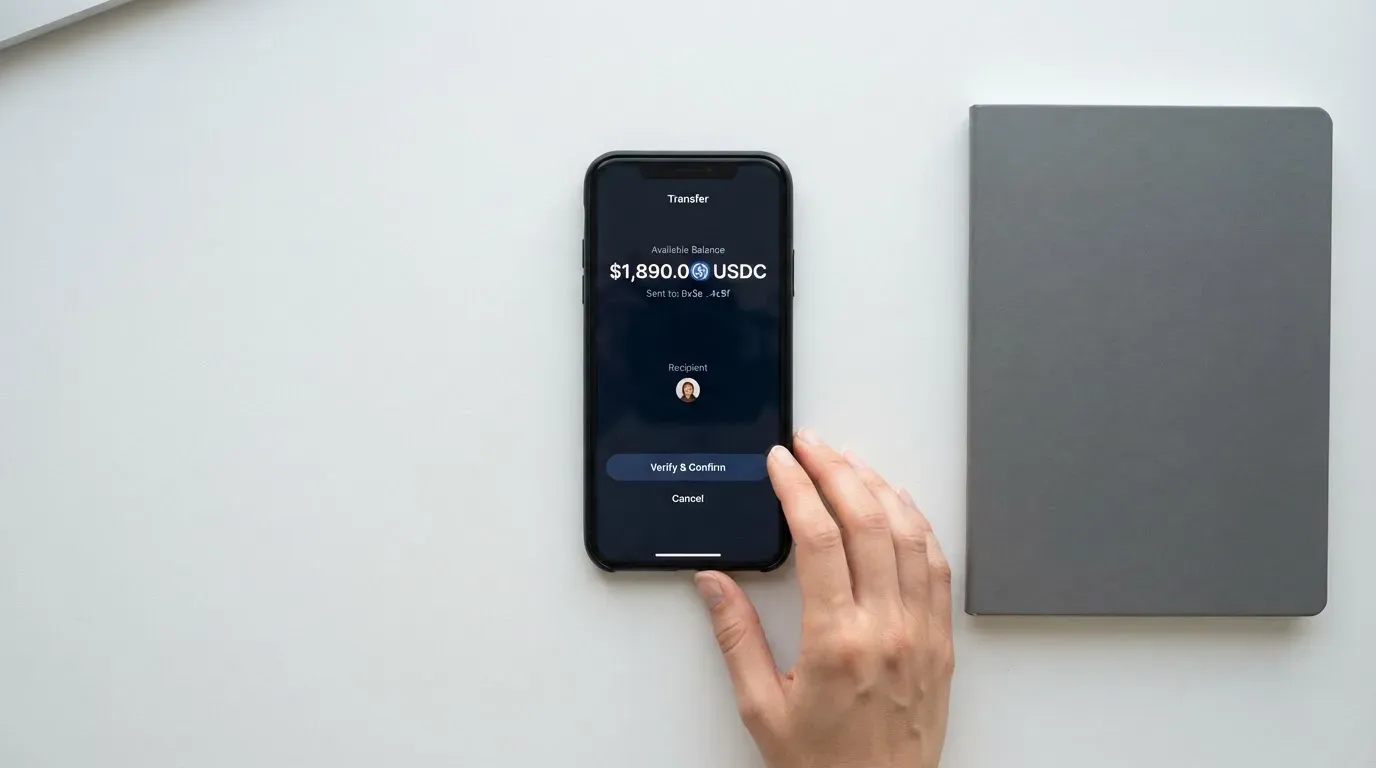
The stated model: USDC held as collateral in a self-custody wallet on Base or Arbitrum, with spending over Visa rails and no manual conversion. That is a clean design in one sentence. You are not selling crypto to buy a balance, and you are not watching a card account drift away from a price you set — the card draws against collateral you already hold, on networks you choose.
Unofficial additions from the same third-party source: USDT is supported alongside USDC, Base and Arbitrum are the networks, and there is a 0% deposit fee on USDC top-ups. The card’s own pages do not state a top-up method or a top-up fee, so the “0%” is a directory claim.
The part that catches people out is the network, not the asset. Blockchain transfers are irreversible, so a deposit sent on a network the card provider does not support, or to an address belonging to a different network, can be lost entirely or need manual support recovery with no guarantee of success. Get the network right. If you have ever lost funds to a wrong-chain transfer, you already know how expensive that class of mistake is.
A second detail that catches people: sending tokens does not always work by itself. Gas on Ethereum-based networks is paid only in ETH, so a wallet holding USDT but no ETH cannot send. This card’s networks are Base and Arbitrum rather than Ethereum mainnet, which is friendlier, but the same underlying rule applies — check that your wallet holds what the network needs.
On the stablecoin itself. A stablecoin aims to hold a stable value against a fiat currency, but despite the name, stablecoins are not necessarily stable: TerraUSD collapsed in May 2022, and USDC temporarily lost its peg in March 2023 during the US banking crisis. Tether’s USDT and Circle’s USDC are US-dollar-pegged, and the BIS in July 2025 put about 90% of stablecoin market capitalisation in these two. Circle says USDC is redeemable 1:1 for USD and 100% backed by cash and cash equivalents, mostly in an SEC-registered government money market fund, with monthly reserve attestations. Circle lists USDC as natively supported on 38 networks as of 16 September 2026, including Base and Arbitrum.
What the card does not state, and what you should look for yourself: how to withdraw money back out. There is no published withdrawal method. If the card is one-directional — money in, spend, but no clean way out — that changes how you should size your balance, and you should find the answer before you load it heavily rather than after.
Paying with it every day
Everyday use is where this card scores highest, and again the source matters. Unofficial: Visa Infinite, virtual and physical, Apple Pay and Google Pay supported, contactless, ATM withdrawal without a card fee. None of that is confirmed by the card’s public pages.
If it holds, it is a genuinely well-equipped everyday card, and the rewards picture is not the reason. Unofficially there is no cashback, no staking rewards, no welcome bonus and no referral bonus listed — the one lifestyle item is free access to over 1,300 airport lounges, which is a real Visa Infinite perk rather than a crypto-card gimmick. The practical read: you would be paying a fair price for a premium card experience, not being paid to use it.
The mobile wallet support is the detail that most affects daily friction. When you add a card to Apple Pay, the card number is replaced with a device-specific Device Account Number stored in the Secure Element, never on Apple’s servers, and each payment uses a one-time dynamic security code. In practice that is tap-to-pay at a terminal without touching a physical card — which, given that most everyday friction with a prepaid or foreign-issued card happens at exactly that terminal, is where the virtual card earns its keep.
Three limits of that everyday experience are worth planning around:
- Gambling and some merchant categories. MCC 7995 covers gambling — casinos, betting, lotteries. Many issuers block it on specific cards by policy rather than by law, and the blocked list varies by issuer. Bitypay does not publish its list.
- Online payments can prompt for a step-up. 3-D Secure adds an identity check to online card payments: the issuer assesses risk and either approves frictionlessly or challenges you, for example with a one-time code or biometric. Visa’s brand is Visa Secure, Mastercard’s is Identity Check.
- Some foreign-issued cards simply fail address checks. Address Verification Service compares the numeric parts of the billing address you typed with issuer records; it is mainly offered in the US, Canada and the UK and is generally unavailable for foreign-issued cards, which can cause declines. This is one of the more likely reasons a legitimate payment would not go through here.
Not stated publicly: which wallets are supported, whether there is an app with spending controls and notifications, and how disputes work. I would not assume a dispute process exists until you have read the terms, because you cannot charge back a mechanism that has no published reason codes.
What can go wrong
Let me separate the things I found from the things I think about.
What I found. No complaints specific to this card. When you search, the dominant result is a different company entirely — the legacy BitPay at bitpay.com — and there is no Trustpilot page for Bitypay; those results also point to legacy BitPay. So the absence of complaints here is not a clean bill of health. It may mean the card is young, or small, or simply uncontested. None of those is the same as proven.
Who is behind it. The brand is owned and operated by Codego Group, per the card file and the third-party directory. The issuer and its licences are not stated, and the official site returned a 403 when the facts were gathered. That single gap does most of the work in this section, so it is worth understanding why it matters. A card sits inside a structure: the network — Visa or Mastercard — routes messages and sets the rules; the issuer, a bank or e-money institution licensed under the network’s licence, holds the card programme; and the crypto brand is often only a programme manager or front end that markets it. Visa and Mastercard do not issue crypto cards to consumers themselves; they license issuers, and they can suspend a programme. In November 2022 Visa said it had “terminated our global agreements with FTX”, and the FTX US debit card was wound down by its issuer. WaveCrest, a Visa issuer that supplied crypto card brands, was suspended by Visa in Europe in 2018, closing all WaveCrest-issued Visa programmes. So an unnamed issuer is not paperwork trivia. It is the entity whose licence determines whether your money is safeguarded and who you complain to when it is not.
If you want to check a provider yourself, ESMA keeps an interim register of authorised crypto-asset service providers, white papers and non-compliant entities, and users can look there. One caveat before you do: a crypto card often depends on two licences. Under MiCA — Regulation (EU) 2023/1114, which ESMA states took legal effect in June 2023 — e-money tokens may be issued only by a credit institution or an electronic money institution, and the asset-referenced token and e-money token rules applied from 30 June 2024 with the remaining provisions, including crypto-asset service provider rules, applying from 30 December 2024. A card itself is a payment service regulated separately under e-money and payment-services law. So finding the crypto licence tells you only half the story.
Custody: the good part and the hard part. Unofficial, the card is self-custody, and that is the strongest structural argument for it. Control of crypto belongs to whoever holds the private key or seed phrase; with a custodial wallet the provider holds the credentials, so you must trust the provider completely. Custodial platforms have a genuine record of failure — Mt. Gox (about US$350 million reported stolen, 2011–2014), Coincheck (about US$400 million in 2018), Ronin Network (US$625 million in 2022) — and holding funds with a custodian carries counterparty and hack risk on top.
Self-custody removes that counterparty and replaces it with your own responsibility for key loss, phishing, and clipboard-hijacking malware that swaps copied addresses. A seed phrase, typically 12 to 24 words, is an unencrypted form of the private key, and anyone who obtains it can restore the wallet and spend its funds. Blockchain transfers are typically irreversible; a stolen private key has no built-in recovery, because the network cannot freeze or return the funds. This is a real trade, not a free upgrade — you are exchanging one risk you do not control for one you do.
Something the card’s marketing will not mention. Stablecoins are not censorship-proof. Tether says it disables tokens in wallets on the OFAC sanctions list and has frozen funds tied to illicit activity. That is the same screening machinery described above, showing up from the token side.
Programmes end. Closures typically give a notice period, then stop spending and loading, then ask users to withdraw remaining balances. One 2026 closure reported by a secondary source ended new loads on 8 July 2026 and spending on 8 August 2026 — a single unconfirmed source, cited here only to show what the timeline looks like, not as a claim about Bitypay.
On chargebacks and disputes. A chargeback is a refund ordered by the issuer to settle a dispute, with reason codes such as fraud, duplicate billing or goods not received. Whether one is available to you depends on the issuer and the programme structure, and Bitypay states neither. In the US, debit card reversal rights come from Regulation E and credit card rights from Regulation Z; prepaid-card coverage varies and should not be assumed. Under 3-D Secure, liability for fraudulent online payments can shift from merchant to the cardholder’s bank — or, per critics, to the cardholder. None of this is stated for this card. Treat dispute handling as unverified.
Support. Not stated. That is the practical thing to pin down before you need it.
What to take instead
Three cards I can compare against published material, with their own scores for context. The comparison is not apples-to-apples — Bitypay’s detail is thinner than any of these — but the shape of what each one commits to publicly is useful.
MetaMask Card (7.1 / 10) is the most documented of the three. Sign-up is open in 45 listed countries and territories — Andorra, Argentina, Brazil, Canada, Mexico, Germany, France, Spain, Uruguay are among them — with other regions on a waitlist, proof of residency required, and US and UK sign-ups temporarily closed. It is a Mastercard; the virtual card is issued instantly, metal can be pre-ordered in the app afterwards, and there is one card per user. Issuer Monovate, card provider Crypto Life. The virtual card is free with no annual or maintenance fee; the metal card is $199/year. Per-transaction fees are described only as “minimal” with the amount not stated on the pages read, there are no additional MetaMask fees, and no foreign transaction fee — the Mastercard rate applies. It spends directly from the connected wallet on Linea, Base, Monad and Solana. Solana-only wallets cannot withdraw credit. Cashback is paid in mUSD into the Money Account: 1% on Virtual; Metal’s headline is 3% with a footnote capping 3% at the first $10,000 spent then 1% — read the footnote. If you want a card whose eligibility list and costs you can actually read before applying, this is the one.
KAST (6.1 / 10) is the transparent-by-design option, and unusually honest in ways others are not. It shows the country list at KYC and tells you plainly: if your country is not listed, it is not available there. It also separates residence from documents — living in a supported country while holding an ID from a restricted region may still fail, dual citizens with an ID from a supported country may pass, only the account holder’s own ID is accepted, and a VPN does not bypass it. You can create an account in an unsupported country but KYC stays locked. Cards are virtual and physical, up to ten per user, across Visa Platinum, Visa Infinite metal and gold-plated tiers. Pricing is stark: Standard 0 USD, Premium 1,000 USD/year, Private 10,000 USD/year, billed annually upfront. Fees are unusually legible — stablecoin top-up 0%, card spend in USD 0%, transaction fee 0%, Apple and Google Pay 0%, non-USD FX between 0.5% and 1.75% depending on residence, transaction country and card programme, non-USD transactions under 25 USD 0.10 USD, declined transaction for insufficient balance 0.50 USD, and an inactivity fee of 1 USD/month after 12 months. One conflict to note: the site names USDT, USDC, PYUSD and RLUSD while the terms say acceptable tokens are “currently USDT and USDC”.
TokenPocket (5.8 / 10) is the narrowest. Visa debit for a list of European countries and territories — Germany, France, Spain, Switzerland among them — Mastercard debit for Australia, Canada, Hong Kong, Japan, Taiwan, New Zealand, Singapore, South Korea and the UK, with the Americas “planned for Q2 2025”. Cards run on Arbitrum, are virtual with no physical card mentioned, and balances are in EUR24 and USD24. There is an NFT creation fee partly covered by TokenPocket with the user paying “a small portion” (amount not stated), and beyond that “TP Card does not charge any additional fees”. The catch is a 1% fee on depositing cryptocurrency, to be refunded later through rewards and reduced transaction fees. Extra fees can also come from inter-institution settlement, which is outside anyone’s control.
| Bitypay | MetaMask | KAST | TokenPocket | |
|---|---|---|---|---|
| Score | 7.4 / 10 | 7.1 / 10 | 6.1 / 10 | 5.8 / 10 |
| Card | Visa Infinite (unofficial) | Mastercard | Visa Platinum / Infinite | Visa or Mastercard debit |
| Form | Virtual + physical (unofficial) | Virtual, metal optional | Virtual + physical | Virtual only |
| Eligibility | not stated | 45 countries/territories listed | shown at KYC, not published | Europe + listed Asia-Pacific |
| Funding | USDC, self-custody, Base/Arbitrum | mUSD, wETH, EURe, GBPe, USDC, USDT | USDT, USDC, PYUSD, RLUSD | Crypto from TokenPocket wallet |
| Cashback | none listed (unofficial) | 1% virtual; metal 3% then 1% | 1.5% / 2% / 3% by tier | 1% deposit fee refunded via rewards |
| Mobile wallets | Apple Pay, Google Pay (unofficial) | not stated here | Apple Pay, Google Pay 0% | not stated |
| Issuer named | no | Monovate | not stated | not stated |
Set against those three, Bitypay’s profile is distinctive in one way and thin in another. Distinctive: it is the only one of the four whose stated funding model is collateral in your own wallet with no manual conversion, and the only one pitched at USDC holders who want a Visa Infinite specifically. Thin: it publishes none of the things the others publish — no eligibility list, no fee table, no issuer, no support terms. When you are deciding between these, that difference may matter more than the scores.
Who I would recommend it to
I would recommend this card to a specific person: someone holding USDC already, in a country the card actually serves, who wants a Visa Infinite rather than a mid-tier card, and who treats a self-custody wallet as something they understand rather than something they have delegated. If that is you, the mechanics are sound — collateral on Base or Arbitrum, spending over Visa rails, no manual conversion, and a card that reportedly works in your phone with no ATM fee.
I would not recommend it as a first crypto card, and I would not recommend it to anyone who needs a card that works everywhere. The reasons are specific, not vibes. You cannot verify your own eligibility from public information, which is disqualifying if you are the kind of person who plans. You cannot price a payment, because the fee schedule is not published and the third-party sources contradict each other. You cannot check who the issuer is or what safeguards apply to the balance. And you cannot withdraw on documented terms, which means a large balance has an unclear exit.
If you are still deciding, the practical next step is not more reading — it is a support conversation. Ask which countries issue the card, who the licensed issuer is, what a payment in a foreign currency costs, and how you withdraw. Four questions, four answers, and you will know in ten minutes what I could not establish from the public record. Take that answer and weigh it against the three alternatives above.
Frequently asked questions
What is Bitypay card?
Bitypay is a crypto payment card built around USDC. The documented model is that you hold USDC as collateral in a self-custody wallet on Base or Arbitrum, and the card then spends over Visa rails with no manual conversion by you. Third-party directories also describe it as a Visa Infinite in both virtual and physical form, but that is unconfirmed by the card’s own pages.
How does Bitypay card work?
You fund a self-custody wallet with USDC on Base or Arbitrum and the card draws against it as collateral when you pay. You are not converting to a fiat card balance yourself. In category terms this is closer to a prepaid card than a debit card, because it spends a balance you have loaded rather than asking a bank to withdraw from your account.
Is Bitypay a bank?
No — and the card does not name one. The brand is owned and operated by Codego Group, while the issuer and its licences are not stated anywhere in the public material I could check. That distinction matters: the licensed entity behind a card is the one whose rules and safeguards apply to your balance.
Is the Bitypay card available in my country?
I cannot tell you, because the issuing countries are not disclosed and the official site was unavailable when I checked. Unofficial directories do not give a list either. Ask support directly before funding anything, and remember that nationality is screened separately from residence, so your passport can matter independently of where you live.
Does the Bitypay card require KYC?
Yes, almost certainly. The card does not publish its verification requirements. A third-party directory describes full “Level 4” verification — email, phone, identity document, proof of address and a selfie — but that is unconfirmed. In this category identity checks are legally required, so treat it as settled and plan for it.
How much does the Bitypay card cost to open and keep?
The card publishes no fee schedule. Unofficial sources list issuance and monthly fee as free, FX and ATM as free, and a 0% deposit fee on USDC — while the same source says transaction and maintenance fees are “not publicly disclosed”. Treat those as claims to verify. One cost is certain regardless: on-chain network fees for your deposit are paid to the blockchain, not to the card.
How do I top up the Bitypay card?
By sending USDC to your own self-custody wallet on Base or Arbitrum; that collateral is what the card spends. Unofficial sources add USDT and repeat the 0% USDC deposit fee. Get the network right — transfers are irreversible, and a deposit on an unsupported network or to another network’s address can be lost.
Can I add the Bitypay card to Apple Pay?
Unofficial sources say Apple Pay and Google Pay are supported, along with contactless payments, and the card is reportedly available in both virtual and physical form. The card itself confirms none of this. If it is accurate, adding it to your phone is the smoothest route — the card number is replaced by a device-specific number and each payment uses a one-time code.
Is the Bitypay card safe?
It depends which risk you are weighing. Self-custody means no custodian holds your key, removing counterparty risk, but you own the risk of key loss, phishing and wrong-address transfers, none of which can be reversed. The gap is transparency: no issuer, no licences, no fee schedule, no support terms are published, and no Trustpilot page exists for this card.
Is the Bitypay card worth it?
For someone already holding USDC who wants a Visa Infinite and is comfortable with self-custody, the mechanics justify themselves. For anyone else, the missing disclosures are the deciding factor: you cannot confirm eligibility, price a foreign-currency payment, or find documented withdrawal terms. Ask support the four questions that decide it, then compare against MetaMask, KAST or TokenPocket.
Wallet cards in the catalogue – cryptocardcatalog
Content created by the «cryptocardcatalog» team