
Moon card review: a crypto-loaded Visa with a narrow promise and a real reliability question
 Available in US
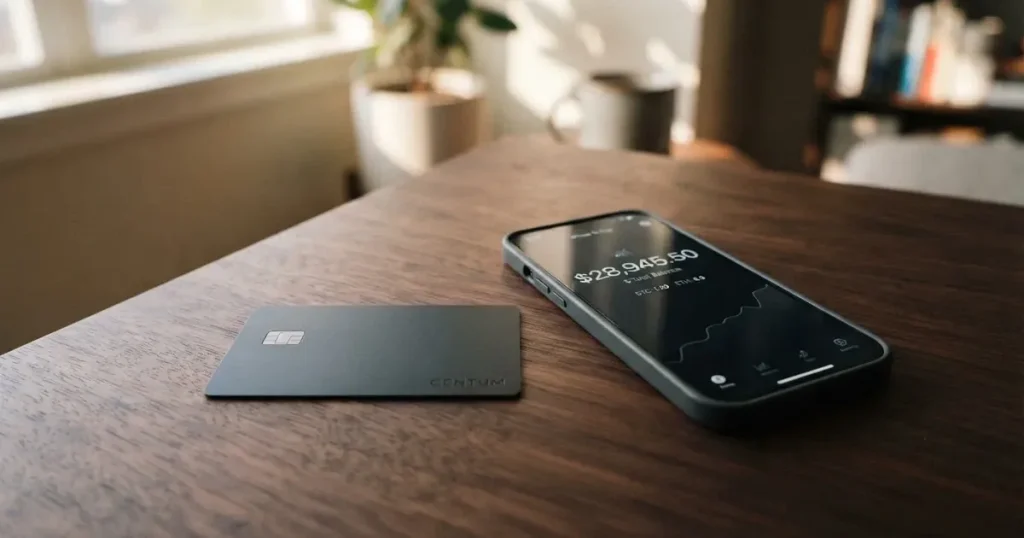
Moon is a Visa prepaid card that you load with crypto, and on paper it is built for one job: turning Bitcoin, Ethereum, USDT or USDC into a payment card that spends like any other Visa at checkout. The reality is more mixed. Moon scores 5.6 out of 10 in this review, and the gap between the parts of the service that work and the parts that worry users is unusually wide for a card in this category.
This review is current as of October 28, 2026. The score, the costs and the country reach are taken from Moon’s published terms, with third-party data marked where it appears. Where Moon’s own pages do not say something, the review says so plainly rather than filling in the gap.
Verdict
Moon’s headline pitch is straightforward: a Visa card funded by crypto, no foreign transaction fees, and a 1% transaction fee on the main product. For small, online, US-dollar purchases, that is a usable proposition. The card’s structure is simple, the top-up options cover the assets most people already hold, and the absence of an FX fee is a real advantage if you are spending in dollars from a non-dollar base.
What drags the score down is not the fee schedule. It is the rest of the picture. Moon’s issuer and the legal entity behind the card are not clearly disclosed on the public pages, Trustpilot reviewers describe accounts that have been frozen with funds held back, support responsiveness is poor, and several basic features (Apple Pay, Google Pay, Samsung Pay) are not yet supported. If you depend on a card working every time, those gaps matter more than the 1% fee.
In short, Moon suits someone who wants a simple crypto-to-USD payment card for small, occasional online purchases, accepts that support may be slow, and is comfortable sending crypto to a provider whose corporate structure is not fully transparent. It does not suit someone who needs a primary card, who relies on mobile wallets, or who wants a card with a clear regulator and a published dispute path.
| Criterion | Mark | Why |
|---|---|---|
| Who can get it | 8 / 10 | Unofficial sources quote “over 130 countries” for Moon X, with sanctioned regions excluded |
| Cost | 6 / 10 | First Moon X card free, 1% transaction fee with a $1.00 minimum, no FX fee charged by Moon, but a string of small penalty fees and an unused-balance fee at expiry |
| Top-up options | 8 / 10 | BTC, Lightning, USDT on Tron, USDC on Ethereum, ETH |
| Reliability and complaints | 2 / 10 | Issuer and legal entity not clearly disclosed, Trustpilot at 2.5/5 across 276 reviews, recurring reports of frozen accounts and withheld funds |
| Everyday use | 3 / 10 | Virtual card is ready instantly, but Apple Pay, Google Pay and Samsung Pay are not yet supported and ATM use is not described |
| Total | 5.6 / 10 |
Who Moon will give the card to
Moon is unusually wide in geographic reach for a crypto card. Unofficial sources, quoting Moon’s own terms, put the service at “over 130 countries” for the Moon X product. There is no public country list on the pages I could read, and Moon does not enumerate which countries are excluded. The clear rule is that regions under sanctions are not served, and any purchase from a country Moon does not allow will not go through. If you live in a sanctioned jurisdiction the answer is simply no; if you do not, you will most likely see whether you can finish sign-up only at the verification step.
Age is set at 18+. Beyond that, Moon does not publish an identity-document list, and it reserves the right to ask for proof of eligibility if something in your account looks unusual. There is also a note in the terms that some merchants initially blocked on a card “may open up after verification”, which is a hint that the card’s reach depends as much on what Moon can verify about you as on where you live.
For someone who cannot get an ordinary bank card — an unbanked freelancer, a person in a country where Visa prepaid is hard to obtain, a traveller with a thin local file — Moon’s reach is genuinely helpful. For someone who already has a normal card and is simply looking for a crypto-funded Visa, the country list is a non-issue and the real comparison comes down to cost and reliability.
How to get the Moon card
Sign-up is the part of Moon that reads easiest. You register with an email and a password, and Moon sends two-factor codes by email rather than through an authenticator app. There is no published list of which identity documents Moon accepts, and there is no tier structure on the public pages; you either pass verification or you do not.
Once you are in, Moon offers two products:
- Moon X is a reloadable Visa linked to a Moon Credit balance and valid for three years from the moment you buy it. The first Moon X card is free; each additional card on your account costs $2.99. The transaction fee is 1% with a $1.00 minimum per transaction.
- Moon 1X is a single-load card for US merchants only. It costs $1.49 per card, has no transaction fee, and has a $5 minimum and $1,000 maximum per card (unofficial figures not confirmed by Moon).
The card you get is virtual, and it is ready to use as soon as your account is set up. Moon’s pages do not describe a physical card, do not state a delivery time, and do not say whether a physical version is offered. If you need a piece of plastic in your wallet, that gap is something to check with support before you commit.
The practical sign-up flow is therefore: create an account, complete the email-based 2FA, pass whatever verification Moon asks for at the time, and the virtual card appears. The friction sits in the verification step, not the registration step, and the people who get stuck there are the ones whose country or document type Moon does not support.
Fees: what Moon really costs
The headline fee numbers on Moon are competitive. The real cost of using the card depends on the small print around the headline, and there are a few of those small-print items worth knowing.
| Fee or limit | What Moon says |
|---|---|
| Card issuance | First Moon X card free; $2.99 per additional Moon X; $1.49 per Moon 1X |
| Monthly fee | None stated |
| Transaction fee (Moon X) | 1%, with a $1.00 minimum per transaction |
| Transaction fee (Moon 1X) | None |
| FX / foreign transaction fee | “We do not charge any FX or foreign transaction fees” |
| Decline, reversal or refund fee | $0.50 each, after 20 of them in a month (unofficial figure not confirmed by Moon) |
| Excess refund fee | $40 (unofficial figure not confirmed by Moon) |
| Overdraw fee | $25 (unofficial figure not confirmed by Moon) |
| Chargeback dispute fee | $17.50, charged only if Moon agrees to open the dispute (unofficial figure not confirmed by Moon) |
| Unused balance at expiry | Charged as a fee |
| Moon X spend limit | $4,000 per month across all cards on the account (unofficial figure not confirmed by Moon) |
| Card creation limit | 10 per day, 30 per month |
| Moon Credit purchase limit | $10,000 per day, $30,000 per month (unofficial figures not confirmed by Moon) |
| Moon 1X load | $5 minimum, $1,000 maximum per card (counted within the $4,000 monthly maximum; unofficial figures not confirmed by Moon) |
| ATM withdrawal | Not stated |
A few everyday examples make the schedule easier to read.
A $5 online subscription paid in USD with Moon X (unofficial figure not confirmed by Moon). The 1% transaction fee would be 5 cents, but the minimum is $1.00, so the fee becomes $1.00. That is 20% of the purchase, which is a sharp reminder that the $1.00 minimum matters whenever you are making small payments. The card itself accepts the payment because there is enough Moon Credit loaded; the cost is just the floor.
A $200 purchase in a foreign currency at a foreign merchant. Moon says it does not charge an FX or foreign transaction fee, so the 1% Moon X transaction fee is the only card-side cost. Network conversion happens at the Visa rate, and the merchant’s own bank may apply its own margin, but Moon’s part of the price is the 1% plus the $1.00 minimum.
A $0.50 decline that keeps happening after a card is locked (unofficial figure not confirmed by Moon). The first 20 declines, reversals or refunds in a month are free. From the 21st onwards, each one is $0.50. For most users that is a non-event; for someone debugging a card, it can add up.
The fee that catches people off guard is the unused balance at expiry. Moon X cards are valid for three years. Anything left on the balance when a card expires is treated as a fee rather than refunded, so the effective rule is to spend down the balance before the card runs out, or accept that what is left is the cost of holding the position.
Top up: how to add money to the card
Topping up Moon starts with a transfer of one of five supported assets:
- Bitcoin (BTC)
- Lightning (Bitcoin’s layer-2 payment network)
- USDT on Tron (TRC-20)
- USDC on Ethereum (ERC-20)
- Ether (ETH)
When the transfer is confirmed on the blockchain, the amount converts into a Moon Credit balance, and that is the balance the card spends from. The cards are loaded in US dollars.
A few practical points are not stated in the terms and matter in real life. Moon does not say who pays the network fee on the deposit — whether the user is charged on top of the transferred amount, or whether it is deducted from what arrives. Moon does not say whether there is a deposit fee. Moon does not say whether you can top up directly from a bank account in fiat, the way you would with a regular prepaid card. If any of those are deal-breakers, you would need to confirm with support before relying on Moon for a specific flow.
The narrow list of supported networks is also worth noting. USDC on Tron is not a native Circle-supported pair, since Circle stopped supporting USDC on Tron in February 2024. The only USDC path Moon lists is ERC-20 (Ethereum), and the only USDT path is TRC-20 (Tron). Sending USDC to a TRC-20 address, or USDT to an ERC-20 address, would be a permanent loss, and the usual blockchain rule applies: the transfer is irreversible, so a deposit to the wrong network cannot be recovered by the network itself.
Refunds from merchants come back in Bitcoin, minus network and partner fees. There is no published account-closure process. The clearest end-of-life rule is the unused-balance fee at card expiry, which is the same idea written from a different angle: when the card is gone, anything left on the balance is gone too.
Paying with Moon day to day
Once the virtual card exists, paying with it works like any other Visa online. The card is ready instantly, the number and the expiry are in the app, and a checkout flow that accepts Visa will accept Moon. That covers the typical use case Moon is built for: small online payments in US dollars.
The gaps are mobile and physical. Apple Pay, Google Pay and Samsung Pay are listed by unofficial sources as not currently supported, with the phrase “on the way” attached. There is no published detail on when that will change, and in the meantime tap-to-pay on a phone or watch is not an option. ATM withdrawal is not described in the public terms at all, so whether you can use Moon to get cash from a Visa ATM is an open question. There is no published list of blocked merchant categories, but Moon does state that some merchants are blocked and that the list is reviewed, with a hint that verification can expand the merchant set.
There is no stated rewards or cashback programme on the pages I could read, no app ratings were checked, and the everyday experience is therefore: card works online, card does not work in your mobile wallet, card has no documented in-person or ATM use, and the balance is plain US dollars with no upside beyond the spending itself.
If your everyday payment is paying for a $9 streaming subscription or a $30 domain renewal from your laptop, Moon handles that without drama. If your everyday payment is grabbing a coffee by tapping your phone, or pulling cash from an ATM in a different country, Moon is the wrong tool.
What can go wrong with Moon
The reliability story is the part of this review where the score does the most work. The fee schedule is reasonable, the country reach is wide, the supported assets cover the main cases. The reliability story is where Moon’s public profile is thinnest.
Corporate structure is not transparent. Moon’s own pages credit “Moon LLC” as the operator and mention that the card is issued by partner financial institutions under a Visa licence. The legal entity, the registration, the issuer bank and the licences themselves are not published on the pages I could read. “Moon is not a custodial service” appears in the terms, which is a useful clarification, but it is not the same as a published regulator or a disclosed issuer.
Trustpilot is poor. As of the date the reviews were read, Trustpilot showed Moon at 2.5 out of 5 from 276 reviews, with 47% five-star and 44% one-star, and 79 of those reviews in the previous 12 months. The themes that come up again and again are: accounts frozen or restricted with funds held back, refunds delayed or tied to identity verification, support tickets that go unanswered, and short platform outages during which cards stop working. Some users describe their cards being cancelled. None of these are official shutdown notices, but the volume of similar reports is hard to ignore.
Outages have happened. Trustpilot users describe a multi-day platform outage and cancelled cards in early December 2025 and a further outage in January 2026. No official notice of either event was found in the search. For a payment card, a few days of not being able to spend is a serious problem, and the absence of a public incident report makes it hard to know what to expect next time.
Dispute fees are charged to the customer. Moon charges $17.50 (unofficial figure not confirmed by Moon) to open a chargeback dispute, and that fee is billed only if Moon agrees to proceed with the dispute. The exact time frames for raising a dispute are not stated, and the whole dispute path depends on a fee structure that may push a customer to absorb a small loss rather than chase it.
Refunds come back in Bitcoin. If a merchant refunds you, the money returns as BTC and is subject to network and partner fees. A user who loaded the card with USDT does not get USDT back. There is no published way to choose a different refund currency.
The risk surface is the same as for any crypto card. Stablecoins can depeg (USDC did briefly in March 2023). Sanctions screening can freeze stablecoin balances on the chain. Blockchain transfers are irreversible, and Moon’s terms do not promise manual recovery for a deposit sent to the wrong network. These are not Moon-specific risks, but they are risks that apply to Moon.
Pro
- First Moon X card is free
- No FX or foreign transaction fees
- Wide geographic reach (“over 130 countries” per third-party reading of the terms)
- Supports the assets most people already hold
- Virtual card is ready immediately
Con
- Issuer and legal entity not clearly disclosed
- Trustpilot at 2.5/5 with recurring complaints about frozen accounts
- No Apple Pay, Google Pay or Samsung Pay yet
- $1.00 minimum fee on small Moon X payments
- Unused balance at expiry is treated as a fee
What to take instead of Moon
If the parts of Moon that work suit you but the reliability story does not, the category has several cards that overlap with Moon’s pitch. None of them is identical; the trade-offs are real, and the table below is meant to be a starting point, not a final answer.
| Card | Country reach | Cost | Top-up | Notable feature |
|---|---|---|---|---|
| Cardex | “One crypto card, 200+ countries”, no published list | Not stated; site mentions an “AI-Powered Conversion Rate” that picks the best rate at spend time | USDT, USDC, BTC (networks not stated) | Card can run on VERVE, VISA, Mastercard and UnionPay; listing is Naira-focused |
| CardFlow | Aimed at Nigeria, “Nigerians and global users”, no published list | Virtual card creation is free; monthly fee not stated | Bitcoin, USDT, ETH, Naira bank transfer | Virtual USD Mastercard, created in three minutes |
| HyperCard | Acceptance in “more than 176 countries” (App Store wording), no eligibility list | App Store listing shows no fees | USDT, BTC, ETH in the app, converted to USD or EUR | Prepaid card with USD or EUR balance |
The honest reading of this short list is that the alternatives are not clearly safer than Moon; they each have their own gaps on cost disclosure, country list or top-up detail. The point of comparing them is not to find a clean winner but to show that the question to ask is not “which crypto card is best” but “which crypto card’s trade-offs can I live with”.
If a published issuer and a clearly named regulator matter more to you than country reach, the safest move is to look outside this trio entirely and pick a card whose issuer is licensed in a jurisdiction you can read about. If country reach is the priority and you are willing to trade transparency for that reach, Moon is one option among several that promise the same thing.
Who I would recommend Moon to
I would recommend Moon to a fairly specific reader. You are buying small things online in US dollars, you already hold BTC, ETH, USDT on Tron or USDC on Ethereum, and you do not need a physical card or a mobile wallet. You are comfortable with a virtual-only experience, you understand that blockchain deposits are irreversible, and you treat the balance on the card as a small float you top up and spend down rather than a long-term store of value. The unused-balance fee at expiry is something you actively manage.
I would not recommend Moon to you if any of the following is true. You need a card that taps to pay at a physical terminal, because Apple Pay, Google Pay and Samsung Pay are not yet supported. You need a card that works every day without exceptions, because Trustpilot users describe frozen accounts, withheld funds and multi-day outages. You want a card whose issuer and regulator you can name, because Moon’s issuer and corporate structure are not clearly disclosed. You make lots of small payments, because the $1.00 minimum fee on Moon X makes very small transactions expensive. You expect a smooth dispute path, because the dispute fee is $17.50 (unofficial figure not confirmed by Moon) and the time frames are not published.
In one line: Moon is fine as a secondary card for a narrow use case, and it is not fine as a primary card on which you depend.
Frequently asked questions
What is the Moon card?
Moon is a Visa prepaid card that you load with crypto. You fund it with Bitcoin, Lightning, USDT on Tron, USDC on Ethereum or Ether, the crypto converts to a Moon Credit balance in US dollars, and the virtual card spends that balance wherever Visa is accepted online.
How does the Moon card work?
You create an account, pass whatever verification Moon asks for, and a virtual Visa card appears. You transfer one of the supported assets to Moon’s address, the deposit converts to a Moon Credit balance, and the card spends that balance in dollars. Refunds from merchants come back to you in Bitcoin.
Is Moon a bank?
No. Moon is not a bank and is not a custodial service for your crypto. It runs a card programme issued by partner financial institutions under a Visa licence, and the legal entity is given as Moon LLC; the specific issuer bank and the licences are not published on the pages I could read.
Who owns Moon?
The published starting data credits “Moon LLC” and the brand “Pay with Moon”. The owner, the registration and the licensing details are not disclosed on the public pages.
Is the Moon card available in my country?
Unofficial sources, quoting Moon’s terms, say the Moon X product is available in “over 130 countries”. Moon does not publish a country list, and sanctioned regions are excluded. The cleanest way to know is to start the sign-up flow and see whether your country is accepted at the verification step.
How do I get a Moon card?
Register with an email and a password, complete the email-based two-factor authentication, pass Moon’s verification and the virtual card is ready to use. The first Moon X card is free; the Moon 1X single-load card costs $1.49.
Does Moon require KYC?
Moon does not publish a list of which identity documents it accepts, but it reserves the right to ask for proof of eligibility, and Trustpilot reviewers describe situations in which a refund is delayed until identity documents are supplied. The answer is therefore yes, KYC is part of the flow, even if the exact documents are not listed.
How do I top up my Moon card?
Send Bitcoin, a Lightning payment, USDT on Tron (TRC-20), USDC on Ethereum (ERC-20) or Ether (ETH) to the address Moon shows in the app. When the transfer is confirmed, it converts to a Moon Credit balance in US dollars that the card spends from.
How do I withdraw money from Moon?
Moon does not describe a standard withdrawal flow. Refunds from merchants come back in Bitcoin, and any unused balance on a Moon X card at the end of its three-year validity is treated as a fee rather than returned. Account closure is not described.
Is the Moon card safe?
The fee schedule is straightforward and Moon states it is not a custodial service, which means your crypto is not held in a Moon-controlled wallet. The reliability signals are weaker: Trustpilot sits at 2.5/5 across 276 reviews, users describe accounts frozen with funds held back, and the issuer and the regulator are not clearly published. The honest answer is that the product design looks fine, but the operational track record is the part to take seriously.
Virtual cards in the catalogue – cryptocardcatalog
Content created by the «cryptocardcatalog» team