
A fast virtual card in Telegram, funded in USDT — and almost nothing on paper
 Available in US
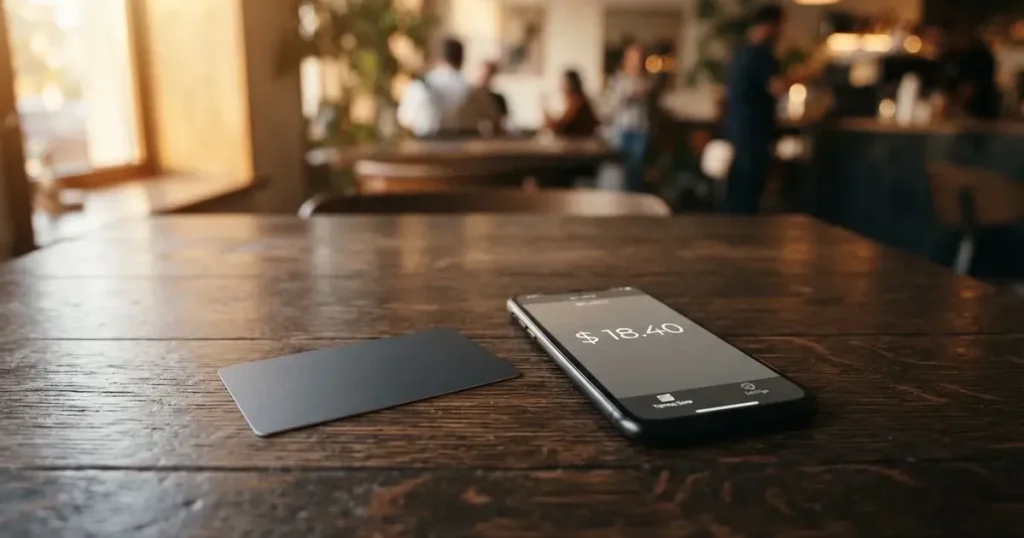
If you have run into trouble getting an ordinary bank card — because of where you live, what your documents say, or simply how long the process takes — then a card that arrives inside Telegram for nothing more than a bot will appeal to you. That is exactly the pitch: a virtual Mastercard or Visa issued straight in the messenger, topped up in USDT on the BEP20 network, added to Apple Pay or Google Pay, and good for buying goods and services. High daily limits, the site says, up to $250,000, and no monthly restrictions.
Having read what the public pages do and do not say, my score is 4.6 out of 10. That is not a verdict on whether the card works well — it may well work exactly as advertised. It is a verdict on how little you can find out before you hand over money. On the pages I could read, there is no fee schedule with a single number in it, no named company, no named issuer, no licence, and no country list. The claim on the site is “Simple and clear fees — no hidden charges”, and I want to take that seriously, but a promise that fees are clear is not the same thing as a fee you can read.
The conditions described here are current as of October 28, 2026.
Who the card suits, and who it does not
This is a fast virtual card in Telegram funded with USDT BEP20 — that single line tells you most of what you need to know, and it cuts both ways. It suits you if you want a card number today rather than in a week, if your everyday spending is digital rather than cash, if you already hold USDT and understand that BEP20 is a specific network, and if you can live with Apple Pay or Google Pay as your point of contact with the physical world. It suits you if losing the card is not a disaster, because a virtual card inside an app can be deleted with the app.
It does not suit you if you need a bank account behind it, a legal contract you can point to, a dispute process, or a card that works in a shop’s terminal as well as online. It does not suit you if your spending touches merchant categories that providers in this space routinely block, because the list of blocked categories is not stated. And it very much does not suit you if the reason you are reading this page is that your existing banking is difficult — because nothing on the public site tells you which countries are served, or whether any country is refused.
| Criterion | Mark | Why |
|---|---|---|
| Who can get it | 5 / 10 | The list of countries is not disclosed |
| Cost | 5 / 10 | “Simple and clear fees — no hidden charges”, with no amounts given |
| Top-up options | 4 / 10 | USDT BEP20 only, no bank transfers accepted |
| Reliability and complaints | 3 / 10 | No legal entity, issuer or licences named, only “© 2026 OnCard”; no reviews found |
| Everyday use | 6 / 10 | Virtual Mastercard / Visa in Telegram, Apple Pay and Google Pay; goods and services only, no plastic, no ATM |
| Total | 4.6 / 10 |
Will they give you the card
Short answer: the public pages do not say. There is no country list, and no mention anywhere of whether Russian or Belarusian citizens or residents are accepted or excluded. That absence matters more here than it might for an ordinary prepaid card, because the criteria in this category are not only about where you live but about citizenship and country of birth as well — sanctions screening and issuer risk policy are applied to citizenship and country of birth, not only to the address on your documents.
It helps to know how the industry works generally, even though none of this is specific to this card. KYC rules require regulated businesses to verify customers and assess risk under anti-money-laundering and counter-terrorism-financing law, including ongoing monitoring and reporting of suspicious activity. In the EU, customer due diligence covers name, address, date of birth, nationality and identity documentation, a sanctions check, the purpose of the relationship, and whether you are a politically exposed person. In the US, the customer identification programme requires name, date of birth, address and an identification number, with electronic systems also validating proof-of-address documents. And if due diligence cannot be completed, EU rules require the institution to decline the transaction or relationship and, where necessary, end an existing one — which is why accounts get closed or frozen while documents are chased.
Prepaid and debit cards are generally available to adults from 18; some issuers set higher limits for their own reasons.
What I could not establish for this card: which countries it serves, whether citizenship affects eligibility, and what identity checks, if any, sit behind the bot. If your situation is one where a bank has previously said no, that is exactly the information you want, and it is the information you do not have.
How to get it
The route is unusually short, and that is the appeal. You open the Telegram bot — the site says “Launch the Telegram Bot” — and activation is automatic. There is no application form described, no waiting period described, and no statement about what verification happens before the card appears.
That brevity is the first thing I would ask about. It is not automatically a red flag: plenty of low-value prepaid products verify nothing at first and verify more later, at the moment a limit or a pattern of use makes it worth the effort. But the absence of any description of the check means you cannot tell in advance whether you are walking into one of those, or into a product where none is coming.
A couple of related details are also unstated. Whether identity verification exists at all, and at what level, is not described. The card currency is not stated, which matters more than it sounds — on a card issued without a clearly stated currency, a conversion cost may be applied to every transaction, and you have no way of knowing its size in advance. If you are choosing between cards partly on what a payment will cost you, this is one of the fields you want to see filled in.
What you can say with confidence: there is no physical card. Delivery is not applicable. Nothing is shipped, so nothing can go missing in the post, and there is no plastic to lose — but also no fallback if your phone is lost or wiped.
Fees: what it really costs
Here is the honest position: the numbers are not published. The site says “Simple and clear fees — no hidden charges” and then does not give amounts. Issuance cost, monthly fee, conversion rate, currency exchange fee, ATM withdrawal fee — none of them appear as figures. The only limit I can quote is a spending limit.
| Fee or limit | Value as stated |
|---|---|
| Card issuance | not stated |
| Monthly fee | not stated |
| Crypto conversion fee | not stated |
| Currency exchange (FX) fee | not stated |
| ATM withdrawal | not stated; the card is “intended for payments of goods and services only” |
| Daily limit | “High daily limits up to $250,000” |
| Monthly limit | “no monthly restrictions” |
| Tiers | not stated — a single product is shown |
Those daily and monthly figures deserve a second look, because of how they are phrased. There is no monthly cap and a daily cap of up to $250,000 — but the daily figure is a maximum rather than a guarantee, and “up to” usually means your actual limit is set lower, per customer, after whatever checks the provider applies. There is no tier structure published either, so I cannot tell you whether the limit you are offered depends on anything you do or anything they assess.
Let me walk through three ordinary payments, because this is where an unstated fee schedule turns into real money.
Paying for something priced in dollars, from a balance funded in USDT. This is the closest thing to the card’s home turf. The payment needs the crypto converted into spendable currency first, and then — if the card’s currency is not the dollar — possibly converted a second time at the point of sale. The site does not say how either step is charged: not a percentage, not a fixed fee, not a spread. You would learn the cost from a statement you may not even have access to, after the money has gone.
Paying for something priced in euros or pounds while you hold dollars. Every crypto card in this category either converts at its own rate or charges an FX fee or both, and the two models feel different. A spread means the rate looks ordinary until you add it up; a separate fee means the rate can be good and the charge still stings. Here, neither the rate nor the fee is visible. The card currency is not stated either, so I cannot even tell you which of the two you would be dealing with.
Paying by phone at a contactless terminal. The card is virtual and you add it to Apple Pay or Google Pay, so the terminal sees a tokenised number rather than the card itself. Apple Pay replaces the card number with a device-specific number held in the phone’s Secure Element, never on Apple servers, and generates a one-time security code for each payment. In practice this is the smoothest way to use this card, and it is the reason a card with no plastic and no ATM is not necessarily a card that cannot touch anything physical. But whether the payment is accepted at a given terminal is a question about the merchant and the network, not about the card.
One general cost that is not the provider’s: when you move crypto across a network to fund the card, the blockchain charges its own network fee. That is separate from anything the card operator might take.
The costs section is where this card is weakest, and I want to be precise about why. It is not that the fees look high — I have no idea what they are. It is that a fee you cannot read is a fee you cannot budget, cannot compare against another card, and cannot hold anyone to.
Top up options: USDT and nothing else
One method, stated plainly: “Fund your card using USDT BEP20”. That is the whole of it, and it comes with a clear implication — bank transfers are not accepted. There is no fiat on-ramp through this card. If you do not already hold USDT, you will need to obtain it somewhere else and move it, and that somewhere else is where most of your friction, fees and paperwork will live.
Two details are missing and both matter. The minimum top-up is not stated, and neither is any fee charged for loading. Small recurring purchases and one-off large purchases would be affected differently by an unknown minimum.
Before you send anything, one habit is worth forming. Blockchain transfers are irreversible, so a deposit sent on a network the provider does not support, or to an address belonging to a different network, can be lost, or may need manual support recovery with no guarantee of success. BEP20 is a specific network, not a generic description of “USDT”. Check the deposit address and network against what the provider shows you, character by character, every time — not once, at the start. On a clipboard, malware can silently replace a copied address.
Withdrawal is not stated either, so the route by which money would come back out is not something I can describe.
Paying with it every day
This is the strongest part of the card, and the section where it scores best. You add the card to Apple Pay or Google Pay, and that is the intended way to spend. The card is described as intended for payments of goods and services only — which, read plainly, means no ATM, and it is why I would not treat this as a card that replaces an everyday bank card.
Everyday mechanics that are not stated, and that you should be tracking yourself for the first few months:
- Blocked merchant categories. Not stated. This is worth more attention than it sounds, because in this category providers routinely restrict gambling and similar categories. Gambling sits under four-digit merchant category code 7995, and blocking it is a policy choice by the issuer rather than a legal requirement, so the list varies from card to card. If you pay with this card for anything you would rather not have appear on a statement, that is worth knowing in advance.
- Rewards. Not stated. No cashback, no points, nothing. If a competitor pays you for spending, that is a difference you should weigh.
- A standalone app. There is none. Everything happens through the Telegram bot, and there are no store ratings to read — no App Store or Play Store page, no star rating, no download count. You are reviewing this product with the same tools you would use to review a stranger’s message.
- Disputes and chargebacks. Not stated. A chargeback is a refund ordered by the card issuer to settle a dispute, with reason codes such as fraud, duplicate billing or goods not received. Whether you can use one here, and what the time limit is, is unaddressed.
Two general things that shape how any card like this behaves at a checkout, and that will apply here whatever the fee schedule turns out to be:
A card number starts with a 6- or 8-digit issuer identification number that identifies the issuing institution; the rest is an account identifier and a check digit. Merchants can look that number up and see which institution and country issued the card, and may apply extra scrutiny if the issuer country differs from the customer’s billing address. This is the ordinary reason a card issued in one country looks “foreign” to a shop in another. Some merchants decline prepaid or foreign-issued cards for exactly this reason, and address verification — which compares the numeric parts of the billing address a buyer typed with the issuer’s records — is mainly offered in the US, Canada and the UK, and is generally unavailable for foreign-issued cards. Declines are not necessarily a statement about you.
And a declined authorisation may leave a hold on your funds that can remain for several days, typically up to seven. A card funded from a crypto balance turns that hold into a real question: does the hold eat into your spendable balance while it sits there?
What can go wrong
The honest summary of this section is that there are no reported incidents, and that is not the same as there being nothing to worry about. No official incidents were found. No third-party reviews were found either, searching for the domain along with the Telegram card, the network and fees: the results were generic USDT-card guides, one of which advises against Telegram-only providers that do not operate publicly. A Trustpilot page for the site could not be read, and no reviews were found.
That last point deserves a second look, and not as an accusation. A search returning nothing is genuinely ambiguous evidence. It can mean a young product with little history, or it can mean a site nobody has reviewed. I cannot tell you which this is, and neither can the search.
The company picture is thinner. The only identifying mark on the pages is “© 2026 OnCard” — a copyright line, which is not a legal entity, not an issuer, and not a licence. Nobody’s name is on the page as the party responsible for your money.
This is where the general structure of this category is worth understanding, because it is not a detail particular to this card. A card payment involves several parties: the network routes messages and sets the rules, the issuer is a bank or e-money institution licensed to issue cards and holds the programme, and the crypto brand is often only a programme manager or front end that markets the card. The card itself is a payment service regulated separately from the crypto side, so a crypto card often depends on two licences. Visa and Mastercard do not issue crypto cards to consumers themselves — they license issuers, and they can suspend a programme. In November 2022 Visa said it had “terminated our global agreements with FTX”, and the FTX US debit card programme was wound down by its issuer. WaveCrest, a Visa issuer that supplied crypto card brands, was suspended by Visa in Europe in 2018, closing all WaveCrest-issued Visa programmes. Programme closures typically follow a pattern: a notice period, then spending and loading stop, then users are asked to withdraw remaining balances. One 2026 closure reported by a secondary source had new loads ending 8 July 2026 and spending stopping 8 August 2026 — a single source, unconfirmed.
So the structural risk is not that anything will happen to your card. It is that the name on your screen may not be the name that stands behind it, and that when you want to know who that is, there is no name to ask.
On top of that:
- Security features. Not stated. The usual safeguards in this category are app-based two-factor authentication, an instant card freeze, spending limits, 3-D Secure confirmation and tokenised mobile wallets. Whether any of them exist here is unknown. 3-D Secure adds an identity check to online payments — the issuer assesses risk and either approves without friction or challenges you, for example with a one-time code or a biometric; Visa’s brand is Visa Secure and Mastercard’s is Identity Check.
- Support. No support channel is listed. The contacts given are Instagram and X. There is no email address, no help centre and no stated response time.
- News. Nothing stated — no announcements, no changelog, nothing about how long the service has been running.
- Custody. This card converts and holds a balance, so before you ask whether it is safe, decide who holds the funds in the meantime. With a custodial wallet the provider holds the credentials, so you must trust the provider completely, and a seed phrase — typically 12 to 24 words — is the unencrypted form of the private key, meaning anyone who obtains it can restore the wallet and spend it. Transfers are typically irreversible and a stolen key has no built-in recovery: the network cannot freeze or return the funds. Custodial platforms have a real record of failure: Mt. Gox (about US$350 million reported stolen, 2011–2014), Coincheck (about US$400 million, 2018) and Ronin Network (US$625 million, 2022). With a self-custody-linked card the funds stay in your own wallet until the moment of payment, but the loss risks pass to you: key loss, phishing, and clipboard-hijacking malware that swaps copied addresses. One further wrinkle with stablecoins: Tether says it disables tokens in wallets on the OFAC sanctions list and has frozen funds tied to illicit activity, so stablecoins are not censorship-proof.
- Regulation. On the EU side, MiCA is the markets-in-crypto-assets regulation, which ESMA states took legal effect in June 2023; its rules on asset-referenced tokens and e-money tokens applied from 30 June 2024 and the remaining provisions, including crypto-asset service provider rules, from 30 December 2024. Under MiCA, e-money tokens may be issued only by a credit institution or an electronic money institution. The transitional period lets providers already operating under national law continue only until 1 July 2026 or until they are authorised or refused authorisation under MiCA, whichever comes first — a date worth bearing in mind when you weigh how established a provider is. ESMA keeps an interim register of authorised providers and non-compliant entities that you can check. In the US, FinCEN guidance treats administrators and exchangers of convertible virtual currency as money transmitters, while ordinary users buying goods are not. And a note on what a licence would mean even if there were one: an electronic money institution must safeguard customer funds by segregating them in dedicated accounts or insuring them, but such funds are not bank deposits and may not be covered by a deposit guarantee scheme.
- Tax. Nothing here is tax advice, but the shape of the question matters. Digital assets are generally treated as property, so exchanging them for goods, services or dollars generally produces a taxable gain or loss, measured in local currency at fair market value on the date of the transaction. On this card, each payment funded from crypto may count as its own disposal. If you spend regularly, that is a bookkeeping question to take to a professional in your own jurisdiction — not something a card review can answer.
What to take instead
If your reason for looking at a Telegram card is access to a card number quickly, the alternatives below publish more of the numbers that matter. Each has its own gaps; none of them is a complete answer, and the choice depends on which gap you can live with.
| Card | Score | Card and currency | Cost | Who it serves |
|---|---|---|---|---|
| OnCards | 4.6 / 10 | Virtual only, Mastercard / Visa, currency not stated | No amounts published; high daily limits up to $250,000, no monthly restrictions | Country list not disclosed |
| Azul Card | 5.3 / 10 | Virtual only, works where Mastercard is accepted, balance in USD (converted to USD) | $20 creation, refunded after $2,000 in spending; $5 monthly; crypto top-up 4%; $0.25 per transaction; FX fee not stated | Worldwide except Russia, Belarus, North Korea, Iran, Syria, Cuba, Sudan, Venezuela, Ukraine and the Crimea, Donetsk, Luhansk, Zaporizhzhia and Kherson regions — the site says the restrictions apply regardless of nationality |
| Telecard | 6.1 / 10 | Instant virtual Mastercard, no physical or metal card, USD (conversion fee on non-USD payments) | Standard $5 one-time; VIP $49 setup then $19/month, VIP reissuance $15; main page says signup is free with no monthly fee on the basic plan; $99 minimum deposit to activate, stated as “NOT a fee” | Over 150 countries where Mastercard is accepted; identity check “available in most major regions”; terms bar users blocked or sanctioned by the US Government, including OFAC |
| Ape Wallet | 5.5 / 10 | Virtual Visa: a “service card” for subscriptions and online, plus Apple Pay / Google Pay card; currency not stated | Issuance price not stated (promo codes change it; active Apple/Google Pay card holders get a discount on the service card); no amounts for fees, but the total is shown before you confirm | No country list; works “wherever Visa is accepted”; Russian focus — SBP payments and Russian-passport KYC; nothing stated on citizenship vs residence |
Three contrasts are worth drawing out.
Where the country rules are actually written down. Azul Card is the only one of the four that publishes an exclusion list, and it says the restrictions apply regardless of the user’s nationality — so someone with a second passport is not buying their way around it. Telecard gives a softer but real statement: over 150 countries, identity checks available in most major regions, and users blocked or sanctioned by the US Government excluded. OnCards and Ape Wallet publish nothing comparable.
How much of the fee you can read. Telecard publishes the most: 1.5% currency conversion on non-USD payments, a 0.5 USDT gas fee per successful card transaction, FX and cross-border fees “up to 3% each”, and a deposit fee advertised as 0%. Azul Card publishes a 4% crypto top-up and $0.25 per transaction. OnCards publishes the sentence about no hidden charges and stops. Ape Wallet publishes no amounts but does promise that the fee and total are shown before you confirm any operation — which, while not a number, is a real design commitment.
What you can put in. This is where OnCards is most constrained. Telecard takes USDT on Tron (TRC-20) or Ethereum (ERC-20) and USDC on Ethereum, with Polygon unsupported, and its main page also lists ETH and TRX which its help page does not; bank transfers are marked “coming soon”. Azul Card takes crypto sent to the card in Telegram, with coins and networks unnamed on the pages read, and timing given as up to 10 minutes for a first top-up and 1 to 5 minutes for later ones. Ape Wallet draws on a wallet balance in USDT. Two practical notes on networks, since this is where mistakes happen: on Ethereum, gas is paid only in ETH, so a wallet holding USDT but no ETH cannot send; on Tron, fees are paid through bandwidth and energy, often burning TRX. Circle stopped supporting USDC on Tron in February 2024, so “USDC over TRC20” is not a native option.
Rewards, briefly: Azul Card has no cashback but pays “up to 40% of our fees from every transaction made by your referrals”. Telecard runs a referral scheme with Fiorini points, 1 USDT = 100 Fiorini, cashback when friends spend, rate not specified. Ape Wallet has no cashback but a two-level referral programme paying a share of invited users’ card purchases, percentages not given. OnCards states nothing.
A final check before you choose any of them, including OnCards: verify the provider where such registers exist. In the EU, ESMA’s interim register lists authorised crypto-asset service providers, white papers and non-compliant entities. That check costs a minute and answers a question marketing pages often leave open.
Who I would recommend it to
I would recommend this card, cautiously, to someone in a narrow and specific position: you already hold USDT, you understand that BEP20 is a specific network and have sent on it before, you want a card number within minutes rather than days, your spending is online and in your phone, and you are willing to treat the money on it as money you could lose in a single afternoon.
Even for that person, I would want three answers first, and I would want them in writing: what the fees actually are, which legal entity and which issuer stand behind the card, and which countries it will open accounts for. A support channel that is Instagram and X is not a place to ask those questions, which is itself part of the answer.
I would not recommend it to you if you need to know what a payment costs before you make it, if a chargeback matters to you, if you spend in physical shops often enough that tokenised mobile payment failing once would be a real problem, or if your situation makes eligibility a genuine question. That last one is the one I feel most strongly about: if you are reading this because a bank turned you down, a provider that will not say which countries it serves is not a solution, it is the same non-answer with a nicer interface.
And I would be careful with a large balance. High daily limits are not an invitation to hold a large sum here. Given that no entity, issuer or licence is named, I would keep on the card only what I could afford to lose entirely, and move the rest back out — though note that the withdrawal route is not stated either, so ask about that before you load, not after.
Frequently asked questions
What is OnCards card?
OnCards is a virtual payment card issued inside Telegram, funded with USDT on the BEP20 network. The site describes it as a virtual Mastercard or Visa card directly in your Telegram, obtained through a Telegram bot with automatic activation, and intended for payments of goods and services. You can add it to Apple Pay or Google Pay. There is no physical card, no ATM function, and no standalone app — everything happens through the bot.
How does OnCards card work?
You launch the Telegram bot, obtain the card, add it to Apple Pay or Google Pay, and pay with it at merchants. Crypto transfers are irreversible, so a deposit sent on a network the provider does not support, or to an address belonging to another network, can be lost, or may need manual support recovery with no guarantee of success. Check the deposit address and network against what the provider shows you, character by character, every time you top up.
Is OnCards a bank?
Nothing on the public pages says it is. The only identifying mark is “© 2026 OnCard” — a copyright line, which names no legal entity, no issuer and no licence. In this category the card is usually a payment service run under an e-money or banking licence held elsewhere, with the brand acting as a programme manager. Nobody’s name appears here as the party responsible for your money, so I would not treat this as a bank relationship.
Who owns OnCards?
That is not disclosed, and it is the single most important unanswered question on the page. No company is named, no registration number, no issuer, no licences. In the EU you can partly close this gap yourself: ESMA keeps an interim register of authorised crypto-asset service providers, white papers and non-compliant entities, and a provider that should be identifiable should be findable there.
Who can get the OnCards card?
The public pages do not say. There is no country list, and no mention of whether Russian or Belarusian citizens or residents are accepted or excluded. This matters because eligibility in this category is not only about residence — sanctions screening and issuer risk policy are often applied to citizenship and country of birth as well as to the address on your documents. If you cannot see your own country on a list, you are guessing.
Does OnCards card require KYC?
Not stated. The pages describe a Telegram bot with automatic activation and say nothing about identity verification or at what level it might occur. Some prepaid products verify nothing at first and more later, once a pattern of use makes it worthwhile; others never do. Since the card is aimed at people who have had difficulty with ordinary banking, the absence of any described check is worth asking about directly before you load money.
How do I top up the OnCards card?
One method only: send USDT on the BEP20 network from your own crypto wallet to the address the provider gives you. Bank transfers are not accepted. Neither the minimum top-up nor any loading fee is stated, so both are unknown in advance. Remember that the blockchain charges its own network fee for the transfer, which is separate from anything the card operator may take.
What does OnCards card cost?
No amounts are published. The site says “Simple and clear fees — no hidden charges” and gives no figures for issuance, monthly fee, conversion or currency exchange. The card currency is not stated either, so you cannot tell whether a dollar purchase involves one conversion or two. The published limits are “high daily limits up to $250,000” and no monthly restrictions. A fee you cannot read is a fee you cannot budget or compare.
Can I withdraw money from OnCards?
The withdrawal route is not stated on the public pages. That is a reasonable thing to establish before you load a large balance rather than after, especially since the only listed contacts are Instagram and X and no support channel or email is given. A declined authorisation can also leave a hold on funds for several days, typically up to seven, which may reduce your spendable balance while it sits.
Is OnCards card safe?
I would not call it safe or unsafe, because there is not enough published to judge. No official incidents were found, and no third-party reviews were found either — a search returned only generic USDT-card guides, one of which advises against Telegram-only providers that do not operate publicly. Absence of complaints is weak evidence in either direction. What is knowable: security features are not stated, support is limited to social media, and no company or issuer is named.
Virtual cards in the catalogue – cryptocardcatalog
Content created by the «cryptocardcatalog» team