
A US Bank-issued Visa that spends straight from a stablecoin balance
 Available in US
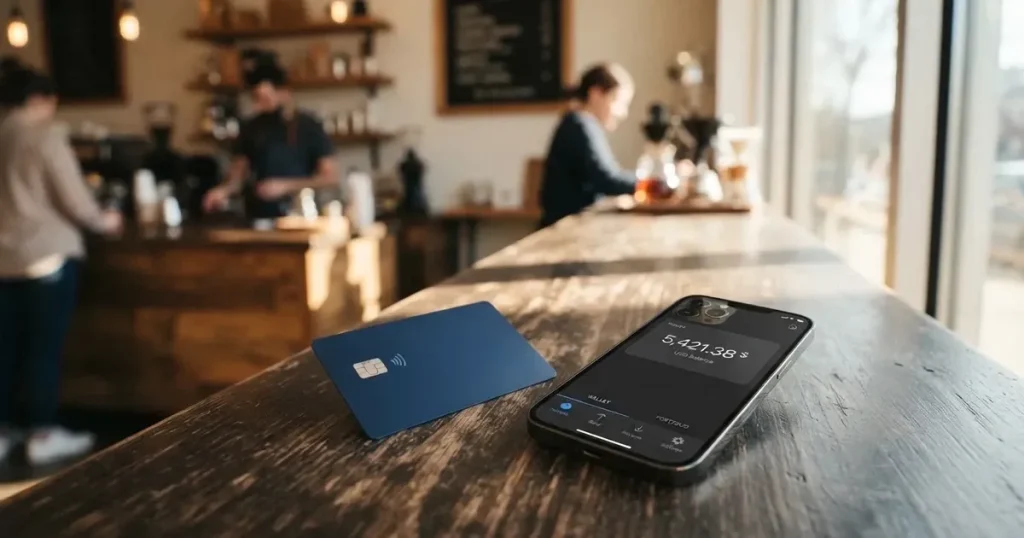
The DPT card sits in an unusual corner of the crypto-card market. It is a Visa debit card issued by U.S. Bank, but the balance behind it is held in USDC or USDT. When you tap to pay at a shop, the stablecoin converts to fiat at the moment the Visa transaction clears. There is no separate “fiat wallet” to manage and no manual conversion step before spending.
This review walks through who DPT accepts, what the card actually costs in everyday use, how the funding flow works, and where the rough edges are. The DPT card suits stablecoin holders who want a clean Visa product from a regulated bank rather than a prepaid programme. It is less suitable for anyone who needs to keep balances in multiple currencies, who wants cashback on every purchase, or who lives in the United States or Canada, because the operator does not offer services there.
Conditions current as of October 28, 2026.
Verdict
I give the DPT card 8.5 out of 10. That score reflects a few things. The card is genuinely issued by U.S. Bank under a Visa licence, custody sits with BitGo, and the operator is a Hong Kong TCSP-licensed entity. The acceptance footprint is wide: DPT says spending works in “150+ countries” wherever Visa is taken. For someone who already holds USDC or USDT, the flow is unusually clean: a transfer in, a tap to pay, no pre-loading step.
Where the score gives ground is in the everyday-use category. The fee schedule is not published in full on the public pages, so you find out about the $0.10 small-transaction charge, the 2.00% foreign-currency ceiling and the ATM surcharge only after signing up. The DPT app is the source of truth for limits, and that means a new user is committing before they see the numbers. There is no cashback on card spend, and multi-currency balances are not part of the product.
The headline audience is straightforward: stablecoin holders who want a US Bank-issued Visa card. If that is you, the DPT card does the job. If your priority is rich rewards, multi-currency accounts or a card you can use while living in the US, you should look elsewhere.
| Criterion | Mark | Why |
|---|---|---|
| Who can get it | 9 / 10 | Spending in 150+ countries wherever Visa is taken; services not offered in the US, Canada or comprehensive-sanctions jurisdictions |
| Cost | 8 / 10 | USD transactions free, foreign-currency 0% to 2.00% FX, no DPT deposit fee; issuance and monthly fees not stated publicly |
| Top-up options | 9 / 10 | USDC or USDT on Ethereum, Polygon, Tron, Solana; Base, BNB and fiat on the roadmap |
| Reliability and complaints | 9 / 10 | DPT (HK) Limited holds TCSP licence TC010834, card issued by U.S. Bank, custody with BitGo; no public complaints found |
| Everyday use | 7 / 10 | Virtual card for Apple Pay and Google Pay, physical card with chip and contactless; ATM fees and merchant restrictions not fully disclosed |
| Total | 8.5 / 10 | A clean stablecoin-to-Visa bridge for the audience it targets |
Will they give you the card
The DPT card is positioned for global use. The product page says you can spend in “150+ countries” wherever Visa is accepted, and eligibility is checked by country of residence inside the app. The Terms narrow that picture in two important places. Services are not offered to persons located in, incorporated in, or resident of the United States or Canada. Services are also not offered to people in comprehensive-sanctions jurisdictions. If you are a US or Canadian resident, you cannot use DPT, regardless of citizenship.
For everyone else, the first check is residency, not nationality. The Terms are written around “located in, incorporated in or resident of” the excluded countries, which means a short trip to New York is not a bar, but moving your address there is. A failed KYC is often explained by an “unsupported jurisdiction”, which is the operator’s way of pointing at the same rule.
What “150+ countries” does not tell you is which currencies DPT can actually settle in, what the issuer (U.S. Bank) thinks of your address, and whether the card will work with merchants in your country. Acceptance depends on the BIN (the first digits of the card number, which identify the issuer) and on the local Visa configuration. A card issued by U.S. Bank looks like a US card to a merchant in another country, and that can cause specific declines for some shops, especially in Europe, where Address Verification Service is patchy. That is a category issue, not a DPT issue, but it shows up at the checkout.
The reader’s first question is usually: “Will they give it to me?” The honest answer is: probably, if you are not in the US, Canada or a sanctions jurisdiction, you are at least 18, and you can pass standard KYC. The next question is “Will it work where I shop?”, and that is something you only really learn by trying the card on your usual merchants. The DPT roadmap says 100+ payout currencies across 80+ corridors, which is broad on paper.
How to get it
Sign-up is app-first. You download the DPT app from the Apple App Store or Google Play, or the Android APK at download.dpt.xyz. The app creates one DPT account per individual, and the minimum age is 18. KYC asks for a government-issued ID and a live selfie taken inside the app, and the Learn guide also lists a passport or national ID plus a proof of address (utility bill or bank statement, no more than three months old). The two DPT pages differ slightly: the main KYC page does not mention proof of address, the Learn guide does. In practice, you should have both ready.
Verification is typically minutes, sometimes up to 24 hours. The reasons for failure are the usual ones: blurry or expired ID, mismatched personal information, or an unsupported jurisdiction. KYC is required before you can have a card, before you can deposit at full capacity, and before you can pay out. There are no guest tiers for limited spending.
Once KYC clears, you can request a virtual card and a physical card. The virtual card is for Apple Pay and Google Pay; the physical card has a chip and contactless. DPT does not publish issuance fees, monthly fees, or shipping times for the physical card on its public pages. All of that shows up after verification, inside the app. If those numbers matter to you, you have to sign up to see them.
There is no separate activation step described in the public pages. Adding the virtual card to Apple Pay or Google Pay and the first successful top-up with USDC or USDT are effectively the activation.
Fees: what it really costs
The published fee schedule is short, and the rest lives in the app. Here is what is stated outright, in the order it tends to show up at a checkout.
| Fee or limit | Amount |
|---|---|
| Issuance fee | Not stated publicly (shown in the app) |
| Monthly fee | Not stated publicly (shown in the app) |
| USD transactions | Free |
| Foreign-currency transactions | 0% to 2.00% FX fee, depending on currency |
| Small transactions ($25 or less) | $0.10 per transaction (currently waived as a limited-time promotion) |
| Declined transactions | First 3 per calendar month free, then $0.50 each |
| DPT deposit fee | None |
| ATM withdrawal | 2% of amount + 0% to 1.75% FX surcharge + any ATM operator fee |
| Spending limits | Not stated publicly (shown in the app after verification) |
The “0% to 2.00% FX” range is the part to think about. DPT does not publish a per-currency table, so you do not know the exact fee for a specific currency without checking inside the app. The 2.00% ceiling is the worst case, and it is a normal ceiling for crypto cards. USD is free, which is a real benefit if you live, work, or run a business in dollars.
The $0.10 small-transaction fee is currently waived. The phrase “limited-time” is doing a lot of work there, so the waiver is promotional and the fee will return. The first three declines per month are free; the fourth costs $0.50. That is unusual. Most issuers do not charge for declines, and a $0.50 fee after three is a clear nudge to fix whatever is going wrong with your card setup rather than tap again.
ATM use is where the costs add up. A withdrawal outside USD costs 2% of the amount, plus up to 1.75% FX surcharge, plus whatever the ATM operator adds. There is no free allowance. If you need ATM cash regularly, this is not the cheapest card for it.
The absence of a stated issuance fee, monthly fee or shipping cost is the bigger gap. A reader has to create an account to see those numbers. That is a friction point if you are comparison shopping.
Three everyday payments
To make the cost picture concrete, here are three typical transactions and what each would cost under the published rules.
- Buying coffee in USD with Apple Pay. A $4.50 tap. USD transactions are free, but the amount is under $25, so without the current promotion there is a $0.10 fee. With the promotion in place, the effective cost is $0. The card balance and the stablecoin balance are the same, so no manual conversion is needed.
- Paying a €40 restaurant bill on a trip. The card converts USD stablecoins into euros at the Visa rate. The FX fee depends on the currency DPT sets for euros in its fee table, somewhere between 0% and 2.00%. The worst case is €0.80; the best case is nothing on top of the Visa rate. There is no $0.10 small-transaction fee because the amount is over $25.
- Withdrawing $200 from a local ATM abroad. A 2% DPT fee ($4.00), a foreign-currency FX surcharge up to 1.75% (up to $3.50), and an ATM operator fee that can be $3 to $5 depending on the bank. Realistic total: around $10 to $13 for $200, before the foreign-exchange spread. ATM cash is the most expensive way to use the card.
The big-picture takeaway is straightforward. For USD spending, the DPT card is essentially free. For non-USD spending, plan on a 0% to 2.00% FX cost. For ATM use, do not use this card for cash unless you have to.
Top up: how to fund the card
The funding model is what makes DPT different. There is no fiat deposit step in the live product. The card balance and the account balance are the same, and that balance is held in stablecoins. When you spend, the conversion to fiat happens at the Visa transaction.
Right now, the live top-up options are USDC and USDT on four networks:
- Ethereum (ERC-20)
- Polygon
- Tron (TRC-20)
- Solana
The DPT app generates a deposit address for the network you choose. The minimum is 1 USDC or 1 USDT on Ethereum, Polygon and Solana, and 10 USDT on Tron. There is no DPT deposit fee; you pay the blockchain gas only, and that goes to the sender’s wallet. In practice that means you keep a small amount of the network’s native token (ETH, MATIC, SOL, TRX) in your wallet so the transfer can go through. Credit to your account arrives about a minute after on-chain confirmation.
The roadmap, not yet live, adds Base, BNB and fiat deposits (card and bank). Until fiat top-up is enabled, the only way to add money is to send stablecoins. That is a real constraint if you earn wages in fiat and do not already hold crypto.
A few practical warnings from the published guidance. Circle stopped supporting USDC on Tron in February 2024, so “USDC over TRC20” is not a native Circle option; if DPT says it accepts USDC on Tron, treat that as the operator’s own wallet handling the deposit. The bigger warning is universal to crypto: a transfer sent on a network DPT does not support, or to an address of a different network, can be lost. Blockchain transactions are irreversible, and recovery is manual, slow, and not guaranteed. Always send a small test amount first if you are using a new network or a new wallet.
For moving money out, there are two paths. Crypto withdrawal: DPT commission 0.1% plus gas. The gas cost depends on the network (around $2.00 on Ethereum, $1.00 on Polygon, $1.00 on Solana, $5.00 on Tron at the time of writing). Bank payouts work across a number of corridors with a provider fee: India 0.30%, Nigeria 0.80%, Vietnam 0.60%, Philippines 0.50%, Brazil 0.45%, Mexico 0.50%, Indonesia 0.55%, Thailand 0.40%, Europe SEPA Instant 0.35%, UK Faster Payments 0.35%. The DPT nav bar mentions 80+ corridors; the Terms mention 100+ payout currencies. On account closure, DPT may delete an account on 7 days’ notice, and how the remaining balance is returned is not stated clearly in the public pages. Ask support before you zero the account.
Paying with it every day
Once you are set up, the card behaves like any other Visa debit card, with the same caveats. A virtual card is added to Apple Pay or Google Pay “where available”, which is the standard hedge. Whether a physical DPT card can be tokenised into a mobile wallet is not stated. In practice, virtual cards almost always can; physical cards depend on the issuer’s policy.
In a shop, the flow is: tap or insert the card, the merchant sends the transaction to Visa, Visa sends it to U.S. Bank, U.S. Bank asks DPT to settle, DPT converts the relevant amount of USDC or USDT to USD at the prevailing rate, and the merchant is paid in fiat. You see the fiat amount in your banking app; the stablecoin balance drops by the equivalent.
There is no card cashback. DPT does run a Rewards and Referral Program (referral commissions, points, elite rewards) and a DPT Earn product that puts stablecoins into a yield vault, but you will not get a flat percentage back on every coffee. If cashback is your main reason to use a card, the DPT card is the wrong tool.
Blocked merchant categories are not stated in the public pages. The help centre has merchant-restriction articles I did not read in full, which is the standard place crypto cards put gambling restrictions, adult content, and so on. The category fact worth knowing: many issuers block MCC 7995 (gambling) on crypto cards. If gambling matters to you, test before committing.
App ratings are not in the public record. A search for the DPT app on the Apple App Store and Google Play did not return a listing I could confirm. The operator hosts an Android APK at download.dpt.xyz, which is itself a small trust signal worth noting: it suggests the Google Play listing is either not published or geo-restricted in the regions I checked. The Telegram channel and X account are linked from the help centre, and the support page lists [email protected], a ticket system, and a help centre with 12 categories.
Disputes work, but the rules are not aligned across DPT’s own pages. The Learn guide says to file a dispute with support within 60 days of the statement posting date for unauthorised charges. The Terms say card disputes or chargebacks must be raised within 90 days of the transaction date. Use the longer window in your own records, and assume the 60-day statement-posting rule is the one support will quote. Decisions by DPT or its Service Partners are generally final, and the Terms point to Hong Kong courts or LCIA arbitration in London. That is a real consideration if you ever need to escalate.
What can go wrong
Crypto cards combine the failure modes of a card programme with the failure modes of a custodian and a blockchain, and the DPT card is no exception. Here are the risks I would weigh before signing up.
- Issuer or programme closure. Crypto card programmes can be shut down by the network or the issuer. Visa terminated its global agreements with FTX in November 2022 and the FTX US debit card was wound down. In 2018, WaveCrest, a Visa issuer that supplied crypto card brands, was suspended by Visa in Europe, closing all WaveCrest-issued Visa programmes. Programme closures typically give a notice period, then stop spending and loading, then ask users to withdraw remaining balances. The DPT card’s programme manager is DPT (HK) Limited; the issuer is U.S. Bank. If either pulled out, cardholders would have a window to act.
- Custodian risk. The Terms say users do not deposit funds with DPT on a custodial basis, which is a specific legal statement rather than a guarantee. The homepage says assets are held with BitGo, described as a “qualified custodian” with coverage up to $250M subject to terms. Custodial platforms have a record of failures. Holding funds with a custodian always carries counterparty and hack risk.
- Sanctions and censorship. Tether has disabled tokens in wallets on the OFAC sanctions list and has frozen funds tied to illicit activity. Stablecoins are not censorship-proof. If your address ends up on a sanctions list, your funds can be frozen even though you control the keys in a self-custody wallet.
- Stablecoin depeg. USDC and USDT aim to hold a 1:1 peg to the US dollar, but “stable” is an aspiration. USDC temporarily lost its peg in March 2023 during the US banking crisis, and TerraUSD collapsed in May 2022. A depeg means the card balance is worth less than the dollar you expected to spend.
- Wrong network or wrong address. Blockchain transfers are irreversible. A deposit on a network DPT does not support, or to an address of a different network, can be lost or require manual support recovery with no guarantee. Send a test amount first.
- AVS and foreign-BIN declines. A US Bank-issued card looks like a US card to a merchant. Address Verification Service is mainly available in the US, Canada and the UK and is patchy elsewhere, which can cause declines for foreign-issued cards at some merchants. Some merchants decline prepaid or foreign BINs outright. The DPT card is a debit card, not a prepaid, but the issuer country is still US.
- 3-D Secure friction. Online card payments increasingly use 3-D Secure (Visa Secure for Visa). The issuer decides whether to challenge the cardholder, and the experience varies. If you do not have a mobile number or app-based authentication set up, expect some online declines.
- Geographic exclusion. DPT does not offer services to people in the US, Canada, or comprehensive-sanctions jurisdictions. If you move, your account becomes unsupported and DPT can ask you to close it.
- Account deletion on 7 days’ notice. The Terms allow DPT to delete an account on 7 days’ notice. What that means for any remaining balance is not stated in plain language.
- No public complaint record. A search for DPT Pay reviews returned nothing on Trustpilot or Reddit. That cuts both ways. It is not evidence of a problem, but it does mean there is no large pool of user experience to learn from. The third-party news that does exist is a KuCoin-hosted post by a single author noting the Android app had about 5,000 downloads and no public card-volume figures.
The DPT card has more transparency than many crypto cards: the operator, the issuer, the custodian and the licence are all named. That is positive. The risk profile is still that of a stablecoin-funded card, and the only ways to reduce it further are to keep balances low, to use a self-custody wallet to send deposits rather than leaving funds on an exchange, and to avoid the card as a long-term store of value.
What to take instead
The DPT card is not the only option. Three alternatives show up in the same general category. None of them is a clone, and each makes different trade-offs.
| Card | Score | Networks | Card type | Funding | Best for |
|---|---|---|---|---|---|
| DPT | 8.5 / 10 | Visa | Virtual and physical, USD | USDC, USDT on Ethereum, Polygon, Tron, Solana | Stablecoin holders wanting a US Bank-issued Visa |
| Cardex | 5.6 / 10 | VERVE, Visa, Mastercard, UnionPay | Virtual and physical, Naira | USDT, USDC, BTC | Users whose primary need is a Naira-denominated card |
| CardFlow | 4.9 / 10 | Mastercard | Virtual USD card, about 3 minutes to create | BTC, USDT, ETH, Naira bank transfer | Nigerians needing a quick virtual USD card |
| HyperCard | 4.7 / 10 | Not stated | Prepaid, balance in USD or EUR | USDT, BTC, ETH | Users wanting a simple USD or EUR balance prepaid card |
- Cardex (5.6 / 10) is a multi-network debit crypto card. The website talks about an “AI-Powered Conversion Rate” that scans global exchanges and picks a rate at the moment of payment, which is a different model from DPT’s Visa-rate conversion. The published material is light on fees and funding details, and the App Store listing is Naira-focused. If you need a Naira card and are comfortable with less disclosure, Cardex is on the table; if you want a US Bank-issued Visa with a named custodian, it is not.
- CardFlow (4.9 / 10) is a virtual USD Mastercard aimed at Nigeria. The site says creating a virtual card is free and takes about 3 minutes. Fees are not stated. If you need a fast virtual USD card and live in the supported corridor, it is worth a look. If you need a physical card or a regulated US issuer behind the card, it is not.
- HyperCard (4.7 / 10) is a prepaid card with a balance in USD or EUR. The official pages give no country list for eligibility; the App Store says it works in “more than 176 countries”, which is an acceptance figure, not an eligibility one. Funding is USDT, BTC, ETH. If a simple USD or EUR balance is the priority and you do not need a named bank issuer, HyperCard is an option; if you want disclosure on fees and a regulated bank behind the card, the DPT card is the stronger product.
The honest comparison is that DPT is the strongest of the four on transparency and regulatory framing. The others may be faster to set up, cheaper to fund, or more useful in specific corridors (Naira for Cardex and CardFlow, EUR balance for HyperCard). The score gap reflects that.
Who I would recommend it to
I would recommend the DPT card to a stablecoin holder who:
- Lives outside the United States and Canada, and outside comprehensive-sanctions jurisdictions.
- Already holds USDC or USDT in a self-custody wallet, or on an exchange that supports the four live networks (Ethereum, Polygon, Tron, Solana).
- Wants a Visa debit card issued by a US bank, and is comfortable with the issuer being a US institution even if they live in another country.
- Spends mostly in USD, or can absorb a 0% to 2.00% FX cost in non-USD spending.
- Does not need cashback, multi-currency balances, or a cheap ATM card.
I would not recommend the DPT card to someone who:
- Lives in the US or Canada. The Terms do not allow it.
- Wants a card that earns rewards on every spend. The DPT card has no cashback.
- Needs to draw cash from ATMs regularly. The ATM cost stack (2% + up to 1.75% FX + operator fee) is high.
- Holds balances in many currencies and expects to hold those balances on the card. Multi-currency balances are not part of the product.
- Wants a fully fiat-funded card today. Fiat deposits are on the roadmap, not live.
- Needs detailed public fee disclosure before signing up. The fee schedule is in the app, not on the public pages.
If you are not sure which bucket you fall into, the cheapest way to find out is to do a small test: download the app, complete KYC, see the fee schedule in the app, send a small USDC transfer, and put the card into Apple Pay. None of those steps commits large amounts of money, and they will tell you in an afternoon whether the DPT card is the right tool.
Frequently asked questions
What is the DPT card?
The DPT card is a Visa debit card issued by U.S. Bank under a Visa licence and managed by DPT (HK) Limited, a Hong Kong company. The balance behind the card is held in USDC or USDT, and the conversion to fiat happens at the moment of the Visa transaction. There is no manual conversion step and no separate fiat wallet.
How does the DPT card work?
You send USDC or USDT to a DPT deposit address on Ethereum, Polygon, Tron or Solana. The stablecoin balance in the DPT app is the card balance. When you pay at a shop, the merchant sees a normal Visa transaction, the issuer settles in fiat, and the equivalent amount of stablecoin is deducted from your account at the prevailing rate.
Is DPT a bank?
DPT itself is not a bank. DPT (HK) Limited holds a Hong Kong TCSP licence (TC010834) under AMLO Cap. 615 for trust or company service provider activities. The card is issued by U.S. Bank under a Visa licence, and custody of the stablecoin assets is with BitGo, which DPT describes as a “qualified custodian” with coverage up to $250M subject to terms.
Who owns DPT?
The public pages name DPT (HK) Limited as the operator. The Terms state that DPT arranges card issuance through a Service Partner, and the licensing structure is Hong Kong TCSP plus U.S. Bank as Visa issuer plus BitGo as custodian.
Is the DPT card available in the United States or Canada?
No. The Terms say services are not offered to persons located in, incorporated in, or resident of the United States or Canada, or in comprehensive-sanctions jurisdictions. A failed KYC for an “unsupported jurisdiction” is the operator’s way of saying the same thing.
Does the DPT card require KYC?
Yes. KYC is required for the card, for deposits at full capacity, and for payouts. You need a government-issued ID and a live selfie in the app, and the Learn guide also lists a proof of address no more than three months old. Verification usually takes minutes, but can take up to 24 hours. Limits appear in the app after verification.
How do I add the DPT card to Apple Pay or Google Pay?
The virtual card is the path into mobile wallets. Once KYC is complete and the virtual card is issued, the DPT app offers an Add to Apple Pay or Add to Google Pay option. Whether the physical card can be tokenised is not stated. Mobile wallet support is “where available”, which is the standard hedge.
How do I top up the DPT card?
You send USDC or USDT to the DPT deposit address for one of the live networks: Ethereum (ERC-20), Polygon, Tron (TRC-20), or Solana. Minimum 1 USDC or USDT on Ethereum, Polygon and Solana, 10 USDT on Tron. There is no DPT deposit fee. The sender pays the blockchain gas. Credit to the account arrives about a minute after on-chain confirmation.
Is the DPT card safe?
The DPT card has more transparency than many crypto cards: a named operator (DPT (HK) Limited), a named US bank issuer (U.S. Bank), a named custodian (BitGo), and 24/7 support. The standard risks of a stablecoin-funded card still apply: custodian and counterparty risk, stablecoin depeg risk, sanctions and censorship risk, and the irreversibility of blockchain transfers. Always send a small test amount first if you are using a new network, and keep balances low.
How do I close my DPT account?
The Terms allow DPT to delete an account on 7 days’ notice. To close from your side, contact support at [email protected] or through the in-app ticket system and ask for closure. How the remaining balance is returned is not stated clearly in the public pages, so ask support before you zero the account. Withdraw any meaningful balance before requesting closure.
Virtual cards in the catalogue – cryptocardcatalog
Content created by the «cryptocardcatalog» team