
What KuCard actually offers in practice, and where it falls short
 Available in US
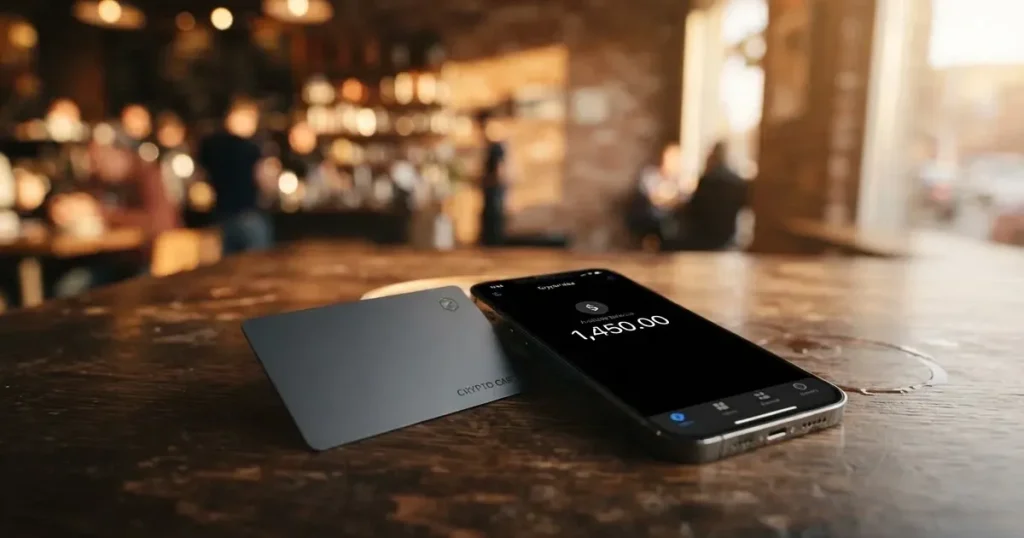
KuCard is a Visa debit card run by the KuCoin exchange and issued by an Estonian e-money institution called Wallester AS. The pitch is straightforward: hold crypto on KuCoin, spend it wherever Visa is accepted, and let the platform handle the conversion at the till. In practice, the card is one product, with a virtual and a physical version, built around a single level of KYC and a fee schedule that is part clear and part deliberately vague. I went through the terms, the help articles and what users are saying, and here is what I found.
The conditions below are current as of October 28, 2026.
Verdict
I would score KuCard 6.0 out of 10. The number reflects a card that does what it says on the tin for a narrow audience, and has real limits once you look past the marketing. It is free for everyday euro spending, it works wherever Visa works, and the regulatory setup is solid: a licensed Estonian issuer under EU supervision, with a Lithuanian virtual-currency entity behind the platform. But eligibility is tightly restricted to the EEA, the top-up side is thin, and several practical questions (ATM allowances, daily limits, top-up fees, supported networks) are not answered in the card’s own pages.
If you are an EU resident who already uses KuCoin and you want a simple way to spend a USDT balance in euros, KuCard is one of the more direct options. If you do not have a KuCoin account, or you live outside the EEA, or you want a card with transparent limits and a published rewards table, this is not it.
| Criterion | Score | Why |
|---|---|---|
| Who can get it | 5 / 10 | EEA citizens and residents only, Malta excluded, requires an EEA-issued ID |
| Cost | 6 / 10 | First virtual card free, further cards €9.90–€9.99, physical €9.90, 2% on non-euro spending, €2 per European ATM withdrawal |
| Top-up options | 4 / 10 | Funded from crypto in the KuCard account, USDT by default; supported coins and networks not listed publicly |
| Reliability and complaints | 7 / 10 | Licensed Estonian issuer, near-zero card-specific complaints; wider KuCoin Trustpilot profile is heavily negative, but that is the exchange, not the card |
| Everyday use | 8 / 10 | Visa debit, virtual and Chip&Pin physical, Apple Pay and Google Pay reported by third parties (unofficial), €2 European ATM fee, virtual card expires at month end |
| Total | 6.0 / 10 | — |
Who can get KuCard
KuCard is not a global card. The terms restrict it to citizens and residents of the European Economic Area. The help page adds that the card is not available in Malta, which leaves the EU member states (minus Malta) plus Iceland, Liechtenstein and Norway. You need an EEA-issued identity document, which rules out, for example, a German resident applying with a non-EEA passport.
This is not a soft preference. The terms describe the EEA-only rule as the availability condition, and the help page confirms the Malta carve-out. If you are not in scope, there is no work-around: the application will be declined. A non-EEA passport is not enough even if you live in, say, France, and conversely an Estonian passport held by someone in Bangkok does not seem to be enough on its own either, because the card is funded from a KuCoin EU account and the KYC ties to the address.
I should also flag the audience point: KuCard is most useful if you are already a KuCoin EU customer. The exchange account, the KYC and the card are all on the same platform, and the card is funded from the crypto balance you already hold there. If you are not on KuCoin, the card is one of the more limited entry points into a crypto card, because you cannot simply open a card account independently.
How to sign up
The sign-up path is the same three steps that any regulated EEA crypto card requires, with KuCoin’s own platform doing the work.
- Open a KuCoin EU account. If you already have one, you can skip this; the card sits inside the same account.
- Complete full KYC. The terms require a supported EEA-issued identity document (passport or national ID), a verified address, and you must be at least 18. The platform also checks the supporting details a person usually fills in (name, date of birth, phone number, a 3-D Secure password) and rejects applications where those are inconsistent. If you do not have enough balance in the KuCard account to cover the card fee at the moment of issue, the application is refused by the risk system.
- Apply for the card on the platform. A virtual card is issued immediately and can be used at once. A physical Chip&Pin card can be ordered and is activated in the app once it arrives.
The terms cap you at five cards in total. If the card you order is physical, it is posted to the address you have on file, and the platform charges €30 for express delivery; a replacement card is €9.90. Standard delivery time and cost are not stated, which is one of the small gaps I would want to close before ordering.
The terms also list a single KYC level: full identity verification with an EEA-issued document, address check, age 18+. There is no lighter “starter” tier and no anonymous card. Processing time for a completed application is not stated in the public pages.
Fees and what you actually pay
The fee schedule on the card’s own pages is a short page with some line items and several “see the FAQ” or “as we may reasonably prescribe” pointers. A fee schedule reproduced by a support article, dated September 2026, fills in more of the picture, and I used that alongside the terms. Where the two disagree (and they do, on a couple of points), I have noted both values.

| Fee or limit | Amount |
|---|---|
| First virtual card | Free |
| Further virtual cards | €9.90 (fee schedule) / €9.99 (older support article) |
| Physical card | €9.90 for the first one (fee schedule) / €19.90 (ambiguous as written) |
| Card replacement | €9.90 |
| Express delivery | €30 per card |
| Card cancellation | Free |
| Payments in euro | Free |
| Payments in another currency | 2% of the transaction total |
| ATM withdrawal in Europe | €2 per withdrawal |
| International ATM withdrawal | 2% of the transaction total + €2 |
| Declined payment (insufficient funds) | Free |
| Overdraft | Not available |
A few everyday scenarios are worth walking through, because the fee mix is what determines whether the card is cheap or merely cheap-looking.
You buy a €40 train ticket on a French rail site. The transaction settles in euro. There is no conversion fee, no foreign-transaction fee, and no platform fee on top. The only thing you have paid is the implicit spread between the crypto-to-euro rate KuCoin sets when it funds the card and the rate you would have got converting the same USDT on a public exchange. The terms describe that rate as “solely determined by” KuCoin, so the spread is opaque, but the explicit fee is zero.
You buy a $30 item from a US website. The transaction settles in dollars. You pay the 2% non-euro fee, which is €0.55 at the then-current rate. Again, the conversion spread is the bigger unknown, because the platform is converting your USDT to dollars (or to euros that the card then converts to dollars) at a rate it controls. If the spread is small, the all-in cost is slightly above the published fee; if it is wider, the all-in cost increases noticeably. The published fee is honest; the spread is not.
You withdraw €100 from an ATM in Berlin. The platform charges €2, the ATM operator may charge its own fee on top, and you have spent 2% of the withdrawal on the platform’s fee alone. That is uncompetitive for routine ATM use, and a reason to keep KuCard as a payments card rather than a cash card.
The limits — daily spending cap, monthly cap, ATM cap — are not stated in the terms. A third-party write-up from October 2026 notes that KuCoin does not publish a universal spending and ATM limit table. The terms do say the issuer may set daily limits and that limits are part of the FAQ rather than the document you sign. This is unusual, and it is the kind of thing you would want to confirm in the app before relying on the card for a large purchase.
Top up
Top-up is where KuCard differs from most of its category, and where it shows its limits.
The primary funding source is supported cryptocurrency held in your KuCard account, which is part of the KuCoin EU platform. The default spending currency is USDT. The full list of supported coins and the list of supported networks are not published in the card’s own pages. In practice this means you can fund the card with whatever KuCoin lets you hold, but the card’s terms do not tell you which coins are spendable, on which networks, or what minimum top-up applies. A third-party search I ran found nothing beyond the USDT default.
There is no row in the fee schedule for “top-up”, which suggests no explicit platform fee on top of the conversion. The terms do say “a conversion spread” may apply, and they are explicit (clause 10.2) that the rate from crypto to euro is “solely determined by” KuCoin. That is the real cost of topping up: not a number on a fee line, but the gap between the rate KuCoin applies at the moment your balance converts and the rate you could have got elsewhere.
A few related details matter for everyday use. Fiat top-up is not mentioned, which I read as “not supported”; the card is a crypto-funded card, not a hybrid card. Who pays the on-chain network fee (gas, bandwidth) for the deposit that funds the card is not stated, but in practice it is the depositor, because that is how blockchain transfers work regardless of which platform you use. Moving card balance back to crypto or to a bank account is not described in the public pages; cancelling a card is free, and refunds always come back in fiat. The terms also let the platform close an unactivated card after three months with no refund of service charges, and let it terminate a card after four months of being closed or blocked, or six months of non-use; what happens to any remaining balance in those cases is not stated.
Paying with it every day
Once the card is in your hand, or in your wallet app, the experience is closer to a standard Visa debit card than to a typical crypto product.
The card is accepted wherever Visa is taken, in store and online, with no merchant category list published and no public list of blocked categories. The terms restrict use to purchases not prohibited by law, which is the usual floor rather than a ceiling. Online checkout uses Visa’s 3-D Secure (Visa Secure), so you should expect the occasional one-time code or biometric prompt.
For mobile payments, the card’s own pages do not say whether Apple Pay and Google Pay are supported. Two third-party sources from 2024 and 2026 report that both are available, but KuCard’s public documents do not confirm it. If mobile wallet support matters to you, that is a question for support before you order.
Refunds are paid in fiat and valued at the euro amount at the time of the original transaction, so a refund for a €40 item from three weeks ago comes back as €40, not as the current crypto equivalent. Disputed or unauthorised transactions have to be reported within 60 days of the transaction date, or the platform treats them as correct. That window is short, and it is worth setting a calendar reminder for any non-trivial charge you do not recognise.
There is a rewards programme, but it is not on the card’s own pages. A third-party report from October 2026 describes a tiered system paid in points redeemable for USDC, with eight monthly tiers based on eligible spend: a 1% rate below 500 USDC (capped at 5 USDC per month) up to an 8% rate above 30,000 USDC (capped at 200 USDC per month), points vesting after 15 days and expiring after 90 days, and 1,000 points equal to 1 USDC. The same source describes a €2 monthly inactivity fee on a virtual card after 90 days without a transaction. None of this is on the card’s official pages, so I would treat the rewards table as unofficial and not guaranteed.
The virtual card has one practical quirk: it expires at the end of the month and must be reapplied. That is a nuisance for anyone who saves a virtual card to a recurring billing profile, because the number changes, and any service that charges it on a schedule will need to be updated. The physical card is a standard Chip&Pin Visa debit and behaves like one.
What can go wrong
The card-specific risk picture is small. There is one card-only review on Trustpilot, from July 2026, about $120 stuck after the card on file expired, with the reviewer describing repeated document requests (an old bank PDF statement) and slow replies, and reporting roughly €110 in accumulated fees. That is a thin signal on its own, but it is also the only card-specific signal I could find, and it is consistent with the wider pattern of complaints about the KuCoin exchange.
That wider pattern matters, because the card sits on top of the exchange. The KuCoin Trustpilot profile (read 2026-10-20) does not show a TrustScore, “unavailable due to a breach of our guidelines”, with 1,597 reviews and 78% one-star. The recurring themes are withdrawal and account restrictions in late summer and early autumn 2026, dormancy fees and repeated ID demands at login in September and October 2026, P2P disputes in August and September 2026, and deposits not credited from June to September 2026. The card is not the subject of most of these complaints, but if your card is funded from the same account that users are reporting problems with, the operational risk is shared.
The corporate setup is reassuring, as far as it goes. The card is issued by Wallester AS, an Estonian e-money institution (registry code 11812882), a Visa principal member, supervised by the Estonian Financial Supervisory Authority. Virtual currency exchange and deposit services are operated by UAB EURLITA in Lithuania. KuCoin operates the platform. The fee schedule page on the card’s own site was last updated on 29 September 2026, and I found no licence loss, no fine and no public regulatory action against the issuer or the platform.
On the operational side, the card has the standard safeguards: Strong Authentication (two independent elements) is required for sensitive actions, the unauthorised-use liability is capped at €50 unless there is fraud or gross negligence, and lost or stolen cards can be frozen immediately on the platform. Two-factor authentication is not specifically called out in the card terms, and insurance on the card balance is not stated, so I would not assume either.
The other risk worth naming is the conversion spread. The terms are explicit that KuCoin alone sets the crypto-to-euro rate. A 1% spread on a €1,000 spend is €10, and it is invisible at the point of sale. That is a higher expected cost than the published 2% foreign-transaction fee on a single non-euro purchase, and it is the part of the cost structure that has the least transparency.
What to take instead
KuCard is one of several crypto cards aimed at users who already hold crypto on a centralised exchange, and the alternatives differ mostly in where they are available, what they cost, and what they pay back. The scores below are from the same review system, so they are comparable.
| Card | Score | What it is, briefly |
|---|---|---|
| KuCard | 6.0 / 10 | EEA-only Visa debit, USDT-funded, no published limits |
| MSX | 6.4 / 10 | Score higher; specific terms not published on the official pages I could read |
| Bybit Card | 6.0 / 10 | Not available to EEA customers; available across Latin America, AIFC, Georgia, Australia, parts of Asia Pacific; multi-region multi-currency; published tiered cashback |
| Young Card | 5.7 / 10 | Cashback paid in YNG tokens, rate varies by Club tier |
A few observations on this set. Bybit Card explicitly bars EEA customers, so it is not a substitute for KuCard if you are in Europe, but it is the more developed product in the regions where it is sold: published issuance fees by region, a six-tier cashback programme (Base 2% / Beta 2% / Alpha 4% / Apex 6% / Omega 8% / Infinite 10%), and a clear funding path through a Bybit Funding Account plus a Flexible Easy Earn balance. MSX scores higher than KuCard on the same scale, but its eligibility, fees and rewards are not on the official pages, so the score is harder to act on. Young Card’s appeal is its token-based cashback, which is also its main risk, because the value of the cashback is tied to the price of the YNG token.
For EEA residents specifically, the realistic alternative set is narrower. If you do not have a KuCoin account, KuCard is not a convenient starting point, and a card from a card-first provider with published limits and a published rewards table is likely to be a better fit.
Who I would recommend it to
KuCard is a reasonable card for a narrow user. If you are an EEA resident (and not in Malta) with an existing KuCoin EU account, a USDT balance you want to spend, and a willingness to live with the conversion spread, KuCard will do the job. It is a Visa debit, it is accepted where Visa is accepted, the euro payments are free, and the regulatory chain is sound. The €2 European ATM fee means it is not the card you reach for when you need cash, but for everyday in-store and online spending it is competitive.
It is not the right card if you want clear, published limits; if you live outside the EEA; if you do not already have a KuCoin account and do not want one; if you want a rewards programme that is described on the card’s own pages; or if your main use case is cash withdrawal. In any of those cases, the cost of working around the card’s gaps is higher than the cost of using a different card.
Frequently asked questions
What is KuCard?
KuCard is a Visa debit card issued by Wallester AS (an Estonian e-money institution) and operated on the KuCoin EU platform. It is funded from supported crypto held in your KuCard account and converts to fiat at the till, with euro payments free and non-euro payments charged a 2% fee.
Is KuCard a bank?
No. KuCard is a card programme run by a licensed e-money institution, not a bank. The e-money licence means the issuer can safeguard customer funds in segregated accounts, but those funds are not bank deposits and are not covered by deposit guarantee schemes.
Who can apply for KuCard?
Citizens and residents of the European Economic Area, with an EEA-issued identity document, a verified address and an age of at least 18. The card is not available in Malta even though Malta is in the EEA.
Does KuCard require KYC?
Yes. There is a single KYC level: full identity verification with an EEA-issued passport or national ID, a verified address, and an age of 18 or older. The application can be refused for an invalid phone number, a name or date of birth that does not match, a 3-D Secure password problem, insufficient balance to cover the card fee, or a risk-control decision.
How do I top up KuCard?
The card is funded from supported cryptocurrency in your KuCard account; the default spending currency is USDT. The card’s own pages do not list the supported coins or networks, and do not state whether fiat top-up is supported.
Can I use KuCard with Apple Pay or Google Pay?
The card’s own pages do not say. Two third-party sources from 2024 and 2026 report that both wallets are supported, but KuCard’s public documents do not confirm this, so it is worth checking with support before ordering if mobile wallet support matters to you.
How much does KuCard cost?
The first virtual card is free, each further virtual card is €9.90 to €9.99, the physical card is €9.90, replacement is €9.90 and express delivery is €30. Euro payments are free, non-euro payments cost 2% of the transaction, European ATM withdrawals cost €2 and international ATM withdrawals cost 2% plus €2. The conversion spread between the crypto rate KuCoin sets and the public market rate is the implicit, unstated cost.
How do I dispute a transaction?
Unauthorised transactions must be reported through the platform within 60 days of the transaction date, or the platform treats them as correct. Refunds are paid in fiat and valued at the euro amount at the time of the original transaction; fee refunds are not available.
Is KuCard safe?
The issuer is a licensed Estonian e-money institution supervised by the Estonian Financial Supervisory Authority, and the card has the standard EU safeguards including Strong Authentication, a €50 cap on unauthorised-use liability and the ability to freeze a card immediately. The wider KuCoin Trustpilot profile is heavily negative, but that is the exchange, not the card; the card-specific signal is one review.
Can I get my money back from KuCard?
Cancelling a card is free. The terms do not describe how to move a card balance back to crypto or to a bank account, and they do not state what happens to any remaining balance when a card is closed for inactivity, so it is worth asking support about the specific withdrawal path before you rely on the card for any balance you cannot leave on it indefinitely.
Exchange cards in the catalogue – cryptocardcatalog
Content created by the «cryptocardcatalog» team