
What I could and could not confirm about the Freedomia virtual Visa
 Available in US

I have spent time with Freedomia’s own pages and with what is written about the card elsewhere, and the honest summary is this: the product is unusual in ways that will suit some of you and worry others, and a good deal of what you would want to know is simply not on the public site. The card is a digital Visa, issued instantly, funded from crypto or stablecoins and automatically swapped into dollars. There is no plastic, no bank branch, no app to download. And the same absence of ceremony that makes it attractive to a privacy-minded person is the absence of information you would normally use to judge a financial provider.
I am going to walk you through what the card states, what it does not state, what a third party has said, and then put it next to three alternatives so you can see the shape of the choice. Read the costs section before you get excited about the Lightning support — that part is the best of the offer and it does not cancel the rest.
The conditions described here are current as of October 28, 2026.
Verdict: 6.1 out of 10, with a lot of the score resting on silence
Freedomia scores 6.1 / 10 overall. That is not a dismissal, and it is not a recommendation either. It is the score I land on after weighing a genuinely strong point — the range of ways you can fund the card — against a genuinely weak one — how little the public pages tell you about who is actually behind it.
| Criterion | Mark | Why |
|---|---|---|
| Who can get it | 8 / 10 | Described only as “Global”, with no country list or restrictions on the home page |
| Cost | 4 / 10 | Founder tier $5/month or $60/year; 1.3% top-up fee, 2.5% standard FX fee, 0% on USD spending; issuance fee not disclosed |
| Top-up options | 9 / 10 | Lightning, BTC, XMR, ETH, LTC, SOL, TRX, BNB, USDT (Polygon), USDC (Polygon) “and more”, plus swapping in USD |
| Reliability and complaints | 5 / 10 | Freedomia Digital Group LLC in Delaware; issuer and licences not named; unofficial reports describe a custodial, closed-source service; no Trustpilot reviews found |
| Everyday use | 5 / 10 | Digital Visa only, instant issuance, 3DS Secure; Google Wallet available, Apple Pay “coming soon”; no plastic, no ATM |
Two things are worth saying plainly before anything else.
First, the top-up mark of 9 is not decoration. Almost every card in this category makes you fund it one way, usually a single stablecoin on a single network. Freedomia accepts the Lightning Network alongside eight named coins and two Polygon stablecoins. If funding from your own node or from a Lightning wallet is the reason you are here, this is the part of the card that delivers.
Second, the cost mark of 4 is driven by one specific gap: the fee for issuing the card is not stated. You can read the subscription prices, you can read the 1.3% top-up fee and the 2.5% FX fee, and you cannot read what it costs to get the card number in the first place. That is the number a first-time buyer most wants, and it is the one the site leaves out.
So who does this card suit? In my reading, it suits a privacy-minded user who wants to fund a virtual Visa with BTC or Lightning, who is comfortable holding money with a provider they cannot inspect, and who will not need a physical card or a cash machine. Who does it not suit? Anyone who needs a physical card in the post, anyone who withdraws cash, anyone who wants to know the name of the bank that issued their card number, and anyone whose country might be on a restricted list they cannot read.
Will they give you the card?
The card describes itself as “Global”. That is the whole of what the home page says about eligibility: no country list, no exclusions, no note about where you must be resident. There is a FAQ question on the site asking which countries are restricted. The answer to that question was not readable to me. I am not going to guess at it.
That gap matters more than it sounds. Nationality is recorded and screened separately from residence, because sanctions screening and issuer risk policy are often applied to citizenship and country of birth as well as to your address. So “I live in a country that is fine” is not the same question as “my citizenship is fine”, and neither is answered here.
There is one more thing the card does not say. Its home page offers no information about licensing at all: no issuer bank, no licence number, no regulator’s register entry. Freedomia Digital Group LLC is registered at Newark, New Castle, Delaware 19713. A Delaware LLC is a company structure, not a financial permission. In the European Union, an e-money institution may issue e-money, payment cards and wallets, and must safeguard customer funds in segregated accounts or by insurance — but those funds are not bank deposits and are not covered by a deposit guarantee scheme. Under MiCA, e-money tokens may be issued only by a credit institution or an e-money institution. If you are in the EU and none of those names and numbers appear on the site’s terms, you have a legitimate question to ask before you send money.
And a related point about networks. Visa and Mastercard do not issue crypto cards to consumers themselves; they license issuers, and they can suspend a programme. Visa said in November 2022 that it had “terminated our global agreements with FTX”, and the FTX US debit card programme was wound down by its issuer. WaveCrest, a Visa issuer that supplied several crypto card brands, was suspended by Visa in Europe in 2018, closing all WaveCrest-issued Visa programmes. A licence from a big network is not a guarantee that a programme will keep running, but its absence is a gap in what you can verify.
My suggestion: before you commit money, look for the issuer’s name and a licence number you can check in a regulator’s register. If the site does not name one, that is information too.
How to get it
Getting the card is described as unusually simple. The site markets it as “No verification. No approval.” Signup is by email. The card is a digital, virtual Visa, issued instantly, re-issuable at any time, with 3-D Secure, and its card currency is USD. There is no physical card mentioned anywhere. Delivery details are not stated, which is consistent with a product that exists only inside your account.
You will not find a step-by-step confirmation that the card is open to you, so the honest version of the answer is: this is as close to instant issuance as anything in this category, and the trade is that you are trusting a process you cannot see.
On identity checks specifically, the picture is this. The official claim is no verification and no approval. Unofficial reporting, from CriptoNoticias in September 2026, describes the card as pseudonymous with no KYC at or below USD 5,000 in monthly spend, and says that the terms section 4.3 permits KYC and AML checks above that monthly figure. The card’s own pages do not state a verification level in those terms. If you are planning to spend more than USD 5,000 a month — and note that the top tiers exist precisely for people who do — assume that documents may eventually be asked for, because an unofficial source says the terms allow it and I could not read the section myself.
What I will not do is help you think about how to get around identity checks or sanctions screening. If checks come, the answer is to comply or walk away.
Fees: what it really costs, including the one number you cannot find
The subscription structure is three tiers, and only the first is live. The prices are the headline cost, but the percentages are what actually determine what a payment costs you.
| Fee or limit | What the card states |
|---|---|
| Founder subscription | $5/month or $60/year, available |
| HODL subscription | $9.99/month or $119.88/year, coming soon |
| MOON subscription | $17.99/month or $215.88/year, coming soon |
| Issuance fee | not stated |
| Top-up / deposit fee | 1.3%, all tiers |
| Standard FX fee | 2.5% |
| Spending in USD | 0% FX fee |
| ATM | not stated, virtual card |
| Founder limits | $5,000 monthly / $60,000 annual |
| HODL limits | $5,000 monthly / $60,000 annual |
| MOON limits | $10,000 monthly / $120,000 annual |
| Card limits | settable in the card interface |
The tiers differ in more than price. Founder and MOON come with priority support; HODL comes with standard support. The Founder and HODL monthly ceilings are the same, at $5,000, and only MOON lifts that to $10,000. If you need more than $5,000 a month, you are waiting on a tier that does not exist yet.
Now the everyday numbers, which is where the pricing structure becomes clearer. Funds are swapped to USD when they arrive. Spending in USD costs nothing in FX terms, so a payment made entirely in dollars avoids that line of the table.
- You top up $500 with USDT on Polygon. The deposit fee is 1.3%, so that is $6.50 charged on the way in, plus whatever the network charges you for the transfer itself — network fees are paid to the blockchain, not to the card provider, and who reimburses that is not stated.
- You then spend $200 in dollars. The FX fee does not apply, so the card costs you the 1.3% you already paid and nothing more on this purchase.
- You spend the equivalent of €150. The standard FX fee of 2.5% applies on top of the card’s own conversion, so the euro payment is the most expensive thing you can do with this card.
Read that last line again if you are European. A card that charges nothing to spend dollars and 2.5% to spend anything else will quietly cost you far more than $5 a month if you buy in your own currency. The dollar is the only currency the card holds.
Two more things that will not appear in a fees table but will appear in your life. Declined authorisations may leave a hold on funds that can remain for several days, typically up to seven. And merchants can decline prepaid or foreign BINs because the card number itself tells them what you are holding: the first six or eight digits of a card number identify the issuing institution, and a shop can look it up, see the issuer and country, and decide a card issued elsewhere deserves extra scrutiny. That is the mechanism behind a lot of “this payment failed for no reason” complaints in this whole category.
How to top up it: Lightning first, then the usual list
The funding options are the strongest thing about this card. You can send over the Lightning Network to a personal Lightning Address. You can send BTC, XMR, ETH, LTC, SOL, TRX or BNB. You can send USDT or USDC on Polygon, and the site says “and more”. Whatever arrives is automatically swapped into USD.
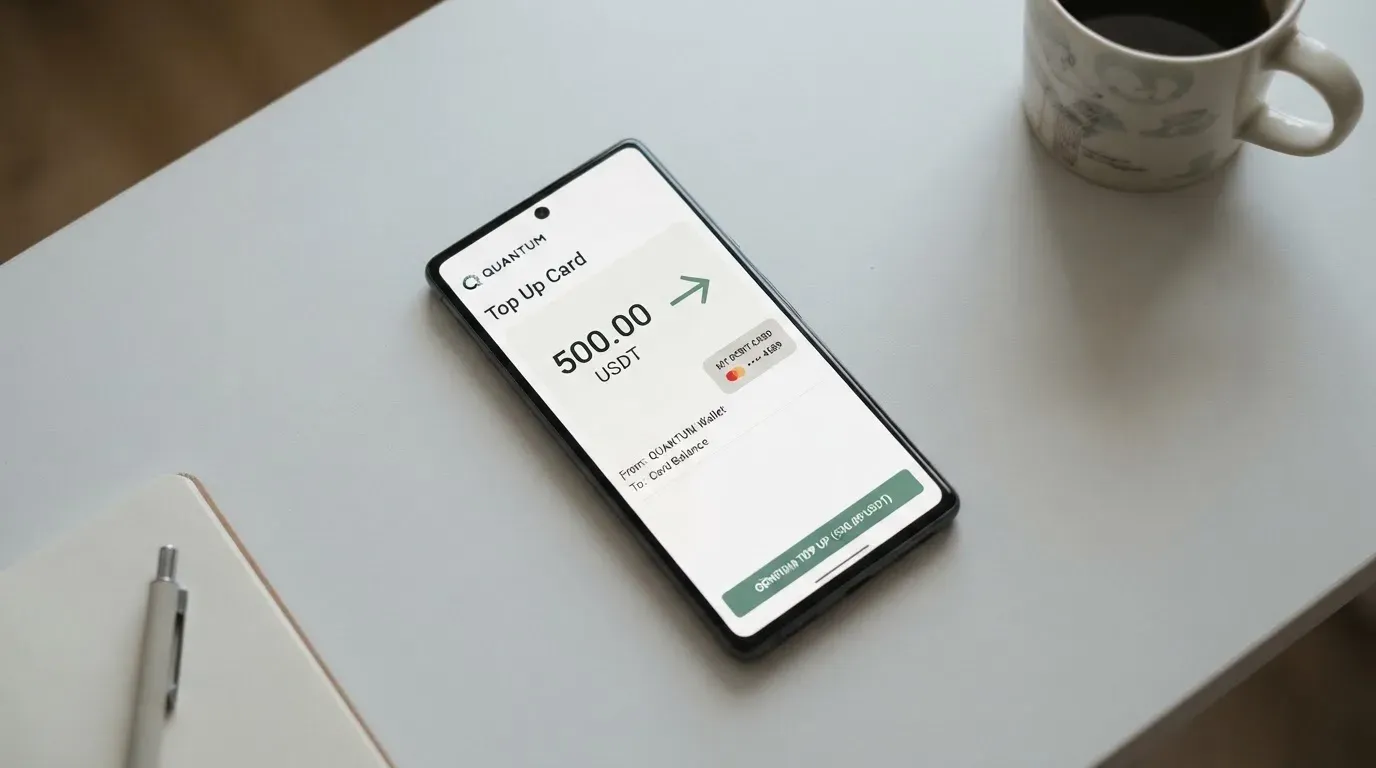
The cost of that is the 1.3% deposit fee, which applies to all tiers. The minimum is not stated, and neither is who pays the network fee on the deposit.
What is not listed is any fiat on-ramp. Lightning and crypto only. So if you hold no cryptocurrency at all, this card cannot help you, because there is no bank transfer and no card-to-card top-up mentioned to get you from euros or dollars to the card.
Two details about stablecoins are worth knowing before you pick a network, because sending on the wrong one is how money disappears. USDT and USDC are both dollar-pegged, and the BIS put roughly 90% of stablecoin market capitalisation in those two as of July 2025. But stablecoins can and do depeg: TerraUSD collapsed in May 2022, and USDC temporarily lost its peg in March 2023 during the US banking crisis. More practically for you: USDC is native on 38 networks according to Circle as of 16 September 2026, but Circle stopped supporting USDC on Tron in February 2024, so “USDC over TRC20” is not a live native option. And on Ethereum, the ERC-20 standard means fees are paid only in ETH — a wallet holding USDT and no ETH cannot send it.
One more reason to read your deposit screen twice. Blockchain transfers are irreversible. A deposit sent on a network the provider does not support, or to an address belonging to a different network, can be lost or need manual recovery with no guarantee. There is also a censorship limit worth knowing: Tether says it disables tokens in wallets on the OFAC sanctions list and has frozen funds tied to illicit activity. Stablecoins are not censorship-proof.
Paying with it every day
The day-to-day mechanics are thin, and it is worth knowing exactly how thin. Google Wallet is enabled for tap-to-pay. Apple Pay is listed as “coming soon”. 3-D Secure is supported, which means online payments get an extra check — a one-time code or biometric — either frictionless or as a challenge. The card number can be frozen at any time, card data is viewable in the account, and card limits are settable in the interface. There is no standalone app described; the card controls live in the web account.
There are three features you will look for and not find. There is no physical card, so it cannot be handed over in a shop that wants to take a card, and it cannot be used in a cash machine — ATM terms are not stated, which for a virtual card means there is nothing to rely on. There is no rewards programme described. And there is no list of blocked merchant categories, so you cannot know in advance whether gambling, adult content or fuel will be declined; merchant category codes are assigned by the merchant’s own acquiring bank, and which of them an issuer blocks varies by issuer.
Two day-to-day friction points that belong in this section because you will hit them. Address verification, which compares the numeric parts of a billing address with issuer records, is mainly offered in the US, Canada and the UK and is generally unavailable for foreign-issued cards, which can cause declines. And if a shop looks at your BIN and sees a prepaid card from an issuer in a country that is not yours, that shop may simply decline. Neither of these is a fault in the card; both are the cost of buying a virtual, foreign-issued, prepaid product.
On disputes: the terms contain a section titled “Returns, disputes and chargebacks” at section 19. I could not read the text. So I cannot tell you how the card handles a chargeback, and you should treat that as an open question. Under 3-D Secure, liability for fraudulent online payments can shift from merchant to your bank — or, critics argue, to you. For prepaid cards, coverage varies and should not be assumed.
What can go wrong
No official incidents came up in my reading, and I found no Trustpilot or Reddit reviews for Freedomia either. I want to be precise about what that means. It is not a clean track record; it is an absence of a track record. A card with no public reviews is a card with no public evidence of how it behaves when something goes wrong, and a company registered in Delaware whose issuing bank and licences are not named on the site is a company whose public footprint you cannot easily evaluate. The Trustpilot finding is what I could locate; it is not proof that no one has ever complained anywhere.
The unofficial picture is less neutral. CriptoNoticias, in September 2026, describes the service as custodial and closed-source. That matters more than it might sound. Control of crypto belongs to whoever holds the private key; with a custodial wallet the provider holds the credentials, so you have to trust them completely. A seed phrase is typically 12 to 24 words and unencrypted, and anyone who obtains it can restore the wallet and spend the funds. Transfers are typically irreversible and a stolen key has no built-in recovery — the network cannot freeze or return anything. And custodial platforms have a history: Mt. Gox reported about US$350 million stolen between 2011 and 2014, Coincheck about US$400 million in 2018, and the Ronin Network US$625 million in 2022.
The practical consequence is that you cannot check whether the money is still there. A self-custody-linked card keeps funds in your own wallet until the moment of payment, and then the risks become yours alone — key loss, phishing, and clipboard-hijacking malware that swaps a copied address before you paste it. Freedomia is not that. You are trading verifiability for convenience, and it is fair to call that trade only after you know you are making it.
There are softer risks too. Support is by email at [email protected] and on Telegram at @Freedomiaio, with priority support on Founder and MOON. Two channels, neither of them a phone line or a regulator. Programme closure is a real category risk, not a hypothetical: closures typically mean a notice period, then loading and spending stop, then you are asked to withdraw your balance. And two of the three paid tiers, HODL and MOON, are “coming soon”, along with Apple Pay — which means the price you might pay later for a higher ceiling is a price for something that does not exist yet.
On the tax side, I will not advise you, but you should know the shape of it. The IRS treats digital assets as property, so exchanging them for goods, services or dollars generally produces a taxable gain or loss, measured in local currency at fair market value on the date of the transaction. For personal holdings that is a capital gain or loss, short-term if held a year or less, and every card payment funded from crypto can be a separate disposal. Talk to someone qualified in your own jurisdiction before you treat this as a spending tool.
What to take instead
None of these three scored higher than Freedomia — they scored 5.6, 4.9 and 4.7. I include them because comparing across the category is more useful than comparing against a single card, and because each solves a different problem.
Cardex, 5.6 / 10, markets itself as “One crypto card, 200+ countries”. It is a debit crypto card on VERVE, Visa, Mastercard and UnionPay, offered as virtual and physical cards, and its App Store listing is Naira-focused, meaning you pay in Naira. It funds from USDT, USDC and BTC wallets with networks not stated. Its distinctive claim is conversion: real-time crypto-to-fiat conversion at the moment of payment, with what it calls an “AI-Powered Conversion Rate” that scans global exchange rates and picks one when you spend. No fee percentage is stated. If you want a physical card and a wider network choice, this is the one to look at; if you want to know exactly what a payment costs, you will not find it on the page.
CardFlow, 4.9 / 10, aims at Nigeria — “Nigeria’s smartest fintech card platform” — and at “Nigerians and global users”. It is a virtual USD Mastercard created in 3 minutes, and creating a virtual card is free. You can fund it with Bitcoin, USDT, ETH or a Naira bank transfer. Its appeal is speed and a free card, not depth: monthly fees and percentage fees are not stated, and there is no rewards programme described.
HyperCard, 4.7 / 10, is a prepaid card whose official pages state no country list, while its App Store listing says the card works in “more than 176 countries” — which is a statement about acceptance, not eligibility, and the distinction is the same one that matters for Freedomia. You deposit crypto such as USDT, BTC or ETH in the app, and the balance is converted to USD or EUR on the card. Networks are not stated, fees are not stated, and the App Store page lists none.
| Freedomia | Cardex | CardFlow | HyperCard | |
|---|---|---|---|---|
| Score | 6.1 / 10 | 5.6 / 10 | 4.9 / 10 | 4.7 / 10 |
| Card | Virtual Visa, digital only | Virtual and physical, VERVE/Visa/Mastercard/UnionPay | Virtual USD Mastercard | Prepaid, network not stated |
| Subscription | $5/month Founder, others coming soon | not stated | free virtual card | not stated |
| Funding | Lightning, BTC, XMR, ETH, LTC, SOL, TRX, BNB, USDT/USDC on Polygon | USDT, USDC, BTC | BTC, USDT, ETH, Naira bank transfer | USDT, BTC, ETH |
| Stated fee | 1.3% top-up, 2.5% FX, 0% USD | none stated | none stated | none stated |
Notice the column that is empty across the whole category. Fees are the one thing most of these pages will not tell you, and the single most useful thing you can do before choosing is write to support and ask for the numbers in writing.
Who I would recommend it to
I would recommend Freedomia to someone who already holds bitcoin or stablecoins, funds with Lightning, has decided that not submitting identity documents matters more to them than verifiable custody, and lives primarily in the dollar economy or spends in dollars anyway. Under those conditions the card is cheap, fast, and unusually flexible about how you get money into it. The 1.3% top-up fee is the only running cost if you stay in USD, and the $5 monthly Founder subscription is the price of the higher monthly ceiling and priority support.
I would not recommend it to someone whose spending is mostly in euros, pounds or another currency, because 2.5% on every foreign-currency payment will exceed the subscription fee many times over. I would not recommend it to someone who needs cash, or a physical card, or to someone who intends to spend above $5,000 a month, since the tier that would allow it is not launched. And I would not recommend it to someone who wants to be able to check a register and see who stands behind their money, because the issuer and the licences are not named on the public pages.
The most common mistake I see with a card like this is treating the low score on cost as a warning about the subscription price, when the real cost is the missing number. You know what you pay monthly. You know what you pay to top up. You do not know what it costs to issue the card. Settle that first.
Frequently asked questions
What is Freedomia?
Freedomia is a crypto-funded payment card rather than a bank account. It issues a virtual Visa you hold inside a web account, funded by crypto or stablecoins that are automatically swapped into dollars when they arrive. The company behind it is Freedomia Digital Group LLC, registered in Delaware. It is a programme and interface, not a bank, and no issuing bank or licence is named on its public pages.
Does Freedomia require KYC?
The card markets itself as “No verification. No approval.” and signup is by email. Unofficial reporting from CriptoNoticias in September 2026 describes it as pseudonymous with no KYC at or below USD 5,000 monthly spend, and says terms section 4.3 permit checks above that amount. I could not read that section myself, so if you plan to spend more than $5,000 a month, expect questions rather than assume none.
How much does a Freedomia card cost?
The Founder tier is $5/month or $60/year and is the only one available. HODL at $9.99/month or $119.88/year and MOON at $17.99/month or $215.88/year are both “coming soon”. On fees: top-up is 1.3%, the standard FX fee is 2.5%, and spending in USD is 0%. The cost of issuing the card itself is not stated anywhere on the public pages.
Can I top up with Lightning?
Yes, and that is the card’s strongest feature. You can send over the Lightning Network to a personal Lightning Address. It also accepts BTC, XMR, ETH, LTC, SOL, TRX, BNB, and USDT and USDC on Polygon, with “and more” on the site. The deposit fee is 1.3% on all tiers. No fiat on-ramp is listed, and the minimum is not stated.
Is there a physical card and can I use an ATM?
No physical card is mentioned anywhere on the card’s pages, and ATM terms are not stated. This is a virtual, digital-only Visa. It works for online payments and for tap-to-pay through Google Wallet; Apple Pay is listed as “coming soon”. If you need to hand a card over in person or take out cash, this is the wrong product.
Where can I use the Freedomia card?
The card describes itself as “Global”, with no country list or restrictions on the home page. There is a FAQ question asking which countries are restricted, but the answer was not readable to me. Note the distinction that matters: where you live, your citizenship, and where the card is accepted are three different questions, and only the third is settled by a “Global” label.
Is Freedomia a bank, and who owns it?
Freedomia Digital Group LLC is the named company, at Newark, New Castle, Delaware 19713. It is not a bank. The issuing bank is not named and no licences are named on the public pages, so there is nothing on the site you can check in a regulator’s register. Visa and Mastercard do not issue consumer crypto cards themselves; they license issuers, and they can suspend a programme.
Is the Freedomia card safe?
The card has 3-D Secure, an instant freeze, spending limits you can set, Tor and onion support, and tokenised mobile wallet use. Against that, the service is described by CriptoNoticias in September 2026 as custodial and closed-source, meaning you cannot verify the funds yourself, and the blockchain cannot reverse a transfer or restore a stolen key. No public user reviews were found, which is an absence of evidence rather than a clean record.
Why do my payments get declined?
The most common reason is the card number itself. Its first six or eight digits identify the issuer, and merchants can look that up, see that it is a prepaid card issued in another country, and decline or apply extra checks. Address verification is generally unavailable for foreign-issued cards. Spending in dollars avoids the FX fee and the associated conversion failures; spending in another currency adds a 2.5% fee on top.
Is the Freedomia card worth it?
Worth it if you fund with bitcoin or Lightning, spend mainly in dollars, will not need cash or a physical card, and have decided that not submitting identity documents is worth more to you than verifiable custody. Not worth it if you spend in another currency, if you need more than $5,000 a month, or if you need to see who stands behind your money. HODL and MOON, the tiers with higher ceilings, have not launched.
Virtual cards in the catalogue – cryptocardcatalog
Content created by the «cryptocardcatalog» team