
A card that works almost anywhere, on terms you cannot check
 Available in US
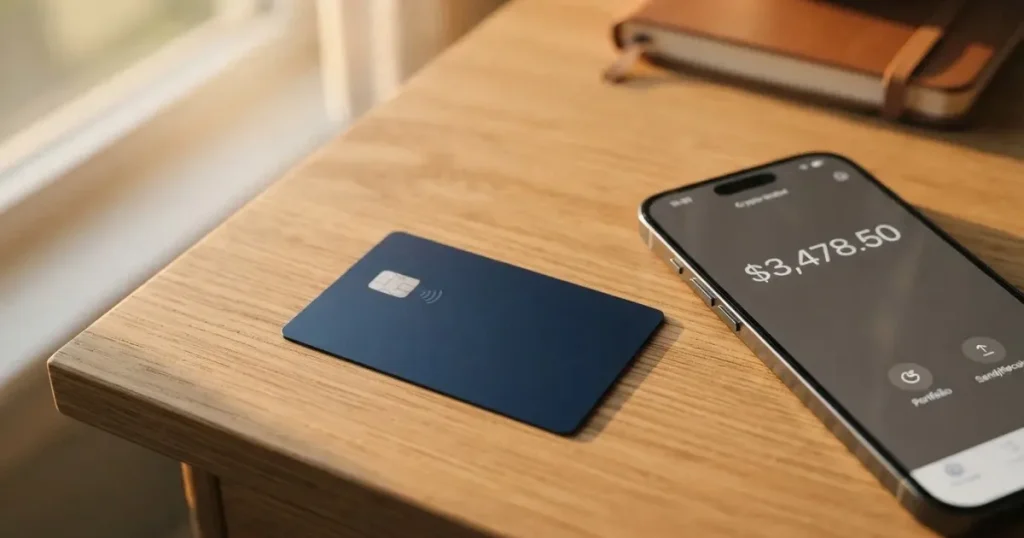
If you cannot get an ordinary bank card, or you are somewhere that hands them out slowly or not at all, ExCards has a specific appeal: a USDT balance converted into a virtual card that works like any other payment card, with Apple Pay and Google Pay on all three products, and no monthly fee. That is a real service for a real situation, and it is set up quickly.
The catch sits underneath it, and you should know about it before you fund anything. ExCards publishes almost nothing about the company behind the brand — no legal entity, no registration country, no named card issuer, no licences. The balance is custodial, meaning the money sits with a third party. The Terms of Service page is described by the brand itself as a placeholder. There are no independent reviews to read, because no review site has an entry for it, and there is no Trustpilot page. The card itself was launched, and people can use it, but it is a building with no address plate.
So my score is 5.9 out of 10. That is not a “stay away” score, and it is not a recommendation either. It is a card that works on the visible part and asks you to take the invisible part on trust — fees you can read, issuer you cannot.
| Criterion | Mark | Why |
|---|---|---|
| Who can get it | 9 / 10 | Excluded places are listed explicitly; the rule is by residence, and residence changes must be reported within 30 days |
| Cost | 3 / 10 | $29–$50 once, no monthly fee, but 2–3.5% per top-up, $0.50 per authorization, and up to 2% on non-USD |
| Top-up options | 9 / 10 | USDT across seven named networks, with BTC, ETH and SOL converted in |
| Reliability and complaints | 4 / 10 | No entity, country, issuer or licence published; custodial balance; Terms marked as placeholder |
| Everyday use | 5 / 10 | Three virtual cards in about 10 minutes, both mobile wallets everywhere, but no ATM and plastic only by pre-order |
| Total | 5.9 / 10 |
The conditions described here are current as of October 28, 2026.
One thing before anything else. This is not a card for everyone, and the audience it actually fits is narrow: online spenders paying subscriptions, software, advertising and hosting bills out of a USDT balance you already hold. If that is you, the arithmetic below is the whole decision, and it can work. If you need cash, or you want to be able to charge back a merchant, or you are putting savings into it, the gaps I describe later are not small.
Will they give you the card
Yes, this is the easiest part of the whole thing — and that is genuinely useful information if you have been turned down elsewhere.
ExCards does something unusual with its geography page: instead of listing the countries it supports, it lists the places it does not. Those are North Korea, Iran, Syria, Cuba, Crimea, Donetsk, Luhansk, Zaporizhzhia and Kherson “where applicable”, Myanmar and Sudan. It also notes Russia “(depending on transaction context and issuer policy)” and Belarus “(for sanctioned persons)”. There is no supported-country list, so I cannot tell you from the public pages which countries are in. That is a gap, and it is worth asking about before you assume.
What is stated clearly is that the test is where you live, not what you hold. You must accurately disclose your country of residence at issuance. If you move, you have 30 days to report it. Disclosing it falsely can lead to retroactive card closure — the card already issued can be closed after the fact, not just the application refused.
The card does not care about your nationality as a separate gate, but every issuer screens names against sanctions lists regardless. There is one KYC level only, so there is no tiered access and no upgrade path — the limits you get are the limits everyone gets.
How to get it
The whole flow is a passport photo page and a wait.
Sign-up happens either at app.excards.io or through a Telegram mini-app at @ex_cards_bot. There is no App Store or Google Play app listed; the service runs on the web dashboard and the bot.
Identity checking is described as “Light KYC”: a clear scan of the photo page of a government-issued passport. No selfie, no video, no liveness check, no proof of address mentioned. Age is “18+ in most countries”, so the legal age in your own jurisdiction is what counts. An issuer partner checks the document’s authenticity and screens against sanctions and PEP lists. The card comes “within 10 minutes after a successful check”.
Three virtual cards are on offer:
- Visa Universe — $29
- Visa E-commerce — $35
- Mastercard Business — $50
A physical Visa E-commerce card can be pre-ordered. There is a mandatory first top-up of 10 USDT, and no shipping date is given. Shipping cost is not stated.
What can get you refused: false or altered documents, which are described as a permanent block; a sanctions or PEP hit; a failed check; or issuance that would break the law or the issuer’s policy. The brand also reserves the right to refuse without giving a reason.
Replacement of a virtual card that is lost, leaked or expired costs the card price again — 29, 35 or 50 USDT depending on which one you had.
Your KYC data is refreshed at card expiry, on a change of residence, on suspicious activity, or by default every 24 months. That is an unusual cadence to state plainly, and it is worth factoring into your planning: this is not a set-and-forget identity check.
Fees: what it really costs
Here is the honest part. There is no monthly fee — no maintenance charge, no inactivity charge — which is genuinely better than many cards in this category. But everything else is priced, and some of it is priced more than once.

| Fee or limit | Value |
|---|---|
| Visa Universe, one-time | $29, in USDT, non-refundable |
| Visa E-commerce, one-time | $35, in USDT, non-refundable |
| Mastercard Business, one-time | $50, in USDT, non-refundable |
| Mandatory first top-up | 10 USDT, credited to the balance, remains spendable |
| Monthly fee | None — no maintenance or inactivity fee |
| Top-up fee, Universe | 2% |
| Top-up fee, E-commerce and Business | 3.5% |
| Authorization fee, Universe and Business | $0.50 flat |
| Authorization fee, E-commerce | $0.10 under $1.00; free at $1.00 and above |
| 3D Secure authentication, E-commerce | $0.03 each |
| Decline surcharge, E-commerce | $0.80 if the decline rate exceeds 10% in a rolling window |
| FX on non-USD merchants | Issuer reference rate plus “a markup of up to 2% over the interbank rate” |
| Non-USDT coins | Converted to USDT “at network rate”, no fee stated |
| ATM cash withdrawal | Not available — all cards are virtual |
| Visa Universe limits | $1,000,000 per transaction, $3,000,000 per day and per month |
| Visa E-commerce limits | $20,000 per transaction, no daily or monthly limit |
| Mastercard Business limits | $250,000 per transaction, $500,000 per day, $1,000,000 per month |
| Limit tiers | Same for all users; no KYC-level split |
| Card pricing tiers | Three products differ by price, top-up fee and limits; no account tiers |
| Transfers between your own cards | 0% |
Now let me run three ordinary payments through it, because that is where the structure reveals itself.
A $40 subscription. Say you top up $40 from USDT on Universe. The 2% top-up fee is $0.80, so you need $40.80 sent in to hold $40 spendable. The $0.50 authorization fee then applies on top, and the merchant is almost certainly a non-USD merchant, so up to 2% FX markup — up to $0.80. Your effective cost on a $40 purchase is roughly $42.10 against $40 of value. That is a notable increase in the cost of your purchase.
The same $40 on E-commerce. Here the top-up fee is 3.5%, so $1.40 instead of $0.80. But the authorization fee is free at $1.00 and above, saving $0.50, and the 3D Secure charge is $0.03. The trade is roughly a wash on one $40 payment — which is exactly the wrong way to look at it, because the $0.03 and the decline surcharge are per-transaction and the top-up fee is per-load. If you top up once and pay ten times, the per-transaction costs shrink and the load cost dominates.
A $0.60 in-app purchase. E-commerce charges $0.10 for authorization plus $0.03 for 3D Secure, plus up to 2% FX. That is roughly 22% of the purchase. Small purchases are where this card hurts most, and if you pay for app store subscriptions, that is where you will live.
The $0.80 decline surcharge is the one I would think hardest about. It is tied to a decline rate above 10% in a rolling window. If you are testing cards, if your balance runs thin, or if you are new and mistyping, you can cross that line without ever noticing — and there is no freeze feature described to help you steady things.
Top up options
This is the strongest section of the card, and if you live in USDT already, it is the reason to stay with it.
The balance is in USDT, and you can fund it across a wide list of networks: ERC-20, TRC-20, BEP-20, Bitcoin, Polygon, Arbitrum, Optimism and Avalanche. The brand adds that these are examples and other networks are accepted. If you send BTC, ETH or SOL, it is converted to USDT first at network rate. That conversion step means you never need to hold a native token for gas — convenient, and one fewer reason a deposit goes wrong.
The minimum first top-up is 10 USDT, which stays spendable. The worked example the card gives: 100 USDT at 3.5% credits 96.50 USDT. The blockchain network fee is paid to the network, not to ExCards. Fiat top-up is not mentioned anywhere, so on the evidence available this is a crypto-to-crypto product, not a bridge from your bank account.
The practical risk here is a network mistake. Blockchain transfers are irreversible. If you send on a chain the provider does not support, or to an address belonging to another network, the funds can be gone and recovery is a support request with no guarantee attached. That risk sits on top of an issuer you cannot name, which is not a comfortable combination.
Withdrawal is not stated. No way to take the balance back out is described anywhere in the public material. For a card whose whole appeal is that you already hold USDT, you may not need it — but if you are testing this card with money you might want to reclaim, you should know that nobody has published an answer.
Paying with it every day
The mechanics are good, and I want to be fair about that.
Apple Pay and Google Pay work on all three cards. That single fact covers most daily spending in most countries, because you tap your phone and the network sees an ordinary tokenised card. Apple Pay replaces the card number with a device-specific Device Account Number kept in the Secure Element, never on Apple’s servers, and each payment carries a one-time code. The issuer can still restrict the tokenised number — block it for phone use, for websites, for anything — and ExCards describes no freeze feature, so that restriction is not something you would be able to lift quickly.
There are no cash withdrawals. All cards are virtual and ATM withdrawal is not available. If you need physical money, this card is out.
What is blocked: use of the terms bar for illegal goods or services, terrorism financing, money laundering, and sanctioned-country transactions. No merchant-category list is published, so you cannot check in advance whether a category you use is restricted. On the standard side of things, gambling sits under merchant category 7995, and issuers commonly block it by policy rather than by law, with the list varying by issuer — but ExCards does not say whether it does.
There are no cashback or rewards of any kind mentioned. The only incentive on offer is a referral programme: 20% of the fee for each card issued at Bronze level, rising through tiers to 40% at Platinum, plus a share of top-ups from 0.05% to 0.20%, and 10% off a first card with a code.
When payments fail, declined transactions return funds to your card balance automatically — that is the good part. The card price, top-up fees and authorization fees are not refunded. And there is no dispute or chargeback process published. The card is explicitly not liable for declined transactions, FX losses, network downtime or merchant rejections. So if a merchant takes your money and delivers something broken, the published process for getting it back is: there isn’t one. I am not giving legal or tax advice here, but I will say plainly that US debit card reversal rights, credit card rights and prepaid-card coverage all differ, and none of it should be assumed.
Support is the one area that reads well. It is 24/7 through in-app chat on app.excards.io, with answers promised “within minutes”, plus a Telegram bot at t.me/excards_bot. The interface is available in English, Russian, Spanish and Ukrainian.
What can go wrong
This is where the score lives, so I will take it in order of how much it should worry you.
Nobody will tell you who is behind it. The brand is “ExCards”, marked © 2026. No legal entity, no registration country. The cards are described as issued by “a third-party card issuer partner” using “licensed BIN sponsors”, and neither the issuer nor any licence is named. This is not a criticism that will be answered by the marketing page; it is the actual structural gap. Behind every Visa or Mastercard programme sits a licensed institution, and here that institution is unnamed. You are asked to hand a balance to a partner you cannot identify.
Your balance is custodial. The money is “held with our card issuer partner”. Control of crypto belongs to whoever holds the private key; with a custodial setup, that is them, and you must trust them completely. The category has a documented record of this failing: Mt. Gox with roughly US$350 million reported stolen between 2011 and 2014, Coincheck with about US$400 million in 2018, and the Ronin Network bridge with US$625 million in 2022. Those are not predictions about ExCards. They are what the risk class looks like.
The Terms are a placeholder. The Terms of Service carry a last-updated date of 17 May 2026 and describe themselves as a placeholder, with the final version due in May–June 2026. Fee changes are announced in-app at least 30 days ahead, which is better than nothing, but the document that would tell you what happens to your money in a bad scenario is not finished. There is no safeguarding statement, no separate risk disclosure, and no explanation of insolvency handling.
There is no independent track record. One search across review sites and forums returned nothing about excards.io. The Trustpilot page does not exist. There is no way to read a stranger’s experience, which cuts both ways: there is no pile of complaints either, and no confirmation that anyone is happy. It simply means you are early.
Security features are baseline, not reassuring. TLS 1.3 and 3D Secure 2.0 on all authorizations, with suspicious activity automatically declined. No freeze feature described, no spending-limit controls mentioned, and no published policy on what happens to a tokenised card number if your phone is lost. Under 3-D Secure, liability for fraudulent online payments can shift from the merchant to your bank, or per its critics to you.
No news, which is neutral. I found no dated licence or issuer events and no official incident published. Not a red flag on its own — it is simply the absence of a record.
The card prices itself in a particular way, though. Its own published position is that it is not liable for declined transactions, FX losses, network downtime or merchant rejections. In a category where network downtime is a normal event rather than an exception, that is a large carve-out, and it belongs in your thinking about how much of your balance to keep loaded.
Alternatives worth comparing
If your reason for wanting this card is that ordinary cards are hard to get, it is worth knowing what else is on the table. The three below are not better in every respect — I am not here to rank them for you — but each answers the same need differently, and the differences are structural rather than cosmetic.
| ExCards | Cardex | CardFlow | HyperCard | |
|---|---|---|---|---|
| Score | 5.9 / 10 | 5.6 / 10 | 4.9 / 10 | 4.7 / 10 |
| Who | Residence-based rule; exclusions listed | “One crypto card, 200+ countries”; no exclusions listed | Aimed at Nigeria and “Nigerians and global users” | Acceptance in “more than 176 countries” per the App Store; eligibility not stated |
| Card | Virtual Visa Universe, Visa E-commerce, Mastercard Business | Debit card on VERVE, VISA, Mastercard, UnionPay; virtual and physical | Virtual USD Mastercard, about 3 minutes | Prepaid “HyperCard”; network not stated on the App Store page |
| Card price | $29 / $35 / $50 | Not stated | Virtual card “completely free” per site FAQ | Not stated |
| Fees | 2% or 3.5% top-up, $0.50 authorization, up to 2% FX | Real-time conversion at the moment of payment, “AI-Powered Conversion Rate”; no percentage stated | Not stated | Not stated on pages available |
| Funding | USDT across seven named networks | USDT, USDC, BTC wallets; networks not stated | BTC, USDT, ETH or Naira bank transfer | USDT, BTC, ETH in the app; networks not stated |
| Rewards | Referral programme only | Not stated | Not stated | Not stated |
| Currency note | USDT/USD | Naira per the App Store listing | USD | USD or EUR |
Two things stand out from that table. First, the card whose price and fees are fully published is the one I can actually review; the others leave large gaps, and a fee you cannot read is a fee you cannot plan for. Second, Cardex’s conversion model — converting at the moment of payment rather than pre-loading — avoids the top-up fee entirely, which is worth asking about, because ExCards’s 2–3.5% is charged every time you load, not once.
On the regulatory side, a check is possible. ESMA keeps an interim register of authorised crypto-asset service providers and their white papers, and MiCA has been in legal effect since June 2023, with its rules on stablecoins applying from 30 June 2024 and the remaining provisions including CASP rules from 30 December 2024. Under MiCA, e-money tokens may be issued only by a credit institution or an electronic money institution, and a card is regulated separately as a payment service — so a card like this typically rests on two licences, not one. In the US, FinCEN guidance treats administrators and exchangers of convertible virtual currency as money transmitters. None of that tells you whether ExCards is properly licensed. It tells you what to look for, and what to ask, in writing, before you send money.
Who I would recommend it to
I would recommend ExCards to someone with three specific things going on: you already hold USDT and want to spend it without converting through an exchange; your spending is overwhelmingly online — subscriptions, ads, hosting, software; and you have read the terms above and decided that a custodial balance with an unnamed issuer is a risk you accept, because the alternative in your situation is no card at all.
I would not recommend it to you if any of these are true. You need cash. You want chargeback protection on a purchase worth arguing about. You are putting savings or salary behind it. You are in a region where mobile money or a local bank e-card would be safer and equally available. Or you simply need to know who holds your money, in writing, before you fund it — and on the evidence published, that question has no answer.
My honest summary is this. ExCards has solved the easy half of the problem and left the hard half open. The card works, it is fast, the fees are readable, and there is no monthly charge. But a payment card is a legal relationship with a licensed issuer, and this one does not tell you who that issuer is. Everything above the visible line — limits, fees, KYC, speed — I could check and did. Everything below it I took on trust, and so would you.
If you use it, load in small amounts, keep your USDT elsewhere, and treat the balance as spending money rather than savings. If someone can tell you the issuer’s name and the licence, that single answer would move this review several points.
Frequently asked questions
What is the ExCards card?
ExCards is a virtual payment card that spends a USDT-denominated balance. You load the balance with crypto, then use the card number for online purchases like any other card. Three products are offered: Visa Universe, Visa E-commerce and Mastercard Business, all virtual, with Apple Pay and Google Pay supported on each. There is no physical card in general use and no ATM withdrawal.
Is ExCards a bank?
No, and it does not present itself as one. The cards are described as issued by a third-party card issuer partner using licensed BIN sponsors, with ExCards acting in front. The brand does not publish a legal entity, a registration country, or the issuer’s name or licences. That makes it a card front-end rather than a deposit-taking bank, and it is the main thing to understand before funding it.
How do I get an ExCards card?
Sign up at app.excards.io or through the Telegram mini-app at @ex_cards_bot, then upload a clear scan of the photo page of a government-issued passport. Identity checking is light: no selfie, video or proof of address is mentioned. An issuer partner verifies the document and screens sanctions and PEP lists. The virtual card is issued within 10 minutes after a successful check, for $29, $35 or $50 depending on the product.
Does ExCards require KYC, and is there a way around it?
Yes, and there is no way around it — which is fine, because the requirement is light. A passport photo page is what is described. There is one KYC level for everyone, and no upgrade path. Data is refreshed at expiry, on a change of residence, on suspicious activity, or by default every 24 months. A false document is described as a permanent block, and refusal can be issued without a reason.
Is ExCards card free?
There is no monthly fee, which is the honest good news. But the card is not free: Visa Universe costs $29 once, Visa E-commerce $35, Mastercard Business $50, all paid in USDT and non-refundable. On top of that, top-ups cost 2% or 3.5%, an authorization fee of $0.50 applies on two of the three cards, and non-USD payments can add a markup of up to 2%.
How do I top up the ExCards card?
You send USDT to the balance over one of the listed networks: ERC-20, TRC-20, BEP-20, Bitcoin, Polygon, Arbitrum, Optimism or Avalanche, with other networks also accepted. BTC, ETH and SOL are converted to USDT first at network rate. The minimum first top-up is 10 USDT, and the network’s own fee is paid to the blockchain. Transfers between your own cards cost 0%. No fiat top-up is described.
Can I withdraw money from ExCards?
Not stated. No withdrawal method is described anywhere in the public material, and ATM cash withdrawal is explicitly unavailable on all cards because they are virtual. The mandatory 10 USDT first top-up is described as remaining spendable. If keeping access to your funds matters to you, ask this question in writing before you load a meaningful balance.
Is the ExCards card safe?
Treat it as a custodial product, which means trusting a party you cannot name. The balance is held with the issuer partner, and no legal entity, issuer or licence is published; the Terms of Service are marked as a placeholder. Security features are standard — TLS 1.3, 3D Secure 2.0, automatic declines on suspicious activity — but no freeze feature or safeguarding statement is described. Custodial platforms have failed before at scale.
What are the fees and limits I should know?
Top-ups cost 2% on Universe and 3.5% on the other two, and the brand’s own example is 100 USDT at 3.5% crediting 96.50 USDT. Authorization is $0.50 flat on Universe and Business; on E-commerce it is $0.10 under $1.00 and free above, plus $0.03 per 3D Secure check and $0.80 if declines exceed 10% in a rolling window. Limits are $1,000,000 per transaction on Universe, $20,000 on E-commerce, $250,000 on Business, with no ATM access.
How do I add ExCards to Apple Wallet?
The card supports Apple Pay on all three products, and the same tokenised number is what you add to the wallet rather than the card details. Payments then use a device-specific account number held in the Secure Element with a one-time code per transaction, which is safer than handing a shop your card number. One caveat: the issuer can restrict a tokenised number for phone or online use, and no freeze feature is described, so test it before a large purchase.
Virtual cards in the catalogue – cryptocardcatalog
Content created by the «cryptocardcatalog» team