
Etoro Money card: a free Visa debit for EU and UK investors, with conditions
 Available in US
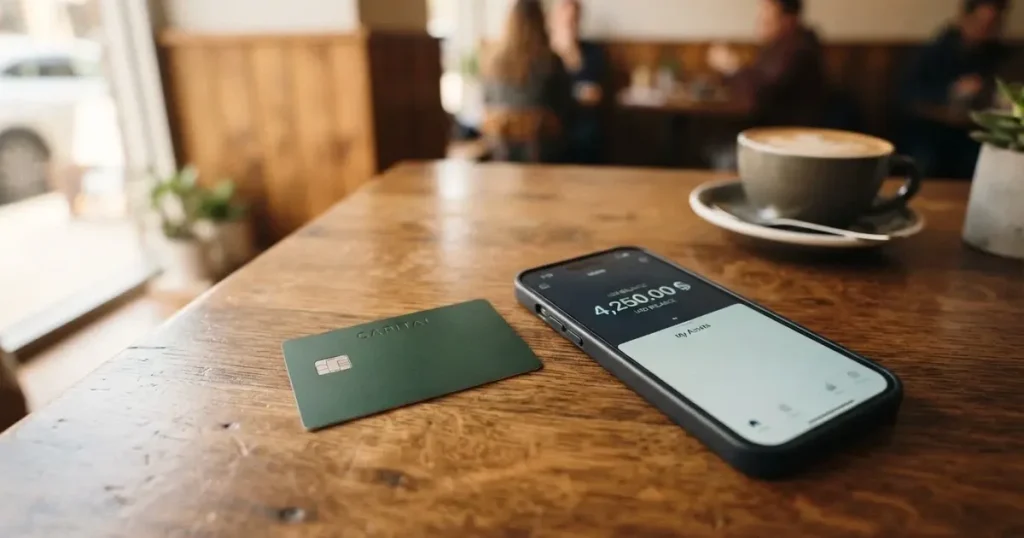
The Etoro Money card is a Visa debit card that lets you spend from a fiat balance on the eToro platform, converting your crypto to pounds or euros first. If you are already investing with eToro and you live in the EU or the UK, the card is a tidy way to turn your portfolio into everyday spending money. If you are outside those two regions, or if you are looking for a standalone crypto card with broad cashback and a slick mobile experience, you will want to look elsewhere.
The conditions described here are current as of October 28, 2026.
Verdict
Etoro Money scores 6.8 out of 10 in our review. The card has real strengths: the Visa debit itself, the issue, replacement and delivery are all free, there is no monthly subscription, and the card advertises “Zero FX fees abroad”. The trade-offs are equally real. The card is only available to residents of the EU or the UK, you need an eToro Club tier to qualify, and the conversion fee the platform takes when you turn crypto into spendable currency is not stated on the card pages. Top-up is one step removed from the card: the card draws on a eToro Money account, and that account is fed either by a SEPA bank transfer in euros or by selling crypto through the eToro crypto wallet.
This is a card for an investor who already keeps money on eToro and who wants a simple, low-fee way to spend that balance. It is not a card for someone who wants a high-rate cashback programme, a metal card, or a card that anyone in the world can apply for.
Here is how the card scored across the criteria we checked:
| Criterion | Score | Why it matters |
|---|---|---|
| Who can get it | 5/10 | EU and UK residents only, with a Club tier requirement |
| Cost | 9/10 | Issue, maintenance, replacement up to 3 a year and delivery are free, no monthly fee, “Zero FX fees abroad” |
| Top-up options | 4/10 | Card pulls from a eToro Money account, crypto is converted via the eToro crypto wallet first, EUR funding is via SEPA |
| Reliability and complaints | 8/10 | Issued by eToro Money Malta Ltd or eToro Money UK Ltd, with segregated funds; eToro on Trustpilot 4.0 from 32,233 reviews, with no card-specific complaint threads |
| Everyday use | 7/10 | Visa debit, Apple Pay and Google Pay supported, ATM allowance of GBP 2,000 a month (Green) or GBP 10,000 (Black) |
The audience in plain terms: someone in the EU or UK who is already investing on eToro and wants a free debit card to spend the balance. If that is you, the card makes sense. If it is not, the rest of the review explains which parts will and will not work for you.
Who they will give the card to
Etoro Money is offered to residents of the EU or the UK. Eligibility is residence-based, so the country you live in matters, not the country on your passport. eToro keeps a separate availability page with the full list of countries, which I did not read for this review.
Beyond residence, you need a eToro Club tier, which is eToro’s investor loyalty programme. The exact tier depends on which entity issues the card. For the UK, the requirement is being an “eToro Club member”. For the EU, the requirement is Diamond, Platinum+ or Platinum in one FAQ, while another FAQ on the same site says Diamond only. There is a conflict in the official pages, and that is worth noting. The fee page also describes two card programmes: the Green card is for Silver through Platinum, the Black card is for Platinum+ and Diamond. So if you are in a lower tier in the EU, you may find yourself in the Green programme rather than the Black one.
The card itself is a Visa debit card, available in Green and Black tiers. The official pages do not say whether it is virtual, physical, or metal. The currency of the card is either pounds for a GBP account or euros for a EUR account. The platform notes that holding both a EUR and a GBP account is “not currently possible”, so you commit to one currency when you set the card up. A footnote on the same page also lists AUD and DKK accounts, but it is not stated whether a card comes with those.
What the official pages do not tell you: the specific KYC documents you will be asked for, the KYC levels, how long the verification takes, and the reasons a verification could fail. The card pages only set residence, Club tier and a EUR or GBP account as requirements. If verification is a sticking point for you, the eToro Help Center is where to look next.
How to get it
The path is straightforward, on paper. You need to be a resident of the EU or UK, you need a eToro Club tier that matches the card you want, and you need a EUR account (in the EU) or a GBP account (in the UK). Once you have those, you can request the card from within the eToro Money area of the app.
Delivery is free on both tiers for the first card, and replacement delivery is also free. Replacement cards are free up to three per year on the GBP card; for the EUR card, replacement is N/A on Green and free up to three per year on Black. The official pages link to a help article for the actual delivery time, but do not give a number themselves.
What is not stated: the exact KYC documents the platform will ask for, the time it takes to verify them, and the steps to activate the card once it arrives. The first card is free and so is delivery, so the only costs to anticipate are the ones that come up if you start moving money or using the card heavily.
What it really costs: Fees
The headline cost story is positive. The Etoro Money card has no monthly subscription. Card issue, maintenance, replacement up to three a year and delivery are all free. Card payments are free. The card advertises “Zero FX fees abroad” on the marketing pages, with a footnote pointing to separate FX terms.

The ATM allowance is generous, but it is not unlimited. On a GBP account you get GBP 2,000 a month free on the Green programme or GBP 10,000 on the Black programme. On a EUR account you get EUR 2,500 a month free on Green or EUR 12,000 on Black. Anything above the free allowance costs 1%. The same threshold logic applies in both currencies, just in different amounts.
The biggest gap in the published fees is the conversion fee from crypto to fiat. The card pages say “Conversion requires etoro crypto wallet” and that you can convert crypto to GBP or EUR, but the conversion fee itself is not stated on those pages. That is the one cost you cannot fully see from the official card material.
Here is the full costs table:
| Fee or limit | Amount |
|---|---|
| Card issue | Free |
| Monthly subscription | None |
| Maintenance | Free |
| Replacement (up to 3 per year) | Free |
| Delivery (first card and replacement) | Free |
| Card payments | Free |
| FX abroad | “Zero FX fees*” (separate FX terms) |
| ATM free allowance, Green GBP | GBP 2,000 / month |
| ATM free allowance, Black GBP | GBP 10,000 / month |
| ATM free allowance, Green EUR | EUR 2,500 / month |
| ATM free allowance, Black EUR | EUR 12,000 / month |
| ATM above allowance | 1% |
| Crypto to fiat conversion fee | Not stated on card pages |
| Daily and monthly transaction limits | Not stated (separate “Account Activity Limits” article) |
A few examples make this concrete. A coffee in London paid with the card: no card payment fee, no FX fee, nothing else. A EUR 200 cash withdrawal in Spain on a EUR Green card: free if you have not yet hit the EUR 2,500 monthly cap, 1% on the whole amount if you have. A EUR 500 online purchase in a non-EUR currency on a EUR card: the card page says “Zero FX fees” but the separate FX terms govern the rate, so this is the one case where the small print is worth reading.
How to top it up: Top up
The card does not hold a balance of its own. It draws on a eToro Money fiat account, and that account is what you top up. That has two practical consequences: you cannot load the card directly with crypto, and you have to think of top-up in two stages.
If you want to top up from your bank, the path on a EUR account is to open the Wallet tab, then Add Funds under the eToro Money account. The EUR local account is funded by a SEPA bank transfer, and SEPA transfers in and out are free. Opening, closing and maintaining the account is free. The minimum top-up and any card-specific top-up fee are not stated on the card pages.
If you want to top up from crypto, the path runs through the eToro crypto wallet. You sell your crypto in the eToro crypto wallet, the platform converts it to GBP or EUR, and the resulting fiat goes to your eToro Money account. The card then spends from that balance. The conversion fee is not stated on the card pages, which is the single most important gap in the official material.
Withdrawing money back out follows the same shape. You send the balance from your local-currency account to a linked bank account by SEPA, which is free. The fees and time frames for closing out a card balance are not stated on the card pages, and the balance on closure is also not stated, although closing the account itself is free.
Paying with it every day
The Etoro Money card is a Visa debit card, and the brand works almost anywhere Visa is accepted. The platform also supports Apple Pay and Google Pay, so you can add the card to your phone’s wallet and pay at contactless terminals without taking the card out. Restricted merchant categories are not stated, so if there is a blocklist for things like gambling, it is not described on the card pages.
There is a rewards programme, but it is more limited than a typical cashback card. The card offers up to 4% back in stocks, up to $100 of value per month, with a GBP or EUR equivalent. Stock rewards are available for Platinum, Platinum+ and Diamond tiers. The official pages are inconsistent about lower tiers: one section says Bronze, Silver and Gold get no rewards, while another says rewards are opt-in. The press release adds detail: the 4% is paid in a European-listed stock that the user picks, the monthly cap is up to EUR 1,500 of value, and the programme is described as a launch offer that may change. Opt-in is via form, and a monthly email confirms the stock that has been added.
The Visa side of the card also comes with a few extra perks through the Visa network: Luxury Hotel Collection, up to 10% off Sixt car rental, and Visa AirRefund. These are standard Visa benefits, not Etoro Money benefits, so they will follow the card as long as the Visa partnership stands.
The app is the eToro app on the App Store and Google Play, plus the web platform. The store rating and number of ratings are not stated on the card pages, and the store listings were not read for this review. If the rating matters to you, it is worth checking the store page yourself before signing up.
If something goes wrong with a transaction, chargebacks are listed as “free” in the fee table. The dispute process and time frames are not described, and the only document linked is a Complaints Policy PDF. That is thin for a product that handles real money, so the practical advice is to keep receipts and to start the dispute from the eToro app as soon as you can.
What can go wrong
The card is issued by Etoro Money Malta Ltd in the EU and by Etoro Money UK Ltd in the UK. The UK entity is described in news coverage as FCA-authorised for e-money, which is the right kind of licence to issue a card in pounds. The EU entity is based in Malta. The BIN sponsor, the bank that sits behind the card programme, is not named in the public material I could read.
Customer funds sit in a safeguarded account at a regulated EU bank in the EU, separate from eToro’s own money and not usable for investing or lending. That is the standard protection for an e-money institution, but it is not the same as deposit insurance: the funds are not covered by the Malta Depositor Protection Scheme. In the UK, the same kind of safeguarding applies, with funds held separately from eToro’s own balance sheet.
Trustpilot reviews for the main eToro site read on 2026-10-20 sit at 4.0 out of 5 from 32,233 reviews, with about 20% one-star. The themes of the negative reviews are withdrawals held pending ID checks, restricted accounts, slow support, and trading and closing fees. None of the threads I looked at were specific to the card itself, which is encouraging, but the broader eToro experience matters because the card sits inside the same platform. Third-party status pages record a credit-card deposit issue on 11 June 2026 and 7 July 2026 and an outbound-payments issue in August 2026.
Security features on the card include instant freeze from the eToro Money app in the UK, and a “Manage Card” → “Report lost or stolen” → “Disable Card” path in the EU. There is also a 24/7 stolen-card phone line in the UK. Two-factor authentication is not mentioned on the card pages, so if that matters to you, the eToro account security settings are where to confirm whether 2FA is on by default.
A single UK Financial Ombudsman decision (DRN-4221697) involved a complainant who did not receive a promised debit card because of account type. That is one decision, and the facts are specific, but it is a useful reminder that a card that is “free” can still fail to reach the customer.
The market risk sits one level up from the card. The card spends fiat, and the fiat comes from selling crypto at the time of payment. The price at the moment of conversion is what the user gets, which means the value of the balance in fiat can move with the market between top-up and spend. Stablecoins reduce that risk, but they do not remove it.
What to take instead
If the Etoro Money card does not fit, here are three alternatives to weigh, with their own scores from our reviews.
Young Card (5.7/10) is a crypto card with cashback paid in YNG tokens. The rate is tied to a Club tier: 0.1% on Essential, 1.8% on Gold, 3.6% on Platinum. The Bronze and Silver tiers are not stated. The card-side material on eligibility, card type, fees, funding and costs is not stated officially, so this is a card to research carefully before relying on it.
MSX (6.4/10) is a higher-scoring alternative where the card-specific material on eligibility, card type, fees, funding and rewards is also not stated on the official page I could read. The score reflects what is known, and the gaps are worth knowing before you commit.
Bybit Card (6.0/10) is the most detailed of the three. It is available in Argentina, AIFC (Kazakhstan), Georgia, Kazakhstan, Australia, Mexico, Brazil, Peru and the broader Asia Pacific region. The application asks for country of residence, and if your country is not supported Bybit “will register your interest”. The card page is explicit: “This product is not meant for European Economic Area customers. All European Economic Area customer participation is strictly prohibited.” The card has both virtual and physical forms, with the physical card not available in Peru. Currencies and networks vary by country: ARS Mastercard prepaid in Argentina, USD Mastercard credit in AIFC, Georgia, Kazakhstan, Australia and Mexico, BRL Visa prepaid in Brazil, PEN or USD Visa prepaid in Peru, USD Visa credit in Asia Pacific. Virtual card issuance is free in all regions “until further notice”. Physical issuance and replacement fees vary: 29.99 USD in Australia, 5 USD/USDT in Argentina, 29.99 USDT in Georgia, 29.99 USDT in Kazakhstan (AIFC), 5 USDT in Asia Pacific, and free in Brazil and Mexico. There is a crypto conversion fee of 0.9% over the One-Click Sell rate in most regions and 0.5% in Argentina. FX fees are 2% on top of the network rate in most regions, 7% in Argentina, 1.5% in Brazil and 1% in Peru. Rewards are tiered: from 5 October 2026 only crypto-funded transactions earn points or cashback, and the rate runs from 2% (Base, Beta) to 10% (Infinite), with monthly caps and a monthly spend to unlock for non-VIPs.
The Bybit Card is the most fully documented alternative, and the geography explains a lot: Bybit does not serve the EEA, and Etoro Money does not serve anywhere outside the EU and UK, so the choice between them is partly about where you live.
Who I would recommend it to
Etoro Money is worth a serious look if you are an EU or UK resident with an eToro account at Silver tier or above, if you want a free Visa debit that draws on a euro or pound balance, and if you do most of your spending in your card’s base currency or through Apple Pay or Google Pay. The card is well suited to someone who already thinks of eToro as their main investing app and wants a simple way to convert crypto to spendable fiat without leaving the platform. The free ATM allowance is generous, especially on the Black programme.
It is not the right card if you are outside the EU or UK, if you are not on eToro, if you want high-rate cashback, if you want a metal card, if you need a card that you can top up directly with stablecoins, or if the unstated crypto conversion fee is a deal-breaker. The card’s strengths are its simplicity, its cost-free structure and the fact that it lives inside a regulated e-money institution. Its weaknesses are its narrow geography, its dependency on a eToro Club tier, and the gaps in what the official pages say about the conversion fee and KYC.
If you fit the audience, the card is one of the cleaner ways to spend a crypto balance in the EU or UK. If you do not, the alternatives above are where to start.
Frequently asked questions
What is the Etoro Money card?
The Etoro Money card is a Visa debit card issued by Etoro Money Malta Ltd in the EU and by Etoro Money UK Ltd in the UK. It draws on a eToro Money fiat account in euros or pounds, and the account is funded by SEPA bank transfer or by selling crypto through the eToro crypto wallet. The card is for EU and UK residents who are eToro Club members.
How does the Etoro Money card work?
The card pulls from your eToro Money fiat account at the moment of payment. To spend from a crypto balance, you convert the crypto to euros or pounds in the eToro crypto wallet, the fiat lands in your eToro Money account, and the card then spends that fiat. The card is a debit card, not a credit card, so the balance on the account is the limit.
Is Etoro Money a bank?
No. Etoro Money is an e-money institution, not a bank. In the EU the entity is Etoro Money Malta Ltd, in the UK it is Etoro Money UK Ltd, which is described in news coverage as FCA-authorised for e-money. Customer funds are held in safeguarded accounts and are not covered by the Malta Depositor Protection Scheme or by UK deposit insurance.
Who owns Etoro Money?
Etoro Money is part of the eToro group. The EU entity is Etoro Money Malta Ltd and the UK entity is Etoro Money UK Ltd. The card programme’s BIN sponsor, the bank that sits behind the Visa licence, is not named in the public material I could read.
How do I get the Etoro Money card?
You need to be an EU or UK resident, hold a eToro Club tier that matches the card you want, and have a EUR account (in the EU) or a GBP account (in the UK). You request the card from inside the eToro Money area of the app. The first card and delivery are free, and replacement is free up to three cards a year on the GBP card and on the EUR Black card.
Does the Etoro Money card require KYC?
Yes. The card sits inside the eToro platform, which is a regulated business and is required to verify customers under anti-money-laundering rules. The specific documents, the verification levels and the time frames are not stated on the card pages, so the eToro Help Center is where to find the current list.
How do I top up the Etoro Money card?
You top up the eToro Money account, not the card directly. On a EUR account, you open the Wallet tab, choose Add Funds under the eToro Money account, and send a SEPA bank transfer. To top up from crypto, you sell it in the eToro crypto wallet, the platform converts it to euros or pounds, and the fiat lands in your eToro Money account. The crypto conversion fee is not stated on the card pages.
How do I add the Etoro Money card to Apple Wallet?
The platform supports Apple Pay and Google Pay. You add the card from inside the eToro app by choosing the card, then the option to add it to the mobile wallet. The card pages do not give step-by-step instructions, so the eToro Help Center is the place to look if the option is not visible.
Where can I use the Etoro Money card?
Anywhere Visa debit is accepted, including contactless terminals via Apple Pay and Google Pay, online merchants, and ATMs. The card advertises “Zero FX fees abroad” with a footnote pointing to separate FX terms, so cross-border spending is the one area where the small print matters.
Is the Etoro Money card safe?
The card is issued by a regulated e-money institution, and customer funds sit in safeguarded accounts at a regulated EU bank, separate from eToro’s own money. The card supports instant freeze from the app, and the UK has a 24/7 stolen-card phone line. The risk to weigh is the broader platform: Trustpilot reviews for the main eToro site sit at 4.0 from 32,233 reviews, with complaints about withdrawals pending ID checks, restricted accounts and slow support, and third-party status pages have logged deposit and outbound-payment incidents in 2026.
Exchange cards in the catalogue – cryptocardcatalog
Content created by the «cryptocardcatalog» team