
The card is free and the everyday spending is simple — until the 1% and the AUD-only maths start adding up
 Available in US
CoinJar’s Mastercard sits in an awkward middle ground. It is genuinely free to hold, it comes with both a physical and a digital card, Apple Pay and Google Pay work with it, and there is one tier rather than a ladder of subscription traps. That is the good news, and it is why the card scores so well on everyday use. The bad news arrives the moment you spend: every purchase costs 1%, foreign transactions cost “2.99%+”, a lost or stolen argument with a merchant costs $27.50, and the whole thing is denominated in Australian dollars for Australian residents. My score for the card is 5.5 out of 10 — a real tool for one specific situation, and frustratingly narrow outside it.
The conditions described below are current as of October 28, 2026.
Verdict: 5.5 out of 10
Let me be blunt about who this suits and who it does not. This card is built for an Australian resident who already holds a verified CoinJar account, is 18 or over, holds crypto they actually want to spend, and is comfortable seeing every purchase become a conversion at CoinJar’s rate plus a 1% slice. If that is you, the day-to-day mechanics are unusually good — free physical card, free replacement, mobile wallets, and a 1% purchase fee that comes back as rewards points rather than vanishing. If you are anywhere else, or you want to keep your crypto, or you mostly want a card for travel, this is the wrong card and the reasons are structural rather than fixable.
Here is how the score breaks down, criterion by criterion.
| Criterion | Mark | Why |
|---|---|---|
| Who can get it | 3 / 10 | 18+, Australian resident, verified CoinJar account; the card page names no countries beyond that |
| Cost | 5 / 10 | Issuance and replacement free; 1% on purchases, “2.99%+” abroad, 1% at ATMs, $27.50 to dispute |
| Top-up options | 5 / 10 | A crypto chosen as the “Spend” account with auto-conversion at CoinJar rates; the coin list is not disclosed |
| Reliability and complaints | 7 / 10 | Issued by EML Payment Solutions Limited (AFSL 404131), CoinJar Australia Pty Ltd as authorised representative; exchange TrustScore 3.3/5 over 2,549 reviews, one card complaint |
| Everyday use | 9 / 10 | Free physical and digital Mastercard, Apple Pay and Google Pay, 1% ATM fee |
| Total | 5.5 / 10 | A good Australian crypto-spending card inside a narrow box |
Reliability scoring deserves a word of context, because 7 out of 10 is doing a lot of work in that row. The card programme itself is run by an established Australian e-money issuer with its own Australian Financial Services Licence, and CoinJar answers 100% of negative reviews on Trustpilot. The 3.3 TrustScore belongs to the exchange, not the card, and the themes in those reviews are about transfers under review and identity re-checks — things that touch cardholders indirectly, because the same account sits underneath. Only one review I found actually complains about the card: a virtual Mastercard with, in the reviewer’s words, technical issues, dated 18 October 2026. One card complaint out of 2,549 exchange reviews is thin evidence, and thin evidence is what a card like this deserves to be judged on.
Will they give you the card?
Short answer: if you are an Australian resident with a verified CoinJar account, the rules point your way. If you are not, there is no published route.
The card page itself does not state eligibility or countries at all — which is the first thing that trips people up when they land on the page from another country. The rules underneath say more. Per the Australian product disclosure statement, you must be 18 or older, a resident of Australia, and hold a verified CoinJar account. Three conditions, all of them Australian. I want to be careful here: the card’s own public pages do not spell out a citizenship test or a list of countries, so what I can tell you is that residency in Australia is a stated requirement and citizenship is not addressed either way. If you are an Australian citizen living abroad, or a resident of another country with an Australian address history, the honest answer is that the documentation does not cover your case and you would have to ask CoinJar directly.
Everything else about verification is unstated. The card documents do not set out how many verification levels exist, how long they take, what documents are required, or on what grounds an application is refused. That is a real gap, and it matters more here than for most cards, because the card draws on your exchange account rather than a separate balance you control. The practical effect is that a rejected application is a rejection of your access to a funded account, not just of a piece of plastic.
One structural detail worth knowing before you apply: this is custodial. Your funds sit in your CoinJar account, and EML Payment Solutions Limited issues the card against them. That is how nearly every crypto card works, and it is why the safety question is not about the card but about the account underneath it.
How to get it
There is no separate card application to describe in detail, because the card is not a separate product — it hangs off the CoinJar account. The realistic sequence is: open a CoinJar account, get it verified, choose which of your crypto holdings becomes your “Spend” account, and the prepaid Mastercard appears in the app with a digital card available immediately and a physical card on the way.
What the card gives you is a prepaid reloadable Mastercard: a digital version plus a free physical card. The currency is AUD — implied by the fee text, since every fee in the fee table is quoted in Australian dollars and includes GST, though the currency is not stated in so many words on the card page.
On delivery, the facts are thinner than I would like. The physical card is free, and a replacement card is also free, which is genuinely generous and not the norm. Beyond that: not stated. CoinJar does not publish the countries it posts cards to, the courier, or how many days it takes. If you are outside Australia and you are wondering whether a card would arrive at all, the answer from the public pages is silence. Plan on weeks rather than days if you are anywhere unfamiliar.
The app is where the card is managed, on both iOS and Android. Official store ratings were not readable from the listing itself. Unofficial trackers put the App Store at 4.1/5 from 123 reviews (per App Pricing Lab, listing updated 7 March 2026, with Marlvel counting 128 ratings) and Google Play at 3.91 from roughly 2.6 thousand ratings (per AppBrain, checked 20 October 2026). Treat those as third-party figures rather than anything CoinJar stands behind, but the gap between them is interesting: Australian iPhone users report a good experience, Android users report a mediocre one.
Fees and what a purchase actually costs
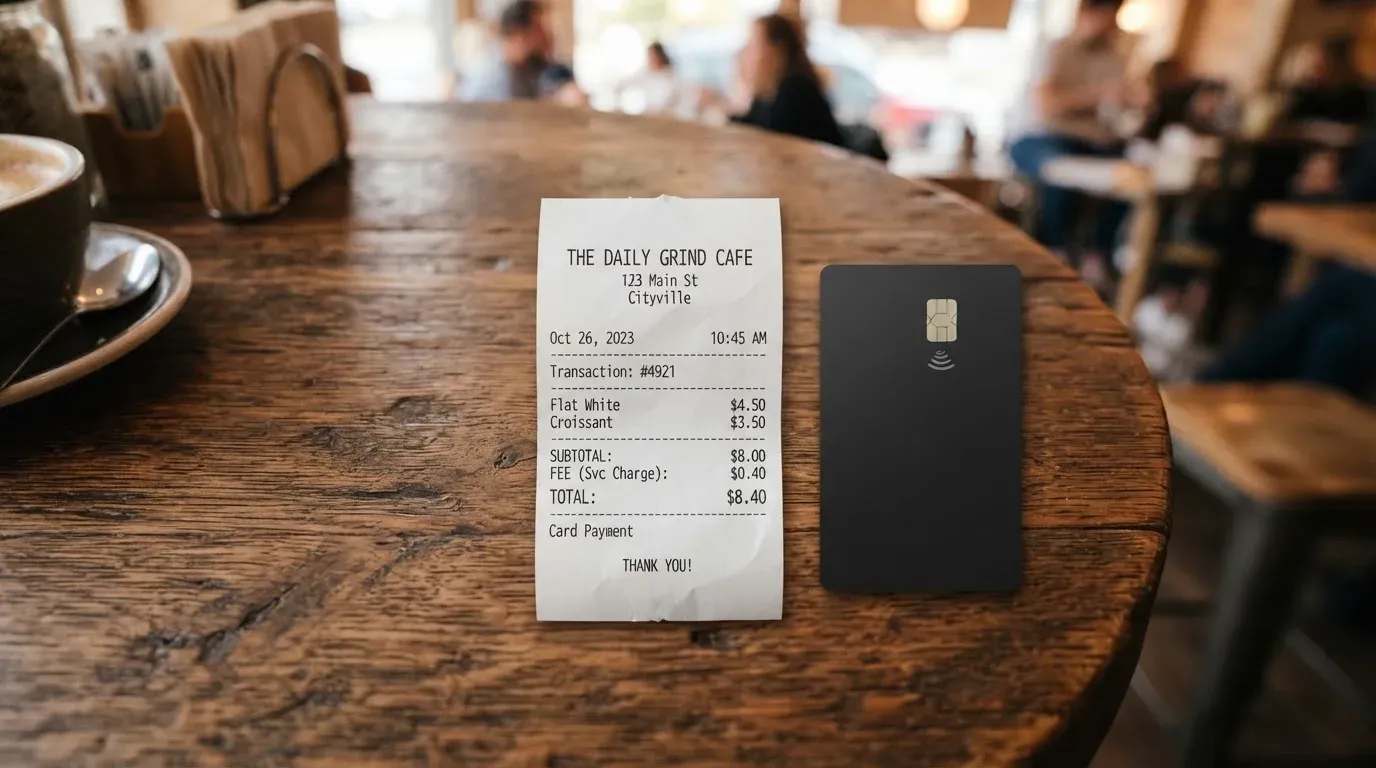
This is where the free card stops being free. Here is every number the card’s own documentation gives.
| Fee or limit | Value |
|---|---|
| Card issuance | No fee |
| Replacement card | Free |
| Account keeping fee | No such line charged in the fee table |
| In-store and online purchase | 1% (returned as Rewards points) |
| Foreign transaction | 2.99%+ (Mastercard rate plus a 2.99% foreign exchange fee) |
| ATM withdrawal | 1% of the withdrawal, plus the ATM operator’s fee; physical card only |
| Dispute fee | $27.50 per transaction |
| Maximum point-of-sale transaction | $5,000 |
| Daily point-of-sale limit | $5,000, including ATM withdrawals |
| ATM limit | $1,000 per day; $20 minimum, $1,000 maximum per withdrawal |
| Free ATM allowance | Not stated |
| Monthly or annual fee | Not stated on the card page |
| Other daily or monthly limits | Not stated on the card page |
Let me walk three ordinary payments through that table, because percentages behave differently depending on what you buy.
A $4.80 flat white. The 1% purchase fee applies, which is $0.048 — call it five cents, returned to you as Rewards points at one point per dollar spent. But this is the purchase where the 1% hurts most as a share, and it also hides the thing that matters more: the payment is funded by crypto converted at CoinJar’s rate, and CoinJar separately charges its normal trading fee when it sells crypto for the purchase. So the real cost is 1% plus whatever the trading fee is at that moment, plus any drift between the rate you see and the rate that lands. A coffee is also the classic place a card gets declined for an authorisation hold and then refunded days later, which is a category-wide nuisance rather than a CoinJar one, but it is more annoying when the balance is being converted on the fly.
A $220 shop order, paid domestically. One percent is $2.20, back as $2.20 in points. The $5,000 per-transaction and daily point-of-sale ceilings are nowhere near, and the free allowance question does not arise. This is the case where the card’s economics look almost fair — you pay one percent and get one percent back, so if you are sure you will spend again, the fee is arguably a loyalty scheme in disguise. The catch is that “back as points” is not the same as money in the bank: points offset future trades or are redeemed in the Rewards Store, so you are back inside the CoinJar ecosystem rather than out of it.
A €40 dinner on holiday. Here the 2.99%+ bites. The Mastercard network rate applies, then a 2.99% foreign exchange fee on top, then the 1% purchase fee. That is a real, structural penalty for using an Australian card abroad, and it is the single clearest reason not to take this card as your travel card. There is a second, quieter cost too: because this is an Australian-issued prepaid card spending abroad, merchants can decline it. A prepaid or foreign BIN is visible to any merchant that looks it up, and some merchants refuse prepaid cards on principle.
Refunds are worth understanding too, because they are where a lot of surprise lives. A refund goes back into the CoinJar Everyday Account in AUD — not into the original crypto, not in the original coin, at a rate set later. If the coin moved between the purchase and the refund, your balance changes accordingly. That is the deal.
How to top it up
“Top up” here is a slightly misleading word, because there is no loading the card with money from a bank. The card spends the AUD value of the Spendable Balance in your CoinJar Everyday Account, and that balance is funded by the crypto you designate as your “Spend” account. When you tap the card, CoinJar converts at its rates and the purchase settles in Australian dollars.
The mechanism has three moving parts, and one of them is missing from the documentation. First, you pick a crypto and call it your Spend account. Second, the card auto-converts at CoinJar rates. Third — and this is the part people forget — CoinJar separately charges its normal trading fee when it sells crypto for the purchase. So your 1% purchase fee is not the only line on a transaction; there is a sale underneath it.
What is not stated: which coins and which networks you can choose. The card documentation does not list them. A 2021 launch press release mentioned 30 digital currencies and a flat 1% conversion, but that is the age of the launch announcement, not a current specification, and I would not plan around it. My practical advice is to check inside your own account for the current Spend-account picker, because that is the only place the real list exists.
Also not stated: any card top-up fee, any minimum, and how network fees are treated. There is no card-specific top-up charge in the fee table, which is consistent with the design — you are not topping the card up, you are trading.
One thing that is stated and worth planning around is what happens at the end. If you cancel the card or it is revoked, the remaining value on it is paid to CoinJar, which pays it into the CoinJar Everyday Account in Australian dollars once no pending authorisations remain and you instruct them to. You can cancel at any time yourself. The issuer can cancel with 14 days’ notice — or immediately if it suspects misuse or that information you supplied was false. That immediate-cancellation language is standard, but it means a compliance flag on your exchange account can reach your card.
Paying with it every day
Everyday use is the card’s best section and the reason it scores 9 out of 10 here. You get a free physical Mastercard and a free digital Mastercard, both in the same account. Apple Pay and Google Pay are both supported, and the card is tokenised when you add it — the device stores a device-specific number rather than your card number, and each payment generates its own one-time code. The app lets you hold and unblock the card, change the PIN, and view transaction history. Contactless payments are mentioned in the context of a sub-$100 limit.
Rewards are simple: one CoinJar Rewards point per $1 spent. Points offset future trades, or you redeem them in the Rewards Store. That is not a separate discount — it is a rebate on the fee you already paid, expressed in platform currency.
Disputes are the part of daily use nobody enjoys, so here is the whole procedure. Chargebacks follow the Mastercard scheme rules. You are to notify EML as soon as possible; the time limit is generally 90 days from the transaction. Extra information must be provided within 10 days or the chargeback may be lost or reversed. There is a $27.50 fee per unsuccessful dispute. The complaint side: resolution is attempted within 5 days, otherwise within 30 days, after which it escalates to AFCA, Australia’s financial complaints authority. The official complaints address is [email protected]. Support also lists [email protected], issuer [email protected], and a help centre at support.coinjar.com.
Blocked merchant categories are not stated. That matters for anyone who expects gambling or similar spend to work; I would not assume it either way.
What can go wrong
Let me separate the things that go wrong for the card from the things that go wrong for the exchange account, because most of the risk sits in the second bucket.
The card is custodial. Your crypto is in your CoinJar account; EML issues the card against it. Nobody can freeze a blockchain transaction in flight, and nobody can reverse a mistaken transfer. Custodial platforms have a real history: Mt. Gox reported about US$350 million stolen between 2011 and 2014, Coincheck about US$400 million in 2018, Ronin Network US$625 million in 2022. I am not predicting anything for CoinJar — I am telling you what class of risk you are accepting when your spending money lives inside someone else’s account.
The account can be frozen or paused mid-life. The Trustpilot picture for the exchange, on 2,549 reviews with a 3.3 TrustScore and 17% one-star, is dominated by three themes between roughly May and October 2026: transfers and withdrawals held “under review” or under Travel Rule holds, including a bitcoin transfer paused more than four days in August 2026; identity re-checks and account freezes from May to September 2026; and slow support from June to October 2026. For a cardholder this is not abstract. A freeze on your exchange account is a freeze on your ability to spend, with the card still sitting in your wallet.
Conversion timing is yours to manage. The card converts at CoinJar rates at the moment of purchase. There is no disclosed way to lock a rate, no minimum, and no fee schedule for the underlying trade beyond “our normal trading fee”. If you are buying something and the coin is volatile, the amount of goods you receive is not fixed.
Refund asymmetry. Money comes back in AUD at a later rate, not in the crypto you paid with.
Disputes cost money before they succeed. $27.50 per unsuccessful dispute, on top of the 90-day clock and a 10-day evidence deadline.
The programme is one link in a chain. Card networks do not issue crypto cards to consumers; they license issuers and can suspend a programme. Visa terminated its global agreements with FTX on 13 November 2022 and the FTX US debit card was wound down. WaveCrest, a Visa issuer that supplied several crypto card brands, was suspended by Visa in Europe in 2018. Closures typically run in a fixed order: a notice period, then spending and loading stop, then you are asked to withdraw remaining balances. On the CoinJar side, the card launched in Australia in August 2021, a UK GBP card followed in February 2022, I found no 2026 programme change, and CoinJar’s own blog in February 2026 still describes the card. That is reassuring continuity, not a guarantee.
Card programmes can be declined at the till. Because the BIN identifies an Australian prepaid issuer, some merchants refuse it or apply extra scrutiny. Expect occasional friction abroad that a locally issued debit card would not meet.
One more thing I want to say plainly, because it is the honest centre of this review: if you have had a card frozen, or you have had an exchange account paused for a compliance review, then this card inherits that risk entirely. Official card-specific complaints are thin — none found on official channels, none on Reddit or Trustpilot for the card specifically — which is a genuine positive. But the absence of card complaints is partly because the card is small and partly because the pain shows up in exchange reviews.
What to take instead
Two alternatives came up in the same comparison set, and I will be candid: for both of them, the public pages I could read were thin, so I am comparing on what is documented rather than on a confident impression.
Bybit Card — 6.0 / 10, and the broadest reach of anything here. Its help centre lists card regions across Argentina, the AIFC in Kazakhstan, Georgia, Kazakhstan, Australia, Mexico, Brazil, Peru and Asia Pacific, and the application asks for your country of residence; if it is unsupported, Bybit says it will register your interest. The cards page is blunt about Europe: the product is not meant for European Economic Area customers and all EEA participation is strictly prohibited. The card currency depends on the country of your Advanced Identity Verification. Costs are more transparent than CoinJar’s: virtual card issuance is free in all regions until further notice, physical issuance is 29.99 USD in Australia, 5 USD or USDT in Argentina, 29.99 USDT in Georgia and Kazakhstan, 5 USDT in Asia Pacific, and free in Brazil and Mexico, with VIP holders in several regions exempt. Conversion runs 0.9% over the One-Click Sell rate in most regions, 0.5% in Argentina; the FX fee is 2% on top of the network rate in several markets and as high as 7% in Argentina. Its rewards structure is the richest here — tiered cashback from 2% up to 10% for crypto-funded spending only, with fiat-funded spending excluded since 5 October 2026 — but it also carries Argentina-specific taxes of 21% VAT, 30% on foreign transactions, and provincial gross-income tax between 1% and 13.2%. If you are in Australia, a Bybit card is a $29.99 physical card with a 0.9% conversion fee and a 2% FX fee, and a much larger reward catalogue. If you are in a supported non-Australian market, it may be the only one of these you can actually have.
MSX — 6.4 / 10. I could not read official pages stating eligibility, the card itself, fees, funding or rewards. I am listing it because it scored higher than CoinJar in the same set, not because I can tell you what you would be buying. Judge it on its own documentation, which you should go and read.
| CoinJar | Bybit Card | MSX | Young Card | |
|---|---|---|---|---|
| Score | 5.5 / 10 | 6.0 / 10 | 6.4 / 10 | 5.7 / 10 |
| Who can get it | 18+, Australian resident, verified account | Many regions; EEA excluded; citizenship rules not published | Not stated on pages I could read | Not stated |
| Card | Free physical plus digital, prepaid Mastercard | Virtual then physical, Mastercard or Visa by region | Not stated officially | Not stated officially |
| Issuance cost | Free | Virtual free; physical 29.99 USD in Australia | Not stated | Not stated |
| Purchase or conversion fee | 1% on purchases | 0.9% over the One-Click Sell rate in most regions | Not stated | Not stated |
| Foreign transaction | 2.99%+ on top of the Mastercard rate | 2% in several markets, 7% Argentina | Not stated | Not stated |
| Rewards | 1 point per $1, offset future trades | 2% to 10% cashback, crypto-funded spending only | Not stated | Cashback in YNG tokens by club tier: Essential 0.1%, Gold 1.8%, Platinum 3.6% |
Young Card — 5.7 / 10, with the same documentation gap: eligibility, card, cost, funding and fees are all not stated on the pages I could read. The one thing documented is its rewards: cashback paid in YNG tokens at a rate set by club tier, with Essential at 0.1%, Gold at 1.8% and Platinum at 3.6%; Bronze and Silver are not stated. Cashback in a platform token of your own is a warning sign dressed as a benefit, and token-denominated rewards should be valued at what you can actually sell them for, which is not what the headline rate suggests.
Who I would recommend it to
I would recommend the CoinJar card to one person: an Australian resident, 18 or over, with a verified CoinJar account, who already holds crypto they are willing to convert to Australian dollars regularly and wants a physical card in the post plus Apple Pay and Google Pay in the wallet, without paying a subscription for tiered perks or a fee for replacement. For that person it is genuinely good — free to hold, free to replace, one flat 1% that comes back as points, and simple enough that a family member could use it.
I would not recommend it if any of these are true of you. You live outside Australia and are not sure your residency qualifies, because the card pages name no countries and I would rather you ask than guess. You want to keep your crypto and spend a normal bank balance, because this card only spends converted value. You travel often, because 2.99%+ foreign exchange on top of the network rate is a tax on being abroad. You want predictable cashback in real money, because rewards here are platform points that only work inside CoinJar. Or you are the kind of person for whom a frozen exchange account would be a serious problem — in which case read the Trustpilot themes in the risks section first, and weigh a self-custody-linked card against a custodial one before you commit.
The honest summary is that this is a well-built, narrowly scoped card for a specific Australian crypto holder, sitting inside an exchange relationship whose reliability questions are not CoinJar’s alone.
Frequently asked questions
What is the CoinJar card?
It is a prepaid, reloadable Mastercard that spends the AUD value of your CoinJar Everyday Account rather than a bank balance. You nominate a crypto as your “Spend” account, the card converts at CoinJar’s rates when you pay, and you also pay a 1% purchase fee. It is issued by EML Payment Solutions Limited, with CoinJar Australia Pty Ltd as authorised representative, and it comes as both a digital card and a free physical one.
Who can apply for it?
You must be 18 or older, a resident of Australia, and hold a verified CoinJar account, according to the Australian product disclosure statement. The card page itself names no countries and gives no eligibility detail. Citizenship is not addressed anywhere I could find, so if you are an Australian citizen living abroad, ask CoinJar directly rather than assuming either way.
Is CoinJar a bank?
No — not as far as the card documentation goes. The card is issued by EML Payment Solutions Limited, which holds Australian Financial Services Licence 404131, and CoinJar Australia Pty Ltd acts as its authorised representative. CoinJar is a crypto exchange and card programme front-end; the card is a payment instrument issued by a licensed payments institution, not a bank account.
What does the CoinJar card cost to use?
The 1% purchase fee is the number that matters, and it is returned to you as one Rewards point per dollar spent. Foreign transactions add 2.99% on top of the Mastercard rate, cash withdrawals cost 1% plus the ATM operator’s fee, and a lost dispute costs $27.50 per transaction. There is no fee to hold the card and no fee to replace it.
Can I use the card overseas?
Technically yes, at any merchant that accepts Mastercard, but you pay “2.99%+” in foreign exchange fees on top of the network rate, and some merchants decline foreign-issued prepaid cards. It is a poor travel card. There is also a subtler risk: an Australian BIN can attract extra scrutiny, and authorisation holds can leave funds tied up for days.
Is the card free, and is there really no monthly fee?
Issuance is stated as “No fee” and the replacement card fee is free too. The fee table shows no account keeping fee line being charged. But monthly or annual fees are not stated on the card page at all, so I would treat the published fee table as the authoritative list rather than assuming nothing else exists.
Do I need KYC to get the CoinJar card?
A verified CoinJar account is required, and verification of that account sits inside CoinJar’s own KYC obligations. The card documents do not state what documents are needed, how many verification levels exist, how long they take, or on what grounds an application is refused. That gap is worth asking about before you rely on the card for anything urgent.
Can I use CoinJar with Apple Pay?
Yes. Apple Pay and Google Pay are both supported, and the card is tokenised when added, so the device stores its own number rather than your card number and generates a fresh security code per payment. You can also hold and unblock the card, change the PIN and check your history in the iOS or Android app.
What happens to my balance if I cancel the card?
The remaining value is paid to CoinJar, which puts it into your CoinJar Everyday Account in Australian dollars once no pending authorisations remain and you instruct them to. You can cancel at any time. The issuer can cancel with 14 days’ notice, or immediately where it suspects misuse or that information you gave was false — which is why an exchange-account compliance flag can reach your card.
What are the spending limits?
Maximum point-of-sale transaction is $5,000, the daily point-of-sale limit is $5,000 including ATM withdrawals, and the ATM limit is $1,000 per day with a $20 minimum and $1,000 maximum per withdrawal. Any free ATM allowance is not stated, and the card page gives no other daily or monthly limits.
Exchange cards in the catalogue – cryptocardcatalog
Content created by the «cryptocardcatalog» team