
A crypto card that keeps your coins in your own wallet — and tells you surprisingly little about the rest
 Available in US
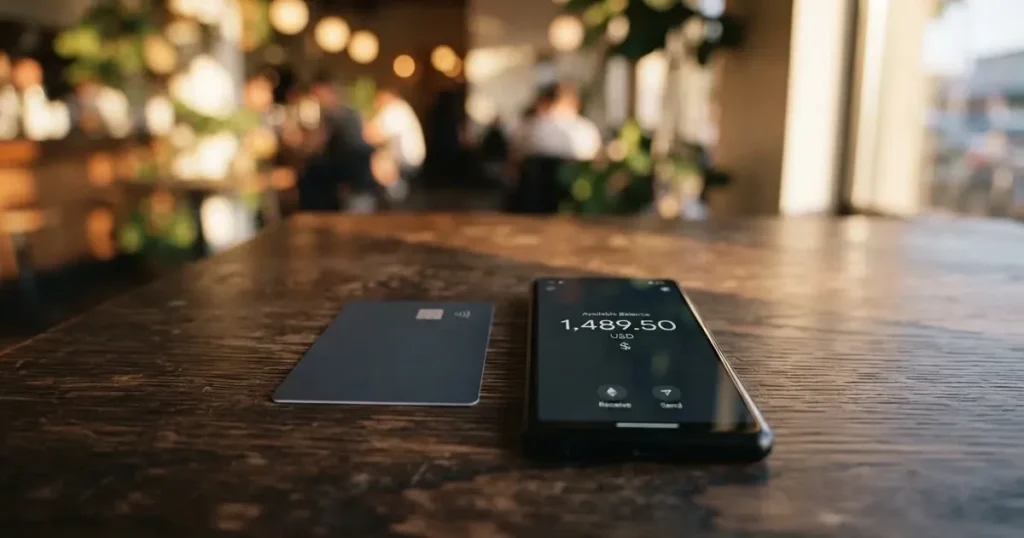
Cadmos is a card for people who already hold stablecoins and want to spend them without moving them to somebody else’s account. You keep the coins in a self-custodial wallet, transfer USDC or USDT to the card, and the card pays merchants in fiat. That core is unusually clean: your balance does not leave your wallet until a top-up is approved, and the company says in its own terms that it does not receive, hold, safeguard or take title to your digital assets or fiat funds.
Around that clean core sits a ring of unanswered questions. The card issuer is not named. No licence is named in the terms. No country list is published. Several ordinary things you would look up before applying — the issuance fee on Premium, whether Standard costs anything, whether you get plastic, what the ATM fees are, how long delivery takes — are simply not stated on the public pages. A search for reviews turned up nothing at all, which cuts both ways: no complaints, but also no long-term track record from other users.
I gave it 7.0 out of 10. The top-up path earns a 9 because it is the part Cadmos has clearly thought about: two stablecoins, three networks, no bank account needed. The rest sits at 6 or 7, dragged down less by anything being bad than by how much is simply unknown.
The conditions described here are current as of October 28, 2026.
The score, criterion by criterion
| Criterion | Mark | Why |
|---|---|---|
| Who can get it | 7 / 10 | Country list not published; terms only rule out countries under a US embargo |
| Cost | 7 / 10 | Premium: 0 USD per month, FX 1.75%; issuance and crypto conversion fee not disclosed; Standard: prices shown on the order screen |
| Top-up options | 9 / 10 | USDC and USDT from your wallet, on Arbitrum, Solana and Tron |
| Reliability and complaints | 6 / 10 | Cadmos LTD, Limassol, Cyprus, since 2021; issuer and licence not named; no complaints found; non-custodial wallet |
| Everyday use | 6 / 10 | Premium: Apple Pay and Google Pay; Standard: Apple Pay; virtual or plastic and ATM not disclosed |
| Total | 7.0 / 10 | A good funding rail attached to a card with a lot of blank fields |
Who this is for
If you are already self-custodying USDC or USDT, you think about networks and settlement, and you would rather not hand a provider the keys, this card does one thing plainly and does it with two coins and three networks. The wallet-until-approved model is real, stated in the terms, and it is the right default for someone who does not want a custodial counterparty.
Who it is not for
If you need to know what a coffee costs in your home currency before you buy it, this is not the card for you today. The Premium foreign-exchange fee is 1.75% and the crypto conversion fee is not stated anywhere I could find. If you plan to pay rent, tuition or anything that arrives as a surprise debit, the unknown spread is not a rounding error. It is also not a first card for anyone who needs a bank account number, an IBAN, proof of address for a landlord, or the reassurance of a deposit-guarantee scheme — Cadmos is a payment card, not a bank.
Will they give you the card?
Here is the honest answer: I cannot tell you, and neither can the card’s public pages.
Cadmos does not publish a country list. What the terms say is narrower: users must not be in a country under a US embargo. That is a compliance exclusion, not an eligibility promise. Availability, in practice, depends on your eligibility and on the options the app shows you when you go to order — so the app, not a webpage, is the authority. If you live somewhere and the card is not offered in your app, there is no appeal process described anywhere.
This matters more than it usually does, because a card without a stated eligibility list has no predictable answer to the question everyone asks first: is it available where I live? You find out by opening the app and looking. That is a legitimate design for a company that ships fast and lets its own compliance system decide, but it means you cannot research your way to a decision. Budget a few minutes with the app rather than an afternoon with a comparison table.
One thing I want to be clear about because people search for it: I did not find any published information on whether citizenship affects eligibility, separate from residence. If that matters to your situation — dual nationality, a passport from one country, residence in another — you will need to ask the company directly before you commit anything.
How to get it
The route runs through the app, and the identity check is the part that varies.
Know Your Customer requirements differ between the two card products and are displayed on the order screen. What that check can include: a government ID, personal information, and proof of liveness. What the public pages do not state: whether proof of address is required, whether an age check is part of it, and how many separate KYC tiers exist. If you are trying to work out in advance what documents to have ready, you will not manage it from the marketing pages — the order screen is where that list lives.
The card itself:
- Premium is a Visa Signature.
- Standard is Visa or Mastercard, and the app shows which one you are getting.
- Whether the card arrives as virtual, plastic, or both is not stated.
- The currency the card is denominated in is not stated.
- Delivery time is not stated.
That last group is the practical annoyance. You can check out and then discover the shipping timeline. If you need a card for something on a specific date, factor in that nobody has published a delivery estimate.
A download page exists at /download. I did not read the store ratings, so I will not pretend to know how people rate it — but I would look before you commit, because the absence of reviews elsewhere is not a quality signal.
Fees: what it really costs
Costs are where this card needs the most reading between the lines, and the pattern is not reassuring: the number that is easy to find (0 USD per month, 1.75% FX) is real, and the numbers that would tell you what a purchase actually costs are missing.
| Fee or limit | Premium | Standard |
|---|---|---|
| Monthly fee | 0 USD | Not stated (costs shown on the order screen) |
| Issuance fee | Not stated | Not stated |
| Crypto conversion fee | Not stated | Not stated |
| Foreign exchange / cross-border | 1.75% FX fee | Per its programme terms, no figures given |
| ATM fees | Not stated | Not stated |
| Card currency | Not stated | Not stated |
| Spending or balance limits | Monthly spend limit 175,000 USD | No wallet-balance or cumulative transfer cap by Cadmos; card limits set by the programme and shown in the app |
| Benefits | Visa Signature benefits, lounge access at 1,300+ lounges in 500+ cities, 24/7 concierge, Visa Airport Companion | No benefits listed |
Three everyday payments, and what each one costs
Here is why I keep coming back to the missing conversion fee. Take a coffee. A meal. A monthly subscription.
- A coffee in your local currency. You tap, and the merchant’s country is not your country. On Premium, that is a 1.75% FX fee on top of whatever Visa’s rate gives you that day. On Standard, cross-border fees follow the programme terms and no figures are published. Add the crypto conversion fee, which is not stated on either product.
- A meal at home, in your own currency. No FX fee, because there is no conversion of currency — but there is still the conversion from stablecoin to fiat at the merchant, and that rate is not disclosed. If it is a one or two percent on the way in, a fifteen-dollar lunch quietly costs you real money and you will not see it itemised.
- A monthly subscription. The same two unknown-or-stated percentages, applied again. This is where a small unstated fee stops being small, because it recurs. The Standard product’s monthly spend cap is not published either — only Premium’s 175,000 USD figure is — so for Standard you would have to find the limit in the app.
The 175,000 USD monthly spend limit on Premium is genuinely generous and, if you spend near it, you will want to know what happens on the other side. The card’s own terms govern; the public pages do not fill in the mechanics.
What is clear, and worth saying plainly: there is no annual fee on Premium, and no benefits are listed for Standard at all. If you are comparing against a card with lounge access and a concierge, Premium is the one with them.
Top up: the part that works
This is the 9 out of 10, and it earns it.

You hold the coins yourself, in a self-custodial wallet. USDC and USDT top up the card, and the settlement is in fiat at the merchant — meaning you are not paying a merchant in crypto, you are paying them in their own currency. The transfer networks listed are Arbitrum, Solana and Tron. Three chains, two coins, no bank account mentioned in the flow.
The model has one genuinely good property: your wallet balance stays self-custodial until a card top-up is approved. Until you approve, the funds are yours, in your wallet, under your key. The terms say this plainly — Cadmos does not receive, hold, safeguard or acquire title to your digital assets or fiat funds.
Fees and minimums for top-ups are not stated. Neither is how you withdraw a card balance if you want to stop. Closure is by email, and closing does not freeze or move your digital assets — that part is reassuring, because it means the coins stay yours. The one gap is the card balance itself: if you had loaded money that has not been spent, what happens to it on closure is not stated.
One practical warning, because this is the most common way people lose money in this category. Transfers are irreversible. If you send on a network the card does not support, or to an address belonging to a different network, the money can be gone or require manual support recovery with no guarantee. Cadmos names its three networks for you; check them before you send, every time.
Paying with it every day
Mobile wallets:
- Premium works with Apple Pay and Google Pay.
- Standard works with Apple Pay, on both the Visa and Mastercard versions. Google Pay is not mentioned for Standard.
That is a meaningful gap between the tiers. If you are on Android and want Google Pay, Premium is the product that names it.
Blocked merchant categories are not stated. This is worth a moment’s thought, because blocks are policy rather than law and vary by issuer — gambling is the usual example, but travel, fuel, or cash withdrawal at a cash machine can also be restricted, and you would find out at the till rather than in advance.
Cash withdrawal and ATM access are not disclosed. If getting cash matters to you, treat that as unanswered.
Rewards are not stated on either product. There is no cashback figure to plan around and nothing to compare against the alternatives’ headline rates.
If something goes wrong with a payment
The dispute position is unusual and worth reading twice. The terms choose French law and the courts of Paris, and commit to a 30-day good-faith resolution after written notice. What the card chargeback process is — how a fraudulent payment is actually reversed — is not stated. A 30-day good-faith resolution is not the same as a chargeback with reason codes and a defined timeline.
Address verification is the other quiet friction point. The address check that compares the street number and postcode a buyer types against issuer records is mainly offered in the US, Canada and the UK, and is generally unavailable for foreign-issued cards — which is exactly what a crypto card often is. That produces declines that look like your fault and are not.
What can go wrong
Let me separate the things that are risks of this card from the things that are risks of the category, because they need different responses.
Specific to Cadmos
The company is Cadmos LTD, Limassol, Cyprus, registration number HE 457316, founded 2021. The card issuer is not named. No licence is named in the terms. The wallet is non-custodial, which is the strongest thing about the setup. But an unnamed issuer behind a named licence-free front page is a question you cannot answer from the public pages, and it is the first thing I would ask.
No complaints were found — searches returned no Trustpilot or Reddit reviews of Cadmos Pay. I want to be careful with that finding, because it is ambiguous. It means nobody has posted a public grievance I could locate. It also means there is no independent user track record, and a card with no complaints and no reviews is a card that has not been stressed yet.
The self-custody design puts the risk on you in a specific, technical way. You hold the recovery phrase. Anyone who obtains it can restore the wallet and spend the funds. Transfers are irreversible. There is no built-in recovery: the network cannot freeze or return a stolen amount. You also carry phishing and clipboard-hijacking risk, where malware quietly swaps a copied address. None of this is unusual for self-custody — it is the standard trade — but it should be a decision, not an accident.
Support: [email protected], tickets inside the app under Settings then Help Center, phone +1 (845) 588-8434. Premium adds a 24/7 concierge by email and WhatsApp. A phone number and an email are modest reassurance from a company that will not name its issuer.
Risks of the category, in brief
Card programme closure is the one that catches people out, and it is not hypothetical. Visa terminated its global agreements with FTX in November 2022 and the FTX US debit card was wound down by its issuer. WaveCrest, a Visa issuer that supplied crypto card brands, was suspended by Visa in Europe in 2018, closing all WaveCrest-issued Visa programmes. Closures typically run in a predictable order — notice, then loading and spending stop, then you are asked to withdraw what is left. Because Cadmos does not name its issuer or licence, you cannot look up the entity’s history, and you do not have a named institution to hold to account when something changes.
Two more that affect your daily life: a declined authorisation can leave a hold on your funds for up to several days, sometimes seven, and merchants sometimes decline prepaid or foreign cards because the card’s identification number reveals the issuer and country. You have less control over both than with a card from a bank you already use.
What to take instead
If you need the same idea — spending crypto you hold yourself — with more of the details published, there are three names worth reading before you commit.
MetaMask scores 7.1 / 10, just above Cadmos. Sign-up is open in 45 listed countries and territories; other regions join a waitlist; US and UK sign-ups are temporarily closed. Proof of residency is required, but ineligible regions limit sign-ups, not spending — a friendlier posture than Cadmos’s silence. The card is Mastercard, issued by Monovate, with a virtual card available instantly and a metal card pre-orderable in the app, one per user. Virtual is free with no annual or maintenance fee; metal is 199 USD per year. Fees are described as minimal per transaction with no additional MetaMask fees and no foreign transaction fee, the Mastercard rate being used. It spends directly from the connected wallet on Linea, Base, Monad and Solana, across mUSD, wETH, EURe, GBPe, USDC and USDT. Cashback is 1% on Virtual; on Metal the headline is 3% but the footnote caps it at 3% up to the first 10,000 USD spent, then 1%.
KAST scores 6.1 / 10 and is the most transparent on membership costs: Standard 0 USD a year, Premium 1,000 USD, Private 10,000 USD, billed annually upfront. Its fee list is also the most complete in this comparison — stablecoin top-up 0%, card spend in USD 0%, transaction fee 0%, Apple and Google Pay 0%, a non-USD FX fee of 0.5%–1.75% depending on your residence, transaction country and card programme, 0.10 USD for non-USD transactions under 25 USD, and 0.50 USD for a declined transaction. It supports USDT and USDC on Ethereum, Solana, Polygon, Arbitrum and TRON, with no bank account needed, and offers USD cashback of 1.5% up to 2,000 USD a month on Standard, rising to 3% up to 40,000 USD on Private. Its catch is eligibility: the country list is not published either, shown only at KYC, and holding an ID from a restricted region can make you ineligible even if you live in a supported country.
TokenPocket scores 5.8 / 10 and is the weakest of the three on paper. It has the clearest geographic split — Visa debit for a list of European countries including Germany, France, Spain and Switzerland, Mastercard debit for Australia, Canada, Hong Kong, Japan, Taiwan, New Zealand, Singapore, South Korea and the UK. Cards run on Arbitrum, with balances in EUR24 and USD24. Its cost structure is odd: an NFT creation fee partly covered by TokenPocket where you pay a small portion, otherwise no additional fees, but a 1% fee on depositing cryptocurrency, to be refunded later through rewards or reduced transaction fees. Specific coins and networks are not listed.
| Cadmos | MetaMask | KAST | TokenPocket | |
|---|---|---|---|---|
| My score | 7.0 / 10 | 7.1 / 10 | 6.1 / 10 | 5.8 / 10 |
| Card network | Visa Signature (Premium); Visa or Mastercard (Standard) | Mastercard | Visa, Platinum to Infinite | Visa or Mastercard debit |
| Issuer named | No | Monovate | Not stated | Not stated |
| Custody | Self-custodial | Wallet-linked | Card balance, with 0% spread on stablecoin deposits | Card balance in EUR24 / USD24 |
| Coins | USDC, USDT | mUSD, wETH, EURe, GBPe, USDC, USDT | USDT, USDC (Terms say these two) | Not listed |
| Networks | Arbitrum, Solana, Tron | Linea, Base, Monad, Solana | Ethereum, Solana, Polygon, Arbitrum, TRON | Arbitrum |
| Annual cost | 0 USD on Premium | Free virtual; 199 USD metal | 0 / 1,000 / 10,000 USD by tier | No additional fees; NFT fee partly self-paid |
| FX fee | 1.75% on Premium | None stated; Mastercard rate | 0.5%–1.75% on non-USD | Not stated |
| Where I would look first | The order screen in the app | Published fee table | Published fee list | The FAQ, which is thin |
Who I would recommend it to
I would recommend Cadmos to someone who is already comfortable with self-custody, holds USDC or USDT, and wants a card fed from a wallet they control rather than an exchange account. If the money you spend with it is money you have already decided to spend, the missing conversion fee matters less; if it is money you need to land at a predictable amount, the missing figures are disqualifying until they are published.
I would not recommend it as a first card, as a primary banking substitute, or as a card for anyone whose country list they cannot confirm before committing. Nor would I recommend holding a large idle balance on it while the issuer and licence are unnamed.
Before you apply, I would do three things, in this order. Open the app and see whether the card is actually offered where you are — that is the only eligibility test that exists. Screenshot the order screen, because the KYC requirements and the Standard prices exist there and nowhere else. Then send one email to [email protected] asking the two questions that would change my answer: what is the crypto conversion fee, and who is the card issuer and under what licence? If you get clear answers, the 7 becomes an 8 in my book. If you do not, you have still lost nothing, because nothing was committed.
Frequently asked questions
What is Cadmos card?
Cadmos is a payment card you fund from your own self-custodial wallet rather than from a bank account. You transfer USDC or USDT to it on Arbitrum, Solana or Tron, the card converts to fiat at the merchant, and the payment goes through as an ordinary card transaction. There are two products: Premium, a Visa Signature at 0 USD a month, and Standard, a Visa or Mastercard with no benefits listed.
How does the Cadmos card work?
Your balance stays in your wallet until you approve a card top-up, and the terms say Cadmos does not receive, hold, safeguard or take title to your digital assets or fiat funds. Once loaded, the card spends a fiat balance like a prepaid card. Premium includes Apple Pay and Google Pay; Standard names Apple Pay only. Cash withdrawal and ATM access are not disclosed.
Is Cadmos a bank?
No — not on anything published. The company is Cadmos LTD, Limassol, Cyprus, registration HE 457316, founded 2021. The card issuer is not named and no licence is named in the terms. So do not treat it as a bank account, a place to hold a salary, or something covered by a deposit guarantee scheme.
Which countries can get the Cadmos card?
The card does not publish a country list. The terms only require that users not be in a country under a US embargo. Actual availability depends on your eligibility and the options shown in the app when you go to order, so the app is the only authority. Whether citizenship counts separately from residence is not stated either.
Does the Cadmos card require KYC?
Yes. KYC requirements differ between the two products and are shown on the order screen, and can include a government ID, personal information and proof of liveness. Whether proof of address is required, whether age is checked, and how many KYC tiers exist are all not stated on the public pages.
How do I top up the Cadmos card?
From your own wallet, with USDC or USDT, on one of three networks: Arbitrum, Solana or Tron. Top-up fees and minimums are not stated. Check the network before you send, because blockchain transfers are irreversible and sending on an unsupported network or to the wrong network’s address can lose the funds.
What does it cost to spend with a Cadmos card?
Premium charges 0 USD a month and a 1.75% foreign exchange fee. The issuance fee and the crypto conversion fee are not stated, and Standard’s costs appear only on the order screen. Since the conversion fee is the one that would tell you what a payment really costs in your own currency, it is the first number to ask for before committing.
Can I add the Cadmos card to Apple Wallet?
Yes — Apple Pay is named for both Premium and Standard, on the Visa and Mastercard versions of Standard. Premium additionally names Google Pay. If you are on Android and want Google Pay, Premium is the product that states it.
Is the Cadmos card safe?
The self-custody side is the strongest part: your coins stay in your wallet until you approve a top-up, and Cadmos states it does not take custody. The unknown side is the card: issuer unnamed, licence unnamed, no published reviews either way, and no published chargeback process. Transfers are irreversible and a lost recovery phrase cannot be reversed by anyone.
How do I close my Cadmos account and get my money out?
Closure is by email. Closing does not freeze or move your digital assets, so anything still in your wallet stays yours. What happens to a card balance you loaded but did not spend is not stated, so if you have money sitting on the card, ask before you close rather than after.
Wallet cards in the catalogue – cryptocardcatalog
Content created by the «cryptocardcatalog» team