
What the Bringin Visa card actually does with your Bitcoin — and where the small print starts to bite
 Available in US
Bringin is a euro-denominated Visa card, physical and virtual, that spends from a personal euro balance. The unusual part is how that balance is funded: alongside a normal SEPA bank transfer, you can top it up with Bitcoin, both on-chain and over Lightning, from any wallet you already control. There is no stablecoin support and no separate tier structure — it is one plan, one monthly price, and a self-custody story the company leans on.
I went through the card’s published pages, the help centre and the underlying company details. Below is what I found, what I could not find, and who I think this card is genuinely useful for.
The conditions on this page are current as of October 28, 2026.
Verdict
Bringin scores 5.7 out of 10. That is a middling result, and the reason is in the split. The card itself is well-built for everyday spending: a real Visa, Google Pay and Samsung Pay direct, contactless and online, with no foreign-exchange fee and a 1% Bitcoin-to-euro conversion rate plus a 0.5% partner markup. Where it stumbles is access and funding. It is only open to people in 30 EEA countries, you can only fund it in euros (either by bank transfer or by selling Bitcoin), there is no USDC or USDT route, and the company behind it is small and still proving itself.
Score table
| Criterion | Mark | Why it scores where it does |
|---|---|---|
| Who can get it | 5 / 10 | 18+ with a valid EEA ID (30 countries); no clarity on citizenship vs residence; sanctioned and restricted countries excluded |
| Cost | 5 / 10 | €37.69 plan, €3.49/month paid annually, 0% FX; BTC-to-eUR conversion 1% plus 0.5% partner markup |
| Top-up options | 4 / 10 | SEPA and Bitcoin on-chain/Lightning only; no stablecoins; everything funnels into euro |
| Reliability and complaints | 7 / 10 | UAB Bringin in Vilnius, partner Lightspark Europe MiCA-authorised; card issuer not named; no complaints found |
| Everyday use | 8 / 10 | Visa physical and virtual, Google Pay and Samsung Pay directly, Apple Pay via Curve, €350/day cash |
| Total | 5.7 / 10 | A capable euro card for a narrow audience |
The audience this card is built for is narrow and specific: EU residents who want to pay with Bitcoin and Lightning from a wallet they already own. If that is you, Bringin is one of the more straightforward options on the market. If you just want a card to spend stablecoins, or you live outside the EEA, this is not the card for you.
Who can get the Bringin card
The Bringin card is only available to people who are 18 or older and hold a valid ID from the EEA. The EEA, as Bringin lists it, covers the EU member states plus Liechtenstein, Norway and Iceland — 30 countries in total.
A few things the page does not spell out clearly. The eligibility check is on a valid ID, but the card does not say whether it judges you by citizenship or by where you actually live. In practice that matters: someone with an Italian ID who has lived in Brazil for years is in a grey zone until they confirm with support. The other missing piece is proof of address — it is not stated whether a recent utility bill or similar is required, only that ID verification (KYC) happens at sign-up.
The other side of access is exclusion. The card cannot be used in restricted countries, and the published list includes Belarus, Russia, Ukraine, Turkey, the UAE, Nigeria and Egypt among others. If your billing address or your travel puts you in any of these places, the card will not work there. The same goes for sanctioned jurisdictions — Bringin is bound by the same EU and international rules any regulated payments firm is.
If you are outside the EEA, the door is closed. The single biggest limitation of the card, before fees, before features, is geography.
How to sign up
Signing up for Bringin is a four-step process: register, verify your ID, fund the euro vIBAN, then create a virtual card or order the physical one. The vIBAN is the personal euro account that holds the balance the card spends from.
Identity verification is the standard EU kind: a valid government-issued ID, run through KYC. What is not shown publicly is what KYC levels exist and what each one unlocks — the published material just says limits depend on your KYC verification level, without giving the tiers. The rejection criteria are also not on the public page, which means the only way to know if a specific nationality or residency situation is accepted is to try.
The card itself comes in two forms. There is an unlimited number of virtual Visa cards, and you can also create one-time virtual cards for single transactions. The physical card is a regular Visa, delivered to the registered address; the time and cost of delivery are not stated. A virtual card is instant.
The published steps assume a clean case. The reality with most European fintechs is that if your name contains accents, your address is recent, or your ID is from a less common country, the manual review queue is what slows you down, not the form.
Fees: what it really costs
Bringin publishes a single plan and a single price. The headline number is €37.69, which the pricing page shows as “Paid annually, €3.49 per month” with a 10% discount. Card issuance, both physical and virtual, is free. The promise on the page is “0 fee per usage”, and on foreign-exchange transactions that is literally true — 0% FX fee.
The cost story changes once Bitcoin enters the picture. Bitcoin-to-euro conversion is 1%, and on top of that the FAQ confirms a 0.5% partner markup on the underlying Bitcoin pricing. So selling €100 of Bitcoin through Bringin costs roughly €1.50, depending on the spot rate at the moment of conversion.
For cash withdrawals, the card allows them but the ATM fee is not stated. The cash limits are €350 per day and €3,000 per month.
Costs at a glance
| Item | Amount |
|---|---|
| Plan price | €37.69 (€3.49/month paid annually) |
| Card issuance | Free (physical and virtual) |
| Monthly fee | Included in the plan |
| Foreign-exchange (FX) fee | 0% |
| Bitcoin-to-euro conversion | 1% |
| Bringin partner markup | 0.5% |
| ATM fee | Not stated |
| Card payment limit | €10,000/day, €15,000/month |
| Cash withdrawal limit | €350/day, €3,000/month |
The pricing looks competitive on the surface, but the comparison changes once you run an actual payment. A €50 lunch paid from a Bitcoin balance involves the 1% conversion fee and 0.5% markup, on top of the Bitcoin network fee you paid to deposit it. For frequent small transactions that adds up.
Three everyday payments, three different cost pictures
Buying a €4 coffee with Bitcoin funds. The card itself charges 0% for the payment and 0% FX (euro to euro). The only Bringin-side cost is the 1% conversion plus 0.5% markup — but the conversion is applied when you top up, not at the moment of payment. If you topped up €20 of Bitcoin to cover several coffees, the €0.30 conversion cost is amortised across them. Real cost: pennies, plus whatever the on-chain Bitcoin fee was.
Withdrawing €200 from an ATM in Berlin. Cash is allowed up to the daily limit. Bringin does not publish its own ATM fee, but Visa itself charges an ATM-acquirer fee that varies by bank. The €3,000 monthly cap is generous, but if you planned to use Bringin as a primary cash card, the absence of a stated fee is a gap.
Paying a €120 hotel bill in a non-EEA country, say Switzerland. FX is 0%. The card payment itself is 0% per usage. There is no DCC trap if you decline the merchant’s dynamic currency conversion. Real cost: zero from Bringin, beyond the cost of having topped up with Bitcoin in the first place.
How to top up Bringin
There are exactly two ways to add money to the card: a SEPA bank transfer, or Bitcoin — either on-chain or over Lightning. Both routes funnel into the same personal euro vIBAN, and that euro balance is what the card actually spends from.
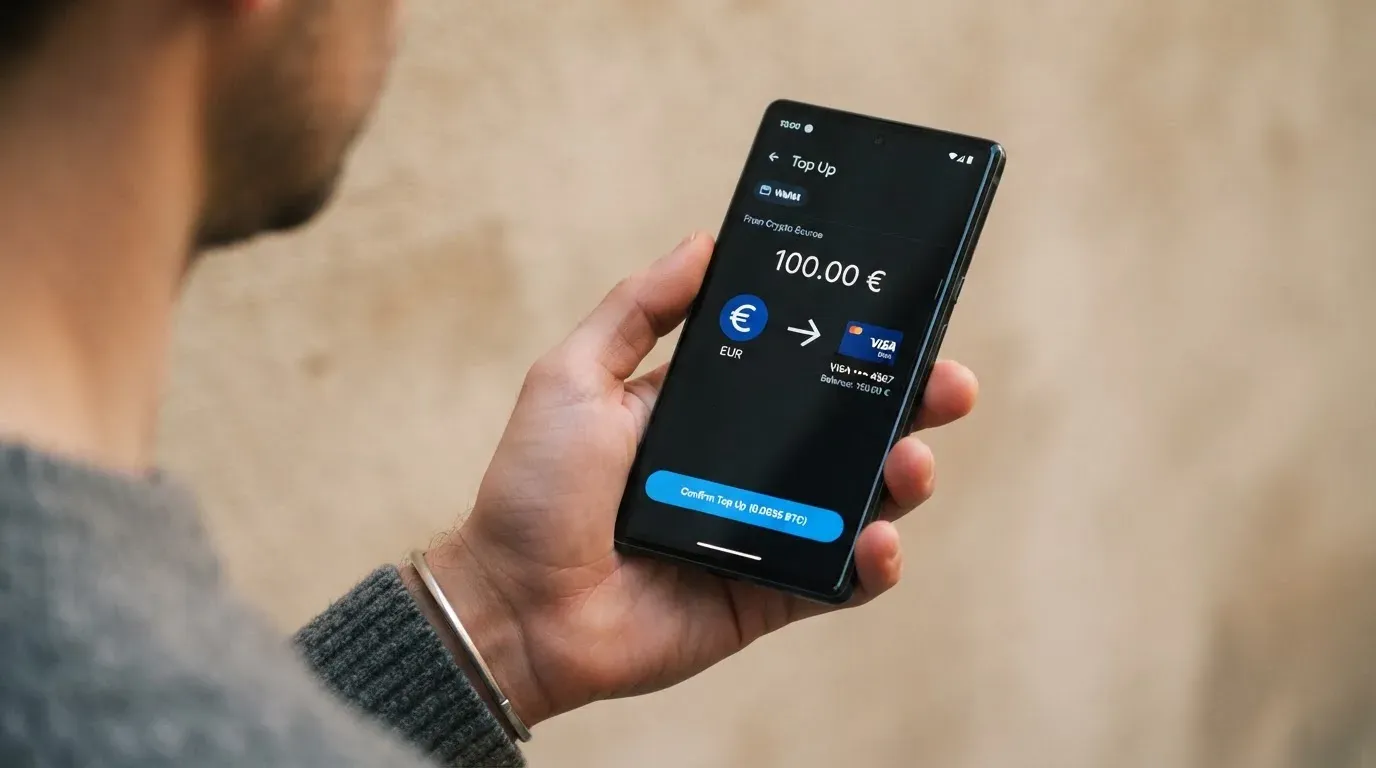
A few details worth knowing. Stablecoins are not supported — there is no USDC, no USDT, no EURT route, only native Bitcoin. The minimum top-up amount and the fee structure for SEPA top-ups are not stated on the public pages; what the app does is show the fees on screen before you confirm, so the actual cost appears in the flow. Fiat top-ups can only go to the Bringin euro account, in euros.
The Lightning angle is what makes Bringin distinctive. A typical crypto card in Europe wants you to send USDC on a specific network, then wait, then trust a custodian. Bringin instead says: bring Bitcoin, on-chain or via a Lightning wallet, and we will credit euros. That is a meaningfully different user experience if you already keep Bitcoin in self-custody.
What is missing from the funding story:
- Minimums and per-top-up fees
- Time for SEPA credit to clear
- Whether Lightning invoices have a size cap
- Account closure mechanics — the help-centre article is dated 24 July 2026, and balance handling on closure is not stated
- Withdrawal fees from the euro balance back to a bank account are not stated, only that you can do it “anytime”
Paying with the card day to day
For everyday use, Bringin is closer to a normal Visa than a crypto card. The physical card is a regular contactless Visa, the virtual card works online, and the card is euro-only.
Mobile wallet support is uneven. Google Pay, Samsung Pay, Fitbit Pay and Garmin Pay all work directly. Apple Pay is not direct — you can add Bringin to Apple Pay only by routing it through the Curve app, and Bringin’s own page describes direct Apple Pay support as “planned”. If Apple Pay is non-negotiable for you, this is friction.
Rewards and perks are thin. There is no cashback programme listed. The published perks are two discount codes: 10% off Alby subscriptions and 10% off the Koinly tax calculator — useful if you use those, irrelevant if you do not.
The app is available on iOS (via TestFlight, not the regular App Store), on Android through Google Play, and as a web app. TestFlight distribution is worth flagging: it is a legitimate Apple channel, but it is also where apps sit before they have a full App Store review, and Apple can revoke TestFlight access at any time. If you only use iOS, this is a small reliability risk worth knowing.
A few everyday-use questions the public material does not answer:
- Which merchant categories are blocked (gambling, crypto, adult)? Not stated.
- How disputes work. Not stated.
- How long an authorisation hold can sit on the card. Not stated.
For a card that is fundamentally a payment tool, the absence of a published dispute process is a real gap.
What can go wrong
Bringin is a small European fintech, and the risk picture reflects that. There is no history of incidents I could find — no official incidents, no user complaint threads, no Trustpilot page — and that is partly because the company is still young. The relevant things to know:
The company. Bringin is UAB Bringin, a Lithuanian company (registry code 306317430), based in Vilnius. The crypto side runs on Lightspark Payments Europe AS, which received a MiCA licence in June 2026. MiCA is the EU’s main crypto regulation, and the licence is a meaningful signal: the partner handling the Bitcoin side is now regulated as a crypto-asset service provider. What is not named publicly is the card issuer — the bank or e-money institution that actually issues the Visa. That is unusual; most cards name the issuer on the front of the website. The omission means you cannot independently check the issuer’s licence or safeguarding arrangements before signing up.
Self-custody framing. The card page describes a self-custody wallet. That is a meaningful security claim: the implication is that the company does not hold your Bitcoin in a pooled custodial account, so the Mt. Gox / Coincheck / Ronin-style custodian-failure risk does not apply to your deposited BTC. The trade-off is that you hold the keys, which means you also hold the risk of losing them.
Security features listed. Instant card freeze, real-time alerts, and 3-D Secure on every transaction. Standard, but solid. Safeguarding of euro balances is not stated, which is the more important question — are customer euro funds held in a segregated account, and are they protected if Bringin itself fails?
Support. Telegram chat, in-app chat, an email address ([email protected]), and a help centre at help.bringin.xyz published in 15 languages — Russian is not among them. Support hours are not stated. The Telegram channel in particular has a different risk profile from a phone-support line: it is fast, but it is also the kind of channel social-engineering attacks use.
Regulatory milestones. The June 2026 MiCA licence for Lightspark Europe is a real positive. It is also a reminder that Bringin is operating in a market where, under MiCA’s transitional rules, providers already in business can keep operating only until 1 July 2026 or until they get (or are refused) their own MiCA authorisation. The card programme has work ahead of it to be fully regulated on its own feet.
Two risk patterns worth naming. First, programme closures happen in this industry: Visa terminated its global agreement with FTX in November 2022, and the FTX US debit card was wound down; Visa’s 2018 suspension of WaveCrest in Europe closed every crypto card programme that issuer ran. If the issuer here is shut down or the programme closes, you get a notice period, then loading stops, then spending stops, then you withdraw. Second, stablecoin depegs and on-chain mistakes are user-side risk: sending USDT to a Bringin top-up address that does not accept it is not recoverable, because blockchain transfers are not reversible.
What to take instead
Bringin is not the only option in this corner of the market. The table below compares three alternatives I have looked at; the full Bringin picture is above.
| Bringin | International Visa Card | UNi Card | Whop Cards | |
|---|---|---|---|---|
| Score | 5.7 / 10 | 6.7 / 10 | 6.1 / 10 | 5.2 / 10 |
| Card network | Visa | Visa | Mastercard | Visa |
| Card currency | EUR | USD | Multicurrency | Not stated |
| Who can get it | EEA 18+ | Excludes residents/registrants of Belarus, mainland China, North Korea, Cuba, India, Iraq, Iran, Israel, Myanmar, Nepal, Nicaragua, Russia, Syria, Turkey, Ukraine, Venezuela, Vietnam; FATF grey-list case by case | Not stated | Consumers in 31 US states; businesses in 41 US states; excludes Belarus, China, Cuba, Hong Kong, India, Iran, Iraq, Israel, Myanmar, Nepal, Nicaragua, North Korea, Russia, Syria, Turkey, Ukraine, Venezuela, Vietnam |
| Plan cost | €37.69/year (€3.49/month) | $5 one-time card; Classic free, Pro $9/mo, Max $19/mo | No annual fee | “No extra fees” |
| FX fee | 0% | 2% | None stated | Not stated |
| Conversion fee | 1% BTC→EUR + 0.5% partner markup | Free for USD, Visa rate + 2% for non-USD | Live OTC rates | Not stated |
| Funding | SEPA, BTC on-chain, Lightning | USDC/USDT (free at 1:1), USD, EUR, SEPA, SWIFT, FedNow | Not stated | Stablecoin-collateralised Whop balance |
| Cashback | None | None stated | Up to 3% | 5% at select merchants (Uber and more) |
| Notes | No stablecoins | Rule is by residence/registration | Multicurrency Mastercard | US-only on the consumer side |
If Bringin’s EEA-only access is the blocker, International Visa Card opens up far more geographies (with a longer exclusion list of its own) and lets you fund with USDC or USDT for free, though at 2% FX outside the US. UNi Card is the multicurrency Mastercard alternative, with up to 3% Spend-to-Earn rewards; the gap is that the card’s funding story is not stated publicly. Whop Cards is the US-only option with stablecoin funding and 5% cashback at selected merchants; it is unavailable to most of Europe.
If you specifically want to spend Bitcoin from a self-custody wallet in the EEA, none of the three alternatives above is a clean substitute — Bringin has that niche largely to itself.
Who I would recommend Bringin to
I would recommend Bringin to a resident of the EEA, 18 or older, who already holds Bitcoin in a self-custody wallet and wants a euro-denominated Visa for everyday spending without first selling to a bank. The card is the simplest way I have seen to convert Bitcoin to a spendable euro balance without handing custody to an exchange.
I would not recommend it to:
- Anyone outside the EEA — the card is not available
- People whose main crypto holdings are stablecoins — there is no USDC or USDT route
- Anyone who needs direct Apple Pay support — it works only through Curve today
- People who want a published dispute process, a named card issuer, and stated safeguarding arrangements before they sign up
- Anyone who needs more than €10,000 of card spending in a single day, or more than €3,000 in cash per month
If you fall into that last set of cases, the alternatives above are worth a closer look. If you fall into the first group, Bringin is one of the more honest small-European crypto cards I have come across — its limits are visible, its pricing is published, and the MiCA licence on the partner side is a real signal that the regulatory direction is correct.
Frequently asked questions
What is the Bringin card?
The Bringin card is a euro-denominated Visa, available in physical and virtual form, that spends from a personal euro vIBAN. The unusual part is that the euro balance can be topped up not just with a SEPA bank transfer but also with Bitcoin sent on-chain or over Lightning from any wallet. The company is UAB Bringin, based in Vilnius, Lithuania, and the crypto side runs on Lightspark Payments Europe AS.
How does the Bringin card work?
You register, verify your identity, fund the euro vIBAN, and create a virtual card or order the physical one. When you pay, the card draws on the euro balance. The balance itself can be loaded two ways: a normal SEPA transfer from a bank, or a Bitcoin transfer that Bringin converts to euros at a quoted rate before crediting your balance.
Is Bringin a bank?
No. Bringin is not a bank. It is a fintech (UAB Bringin) and operates in cooperation with a MiCA-authorised partner on the crypto side (Lightspark Payments Europe AS). The card issuer — the licensed bank or e-money institution that actually issues the Visa — is not named publicly on Bringin’s pages.
Who owns Bringin?
Bringin is UAB Bringin, a Lithuanian-registered company (registry code 306317430) in Vilnius. The ownership structure beyond that, including who the shareholders are, is not detailed on the public-facing card pages I checked.
Is the Bringin card available in the United States?
No. The card is restricted to the European Economic Area: the EU member states plus Liechtenstein, Norway and Iceland. People outside that 30-country list cannot sign up. Residents of the United States should look at US-only alternatives such as Whop Cards.
How do I top up the Bringin card?
You top up by sending a SEPA bank transfer in euros to your personal Bringin vIBAN, or by sending Bitcoin either on-chain or over Lightning. The card has no stablecoin top-up option, so USDC and USDT are not accepted. Fees and minimums are shown in the app before you confirm a top-up.
Does the Bringin card require KYC?
Yes. Sign-up requires you to be 18 or older and to complete identity verification with a valid EEA ID. The help pages mention KYC levels and that limits depend on them, but the levels themselves and the rejection criteria are not published.
How do I add the Bringin card to Apple Pay?
You do not add it directly today. Bringin supports Google Pay, Samsung Pay, Fitbit Pay and Garmin Pay directly. To use the card with Apple Pay you have to add it through the Curve app, which then tokenises it for Apple’s wallet. Bringin’s own page says direct Apple Pay support is planned.
Is the Bringin card safe?
The published security features are solid: 3-D Secure on every transaction, instant card freeze, real-time alerts, and a self-custody model on the Bitcoin side. What is not stated publicly is how euro balances are safeguarded, who the card issuer is, or what the dispute process is. The MiCA licence received by Lightspark Europe in June 2026 is a meaningful regulatory signal on the crypto side.
Is the Bringin card worth it?
It depends on what you need. For EEA residents spending Bitcoin they already hold, the card is one of the more straightforward options in 2026, with a published price (€37.69/year) and a real Visa for everyday use. For anyone outside the EEA, anyone with stablecoin-heavy holdings, or anyone who needs direct Apple Pay and a published dispute process, it is not the right fit.
App and neobank cards in the catalogue – cryptocardcatalog
Content created by the «cryptocardcatalog» team