
The Bitstack card, written for someone who actually has to live with it
 Available in US
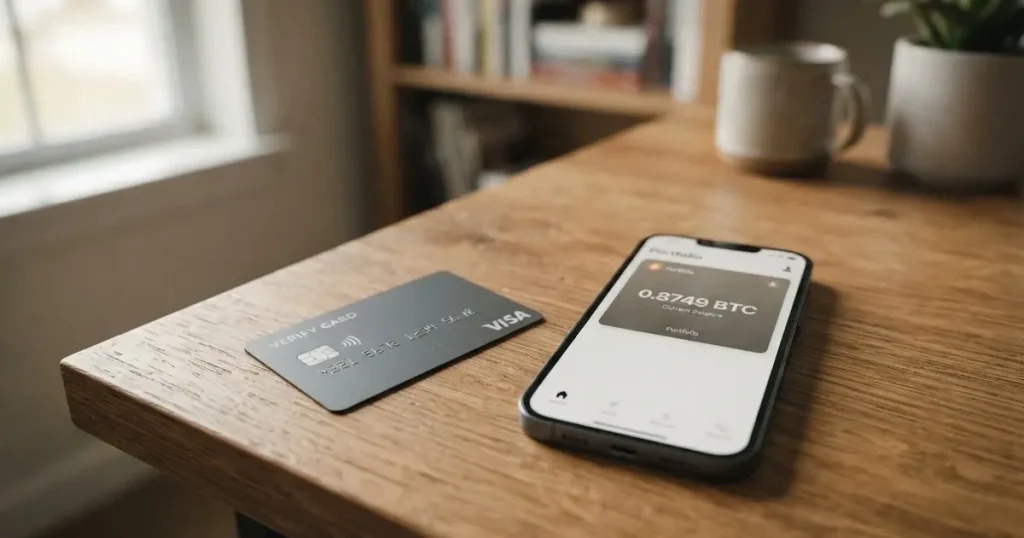
Bitstack is a French crypto brokerage that launched a physical Visa Classic debit card tied to its euro cash account. The way you fund it is by selling bitcoin inside the app: you top up euros, and the card spends those euros. In return, Bitstack pays a small bitcoin reward on each purchase through a programme called Stackback. The pitch is clean, and for a French resident who already saves in bitcoin on Bitstack, the card slots neatly into a savings habit. The catch is that almost everything else about it, the country list, the networks, the monthly cap, is narrow.
This review is written from the card’s own help pages, pricing page, dispute instructions and from a long thread of user reports on Trustpilot, all checked on 20 October 2026. The conditions here are current as of October 28, 2026.
Verdict
The Bitstack card scores 5.5 out of 10. That is a middling score that reflects a product that is well-built for a specific reader and simply not built for anyone else. The costs are low and the company behind it is properly licensed in France, but the card is limited to French residents, only spends euros from a single source, and the help pages leave large gaps (which networks, which coins, what documents, which hours). If you live in France and already use Bitstack to buy bitcoin, this is a sensible way to add a payment card to that habit. If you live anywhere else, or you want a card that holds multiple currencies, or you want a virtual card today, the score is not for you.
| Criterion | Mark | Short reason |
|---|---|---|
| Who can get it | 2 / 10 | France only, including overseas territories; gradual rollout, other EU countries on a waitlist |
| Cost | 8 / 10 | EUR 9.99 card plus delivery, no monthly fee, free FX up to EUR 1,000/month, free ATM up to EUR 200 or 5 withdrawals, Apple/Google Pay deposit 0.70% |
| Top-up options | 3 / 10 | Spends euros from the Bitstack cash account; other coins and networks not stated |
| Reliability and complaints | 9 / 10 | AMF-registered, ACPR-supervised EMI agent, card issued by BPCE; Trustpilot 4.3/5 from 1,417 reviews with typical delivery and support complaints |
| Everyday use | 5 / 10 | Physical Visa Classic, Apple Pay since 30 June 2026, ATM access; no virtual card yet, Google Pay still in development |
The audience the score describes, in plain words: a French resident who is already saving in bitcoin on Bitstack and wants a payment card that gives a small bitcoin kickback on every spend. For that reader the card makes sense. For a reader outside France, or one who needs a multicurrency card or a virtual card, the same numbers add up to a different conclusion.
Who Bitstack will give the card to
Bitstack’s own help pages say the card is “available exclusively to residents of France”, and the rollout is gradual: the option to order it appears in the app’s Cash tab once the account qualifies, rather than being open to every French account from day one. The help pages also say that other EU countries are on a waitlist. The pages do not give a public ETA, an order of arrival, or a way to reserve a slot.
The rule is residence-based. French overseas territories are included. Citizenship is not used as a gate. So a non-French citizen who lives in France and has a French address can apply on the same footing as a French citizen, provided the rest of the account checks out; conversely, a French citizen living abroad does not qualify. The card pages do not say which documents the application asks for. There is no list of required proofs of address, no minimum age stated, no description of the identity-check steps. A user report from July 2026 on Trustpilot describes a slow identity verification that ended in a rejection, with Bitstack replying that the decision follows regulatory requirements and that specifics are not shared publicly. That is the only public signal you have on how strict the checks are.
A practical reading of this section: if you live in mainland France or one of the overseas territories, you can try, and the order flow will let you know whether your account qualifies. If you live in another EU country, you cannot get the card today, only sit on a waitlist that has no public timeline. If you live outside the EU, the card is not offered at all, and the waitlist is not described as open to you.
How to sign up
The sign-up path, as the help pages describe it, lives entirely inside the app. You open the Cash tab, choose to order the card, pick a PIN, enter a delivery address, see the total (card price plus a delivery fee that varies by address and is not stated as a fixed number), and pay. The accepted payment methods for the order itself are the cash account, a bank card, Apple Pay or Google Pay. There is no separate web form, no branch visit, no paper application.
The help pages do not list the documents that may be requested, the age requirement, the proof of address, or what the KYC levels look like. The card pages simply assume that the account already exists and is in good standing. If your Bitstack account has not been through whatever identity checks the platform requires, the card order is the first place those gaps will surface, not the last.
The card is described as a physical Visa Classic debit card that spends the euro balance on your Bitstack cash account. The pages explicitly say a virtual card is planned but not yet available. A metal tier is not mentioned. The card’s currency is not stated outright, but every fee in the help and pricing pages is quoted in euros, and the card’s foreign-currency rule is described as “spending in another currency” against the euro balance, so the working assumption is that the card is euro-denominated. If you are reading the marketing and assumed the card itself was multicurrency, that assumption is not supported by the public pages.
Delivery is to France including overseas territories. Production usually starts the day after the order is confirmed. Metropolitan France can take up to ten business days from the start of production, and overseas territories up to three weeks. The delivery fee varies by address; the help pages do not give a number. The replacement cost for a lost or damaged card is not stated either, so it is worth treating the card as something you do not want to lose without budgeting for an unknown charge.
What the Bitstack card really costs
The headline cost number is EUR 9.99 for the card itself, plus a delivery fee that varies by address. The help article on costs states clearly that “the Bitstack card has no monthly subscription”. The pricing page, however, is internally inconsistent: it shows a Standard card at EUR 14.97 or 14.98 with delivery included, a Plus monthly plan at EUR 9.99 with free shipping, and a Plus annual plan that includes the card and delivery at no extra cost. Treat the help article as the safer reading: EUR 9.99 card, delivery on top, no subscription, with the pricing page’s Plus tier adding a different fee structure on top.
| Fee or limit | Value |
|---|---|
| Card issuance | EUR 9.99 (help article) plus a variable delivery fee; pricing page shows EUR 14.97–14.98 with delivery for the Standard card and a Plus plan at EUR 9.99/month with free shipping |
| Monthly subscription | None on the help article’s account; Plus plan adds EUR 9.99/month per the pricing page |
| FX fee | None on the first EUR 1,000 of foreign-currency spending per month; about 1% on the excess, at the Visa rate at the time of the transaction |
| ATM withdrawals | Free up to EUR 200 per month or 5 withdrawals, whichever comes first; beyond that the higher of EUR 1 or 1% per withdrawal, in France and abroad; third-party ATM fees may apply and are shown before you confirm |
| Card payment cap | EUR 5,000 per month |
| ATM cap | EUR 200 per week, EUR 1,000 per month |
| International payments cap | EUR 1,000/month (Standard), EUR 3,000/month (Plus) per the pricing page |
| Bitcoin purchase fee | Standard 1.5% under EUR 250, 1.25% from EUR 250 to 1,000, 1% over EUR 1,000; Plus 0.75% flat; extra 0.70% on purchases not funded by the cash account |
| Apple Pay / Google Pay deposit | 0.70% on all plans |
| Cardholder-set limits | Not changeable per the help pages |
Now translate that table into a few everyday payments. If you buy a EUR 40 train ticket in Paris, paid from a euro balance, there is no FX fee, no conversion fee, no monthly fee. You earn 0.1% back in bitcoin on Standard, or 0.15% on Plus, with a minimum payout of 1 satoshi; the boosted Stackback rates only apply if you also set up automatic savings (recurring buys or round-ups), and the cap is set by the previous month’s savings volume. If you spend the same EUR 40 in London, the same rules apply, because you are still under the EUR 1,000 monthly FX-free band; the rate used is the Visa rate at the time the transaction settles. If you travel for a month and put EUR 1,800 on the card in a mix of pounds, dollars and Swiss francs, the first EUR 1,000 is converted at the Visa rate with no extra fee, and the remaining EUR 800 picks up roughly 1% on top. If you take out EUR 250 from a Paris ATM in three visits, the first 200 is free; the next 50 costs the higher of EUR 1 or 1% (so 1% of EUR 50, i.e. EUR 0.50, but never less than EUR 1, so EUR 1). If you pay a EUR 60 dinner in Tokyo, the FX is free, you pay the Visa rate, and you earn a small bitcoin rebate at the base rate.
A few things the cost section does not cover and that the help pages do not fill in: a replacement-card fee, a closure-balance rule, an inactivity fee, an explicit list of which merchant categories are blocked from earning Stackback, and the minimum top-up amount. The dispute article also implies that a card is tied to a cash account that can run dry if you do not keep an eye on it, since the card is debit and there is no overdraft.
How to top up the Bitstack card
Top-up is where this card’s design becomes clearest, and where it is also most constrained. The card spends euros from the Bitstack cash account. To get euros onto that account from bitcoin, you sell bitcoin inside the Bitstack app; the euro proceeds land in the cash account and the card then draws on them. The card itself is a debit card, not a credit card, and the pages describe no overdraft, so the card cannot spend more than the cash account holds.
The help and pricing pages do not list the supported networks for on-chain deposits, do not list the supported coins for direct deposit, do not name a minimum top-up, and do not say who pays the network fee when you transfer bitcoin in. In practice that means two things. First, the expected way to fund the card is not a chain transfer but an in-app sale of bitcoin you already hold on Bitstack. Second, anyone hoping to use Bitstack as a way to spend USDT or USDC held on an external wallet will not find a path described in the public pages; the card’s funding story is built around bitcoin, not stablecoins.
The fees on the funding path are these: depositing via Apple Pay or Google Pay costs 0.70% on all plans, and any bitcoin purchase that is not funded by the cash account itself picks up an extra 0.70%. That second charge is the one to watch. The pricing page describes Plus’s bitcoin purchase fee as 0.75% flat, with the 0.70% extra “inconsistent” on the page, so the working assumption is that the 0.70% surcharge is what the pricing page charges on top of the headline tier rate. If you keep your bitcoin on Bitstack and sell from there into the cash account, you avoid the 0.70% surcharge and pay only the tier’s purchase fee. If you fund the card from a bank card or Apple Pay or Google Pay, expect the 0.70% to land on top of the conversion.
A note on what the public pages do not say: the help pages do not describe a bank-transfer withdrawal flow with a fee, a minimum, or a closure-balance rule, even though Trustpilot users mention asking support to push euros back to a bank account. The absence of that information in the public pages is itself the answer: it is not stated, and the help centre and a Telegram community are the listed channels if you need to ask.
Paying with the Bitstack card day to day
The card is a physical Visa Classic. It is accepted wherever Visa debit is taken in France and abroad, including at ATMs. The two digital-wallet stories have moved at different speeds: Apple Pay became available on 30 June 2026 with app version 3.10.0, and Google Pay is described as “in development, not yet available”. A virtual card is planned, but is not yet available on the public pages.
Spending follows the rules the cost section already covered. Payments draw on the euro balance, foreign-currency transactions go through the FX-free band and then pick up a roughly 1% surcharge, and the monthly cap is EUR 5,000 in card payments. There is no daily limit stated, no per-KYC-level limit, and the user-facing limits on the card “cannot be changed” per the help pages. If you need a higher ceiling, the lever is the Plus plan, which lifts the international payments cap from EUR 1,000 to EUR 3,000 per month.
The Stackback programme pays bitcoin on every purchase once it has fully settled. The base rate, with no opt-in, is 0.1% on Standard and 0.15% on Plus, with a minimum of 1 satoshi. The boosted rate kicks in only if you have set up automatic savings, either recurring buys or round-ups, and the cap is set by your previous month’s savings volume; the published tops are 1% on Standard and 1.5% on Plus, falling back to the base rate once the cap is hit. From 10 August 2026, round-ups count toward the Stackback tier. Stackback excludes peer-to-peer and top-up transactions, ATM withdrawals, gambling and cash equivalents, loan repayments, government payments, and some securities purchases; the card’s own blocked merchant categories for spending are not stated on the public pages, so treat the Stackback exclusions as the floor, not the ceiling, of what is restricted.
The iOS app, in the French App Store, holds a 4.79 rating from 11,152 ratings read on 21 October 2026. The Google Play rating was not read for this review. The help centre, a contact page, and a Telegram community are the listed support channels; hours are not stated. The dispute path is well documented and worth knowing: you can freeze the card in the app first, then call +33 9 69 32 00 61 to register an opposition, mentioning that the card was issued by BPCE, and then call +33 9 69 39 03 49 to open a contestation case, which is handled by BPCE. The time window for raising a dispute is 13 months from the payment settlement date.
What can go wrong
The honest read of the risk section is that Bitstack is a properly licensed, supervised business with a clean public record, and that the failure modes the card has shown so far are the ordinary ones, slow support, slow delivery, occasional unexplained KYC rejections, rather than anything systemic.
On the company side, the card sits on a real regulatory stack. Bitstack Digital Assets SAS is registered at the Aix-en-Provence trade register under number 899 125 090, with offices in Meyreuil, France. It is registered with the AMF, the French financial-markets authority, as a crypto-asset service provider under number A2025-003. The card programme itself runs through Xpollens, an electronic money institution authorised by the ACPR, the French banking supervisor. The dispute page states that the card was issued by BPCE (Banque Populaire Caisse d’Épargne), the issuer that actually puts the Visa cards in the post. So the chain of licences is: Bitstack the platform is AMF-registered, Xpollens is the ACPR-supervised e-money partner, and BPCE is the issuing bank. That is more licences than a lot of crypto cards can show, and it is the reason the reliability score in the verdict sits at 9 out of 10.
The user reports on Trustpilot, 4.3 out of 5 from 1,417 reviews read on 21 October 2026, line up with that picture. The themes are familiar rather than alarming. There are withdrawal-to-bank and support delays reported in July 2026, an identity-verification rejection in July 2026 that Bitstack replied to without sharing the specifics, card delivery delays in June 2026, and complaints from June 2026 about low limits and about Apple Pay not working at some merchants in the early days. None of these is the kind of failure that ends with missing funds; they are the kind that ends with a frustrated afternoon. The main risks to plan for, in order, are these:
- The card is a debit card on a euro balance, and the euro balance depends on selling bitcoin in the app. If the bitcoin market is closed or your sell does not settle, the card cannot spend. The card pages do not describe an instant sell, and the help pages do not say how long an in-app sale takes.
- The limits are fixed. EUR 5,000 per month on card payments, EUR 1,000 per month on international payments on Standard (EUR 3,000 on Plus), EUR 200 per week and EUR 1,000 per month at ATMs, and no user-tunable override. If your spend does not fit inside that, the only way up is the Plus tier.
- Custodial risk is real even with a licensed operator. Bitstack holds your bitcoin, the cash account holds your euros, and the card programme is run through an EMI. EMIs safeguard customer funds, by segregation or insurance, but those safeguarded funds are not bank deposits and are not covered by a deposit guarantee scheme. If you carry a large balance, you are trusting three regulated entities, Bitstack, Xpollens and BPCE, rather than one bank.
- Replacement cost, inactivity fee, closure-balance rule and the documents needed for a higher KYC level are all not stated. A reader who plans to use the card for a long time should expect to ask support for those answers.
- The information on the public pages leaves gaps. Networks for crypto deposits, supported coins for direct deposit, identity-check documents, support hours and merchant-category blocks are all not stated. That is not a risk of loss, but it is a risk of friction, because you only find out what the rules are when you try.
The only official incident in the news is the 30 June 2026 launch of Apple Pay with app v3.10.0; the AMF registration A2025-003 has no public date, and the round-up change took effect on 10 August 2026. There is no public incident of card programme suspension, no fund-loss event, and no published regulatory action against Bitstack or its partners at the time of writing.
What to take instead
The Bitstack card is built for a French-resident bitcoin saver. If you do not fit that profile, the comparison below is meant to help you see, at a glance, what other cards look like. Each alternative is a different trade-off, and the points below only repeat the published facts; the right card still depends on where you live and what you want to do.
| Card | Score | Where it works | Card type | Card cost | FX | Reward | Funding |
|---|---|---|---|---|---|---|---|
| International Visa Card | 6.7 / 10 | Blocked in Belarus, mainland China, North Korea, Cuba, India, Iraq, Iran, Israel, Myanmar, Nepal, Nicaragua, Russia, Syria, Turkey, Ukraine, Venezuela, Vietnam; FATF grey-list countries case by case | U.S.-issued Platinum Visa, virtual, pays in USD; physical coming soon | $5 one-time issuance; no maintenance; Classic free, Pro $9/month, Max $19/month | “Visa exchange rate + 2% FX fee” | No cashback stated | USDC or USDT to USD account at 1:1; also USD, EUR, SEPA, SWIFT, FedNow; no deposit fees |
| UNi Card | 6.1 / 10 | Where Mastercard is taken; country list not stated | Mastercard multicurrency on the UNi.Global account; physical/virtual not stated | “No annual fee”; issuance not stated | “No foreign transaction fee” | Spend-to-Earn up to 3% | Not stated on the public page |
| Whop Cards | 5.2 / 10 | Consumers in 31 US states; businesses in 41 US states; blocked in Belarus, mainland China, Cuba, Hong Kong, India, Iran, Iraq, Israel, Myanmar, Nepal, Nicaragua, North Korea, Russia, Syria, Turkey, Ukraine, Venezuela, Vietnam | Visa, online and in stores; virtual/physical and card currency not stated | “No extra fees” on the page; no issuance or monthly amount listed | Not stated | 5% cashback at select merchants (Uber, more planned) | Spends from a Whop balance; backed by stablecoin collateral from a linked wallet; coins and networks not stated |
What the table does not show is whether the alternative accepts your country, your currencies or your coins, because the public pages leave gaps there too. The International Visa Card is the most fully described, with a published blocked-country list and a stablecoin funding path; UNi Card’s country list is missing from the public page; Whop Cards is the most US-centric of the three. Treat this section as a starting point for your own check on the alternative’s current terms, not a shortlist.
Who I would recommend the Bitstack card to
If you live in France, including the overseas territories, and you already buy bitcoin on Bitstack through recurring buys or round-ups, the card is a sensible extension of that habit. The euro balance avoids a separate top-up app, the FX-free band covers most months of foreign travel, the ATM allowance covers a normal week of cash, and the Stackback rebate puts a small slice of every spend back into bitcoin, with the boosted rate doing the work of an automatic savings plan. The Plus plan is the version to look at if you travel often, because it lifts the international cap to EUR 3,000 a month and flattens the bitcoin purchase fee at 0.75%.
If you live anywhere else, the card is not for you today. If you want a virtual card, it is not for you today. If you want to fund the card with USDT or USDC on a public chain, the public pages do not describe a path, and the working assumption is that there is not one. If you want to set your own daily or monthly limits, you cannot. If your monthly spend on the card is going to exceed EUR 5,000, you will be declined. If you are not already comfortable with Bitstack as a custodian for your bitcoin, this is not the place to start; the card adds convenience, but it does not change who holds the keys.
In short, this is a card for a specific reader, and for that reader it works.
Frequently asked questions
What is the Bitstack card?
A physical Visa Classic debit card issued by BPCE and distributed by Bitstack in France. It spends the euro balance on your Bitstack cash account, and you fund that balance by selling bitcoin inside the Bitstack app. A small bitcoin rebate called Stackback is paid on every settled purchase. The card is described in more detail in the cost and funding sections above.
How does the Bitstack card work?
You keep bitcoin on Bitstack, sell some of it into euros inside the app, the euros land in your Bitstack cash account, and the card spends those euros wherever Visa debit is accepted. There is no overdraft, so the card cannot spend more than the cash account holds, and Stackback pays a small bitcoin reward on each settled purchase. The mechanics are spelled out in the everyday-use and funding sections.
Is Bitstack a bank?
No. Bitstack Digital Assets SAS is an AMF-registered crypto-asset service provider (number A2025-003), and the card programme runs through Xpollens, an electronic money institution authorised by the ACPR. The card itself is issued by BPCE. So three regulated entities sit behind the card, none of them a bank in the usual deposit-taking sense, and the safeguarded funds on the EMI side are not covered by a deposit guarantee scheme.
Who owns Bitstack?
Bitstack Digital Assets SAS is the company, registered in France under Aix-en-Provence trade-register number 899 125 090, with offices in Meyreuil. The card is issued by BPCE, and the e-money infrastructure is provided by Xpollens. The ownership of Bitstack the company itself is not stated on the public pages reviewed here.
Is the Bitstack card available in my country?
The card is available exclusively to residents of France, including the overseas territories, and the rollout is gradual. Other EU countries are on a waitlist with no public timeline, and the card is not offered outside the EU at all. If you live in France, the order option appears in the app’s Cash tab once your account qualifies; if you live anywhere else, the answer today is no. The eligibility rules are laid out in the who section.
How do I get the Bitstack card?
Open the Bitstack app, go to the Cash tab, choose to order the card, pick a PIN, enter a delivery address in France, see the total of EUR 9.99 plus a variable delivery fee, and pay from the cash account, a bank card, Apple Pay or Google Pay. The card is then produced, usually the day after confirmation, and shipped within up to 10 business days in metropolitan France or up to three weeks to an overseas territory. The exact documents asked for are not listed on the public pages.
Does the Bitstack card require KYC?
The help pages do not list the documents requested, the age requirement, or the KYC levels. A user report from July 2026 on Trustpilot describes a slow identity check that ended in a rejection, with Bitstack replying that the decision follows regulatory requirements and that specifics are not shared publicly. The practical reading is that the standard EU customer-due-diligence rules apply, but the card pages do not tell you the steps in advance.
How do I top up the Bitstack card?
You top up the Bitstack cash account in euros, and the card draws on that account. The expected path is to sell bitcoin inside the Bitstack app, with the euro proceeds landing in the cash account. Depositing via Apple Pay or Google Pay costs 0.70% on all plans, and the help pages do not list a minimum top-up or describe on-chain deposits in other coins or networks. The full funding story is in the top-up section.
Is the Bitstack card free?
There is no monthly subscription according to the help article. The card itself costs EUR 9.99 plus a delivery fee that varies by address; the pricing page also describes a Plus plan at EUR 9.99 per month with free shipping. The FX-free band is EUR 1,000 a month, the ATM allowance is EUR 200 or 5 withdrawals a month, and any spend above those bands picks up roughly 1% on the FX side and the higher of EUR 1 or 1% on the ATM side. The full cost breakdown is in the cost section.
Is the Bitstack card safe?
Bitstack is an AMF-registered crypto-asset service provider, Xpollens is an ACPR-authorised e-money institution, and the card is issued by BPCE. Safeguards include strong customer authentication on every payment, an instant card freeze in the app, fixed limits, and tokenised mobile-wallet support for Apple Pay. The trade-off is custodial risk: Bitstack holds your bitcoin, the cash account holds your euros, and safeguarded funds on the EMI side are not the same as bank deposits. The full risk discussion is in the what-can-go-wrong section.
App and neobank cards in the catalogue – cryptocardcatalog
Content created by the «cryptocardcatalog» team