
Xexon review: a 600 USD entry fee and an unnamed card issuer
 Available in US
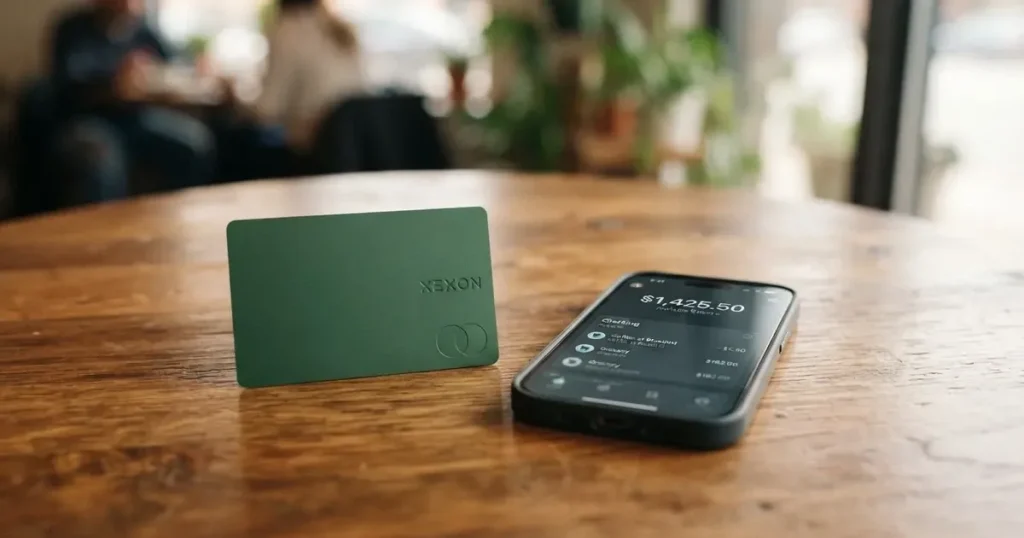
Xexon is not really a crypto card in the way the marketing usually uses that phrase. It is an offshore USD bank account with a physical Visa debit card attached to it, and the crypto side — a wallet where you swap BTC or USDT into dollars — is the part that fills it. That distinction matters more than the marketing copy, because the money you are spending at the till sits with a provider whose card issuer and licences the public pages do not name. I scored it 4.8 out of 10, and I want to walk you through exactly how that number breaks down and where I would push back on my own score if you disagree.
The conditions described are current as of October 28, 2026.
Verdict: 4.8 out of 10, and the low mark is mostly about trust, not about the card itself
| Criterion | Mark | Why |
|---|---|---|
| Who can get it | 7 / 10 | Issued online, described as available “not only in Europe but throughout Asia”; no country list and no stated exclusions |
| Cost | 1 / 10 | Account opening 450 USD, minimum deposit 150 USD, total initial 600 USD, 50 USD a year; 3% exchange, 0.75% card payment |
| Top-up options | 7 / 10 | BTC and USDT (ERC20, BEP20, TRC20) into Xexon Wallet, exchanged to USD and loaded to the card; card loading 0.25 USD, USDT deposit 20 USDT on ERC20 and TRC20 but 0.2 USDT on BEP20 |
| Reliability and complaints | 5 / 10 | Operated by Silver Capital Financial s.r.o. in Prague; account at JDB Bank, Laos; wallet with Fireblocks; card issuer and licences not named; no reviews found |
| Everyday use | 5 / 10 | Physical Platinum Visa, ATMs worldwide up to 3,000 USD a day; no virtual card, Apple Pay and Google Pay not disclosed |
The score is not a verdict on whether the card works. Mechanically, the setup is straightforward: convert crypto to dollars, hold dollars, spend dollars on Visa. What holds it down is the combination of a genuinely high entry cost and the absence of the one piece of information that would let me sleep at night — who issued the card and under what licence. No reviews is not a clean record; it is an absence of data.
Who this suits: someone in Asia or Europe who wants an offshore USD account, already holds crypto, and can afford to put 600 USD into the entry cost before spending anything. Who it does not suit: anyone starting from a bank account they already hold, anyone who needs a virtual card tomorrow, and anyone who would lose sleep at an unnamed issuer.
Will they give you the card?
On the evidence published, probably yes — the card page says it can be issued online and is “available not only in Europe but throughout Asia”, and the offshore-account page says the account “can be opened from Europe, Asia, and more”. That is a broad claim made without a country list, which cuts both ways. It means no obvious regional block, and it means no clear answer if you are somewhere unusual and want to know before applying.
What I cannot tell you is who you have to be. The card’s public pages do not state whether identity documents or proof of address are required, and they do not state what verification tiers exist. There is an AML Policy page on the site, but the content of it is not something the public material spells out, so I am not going to guess at it. What is stated is an age floor: the website is not for users under 18.
That combination — broad availability, unstated KYC — is the first thing I would ask about, on a live chat, before sending any money. If a provider will not tell you what documents it wants before you apply, that is information in itself.
How to get it
The stated sequence is four steps: apply online and sign up, open the USD bank account and the card together, exchange crypto to USD in the Xexon Wallet, and load the USD onto the card. The card arrives at home “within a few weeks”. Xexon covers the cost of sending the card.
On the card itself: it is a Visa debit, tier “Platinum”, and it is physical — shipped to you. The price page’s comparison table also lists Visa, Mastercard and UnionPay as brands, but that table is a comparison across the category rather than something Xexon alone offers, so I would not read it as a menu for you. Card currency is not stated; the account is in USD.
Two things are genuinely missing. Destination countries for the shipping are not listed, so “within a few weeks” is a promise without a map attached. And if the card is lost or damaged, the stated procedure is to contact support for reissue or suspension — no replacement cost is given, and I would want that number before I am in a taxi somewhere with a broken card.
Fees: what it really costs, in total and per swipe
The headline cost of getting in is 600 USD, before you have spent anything. That is what the price page shows, and the card page reaches the same total with different labels — it calls 450 USD the card issuance fee and 150 USD the bank account deposit, while the price page calls 450 USD the account opening fee and the card issuance free. The labels conflict; the total agrees. That inconsistency is worth remembering when you read anything else the two pages say about fees.
| Fee or limit | What is stated |
|---|---|
| Card issuance | Free on the price page; 450 USD as “card issuance fee” on the card page |
| Account opening | 450 USD |
| Minimum deposit | 150 USD |
| Total initial cost | 600 USD, shipping included |
| Annual fee | 50 USD (bank account maintenance) |
| Card transaction | 0.75% |
| Exchange | 3% on the price page; the card page calls exchange fees “low” with no figure |
| ATM | 0.75% with a 3,000 USD daily limit on the price page; 1.5% on the card page |
| Balance inquiry | Free |
| Card loading | 0.25 USD |
| BTC deposit | Free |
| USDT deposit | 20 USDT on ERC20; 0.2 USDT on BEP20; 20 USDT on TRC20 |
| Exchange minimums | BTC 0.001, USDT 20 |
| Payment limit | “no limit” |
| Deposit limit to bank account | No limit |
Let me put that in the order you will actually meet it.
The first payment, whatever it is. The 600 USD is gone before your first purchase — that is the entry cost, and it is not a fee you get back. Then any conversion from crypto to USD costs 3% on the price page, and the payment itself costs 0.75%. If you convert 200 USD worth of USDT and then spend it in one go, you have already paid the 3% exchange and will pay 0.75% on the spend. If the card page’s word “low” is the real number for exchange, this gets better; if the price page’s 3% is the real one, it does not. Ask.
Eating out in a country that is not the United States. The card is a USD account and the card currency is not stated. The price page does not publish a foreign-exchange fee, and multi-currency support is not stated, so I cannot tell you what happens to a euro or baht purchase. What I can tell you is that a card which spends a USD balance abroad almost always involves the network’s own conversion rate, and providers add a markup on top. Here the markup is not documented. That is a real gap for anyone living outside the dollar zone, which is a strange thing to find in a card marketed across Asia and Europe.
Withdrawing cash. Here the two pages flatly contradict each other: 0.75% on the price page, 1.5% on the card page, with a 3,000 USD daily limit and availability worldwide. The higher figure is the one to plan around. And balance inquiry is free, which sounds trivial until you are standing at a machine in another time zone wondering whether you have been charged to find out.
One more number that does not appear anywhere: the ATM fee aside, what a declined payment costs. Not stated, and I would want to know before I rely on this card for anything I cannot afford to lose the use of for a week.
Top up: the route is short, and the network choice is expensive
The funding route is: BTC or USDT into the Xexon Wallet, exchange to USD, load the card. USDT is accepted on ERC20, BEP20 and TRC20. The loading fee is 0.25 USD. BTC deposits are free; USDT deposits cost 20 USDT on ERC20, 0.2 USDT on BEP20, and 20 USDT on TRC20. Exchange minimums are 0.001 BTC and 20 USDT. Fiat top-up — putting dollars in from a bank — is not stated.
That spread on USDT networks is the single most useful thing in this section. On the same token, the deposit costs significantly more on ERC20 than on BEP20. Why: on Ethereum, fees are gas paid in ETH, so a wallet holding USDT and no ETH cannot send at all. Tron prices its fees differently, through bandwidth and energy and often by burning TRX, which is why TRC20 is cheap in principle. The choice of network is a real decision with a real cost difference, not a detail.
Which leads to the warning I would not skip. Blockchain transfers are irreversible. If you send USDT on a network the provider does not support, or to an address belonging to a different network, the money can be gone, and recovery becomes a support ticket with no guarantee. Check the network twice. And note the stablecoin caveat underneath all of this: USDT and USDC are meant to hold a dollar value, and “despite the name, stablecoins are not necessarily stable”. TerraUSD collapsed in May 2022; USDC lost its peg briefly in March 2023.
Getting money back out: BTC withdrawals cost 0.1% plus 0.001 BTC, minimum 0.0025 BTC. USDT withdrawals cost 0.1% plus 20 USDT, minimum 70 USDT. What you are owed if you close the account is not stated — another reason not to treat this balance as permanent storage.
Paying with it every day
The card is physical. There is no virtual card, which rules out the most common workaround for people who cannot wait for post: using a card number in a phone wallet or an online-only shop the day they sign up. Apple Pay and Google Pay are not disclosed, so I cannot tell you whether you can add it to a phone wallet at all. The issuer can restrict a tokenised number — blocking it for phone or website use is a routine control — so “it’s a Visa” is not the same as “it will work in Apple Pay”.
Where it should work: anywhere Visa is accepted, in stores and online, with ATMs worldwide. Payment limit “no limit” and deposit limit to bank account no limit. Whether those limits survive contact with the issuer’s own risk policy is anyone’s guess.
Three everyday situations and what actually happens:
- A subscription you forgot about. The card is a debit card against a stored balance, so a recurring charge goes through as long as dollars are there. But if the balance runs out mid-cycle, you get declines, and a declined authorisation can leave a hold on your funds that stays for days — typically up to seven.
- A shop that does not like prepaid or foreign cards. A card number starts with six or eight digits that identify the issuing institution, and merchants can look that up. If the issuer’s country differs from your billing address, some merchants apply extra scrutiny or decline. This is why a card issued in one country can look foreign to a shop in another. It is a category-wide characteristic, not a defect of this card, but it is a reason to keep a backup card.
- Gambling or a merchant category the issuer blocks. Merchant category codes are four-digit classifications assigned when a business starts taking cards, and many issuers block specific codes on specific cards by policy rather than by law, with the list differing per issuer. Xexon’s blocked categories are not stated, so I cannot tell you what you will or will not be able to pay for.
On refunds and disputes: not stated. If a charge goes wrong, I have no published procedure to point you at. That is not a small gap. In the US, debit card reversal rights come from Regulation E and credit card rights from Regulation Z, and prepaid-card coverage varies and should not be assumed — which is exactly the situation a stored-balance card occupies.
What can go wrong
Start with the thing I keep coming back to. The operator is Silver Capital Financial s.r.o. — the Czech form, with an address in Prague — but the registration country and owners are not stated on the page. The account is at JDB Bank, in Laos. The wallet is described as “with Fireblocks”, a recognised custody provider. And then: the card issuer and licences are not stated.
That last gap is structural, not cosmetic. Here is why it matters. Visa and Mastercard do not issue crypto cards to consumers themselves; they license issuers, and they can suspend a programme. A card payment involves several parties: the network routes messages and sets rules, the issuer is the bank or e-money institution licensed under the network’s licence and holds the programme, and the crypto brand is often only a programme manager or the front end that markets it. When I cannot name the issuer, I cannot tell you who is responsible for a fraudulent charge, who holds your funds, or which regulator to complain to.
On EU rules, for context: an electronic money institution can issue e-money, payment cards and wallets, but cannot lend, and it may serve the whole EU from a licence granted in one member state. Under MiCA — the EU’s crypto regulation, in legal effect since June 2023, with the stablecoin and e-money-token rules applying from 30 June 2024 and the crypto-asset service provider rules from 30 December 2024 — e-money tokens may be issued only by a credit institution or an electronic money institution. And note that a card is regulated separately from the crypto side: a crypto card often rests on two licences, not one. Transitional providers can continue under national law only until 1 July 2026 or until they get or are refused a MiCA authorisation, whichever comes first, and ESMA keeps a public interim register of authorised providers that you can check.
None of that tells me Xexon is unregulated. It tells me the public pages do not let me verify anything, which is a different and more serious problem for the person whose money it is.
The second cluster is custody. Control of crypto belongs to whoever holds the private key, and a seed phrase — typically twelve to twenty-four words — is an unencrypted key that anyone who obtains it can use to spend the funds. Transfers are irreversible and the network cannot freeze or return them. The record of custodial failures is not theoretical: about US$350 million reported stolen from Mt. Gox over 2011–2014, about US$400 million from Coincheck in 2018, US$625 million from Ronin Network in 2022. Xexon says the wallet runs with Fireblocks, that there are 24/7 security operations and two-step authentication, and it states that it “cannot be held responsible for a loss of funds” if you fall for a scam. That last sentence is a plain statement of where the line sits.
The third cluster is the card programme itself. Programmes do close. Visa terminated its global agreements with FTX in November 2022 and the FTX US debit card programme was wound down; WaveCrest, a card issuer that supplied several crypto brands, was suspended by Visa in Europe in 2018, closing every WaveCrest-issued Visa programme. Closures follow a pattern — a notice period, then spending and loading stop, then you are asked to withdraw what is left. If you hold a balance here, that is the scenario to imagine.
Finally, the record itself. I found no official incidents and no reviews. Searching for Xexon Platinum card reviews turned up nothing about Xexon at all — no Trustpilot page, no user reports. There is also nothing in the news. I read that as thin evidence rather than a clean sheet, and I would treat a company with no public review footprint the way I would treat any other untested counterparty: not with suspicion, but without depositing more than you can afford to lose.
Support exists: an FAQ, real-time chat, email and a contact form. Hours are not stated. For a card where I cannot name the issuer, the practical test is simple — message them before you fund anything and see whether you get a straight answer about who issued the card.
What to take instead
Three alternatives came up in the same category. None is a substitute for everything Xexon offers, and the comparisons below use only what each provider publishes.
| International Visa Card | UNi Card | Whop Cards | |
|---|---|---|---|
| Score | 6.7 / 10 | 6.1 / 10 | 5.2 / 10 |
| Card | U.S.-issued Platinum Visa, virtual; physical “coming soon” | Multicurrency, on the Mastercard network | Visa, online and in stores; physical/virtual not stated |
| Cost | Virtual card $5 one-time, no maintenance; plans Classic free, Pro $9.00/month, Max $19.00/month | No annual fee; issuance not stated | “No extra fees”, no amounts listed |
| Spend fee | Free in USD on all plans; foreign currency at Visa exchange rate + 2% FX fee | No foreign transaction fee; assets converted at live OTC rates | Not stated |
| Funding | USDC or USDT into the USD account at 1:1, free; also USD, EUR, SEPA, SWIFT, FedNow | Not stated | Spends from a Whop balance, backed by stablecoin collateral from a linked wallet |
| Rewards | No cashback stated | Spend-to-Earn up to 3% | 5% cashback at select merchants, currently Uber |
Where each is clearly better: International Visa Card names its issuer country, publishes its full fee schedule including the 2% FX fee, and has a five-dollar entry point instead of six hundred. Its weakness is eligibility, and it is explicit — no account or card for residents or legal registrants of Belarus, mainland China, North Korea, Cuba, India, Iraq, Iran, Israel, Myanmar, Nepal, Nicaragua, Russia, Syria, Turkey, Ukraine, Venezuela or Vietnam, with FATF grey-list countries handled case by case, and purchases blocked in seven of those. The rule follows residence or registration, not citizenship. And it is virtual only, with the physical card listed as coming soon.
UNi Card publishes the cleanest fee sentence in this whole group: no annual fee, no foreign transaction fee, conversion at live OTC rates, no hidden exchange fees, plus up to 3% spend-to-earn. Its eligibility is not stated, which is the same gap Xexon has, so you would be asking questions in both directions.
Whop Cards cover 31 US states for consumers and 41 for businesses, and name their unsupported countries including Belarus and Russia for corporate entities — but do not say whether the test is citizenship or residence. Cashback of 5% at select merchants is genuinely attractive, and “no extra fees” with no numbers attached is not.
My honest comparison: if your problem is that you cannot get an ordinary bank card, an alternative that names its issuer and prints its fees is worth a lot, even with a restriction list. If your problem is specifically an offshore USD balance with a physical card in your hand, Xexon is in a smaller pool and you should price the 600 USD as the cost of that, not as a fee.
Who I would recommend it to
I would recommend Xexon to someone who has a specific reason to want dollars outside their domestic banking system, already holds crypto, is comfortable sending value to an offshore structure they cannot fully inspect from the public pages, and has 600 USD to spend on getting in. To that person the product is coherent: crypto in, dollars out, a physical Visa, 3,000 USD a day at ATMs worldwide.
I would not recommend it as a first card, as a everyday replacement for a bank card you already have, or as a place to keep money you cannot afford to lose the access to. The 600 USD entry cost is the reason for the cost score of 1 out of 10 — nothing else in this review comes close to it — and it is paid before any of the product’s benefits reach you. The unnamed issuer is the reason for the reliability mark of 5 rather than higher, and it is a gap that cost, however low, would not fix.
If you are still considering it after reading all of that, the questions to ask support before you fund anything are these: who issued the card and under whose licence; what happens to my balance if the programme ends; what does a lost card cost to replace; which merchant categories are blocked; what is the FX markup on a non-USD purchase; and what is the procedure and time limit for a disputed charge. If the answers to those come back clearly, the product may well be fine for you. If they come back vague, that vagueness is the information.
Frequently asked questions
What is the Xexon card?
It is a physical Visa debit card, tier Platinum, attached to an offshore USD bank account. You fund the account by converting BTC or USDT into dollars in the Xexon Wallet and loading the card. It is closer to an offshore current account with a card attached than to a typical crypto payment card, and the account pays 1.5% annual interest on USD balances.
How does the Xexon card work?
Four steps as published: apply online, open the USD account and card together, exchange crypto to USD in the wallet, load the card. The card ships to your home within a few weeks at Xexon’s cost. Spending then draws down the stored dollar balance, so the card cannot overdraw it, and each purchase costs 0.75% on the price page.
Is Xexon a bank?
Not one it identifies itself as, and this is the question I would push hardest on. The operator is Silver Capital Financial s.r.o. with a Prague address, the account sits at JDB Bank in Laos, and the card issuer and the licences behind it are not stated on the public pages. An account held at a bank is not the same as the card programme being a licensed, named institution you can hold responsible.
Who owns Xexon?
The public pages name Silver Capital Financial s.r.o., which uses the Czech company form, but the registration country and the owners are not stated. The wallet is described as running with Fireblocks. Beyond that, the ownership picture is not published, which is a real limitation for anyone deciding how much to leave on the platform.
Does the Xexon card require KYC?
The public pages do not state which documents are required, whether proof of address is needed, or how many verification tiers exist. An AML Policy page exists on the site, but it does not detail these requirements. The one clear rule is an age limit: the website is not for users under 18.
How much does it cost to open and keep?
The total initial cost is 600 USD — a 450 USD account opening fee plus a 150 USD minimum deposit, with the card page labelling the same total differently but agreeing on the number, shipping included. The annual fee is 50 USD for account maintenance. Exchange is 3%, card transactions are 0.75%, ATM withdrawals are either 0.75% or 1.5% depending on which page you read, and loading the card costs 0.25 USD.
How do I top up the Xexon card?
Send BTC or USDT to the Xexon Wallet, exchange it to USD, and load the card for 0.25 USD. BTC deposits are free. USDT deposits cost 20 USDT on ERC20, 0.2 USDT on BEP20 and 20 USDT on TRC20 — the network choice changes the cost by a factor of about a hundred. Exchange minimums are 0.001 BTC and 20 USDT. Fiat top-up is not stated.
Can I use the Xexon card in my country?
The card page says it is available “not only in Europe but throughout Asia” and the account page says it can be opened from Europe, Asia and more, but no country list and no exclusions are published. ATMs are stated as available worldwide with a 3,000 USD daily limit. There is no virtual card, and Apple Pay and Google Pay support is not disclosed, which matters if you need to pay online the day you sign up.
Is the Xexon card safe?
Safety here is a judgement, not a fact. The wallet is described as running with Fireblocks, with 24/7 security operations and two-step authentication, but the custody model is not stated and Xexon says it “cannot be held responsible for a loss of funds” if you fall for a scam. No reviews were found anywhere, which is absence of evidence rather than evidence of safety. Treat the balance as spend money, not savings.
Is the Xexon card worth it?
Only if the offshore dollar account is the point. If you want a way to convert crypto and spend it, the 600 USD entry cost is hard to justify against alternatives that print their fees and name their issuer. If you specifically need dollars held outside your domestic system with a physical Visa in hand, the pool of comparable options is small and the cost may be the price of access.
App and neobank cards in the catalogue – cryptocardcatalog
Content created by the «cryptocardcatalog» team