
The premium crypto card that charges a five-figure membership and refuses to publish its country list
 Available in US

Xapo Bank’s card is not a free crypto debit card. It sits behind a membership that costs USD 1,000 a year, with a 30-day full-refund window, and it hands you a metal Visa debit card that draws on a multi-currency account balance rather than on a bank account you already have. That positioning — premium banking for clients who hold USD, EUR and Bitcoin — is the honest summary of who it is for. It is also, after the membership and the crypto-account rules are counted, an expensive way to buy the same function a cheaper card gives you. My score is 5.8 out of 10: respectable reliability and a genuinely decent everyday card, dragged down by cost, by a published terms page that does not tell you which countries qualify, and by a steady drumbeat of user complaints about frozen accounts.
The conditions described below are current as of October 28, 2026.
Verdict: 5.8 out of 10, and the number is not close
Here is where the score comes from, criterion by criterion, exactly as I scored it.
| Criterion | Mark | Why |
|---|---|---|
| Who can get it | 7 / 10 | The official list of countries is not stated anywhere on the card terms or the Transact page; third-party sources say 50 countries are supported and 28 are restricted, including the United States |
| Cost | 2 / 10 | Membership is USD 1,000 a year with a 30-day refund; the metal card is free to order and FX is advertised as fee-free, but ATMs charge 2% of the withdrawal amount above USD 100 a month |
| Top-up options | 6 / 10 | The card spends the Xapo account balance; USDC and USDT convert to USD automatically, and you can fund by SWIFT, ACH, SEPA, Faster Payments or Bitcoin over Lightning |
| Reliability and complaints | 7 / 10 | Xapo Bank is a Gibraltar company with an FSC credit-institution licence and USD deposits covered up to GBP 120,000; Trustpilot sits at 3.9 out of 5 from 1,141 reviews with 31% one-star |
| Everyday use | 8 / 10 | Metal, standard and virtual debit cards, ATMs in 100+ countries, spending in USD or from your Bitcoin balance; Apple Pay and Google Pay support is not disclosed |
That table is the whole argument in miniature. The card is good at being a card. It is expensive at being one.
Who it suits: someone who already holds a funded Xapo account, who pays in several currencies and does not mind a conversion spread, who wants a physical metal card with a named relationship manager, and who treats the USD 1,000 as the price of a banking relationship rather than the price of plastic. If you hold USD, EUR and Bitcoin across currencies and spend from all three, the flexibility is real.
Who it does not suit: almost anyone reading a bank comparison. If your card is free elsewhere, USD 1,000 a year has to be earned back in avoided fees, and the honest arithmetic is brutal — the first USD 100 of ATM withdrawals each month are free, so you would need to be withdrawing far more than that, or spending in a way that genuinely saves you something, for the membership to pay for itself. It also does not suit anyone who needs certainty about whether their country is eligible, because the card’s own public pages do not say. And it does not suit a US resident, who is on the restricted list by every third-party account of the eligibility rules.
Will they give you the card?
Short answer: probably, if you clear identity verification and your country is not on the restricted list — but the card’s own pages will not tell you which countries those are.
What the terms do say is thin. The card terms are titled “Cards Issued Outside Europe Region”, which tells you the document is not even a single global termset. The country list is not stated there, and not on the Transact page either. Whether Xapo tests citizenship or residence is not stated. Xapo may refuse to issue a card at its discretion, and anyone whose account was previously suspended cannot order one.
What third-party sources say — and this is unofficial, not confirmed by the card, so treat it as a starting point rather than a rule — is that the card is available in 50 listed countries, among them the United Kingdom, Canada, Germany, Japan and Singapore, with 28 restricted countries or jurisdictions including the United States, Russia and Ukraine, and eligibility judged by residence. One of those sources updated its page on 11 August 2026; another puts the reach at over 100 countries, excluding US residents and holders of a US passport. Two unofficial sources disagree with each other. That disagreement is itself the answer to the question a careful reader should be asking.
Two things are worth separating here, because people often run them together. Verification is a KYC process with a defined shape. Eligibility is a policy decision about where you live. You can pass one and fail the other.
How to get it
You open a Xapo account first, and the card is linked to that account — the card is not a standalone product. Then you order it, and you verify.
The order has a hard floor: you must be at least 18. The card terms do not state which KYC documents are accepted or what proof of address is required, but Xapo’s own verification flow describes what it needs: a valid passport or national ID, personal details confirming both identity and residence, and a real-time photo or short video taken in the app. There are no named tiers, no published processing time, and no published list of rejection reasons.
One membership, no tiers: metal, standard and virtual debit cards are all included, and the metal card is described as complimentary, free to order. That is where the “free card” search queries come from — the card really is free. The membership is not.
Cards are posted only to the verified address. You can send to another address, but that is at your own risk and not guaranteed. Countries, delivery time and delivery cost are not stated. A replacement card within a calendar year costs USD 25; for other lost, stolen or damaged re-issues, fees “may apply”, with the amounts sitting in a Fees Information Sheet I did not read. Unofficial sources describe regional delivery times, an emergency replacement at USD 100 plus address-dependent shipping, and a first replacement each year being free — which directly contradicts the USD 25 figure, so I would not build a plan around either number until you have seen the sheet yourself.
Fees and what a payment actually costs
The card has two cost centres and only one of them is obvious. The membership is the headline. The ATM and the spread are where the day-to-day money goes.
| Fee or limit | What the card states |
|---|---|
| Membership | USD 1,000 per year, with a 30-day full-refund window |
| Metal card issuance | Free to order at present |
| Second replacement card in a calendar year | USD 25 |
| Other lost, stolen or damaged re-issues | Fees “may apply”; amounts are in a Fees Information Sheet |
| Foreign exchange | “no FX fees and no hidden markups” |
| Spending Bitcoin | “no fees and competitive spreads” |
| ATM withdrawal | 2% of the withdrawal amount above USD 100 per month; the first USD 100 each month is free |
| ATM operator fees | May apply, on top |
| Payment in a currency you do not hold | Converted and debited from your balance at no stated FX fee |
| Dynamic currency conversion | Discouraged — decline it at the terminal |
| Default monthly spending and withdrawal limits | Exist, adjustable in the app, amounts not stated |
Now the three payments that show how this behaves.
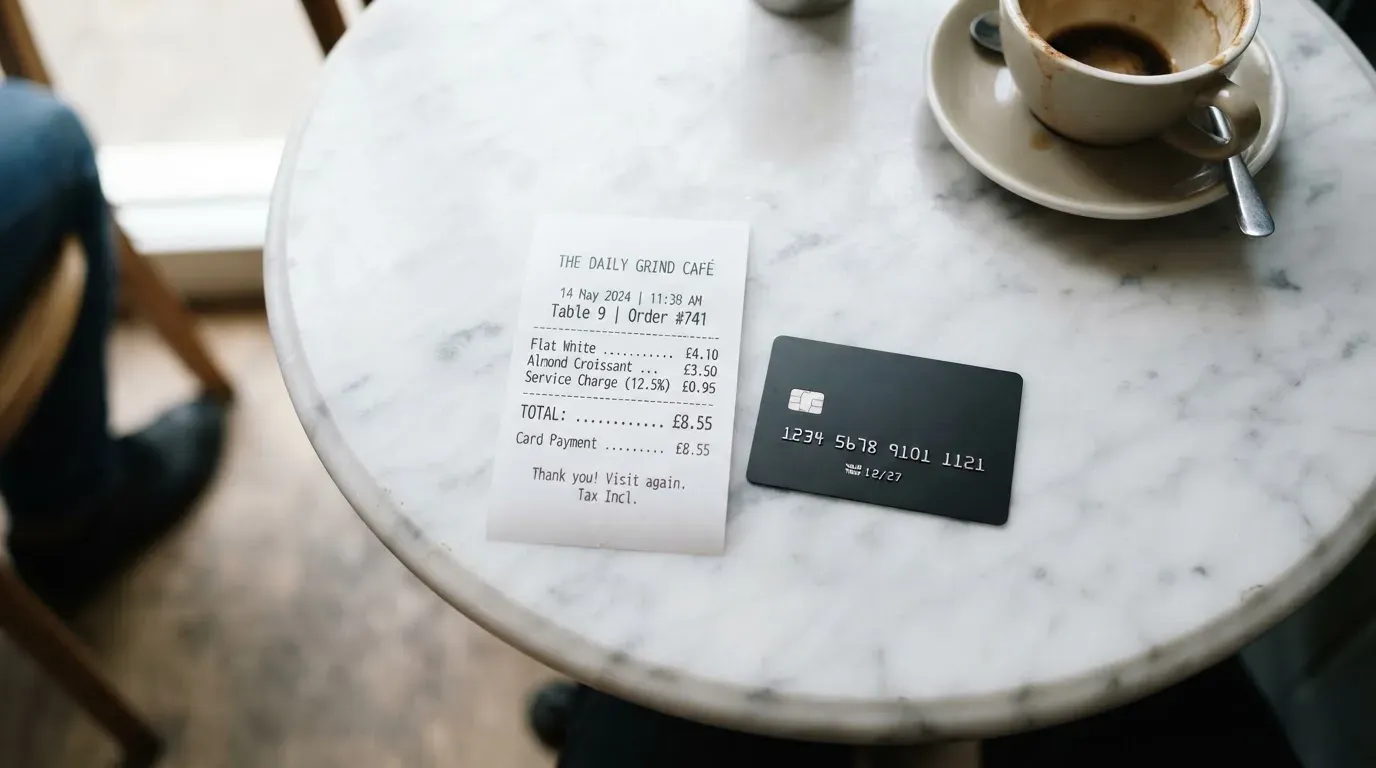
A coffee in a country whose currency you do not hold. The terminal offers you a price in your home currency or in the local one. Choose the local currency and let Xapo convert; choose the terminal’s conversion and the merchant’s rate eats into the payment. This is the single cheapest decision on the whole card, and it costs nothing to get right.
A £60 train ticket, paid from a EUR balance. Xapo converts and debits your balance, and advertises no FX fee on top. What you pay is the rate, not a surcharge on the rate — which is better than most, and is genuinely one of the card’s stronger points.
A $200 ATM withdrawal, having already taken $60 out that month. The first $100 is free; the $140 above it is charged at 2% of the withdrawal amount. The operator’s own fee may apply as well. On a large withdrawal — a foreign ATM, an emergency — you are paying a percentage plus someone else’s surcharge for cash you could have taken by transfer, which Xapo supports over SWIFT, ACH, Faster Payments and SEPA.
What is genuinely missing from this table is the number most readers want: the limits. Default monthly spending and withdrawal limits exist, adjustable in the app, described only as “high spending limits”, with no amounts published. Unofficial sources suggest $50,000 per day in stores and online, $2,000 per day at ATMs, and much larger one-off purchases on case-by-case approval — unofficial, unconfirmed, and the kind of figure that changes without notice. Also worth knowing: some merchant categories are blocked, and recurring pre-authorised payments, self-service petrol pumps and cash-like transactions may be declined. That last one will surprise you at exactly the wrong moment.
Top up: the balance is the card
There is no separate card balance to fund. The card spends the Xapo account balance, full stop — and that single design choice explains almost every operational fact about the card.
So the question is how the account gets funded, and Xapo offers several routes. Deposits of USDC and USDT are converted to USD automatically. For fiat: SWIFT, ACH, RTP and FedACH for USD; Faster Payments for GBP; SEPA for EUR. Bitcoin arrives over Lightning.
Two things are not stated and you should notice their absence: the deposit fee and the minimum top-up amount. Neither appears on the pages I checked.
Worth understanding why the stablecoin route is the point rather than a side door. On a card like this, a stablecoin deposit is not speculation with a purchase attached — it is a way of turning a balance you hold on a blockchain into spendable dollars. USDC and USDT are the two tokens the BIS put at roughly 90% of stablecoin market capitalisation in July 2025, and Circle says USDC is redeemable 1:1 for USD, fully backed by cash and cash equivalents held mostly in an SEC-registered government money market fund, with monthly reserve attestations.
The catch is the network, and it is a big one. Circle listed USDC as natively supported on 38 networks as of 16 September 2026, including Ethereum, Solana, Base, Polygon PoS, Avalanche, Arbitrum and Stellar; USDT has been issued on networks including Ethereum, Tron, Solana, Polygon and Avalanche. Send on the wrong one and you have made a mistake with no undo: blockchain transfers are irreversible. Circle stopped supporting USDC on Tron in February 2024, so “USDC over TRC20” is not a native option here. If your exchange’s only USDC balance lives on Tron, you have a transfer to make first. And a detail that catches people: on Ethereum, gas is paid in ETH, so a wallet holding USDT and nothing else cannot send it.
Getting money out works in the same set of rails — SWIFT, ACH, Faster Payments, SEPA, and Lightning for Bitcoin — with withdrawal fee amounts not stated. Closing the account cancels the card, the card can be cancelled on its own, and what happens to a remaining balance on closure is not stated. Xapo may end the agreement with two months’ written notice.
Paying with it every day
Three debit cards come with the membership — metal, standard and virtual — and you spend the USD balance, or draw on your Bitcoin balance for a payment. The virtual card is the one to use for anything you’d rather not have a physical piece of plastic attached to.
For daily use the honest summary is: it behaves like a normal premium debit card, with two open questions attached. The first is Apple Pay and Google Pay, which the card’s pages do not address. For a card that costs USD 1,000 a year, I find that hard to defend, and you should ask before you join rather than after.
The second is merchant filtering. Xapo blocks a list of merchant category codes and does not publish the list. A merchant category code is the four-digit number, specified in ISO 18245, that classifies a business by what it sells — 7995, for instance, covers gambling, and many issuers block it by policy rather than by law, with the blocked list differing per issuer. So this card may decline a transaction in a shop that accepts the same card from someone else, and you would not know in advance which shops.
Add the declines that come from being a foreign-issued card, which is worth understanding once. A card number begins with six or eight digits identifying the issuing institution, and merchants can look that up and see which institution and country issued it; some apply extra scrutiny when the issuer country differs from the billing address. Address verification, which compares the numeric parts of a billing address against issuer records, is mainly offered in the US, Canada and the UK and is generally unavailable for foreign-issued cards — a common cause of declines. None of this is Xapo-specific, but a Gibraltar-issued card carries it structurally.
Refunds are the quiet risk here. The terms give no dispute or chargeback timeframe at all. Refunds are “usually up to 10 Business Days”, and a refund in a currency the card does not support is converted at the payment system’s rate with Xapo disclaiming liability for the loss. If something goes wrong with a payment, you are negotiating without a published clock.
On the positive side, the app is one iOS and Android application running 24/7, with card freeze and unfreeze in-app, fraud monitoring, and listed certifications including PCI DSS, SOC 2 Type II and SOC 3. Two-factor authentication is not mentioned in the card terms, which is a gap rather than a red flag.
What can go wrong
Start with the money you cannot get back. Xapo Bank is a custodial arrangement: a company incorporated in Gibraltar, Company No. 111928, at 2 Irish Town, Gibraltar GX11 1AA, regulated by the Gibraltar Financial Services Commission as a credit institution under the Financial Services Act 2019, permission No. 23171. Xapo holds the credentials, so you trust them completely. That is the trade for the convenience, and it is the trade the whole category makes.
What protection you get is real but partial. USD deposits are covered by the Gibraltar Deposit Guarantee Scheme up to the USD equivalent of GBP 120,000. Bitcoin and crypto are not covered. In the EU, e-money funds must be safeguarded in dedicated accounts or insured — but safeguarded e-money funds are not the same as bank deposits, and the guarantee scheme may not reach them at all. Read the two sentences side by side before you decide how much to leave on the balance.
Now the complaints, because this is where the 7/10 becomes arguable. I found no official incidents. The user picture is what shapes the mark. On Trustpilot, Xapo Bank sits at 3.9 out of 5 from 1,141 reviews as of 20 October 2026, with 31% of those being one star. Support gets praise in some of them. The recurring themes are specific and worth reading rather than skimming:
- Account freezes and closures, reported in November 2025, July 2026 and August 2026.
- Inability to withdraw or to close an account, August 2026, and a $1,000 annual fee not refunded, July 2026.
- Slow compliance reviews — one reportedly took seven weeks, June to August 2026.
- High fees, June to September 2026.
- Templated support, June and September 2026.
- A single one-star review calling the bank fraudulent over a year of failed transactions.
- On Reddit’s r/CryptoHelp, in 2025, one user reported an unresolved identity-verification problem lasting more than three years with unresponsive support.
One reviewer is an anecdote. Six themes across eighteen months is a pattern. Every one of them is a pattern about access to your own money — which is the thing a bank card is supposed to be reliable about.
There is also older history: in 2014 Xapo faced backlash over its debit card fee schedule, blamed its issuer and promised reimbursement. That was a different product under different conditions, and I would not hold it against the current card — except as a reminder that Xapo has been an issuer before and knows how the arrangement can fail.
There is one more historical pattern worth naming, because it is a category risk and not a Xapo risk. Card programmes do get shut down. Visa terminated its global agreements with FTX on 13 November 2022 and the FTX US debit card was wound down. WaveCrest, a Visa issuer that supplied several crypto card brands, was suspended by Visa in Europe in 2018 and all its Visa programmes closed. Closures typically run in an order: a notice period, then loading and spending stop, then you are asked to withdraw what is left. Programme closures give notice — but a notice period is not the same as a guarantee of timing.
What to take instead
If the USD 1,000 membership is the thing stopping you, these are the three comparisons worth making, and I want to be even-handed about their gaps.
| Xapo Bank | International Visa Card | UNi Card | Whop Cards | |
|---|---|---|---|---|
| My score | 5.8 | 6.7 | 6.1 | 5.2 |
| Network / type | Metal, standard and virtual debit cards | U.S.-issued Platinum Visa, virtual (physical “coming soon”) | Mastercard multicurrency card | Visa |
| Annual or monthly cost | USD 1,000 a year | Classic free, Pro $9.00/month, Max $19.00/month | “No annual fee” | “No extra fees” listed |
| Issuing / cost | Virtual card issuance $5 one-time | — | Issuance fee not stated | No amounts listed |
| FX | “no FX fees and no hidden markups” | Visa exchange rate plus 2% FX fee | Live OTC rates, “no hidden exchange fees” | Not stated |
| Funding | USDC/USDT, SWIFT, ACH, SEPA, Faster Payments, Lightning | USDC/USDT 1:1, USD, EUR, SEPA, SWIFT, FedNow | Not stated | Whop balance, stablecoin-collateral backing |
| Rewards | Targeted campaigns only | No cashback stated | Spend-to-Earn up to 3% | 5% cashback at select merchants, currently Uber |
| Where it is not available | 28 restricted jurisdictions incl. US (unofficial) | 16 countries incl. Russia, Ukraine, Turkey, Venezuela; purchases blocked in several | Not stated | 31 US states for consumers; 16 unsupported countries |
| Main gap | Price, and an unpublished country list | 2% FX fee, and the card is virtual for now | Funding routes unknown | US-centric, no fee detail |
The International Visa Card scores highest of the four and has the most published detail: a $5 virtual issuance fee, no maintenance fee, free USD use on all plans, free deposits of any kind. It also has a hard limit I would not gloss over — its card and account are not available to residents or legal registrants of a sixteen-country list including Belarus, mainland China, North Korea, Cuba, India, Iraq, Iran, Israel, Myanmar, Nepal, Nicaragua, Russia, Syria, Turkey, Ukraine, Venezuela and Vietnam, with FATF grey-list countries reviewed case by case, and purchases blocked in North Korea, Cuba, Iran, Russia, Syria, Ukraine and Venezuela. Note that it works on residence or registration, not citizenship.
UNi Card’s pitch is the cleanest economics on paper — no annual fee, no foreign transaction fee, live OTC rates — and it has the card network most people already trust. But its funding routes and its physical/virtual form are not stated, and its eligibility is not stated either. I would not move money to it on that.
Whop Cards has the best rewards line: 5% cashback at select merchants, currently Uber, with more planned. It is also the least transparent on fees — the page says “no extra fees” without listing a single amount — and its consumer reach is 31 named US states, from Alabama to Wyoming. Businesses get 41 states. If you are outside the US, it is not a comparison at all.
Who I would recommend it to
I would recommend this card in one specific situation: you already use Xapo as your main crypto platform, you hold several currencies across the account, you are spending from Bitcoin as well as dollars, and you value a named relationship manager and a physical metal card more than you value not paying USD 1,000 a year. If that is you, the card does what it says — the 8/10 on everyday use is the most defensible score in the table.
I would recommend it against itself if any of these are true. You hold the card mainly to spend crypto occasionally — a cheaper card does that. You need to know today whether your country qualifies — the card will not tell you. You need your funds reachable without friction, given the documented pattern of freezes and slow compliance reviews. You are a US resident. Or you want a card that works with your phone’s wallet and cannot find that promised anywhere in the terms.
And the honest framing for a first-time reader: this is not a crypto card that happens to have a fee. It is a private banking relationship priced like one, with crypto at the centre of it. If that is a thing you want, the price is not absurd. If what you want is a card that spends your balance, you are paying a five-figure annual figure for a convenience that costs a few pounds elsewhere.
Frequently asked questions
What is the Xapo Bank card?
The Xapo Bank card is a Visa debit card that draws on your Xapo account balance rather than on a separate bank account. Membership includes metal, standard and virtual debit cards. Payments come out of your USD balance or your Bitcoin balance, and balances in USD, GBP, EUR and Bitcoin sit in one account. It is the card arm of a Gibraltar-based bank, not a standalone fintech product.
How does the Xapo Bank card work?
You convert or deposit funds into your Xapo account first — USDC and USDT are converted to USD automatically, or you fund by SWIFT, ACH, RTP, FedACH, Faster Payments, SEPA, or Bitcoin over Lightning. The card then spends that balance directly, so it cannot overdraw. If you pay in a currency you do not hold, the amount is converted and debited from your balance.
Is Xapo Bank actually a bank?
Yes, and this is the part that surprises people. Xapo Bank is incorporated in Gibraltar, Company No. 111928, at 2 Irish Town, Gibraltar GX11 1AA, and is regulated by the Gibraltar Financial Services Commission as a credit institution under the Financial Services Act 2019, permission No. 23171. Xapo VASP Limited separately holds DLT provider permission No. 26061. USD deposits are covered by the Gibraltar Deposit Guarantee Scheme.
Who owns Xapo Bank, and where is it based?
Xapo Bank is a Gibraltar company, and that is where its regulatory home is: the Gibraltar Financial Services Commission supervises it. Being a Gibraltar-licensed credit institution is what allows it to take deposits and issue cards, and it is why your USD balance sits inside a deposit guarantee scheme with a GBP 120,000 equivalent ceiling. Crypto holdings, by contrast, sit outside that protection.
Is the Xapo Bank card available in my country?
Honestly, you cannot tell from the card’s own public pages — the country list is not stated on the card terms or the Transact page, and the terms are titled “Cards Issued Outside Europe Region”. Unofficial sources say 50 countries are supported, including the UK, Canada, Germany, Japan and Singapore, with 28 restricted jurisdictions including the United States, Russia and Ukraine, judged by residence. Apply, and treat the country question as part of your verification.
Does the Xapo Bank card require KYC?
Yes. You must be at least 18, and Xapo’s verification flow asks for a valid passport or national ID, personal details confirming identity and residence, and a real-time photo or short video in the app. The card terms themselves do not state which documents qualify or what proof of address is needed. This is normal regulated-business practice under anti-money-laundering rules, not a quirk of this card.
How much does the Xapo Bank card cost?
The membership is USD 1,000 a year, with a full refund available within 30 days. The metal card itself is free to order, and there are no annual or monthly fees beyond that membership. What costs money in practice: a second replacement card within a calendar year is USD 25, ATM withdrawals are charged at 2% of the withdrawal amount above USD 100 each month, and ATM operator fees may apply on top.
Is the Xapo Bank card free?
The card is free; the account is not. Metal, standard and virtual debit cards are all included in membership, and the metal card is described as complimentary. But the membership itself is USD 1,000 a year. That distinction is where most search results about “free Xapo card” come from, and it is the first thing to check before getting excited about the card.
Is the Xapo Bank card safe?
Treat that as two questions. First, can you trust the provider: Xapo Bank is FSC-regulated as a credit institution in Gibraltar, holds PCI DSS, SOC 2 Type II and SOC 3 certifications, offers in-app card freeze, and monitors for fraud. Second, will you always get your money: Trustpilot shows 3.9 out of 5 from 1,141 reviews, with 31% one-star and recurring themes of account freezes, blocked withdrawals and slow compliance reviews.
Is the Xapo Bank card worth it?
Only if you use the account heavily. The membership is USD 1,000 a year, so you need to earn that back in avoided fees and used features — multi-currency spending, Bitcoin spending at competitive spreads, named support, a metal card. If you just want a card to spend a crypto balance occasionally, a card with no annual fee does the same job, and I would rather you spent the money elsewhere.
App and neobank cards in the catalogue – cryptocardcatalog
Content created by the «cryptocardcatalog» team