
Trade Republic card review: spending crypto from a German broker
 Available in US
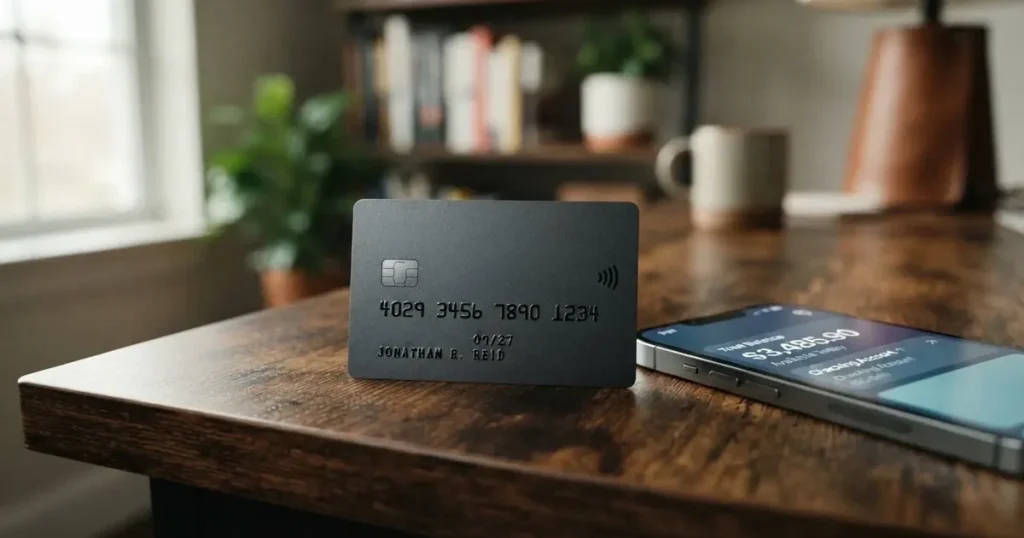
Trade Republic is a Berlin-based broker that has spent the last few years turning itself from a pure trading app into a more complete banking-style account. The Trade Republic card sits at the centre of that shift: it is a Visa payment card linked to your Trade Republic account, and you can fund the spending on it with the crypto you hold there. The pitch is simple — you hold Bitcoin, Ether or a euro balance in the app, you tap to pay at a shop, and Trade Republic does the conversion in the background.
I went through the official pages, the press materials, the user reviews and a handful of German third-party sites to see how well that pitch holds up. The short version is that it is a quietly competent product with a clear use case for one group of people, a few weak spots in the public information, and a couple of things to check before you sign up. The longer version is below.
The conditions described here are current as of October 28, 2026.
Verdict
Trade Republic earns 7.2 out of 10 in this review. The breakdown is on the table below. The strengths are everyday usability (Apple Pay, Google Pay, free ATM withdrawals above a small threshold) and the issuer’s standing — a regulated German bank with a strong Trustpilot score and a real complaint process, even if some of that feedback is mixed. The weaknesses are transparency: the public product pages leave a lot of the practical details — coin list, country list, fees, limits — unstated, so you end up relying on third-party reviews to fill in the gaps.
The card is best suited to EU residents who already have a Trade Republic brokerage account, hold some crypto there, and want a low-friction way to spend it without first selling it on an exchange and waiting for a bank transfer. If you are outside the EU, want a self-custody wallet as the source of your card, or need an anonymous or document-free card, this is not the product for you.
Score breakdown
| Criterion | Score | Why it scored this way |
|---|---|---|
| Who can get it | 5 / 10 | Germany and EU based, but the official site does not publish a country list |
| Cost | 8 / 10 | Unofficial sources agree on a one-time issuance fee and no monthly fee; the card’s own page does not state amounts |
| Top-up options | 5 / 10 | Crypto held at Trade Republic can be spent, but the list of supported coins is not published |
| Reliability and complaints | 9 / 10 | Issued by Trade Republic Bank GmbH in Berlin; 4.6/5 on Trustpilot from 67,608 reviews; no card-specific complaint theme |
| Everyday use | 9 / 10 | Virtual, Classic and Mirror (metal) versions; Apple Pay and Google Pay; free ATM withdrawals from 100 EUR worldwide |
| Total | 7.2 / 10 |
Who will they give you the card
Trade Republic is a German company, headquartered at Brunnenstrasse 19-21, 10119 Berlin, and the card is issued by Trade Republic Bank GmbH, its German banking arm. The product is positioned for the European market: the public pages are available in German and Dutch, with English in places. The company describes itself as serving EU residents.
Beyond that, the official pages do not publish a country list, an age threshold or a residency requirement in plain text. The press materials say the card is available to Trade Republic customers, and the account itself is opened through the standard German KYC process, but I could not find a public, machine-readable statement of which nationalities or residencies are accepted or refused. This is a real gap if you are deciding from outside Germany — you have to start the sign-up flow to find out where the boundary sits, and the boundary itself is set by the regulated entity rather than the marketing page.
What that means in practice is that if you live in the EU, the card is broadly available to you as long as the account-opening checks pass. If you live elsewhere, you should expect the answer to be “no” or “case by case” rather than “yes”, and you should not rely on this card as a way to get a euro-denominated Visa from outside the EU’s regulatory perimeter.
The fact that this section is short is the point: the official pages do not give much detail, and I would rather say so than invent precision. If country availability matters to you, check it at the start of the sign-up flow before you commit time to it.
How to get it
The card is tied to the Trade Republic account, so the journey is really the account-opening journey with the card added at the end. The official product page does not lay out the steps in a public checklist, and the verification process is not described in readable form on the marketing site. From the press release and from the way the app is set up, you open a Trade Republic account, complete the identity checks, and then order a card from inside the app.
The card itself comes in three versions according to German third-party reviews: a virtual card that you can use immediately after the account is open, a Classic plastic card, and a Mirror metal card. The network, the card currency and the exact delivery times are not stated on the official pages. Unofficial sources say a replacement — for loss, theft or expiry — costs the same as the original, and that the virtual card is available straight away while the physical card has to be sent out. The “immediately” part is useful if you need a card number for an online subscription today and are happy to add the physical card to Apple Pay or Google Pay when it arrives.
If you are coming to Trade Republic purely for the card, the thing to know is that the card is one feature of a broader brokerage and savings account, not a standalone product. The sign-up, the identity checks and the day-to-day management all run through the main app, and the card sits inside that.
What it really costs: Fees
This is the section where the gap between the official page and the third-party reviews is widest. The Trade Republic card’s product page says, in short, that card spending is free of card-specific fees, that ATM withdrawals are free worldwide, and that crypto card spending counts as a sale of the crypto for tax purposes. The actual numbers — issuance, monthly, FX — are not stated in readable form on the official site.
The third-party picture, which the German reviews broadly agree on, looks like this.
Costs at a glance
| Fee or limit | Amount | Notes |
|---|---|---|
| Virtual card issuance | 0 EUR | Available immediately after account opening |
| Classic card issuance | 5 EUR (one-time) | Plastic card |
| Mirror card issuance | 50 EUR (one-time) | Metal card, otherwise same fees and limits as Classic |
| Monthly or annual fee | None | Unofficial sources agree, official page does not state |
| Crypto trading commission | None, plus 1 EUR third-party cost per trade | From the Trade Republic help centre |
| Foreign-currency surcharge | None | Official Visa exchange rate used, according to third-party sources |
| ATM withdrawal, 100 EUR or more | Free worldwide | At Visa-accepting ATMs; the ATM operator may still charge its own fee |
| ATM withdrawal, under 100 EUR | 1 EUR fee | Per third-party review |
| Card top-up by debit/credit card, Apple Pay or Google Pay | 1% of the amount | Per third-party review |
| SEPA transfer to the account | Free | Per third-party review |
| Daily card spending limit | 1,500 EUR | Per third-party review |
| Weekly card spending limit | 6,000 EUR | Per third-party review |
A few everyday scenarios are worth walking through, because the cost question is less about the headline fee and more about what actually happens when you pay.
Buying coffee with a euro balance. You have euros in your Trade Republic account, you tap the card at a café in Berlin, and the merchant charges you in euros. The card network settles in euros, there is no FX, and the only cost is the merchant’s own price. This is the cheapest path and the one the card is best at.
Buying coffee abroad with crypto. You have Bitcoin in your Trade Republic account, you tap the card in a café in Lisbon, and the merchant charges in euros. Trade Republic sells enough Bitcoin to cover the payment at the then-current rate, the network settles in euros, and you pay the spread between the Trade Republic rate and the market rate at the moment of sale. There is no card-level FX fee on top of that, according to third-party sources, but the crypto spread is the real cost, and it is not published.
Buying coffee in dollars. You are in New York, the merchant charges in dollars, and the network converts euros to dollars at the Visa rate. Third-party sources say there is no foreign-currency surcharge, so the cost is again the spread at the conversion moment, plus whatever rate the Visa network sets for that day. The card’s own page does not state this in numbers.
The honest summary is: the card’s own fees look low, the trading spread is where you actually pay, and the official page does not tell you how big that spread is. If you fund the card from euros, you have a clean number. If you fund it from crypto, you do not.
How to top it up: Top up options
The interesting thing about this card is the funding side. A Trade Republic customer can hold euros, securities and crypto in the same account, and the card can draw on that account for payments. Press materials say you can use the crypto you hold with Trade Republic to pay with the card; the list of supported coins is not stated in the public pages.
In practice, top-up options break into three groups:
- From your euro balance at Trade Republic. This is the default, and the cheapest in fee terms. You sell securities or transfer euros in, and the card spends that balance.
- From your crypto balance at Trade Republic. Each card payment is treated as a sale of the underlying crypto at the then-current rate, and the proceeds settle the merchant. There is no card-level fee for this on top of the trading spread, but the spread is the cost.
- From an external source. SEPA bank transfers to the Trade Republic account are free according to third-party sources. Card top-ups — paying into Trade Republic from a debit card, credit card, Apple Pay or Google Pay — cost 1% of the amount, again per third-party sources.
A few things follow from that. First, if you intend to spend crypto, the cheapest path is to hold it at Trade Republic already, because every other route involves a transfer in (and possibly out again). Second, if you intend to spend euros, the cheapest top-up is a SEPA transfer, not a card top-up. Third, the network you use to move crypto into Trade Republic matters, because transfers are irreversible and a coin sent on a network the broker does not support can be lost or require slow manual recovery. The official pages do not list which networks are accepted, so this is another thing to confirm inside the app before you send anything of value.
There is no separate “card balance” you load in advance, and there is no published ATM-loading or cash-deposit option. The card simply draws on the account.
Paying with it every day
Once the card is in your hand, or once the virtual card is provisioned into Apple Pay or Google Pay, the day-to-day experience is mostly the experience of paying with a Visa. Third-party sources confirm that Apple Pay and Google Pay are supported and that the card is added from inside the app. The card’s product page confirms free ATM withdrawals worldwide; the unofficial sources put a 100 EUR floor on the free withdrawal, with a 1 EUR fee below that and no cap on the amount or number of free withdrawals at or above the floor. The ATM operator may still charge its own fee on top.
The reward side is where the card tries to differentiate. Trade Republic advertises a “Saveback” feature: a percentage of card spending reinvested into a savings plan. The press release from November 2025 talks about a 2% Crypto Saveback on card spending, paid into a savings plan, with a 1,500 EUR monthly spend cap. The card’s product page, by contrast, talks about 1% Saveback on card payments. Third-party German reviews settle on 1% as the current rate for most spending, with a 15 EUR monthly cap, and they add a long list of exclusions: transfers, ATM withdrawals, investments, top-ups, PayPal, gambling and quasi-cash transactions. One review mentions a 2% rate specifically for crypto-funded payments with a 30 EUR cap since the end of 2025, which is partly consistent with the press release. The net effect is that the Saveback is real but small, and the conditions around it are best read inside the app rather than on the marketing page.
A few practical points that fall out of this:
- The card is provisioned as a token in Apple Pay or Google Pay, so contactless payments use a device-specific number rather than the plastic card’s number, and a token can be restricted (for example, blocked for online use) by the issuer without affecting the physical card.
- The published spending limits are 1,500 EUR per day and 6,000 EUR per week, per third-party sources. There is no separate point-of-sale limit given. If you need higher limits, the path is to ask inside the app, not to assume.
- 3-D Secure applies for online payments where the merchant or the issuer asks for it, and you confirm in the app. Address Verification Service is mainly a US, Canada and UK tool and is generally unavailable for foreign-issued cards, which can lead to declined online checkouts at smaller merchants.
- Authorisation holds can stay on a balance for several days, typically up to seven, even after a transaction is cancelled or refunded. If you fund the card from crypto, that hold sits on a crypto balance until it clears.
For everyday use, the card is in the right place: it works at the supermarket, it works on the train, it works in Apple Pay, and the ATM fee is small or zero. The reward is modest and the limits are modest, but the product does not pretend otherwise.
What can go wrong
The risks worth thinking about fall into three buckets: product-specific, issuer-specific and category-specific.
Product-specific. The card’s public pages leave a lot of detail unstated — the list of supported coins, the country list, the FX markup, the spread on crypto-to-euro conversion at the point of sale. If you are sensitive to transparency, that is itself a risk: you do not know the all-in cost of a crypto-funded payment until you see it in your statement. The Saveback terms have already been changed once — a third-party report says a user lost the 1% rate after terms were updated, with the date not specified in the report — so the headline reward is not necessarily permanent.
Issuer-specific. The general Trade Republic user feedback is mixed in the same way most neobank feedback is: a strong Trustpilot score (4.6/5 from 67,608 reviews, 11% one-star) with the usual complaints about slow or hard-to-reach support, crypto spreads that are wider than the largest exchanges, and account blocks that take time to resolve. I did not find a card-specific complaint theme in the Trustpilot reviews — the visible reviews are mostly positive, including one user reporting that the card works worldwide — but the broader support and block issues apply to the card as well, because the card sits inside the same account. German press has reported rising complaint volumes to BaFin, the German regulator, although the date of that report is not pinned down in the materials I read. A July 2026 Portuguese complaint about a crypto deposit address that did not show a network warning is a useful reminder that funding the account from crypto is the part most likely to go wrong.
Category-specific. Crypto cards depend on two licences — one for the payment side and one for the crypto side — and the crypto side in the EU is now governed by MiCA, the markets-in-crypto-assets regulation. The transitional period for already-authorised providers runs until 1 July 2026, so the regulatory ground is still moving under this product. Stablecoin transfers are irreversible: a coin sent to a wrong address or on a network the broker does not support can be lost, and the broker’s support team may or may not be able to recover it. Crypto-funded payments are a taxable disposal of the asset in most jurisdictions, and Trade Republic explicitly says as much in its press materials — that is not a complaint, but it is a thing to be ready for, especially if you use the card for many small purchases.
Two smaller things round out the risk picture. First, the card’s BIN is German, so a US merchant running a strict Address Verification Service check may decline it not because of fraud risk but because of the issuer country. Second, an authorisation hold on a crypto-funded balance locks up the underlying crypto until the hold clears, so a few large authorisations in quick succession can leave the balance temporarily unusable.
What to take instead
Trade Republic is not the only card on the market. The three alternatives below offer similar features, though each has its own focus and trade-offs.
| Card | Score | Key idea | Who it suits | Trade-off |
|---|---|---|---|---|
| International Visa Card | 6.7 / 10 | US-issued Platinum Visa, USD balance, free in USD, 2% FX on other currencies | US residents or anyone comfortable with a US-issued card | Plans cost $9 or $19 a month on top of a $5 virtual issuance; only 31 US states for consumers |
| UNi Card | 6.1 / 10 | Multicurrency Mastercard on the UNi.Global account, no annual or foreign transaction fee, up to 3% spend-to-earn | Users already inside the UNi ecosystem who want a multicurrency card | Coin list, fees and funding details are thin on the public page |
| Whop Cards | 5.2 / 10 | Visa spending from a Whop balance, 5% cashback at selected merchants (currently Uber) | US-based sellers and buyers inside the Whop platform | Only 31 US states, foreign-country blocklist similar to other US programmes |
If you are inside the EU and you want a card that spends your brokerage crypto without sending it anywhere first, Trade Republic is the most natural fit of these three. If you are in the US and you want a card funded by stablecoins, the International Visa Card is the closer match, with the important caveat that it is a US-issued card with a US state list and a USD balance. If you want a multicurrency Mastercard with an explicit “no FX fee” line and you are already in the UNi ecosystem, the UNi Card is the one to look at. If you live in the Whop seller world and you mainly want cashback at a few named merchants, Whop Cards does that, but it is a US-state product with the same kind of country restrictions as the others.
The honest comparison is that none of these products is fully transparent, and none of them is a fit for everyone. The right card depends on which of these trade-offs you can live with.
Who I would recommend it to
Putting the whole review together, I would recommend the Trade Republic card to a specific kind of reader and steer a different kind away from it.
I would recommend it if you live in the EU, you already have (or are happy to open) a Trade Republic account, you hold some crypto there and you would like to spend it at point-of-sale without first selling on an exchange and waiting for a SEPA transfer to clear. The card is also a reasonable choice if you simply want a low-fee euro Visa from a regulated German bank, with the small annual issuance cost on the Classic or Mirror versions as the price of admission, and Apple Pay and Google Pay as the way you actually carry it. The reward is modest, the limits are modest, and the product does what it says.
I would steer away from it if you are outside the EU, because the official pages do not confirm availability and the regulated entity is German. I would steer away if you keep your crypto in a self-custody wallet and want a card that draws on it directly — Trade Republic’s card draws on the balance inside Trade Republic, not on your own wallet. I would steer away if you want a fully transparent fee schedule in writing, because the card’s own page does not provide one and you end up relying on third-party reviews for the numbers. And I would steer away if anonymity or document-free sign-up is a requirement, because the product is a regulated German bank card and that is not what it is.
For everyone in between — the EU resident who holds some Bitcoin and Ether in their Trade Republic account and wants a Visa in their phone — this is a quietly good product that does the job. The score of 7.2 out of 10 reflects that: solid where it counts, opaque where it should not be, and best understood as one feature of a broker account rather than a standalone card.
Frequently asked questions
What is the Trade Republic card?
The Trade Republic card is a Visa payment card issued by Trade Republic Bank GmbH in Berlin and linked to a Trade Republic account. You can fund the spending on it from the euro balance in the account, or from the crypto you hold with Trade Republic, with the conversion happening at the point of sale. It comes as a virtual card, a Classic plastic card and a Mirror metal card.
Is Trade Republic a bank?
Yes. The card is issued by Trade Republic Bank GmbH, the German banking subsidiary of Trade Republic, headquartered in Berlin. The product pages, the press materials and the card’s own terms name Trade Republic Bank as the issuer.
How does the Trade Republic card work?
You open a Trade Republic account, complete the identity checks, order a card from inside the app and add it to Apple Pay or Google Pay. When you pay, the card draws on your account balance; if the balance is in crypto, Trade Republic sells the right amount at the current rate to settle the merchant, and the press materials describe this as a sale of the asset for tax purposes. The reward is a small Saveback reinvested into a savings plan.
Is the Trade Republic card available in my country?
The official pages do not publish a country list in plain text. The product is positioned for the EU market, the company is based in Germany, and the public pages are available in German and Dutch with English in places. If you live outside the EU, expect the answer to depend on the account-opening checks rather than on a published policy, and check at the start of the sign-up flow.
Does the Trade Republic card require KYC?
Yes. The card is part of a regulated bank account, so the sign-up involves the standard identity checks for a German bank: name, address, date of birth, nationality and an identity document, with sanctions and PEP screening. The exact documents required are not listed on the public marketing page, but the underlying account is a regulated one and the checks are part of opening it.
How do I top up the Trade Republic card?
There is no separate card balance to load. The card draws on your Trade Republic account, so you top up the account itself. A SEPA transfer from a bank is free according to third-party sources, while a top-up by debit card, credit card, Apple Pay or Google Pay costs 1% of the amount. Crypto held at Trade Republic can be used to fund card spending without a separate transfer step.
Can I add the Trade Republic card to Apple Wallet or Google Pay?
Yes. Third-party sources confirm that Apple Pay and Google Pay are supported and that the card is added from inside the Trade Republic app. The tokenised device number, not the plastic card’s number, is what gets used at the terminal, and a token can be restricted by the issuer without affecting the physical card.
How much does the Trade Republic card cost?
The headline numbers, per German third-party reviews, are 0 EUR for the virtual card, 5 EUR one-time for the Classic card and 50 EUR one-time for the Mirror metal card, with no monthly or annual fee. Foreign-currency surcharges are not applied according to those same sources, the official Visa rate is used, and ATM withdrawals of 100 EUR or more are free at Visa-accepting ATMs. The official product page does not state the amounts in numbers.
Is the Trade Republic card safe?
The card is issued by a regulated German bank and the user base is large, with a 4.6/5 Trustpilot score from over 67,000 reviews. The card-specific complaint picture is light; the broader account-level complaints are about support responsiveness, crypto spreads and account blocks that take time to resolve. As with any payment card, the usual safeguards apply: app-based 2FA, instant card freeze, 3-D Secure on online payments and tokenised mobile wallets. Crypto-funded payments are a taxable disposal of the asset in most jurisdictions.
How do I close my Trade Republic account?
The card is tied to the Trade Republic account, so closing the card means closing the account, not the other way round. The exact steps and the treatment of any remaining balance — euros, securities or crypto — are handled inside the app rather than described on the public marketing pages, and account closures can take time if the broker is resolving open positions or pending authorisations.
App and neobank cards in the catalogue – cryptocardcatalog
Content created by the «cryptocardcatalog» team