
A prepaid card from Gibraltar that converts crypto and spends like any other card — with fees the card never states
 Available in US
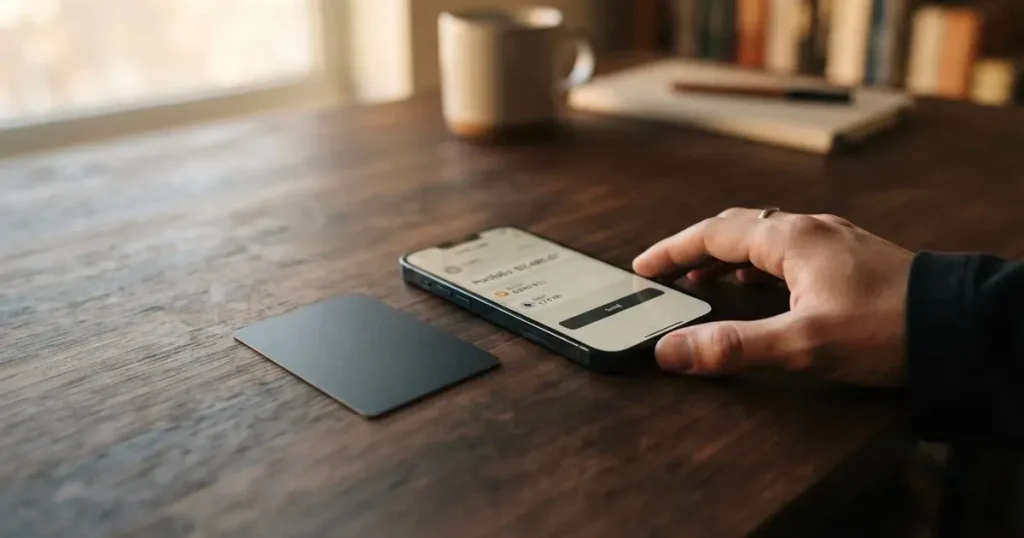
The Tap card is a Mastercard you load with money, and the money can come from crypto. You convert first, the card spends afterwards, and on the surface it behaves like an ordinary payment card: you can freeze it from the app, reveal the PIN in the app, and there is cashback on qualified purchases. That is the good half. The other half is that almost none of the numbers you would want to check before opening an account are printed anywhere on the company’s own pages. The fee schedule is not published. The country list is not published. The list of supported coins is not published. Tap itself says services may not be available in all jurisdictions, and tells you to verify eligibility in your region.
I gave it 5.6 out of 10. That is not a condemnation, and it is not a recommendation either. It is a card that scores well on the thing most people judge a card by — can I pay with it tomorrow — and poorly on the thing a careful person judges it by — can I read the rules before I commit. If you are already inside crypto, already hold an account, and you mostly need a card that works at the till and online, the everyday-use picture is genuinely good. If you are comparing cards on paper, choosing a country to move to, or deciding whether your money is safe, you will finish this review with more questions than you started with. Those questions are legitimate; the card simply does not answer them.
This page reflects the conditions I found, current as of October 28, 2026.
| Criterion | Mark | Why |
|---|---|---|
| Who can get it | 6 / 10 | No country list on the site; only “Services May Not Be Available In All Jurisdictions” and a line to verify eligibility in your region. The number of countries is not disclosed. |
| Cost | 6 / 10 | Nothing official published. Unofficial sources: monthly fee, issuance, top-up and ATM all free, FX 1.5%; user reports mention a $35 withdrawal fee and an inactivity fee. |
| Top-up options | 5 / 10 | No coin list published. Stablecoins, USDT, BTC and SOL are mentioned, plus a bank-to-crypto on/off ramp. Unofficial: crypto has to be converted before it is loaded. |
| Reliability and complaints | 4 / 10 | Tap Global Limited (Gibraltar), Gibraltar FSC DLT licence No. 25532, Moorwand Ltd as issuer for the new card. Trustpilot 3.4 out of 5, accounts frozen for days and weeks, withdrawal delays. |
| Everyday use | 7 / 10 | Physical and virtual Mastercard. Unofficial: Apple Pay and Google Pay marked as supported, though the same source lists “No Apple Pay” among the cons. ATM free. |
| Total | 5.6 / 10 | A card that spends well on the information the public pages withhold. |
Who it suits, in one line: users who want crypto, currency accounts and cashback, and who read an app’s terms rather than a website’s. Who it does not suit: anyone who needs a published fee table, a guaranteed country list, or a clear answer on what happens to their balance if they stop using the card. If any of those three matter to you — and if you are reading this because a normal bank card is not available to you — keep reading before you decide.
Will they give you the card?
Short answer: probably, but nobody will tell you in advance. There is no country list on Tap’s site. What is there instead is a warning that “Services May Not Be Available In All Jurisdictions” and an instruction to verify eligibility in your region. So the honest answer to “will they give you the card” is: in many places, yes, and in some places no, and there is no published list that would let you tell which is which before you try.
That is a different situation from a card that publishes a country table and shows you a row with your name in it. It also sits oddly against the fact that Tap mentions dedicated IBANs for holding seven national currencies, and a multi-currency Mastercard announced for October 2026. A product that holds seven currencies and issues a multi-currency card is not a small operation. It is just one that has not written down where it operates.
Here is what I would tell you to do about it. Treat “may not be available in all jurisdictions” as an answer, because it is the only one you have. If your country is one where crypto is restricted, or where a card from a Gibraltar-issued BIN would be unwelcome at your bank, do not assume the app will let you through simply because you downloaded it. Conversely, if you are in an ordinary European or Latin American jurisdiction, the seven-currency IBAN claim and the sizeable user base suggest the ordinary case works. But I would not put money into it on that basis without reading the terms in the app first.
The issuer side is worth understanding, because it decides who you are actually banking with. Tap Global Limited is registered in Gibraltar (No. 118724, Madison Building, Midtown, Line Wall Road, Gibraltar GX11 1AA) and licensed by the Gibraltar FSC under the DLT Regulatory Framework, Licence No. 25532. Tap describes banking and e-money as provided by “Our Authorised Issuing Partners”; the specific provider is shown in the app and varies by region, currency and account type, and the issuer’s name is not stated on the site. Tap is explicit that it is “not a bank”. The Gibraltar FSC DLT licence covers the crypto side; the card itself is issued under a partner’s licence.
That distinction matters more than it sounds. A card is a payment instrument, regulated under e-money and payments law, separately from crypto regulation. A crypto card often depends on two licences: one for the crypto activity and one for the card programme. When you open an account you are therefore dealing with two regulatory relationships, and the site only tells you about one of them by name.
What I would check first, before you hand over a document: open the app, read the issuer name for your region, then look that issuer up in its own national regulator’s register. If the partner is a licensed electronic money institution, its licence number should be findable. If you cannot find it, that is your answer for now.
How to get it
Tap does not publish its onboarding steps, so what follows splits cleanly into what the site says and what a third party says. Tap’s own pages are silent on the identity checks required, on delivery times for the physical card, on whether there are different verification tiers, and on the card’s currency. A third-party site (cryptocards.so, 2026, unofficial and not confirmed by Tap) says verification is email, phone and an identity document, with no proof of address and no selfie required. I have no way to confirm that from Tap’s pages, and it changes often — treat it as a hint, not a plan.
What Tap does show is the product itself: physical and virtual cards, on Mastercard, with a dark-finish Tap Mastercard pictured. The app is on the App Store at 4.5 out of 5 from 25 ratings, version 3.8.8, requiring iOS 15.6 or later (read 2026-10-20). The Google Play listing is under the package com.tapngo.tap; its rating was not read.
One thing to be aware of, because it will confuse you if you read third-party pages and Tap’s own side by side: that same third-party site lists the network as Visa, which contradicts Tap’s own Mastercard. When a card’s own site and a review site disagree on the network, the card’s site wins. I would plan around Mastercard and check the network printed on the card when it arrives.
For the sequence itself, the practical version is: download the app, create the account, work through whatever verification your region triggers, then choose whether you want the virtual card immediately (useful for online payments the day you start) or wait for the physical card to arrive. The card currency is not stated by Tap, and the site says the existing card is euro-denominated with other currencies converted at the point of sale — so if you are paid in dollars or pounds, understand that conversion happens on the transaction, not on your account. On 5 October 2026 Tap announced a new multi-currency Mastercard that spends from app balances instead, with no launch date given. That announcement is the direction of travel; it is not something you can rely on today.
Fees: what it really costs
Here is the uncomfortable part of this review. Tap publishes no fee table. There is no stated monthly fee, no issuance fee, no conversion figure and no FX percentage on the official pages. The word “Zero” does not appear in a claim you can point to. The costs I can give you come from a third-party source and from user reports, and I am labelling them as such — but I have to be straight with you about how much weight they carry.
| Fee or limit | What is stated |
|---|---|
| Issuance | Not stated by Tap. Unofficial source (cryptocards.so, 2026): free |
| Monthly fee | Not stated by Tap. Unofficial source: free. User reports mention fees charged for inactivity or as a monthly charge |
| Conversion | Not stated by Tap. Unofficial source: crypto must be converted before the card is loaded |
| FX | Not stated by Tap. Unofficial source: 1.5% |
| ATM | Not stated by Tap. Unofficial source: withdrawals free and unlimited |
| Withdrawal | Not stated by Tap. User reports on Trustpilot mention a $35 withdrawal fee; Tap says its fees are in its terms |
| Cashback | “Up to 8%” on qualified purchases (official). Tiers, caps and the payout asset are not stated |
| Daily and monthly limits | Not stated by Tap. Unofficial source: daily spend listed as “Unlimited” in one place, with a 15,000 EUR daily cap cited in the same source’s cons |
Let me take three ordinary payments and walk through what applies, because that is where the missing numbers bite.
A coffee abroad. You are in a country whose currency is not the euro, the card is euro-denominated, and Tap says other currencies are converted at the point of sale. On top of that conversion, the unofficial FX figure of 1.5% applies. So the cost of a coffee when your card’s network converts it at the terminal is the terminal’s own rate plus 1.5%, and I cannot tell you who sets that terminal rate or what it is. Neither Tap nor the third-party source breaks this out.
A subscription you already pay for. Here the risk is not percentage, it is a decline. Tap does not publish which merchant category codes are blocked, and third-party sources describe the 80-plus currencies the card says you can use, but not the merchant categories it refuses. If the subscription silently declines, the effect is a service interruption, not a fee. This is the kind of thing you discover rather than read.
Withdrawing cash. The unofficial figure is that ATM withdrawals are free and unlimited, which would make Tap unusually generous; the same source elsewhere cites a 15,000 EUR daily cap. Tap publishes neither number. And then there is the $35 withdrawal fee that user reports on Trustpilot mention, which Tap’s response to is that its fees are in its terms — meaning the terms in the app, not on the website.
The pattern across all three: the direction of every fee is knowable, the magnitude is not. Free here, small percentage there, a flat charge that users noticed only after the fact. For a card you might use as your only card, that is the wrong balance. I would not treat the unofficial table above as a price list; I would treat it as a set of claims to verify in the app before you rely on any of them.
One thing that is genuinely good: cashback of “up to 8%” on qualified purchases is official. An unofficial source adds that there are VIP tiers with an entry level of 0.5%. Neither Tap nor that source explains which purchases qualify, what the caps are, or what asset the cashback arrives in — so “up to 8%” is a ceiling, not an expectation.
How to top it up
Tap does not publish a funding list or the networks it supports, and that is the second thing you cannot check. What the site mentions is stablecoins, USDT/BTC/SOL yields, and a Bitcoin on/off ramp. It also mentions dedicated IBANs to hold seven national currencies, and a route between a bank account or wallet and crypto that is “available anytime”. Networks, minimums and fees for topping up are not stated.
The mechanism is more useful than the omission, though. Tap describes an on/off ramp between a bank account or wallet and crypto, and IBANs in seven national currencies. That means you have two doors into the account: a bank route, which behaves like a normal multi-currency account, and a crypto route. For someone who cannot get a bank card, holding a euro IBAN is often more valuable than the card itself.
What makes the crypto route awkward is a detail that only appears in the third-party material. It is listed as a con: crypto must be converted before the card is loaded. So you are not spending USDT directly — you convert to fiat, and the fiat balance is what the card sees. That matches how most crypto cards work, but it means two things you should know before you do it. First, you are exposed to the conversion rate on the day, not the day you bought the token. Second, you are exposed to network choice: a transfer sent on a network the provider does not support can be lost or need manual support recovery with no guarantee. There is no way to check which networks Tap supports, because Tap does not say.
The same third-party page is internally inconsistent on how many coins are supported — 48 in one place and 0 in another — which is a fair illustration of how much weight any unofficial number here should carry.
Worth repeating from the background: on-chain network fees are charged by the blockchain, not by the card provider. Whatever Tap charges you, the chain charges on top.
Paying with it every day
This is the section where Tap scores best, and the score is 7 out of 10 for a reason. Physical and virtual Mastercard, an app you can freeze from, PIN reveal in the app, instant card or account lock, cashback on qualified spending, and — per third-party sources — free ATM withdrawals. For the actual act of paying, it does what a card does.
Digital wallets are where the sources disagree with each other. Tap’s own pages do not state Apple Pay or Google Pay support. The third-party source marks both as supported in one place and lists “No Apple Pay support” among the cons. I would not promise myself either way; I would test it with a small transaction after the card arrives. What is true structurally is that if mobile wallet support exists, the card number is replaced on the device by a device-specific number stored in the Secure Element, never on Apple’s servers, and each payment carries a one-time code — which is a safety feature rather than a convenience one.
What you lose by using a card from a Gibraltar BIN is worth stating plainly, because it is the tax everyone in this category pays. Merchants can look up the BIN and see which institution and country issued the card, and may apply extra scrutiny if the issuer country differs from your billing address. Some merchants decline prepaid or foreign BINs for exactly that reason. Address verification is offered mainly in the US, Canada and the UK and is generally unavailable for foreign-issued cards, which can cause declines. So yes, the card works — and in some corners of the payment world it works with a small amount of friction that an ordinary domestic card would not.
The other thing this card does not do is tell you about disputes. The terms page did not load text, so Tap’s dispute process, its handling of a chargeback, and its refund policy are all not stated to me. That is not a small gap: a chargeback is a refund ordered by the card issuer to settle a dispute, and who orders yours matters when a payment goes wrong.
What can go wrong
Tap’s own pages contain no complaints, and Tap has not published any. The reliability problems show up in user reports, and they are consistent enough to take seriously.
On Trustpilot, tap.global scores 3.4 out of 5 from 321 reviews, 36 of them in the last 12 months (read 2026-10-20). A separate Trustpilot UK listing shows 3.5 out of 5 from around 309 reviews, with individual undated reviews describing an account frozen for 13 days without explanation, repeated KYC checks and long onboarding, a revoked referral bonus, and a high crypto withdrawal fee. The dated detail from the main listing: accounts frozen or locked for days to weeks between December 2025 and February 2026; deposits and withdrawals not arriving in January, June and September 2026; inactivity or monthly fees draining balances between April and June 2026; slow support at weekends. Tap’s answer to the fee reports is that its fees are in its terms.
Read that pattern as one thing rather than four. A frozen account and a missing deposit are the same event seen from inside and outside. And the mechanism is regulatory, not careless: if due diligence cannot be completed, EU rules require the institution to refrain from the transaction or relationship and, where necessary, end existing relationships. That is why accounts close or freeze pending documents. It is a legal requirement, not a punishment — but from where you sit, a freeze with no explanation for thirteen days is a freeze.
Tap says support is “available 24/7” without naming the channels, in English, French, Greek, Italian, Spanish and Swedish. Weekend slowness and a promise of round-the-clock availability sit uncomfortably together, and the app languages tell you something about where the customer base is.
Then there is the structural risk nobody in this category can remove. Many of these cards are custodial: the provider holds the credentials, so you must trust the provider completely. Cryptocurrency transfers are typically irreversible, and a stolen private key has no built-in recovery — the network cannot freeze or return the funds. Custodial platforms have a real record of failure: Mt. Gox (about US$350 million reported stolen, 2011–2014), Coincheck (about US$400 million, 2018), Ronin Network (US$625 million, 2022). And the card programme itself can end: programme closures typically give notice, then stop spending and loading, then ask users to withdraw remaining balances.
Two Tap-specific things sit under that. First, the e-money safeguard: EMIs must safeguard customer funds by segregating them in dedicated accounts or insuring them, but such funds are not the same as bank deposits and may not be covered by deposit guarantee schemes. Second, a name you will not have seen elsewhere: Moorwand Ltd was appointed on 5 October 2026 as issuer and BIN sponsor for the new multi-currency Tap Mastercard replacing the euro card, with the CEO citing 400,000 customers. Moorwand is a known card-programme issuer in this market, and the appointment is a sign of institutional progress. It is also, for you, a change of the party on the other side of your payments at the same moment the card’s currency behaviour is changing. Worth asking about, not worth panicking about.
And what Tap offers in response is genuinely useful: freeze your card or lock your account instantly, reveal and view your PIN in the app. Two-factor authentication and insurance are not stated.
What to take instead
If the thing stopping you is the missing fee table, three alternatives publish more. None of them is clearly better than Tap for the person who cannot get a bank card — that is why Tap is worth considering at all — but you should see them side by side.
| Tap | International Visa Card | UNi Card | Whop Cards | |
|---|---|---|---|---|
| Score | 5.6 / 10 | 6.7 / 10 | 6.1 / 10 | 5.2 / 10 |
| Card | Physical and virtual Mastercard (official); a third party says Visa | “U.S.-issued Platinum Visa card”, virtual; physical “Coming soon” | Multicurrency UNi Card on the Mastercard network | Visa, works anywhere Visa is accepted; type not stated |
| Who can get it | No country list; “may not be available in all jurisdictions” | Not available to residents or registrants of Belarus, mainland China, North Korea, Cuba, India, Iraq, Iran, Israel, Myanmar, Nepal, Nicaragua, Russia, Syria, Turkey, Ukraine, Venezuela, Vietnam; FATF grey list case by case | Not stated | Consumers in 31 US states; businesses in 41; unsupported countries include Belarus, mainland China, Cuba, Hong Kong, India, Iran, Iraq, Israel, Myanmar, Nepal, Nicaragua, North Korea, Russia, Syria, Turkey, Ukraine, Venezuela, Vietnam |
| Cost | Not stated (unofficial: free monthly, issuance, top-up, ATM) | $5 one-time virtual issuance; Classic free, Pro $9.00/month, Max $19.00/month | “No annual fee”; issuance fee not stated | “No extra fees”; no amounts listed |
| FX / conversion | Not stated (unofficial FX 1.5%) | “Visa exchange rate + 2% FX fee”; deposits free | No foreign transaction fee; live OTC rates, “no hidden exchange fees” | Not stated |
| Cashback | “Up to 8%” | None stated | Up to 3% | 5% at select merchants, currently Uber |
The International Visa Card is the strongest of the four on paper and the most restrictive in practice: a list of sixteen barred countries, purchases blocked in seven of them, and a card you cannot hold. Its rule is by residence or registration, and citizenship is not mentioned — which is a detail worth noticing, because sanctions screening and issuer risk policy are often applied to citizenship and country of birth as well as to the country of address. If you are in a listed country, this is not a card for you.
UNi Card is the cleanest on fees: no annual fee, no foreign transaction fee, assets converted at live OTC rates with “no hidden exchange fees”, and up to 3% back. Its eligibility is not stated, which puts it in the same documentation hole as Tap but without Tap’s warning label.
Whop Cards are the most country-constrained in a different way: 31 states for consumers, 41 for businesses, and a card that spends from a Whop balance rather than from a wallet of your own. No fees are listed at all.
What none of the four does is remove the core problem you have, so choose on the axis that hurts you least: published numbers (the Visa card, UNi), or the widest reach (Tap, on an unverified basis). If you are outside the United States, the US-issued Platinum Visa’s 2% FX fee on top of the Visa exchange rate makes it a poor everyday card; Tap’s unofficial 1.5% is cheaper on paper, if paper is what you have.
Who I would recommend it to
I would recommend Tap to someone who already lives inside the crypto world, who has decided that a prepaid balance is the right shape for them, and who will spend the ten minutes in the app reading the fee table that the website will not publish. For that person the card is good: it spends like a card, it holds seven currencies in IBANs, it freezes instantly, it pays cashback, and it costs nothing to hold per the best available unofficial figures.
I would not recommend it to someone choosing their first financial account, to someone who needs to know on day one exactly what a withdrawal costs, or to anyone for whom a frozen account for thirteen days would be a crisis rather than an annoyance. If your income arrives in a currency Tap does not hold, or if you live in a jurisdiction the company has never named, the absence of a country list is not a formality — it is the whole question.
My own test, if I were applying: open the app, find the issuer name for my region, read the fees, and try a small withdrawal before I put a month’s money on it. If the fee table in the app is as clear as the app’s card-freeze button, Tap is fine. If it is not, then the card is fine and the disclosure is not, and I would rather bank with a company that publishes both.
Before you use it day to day, three things are worth knowing. A crypto payment funded from tokens can be a taxable event — the IRS treats digital assets as property, so exchanging them for goods, services or dollars generally produces a taxable gain or loss, measured in local currency at the value on the transaction date, so each card payment funded from crypto may be a separate disposal. Nothing here is tax advice; it is a reason to keep records. Second, keep a buffer: declined authorisations can leave a hold on your funds that stays for several days. Third, if you are in the EU, you can check whether a provider is authorised on ESMA’s interim register of CASPs, and you should know that under MiCA, e-money tokens may be issued only by a credit institution or an electronic money institution — and that the transitional period for providers already operating under national law ran until 1 July 2026 or until a MiCA authorisation was received or refused, whichever came first.
Frequently asked questions
What is the Tap card?
The Tap card is a Mastercard, physical and virtual, that spends from a balance you load first. Money reaches the account through a bank route or a crypto route, and crypto is converted before it is loaded rather than spent directly as a token. Tap calls itself a crypto company rather than a bank, and says banking and e-money come from authorised issuing partners.
How does the Tap card work?
You top up a balance, then the card spends that balance, which is how most prepaid cards work rather than how a bank debit card works. Because the balance is loaded first, the card cannot overdraw it. On the spending side, Tap says the existing card is euro-denominated and other currencies are converted at the point of sale, and on 5 October 2026 it announced a multi-currency Mastercard to replace it.
Is Tap a bank, and who owns it?
Tap is explicit that it is not a bank. It is Tap Global Limited, registered in Gibraltar (No. 118724), licensed by the Gibraltar FSC under the DLT Regulatory Framework, Licence No. 25532. Cards are issued by authorised partners whose names appear in the app; on 5 October 2026 Moorwand Ltd was appointed issuer and BIN sponsor for the new multi-currency card.
Who can get the Tap card?
Nobody can tell you from the website, because Tap publishes no country list. Its only statements are that services may not be available in all jurisdictions and that you should verify eligibility in your region. A third-party site suggests verification is email, phone and an identity document, but that is unconfirmed and may already be out of date.
How much does the Tap card cost?
Officially, nothing is published — no monthly fee, no issuance fee, no FX percentage, no conversion figure. Unofficial sources (cryptocards.so, 2026) say the monthly fee, issuance, top-up and ATM are free and FX is 1.5%, while Trustpilot users report a $35 withdrawal fee. Tap says its fees are set out in its terms inside the app.
Does the Tap card require KYC?
Tap does not state its requirements. Anti-money-laundering rules require regulated businesses to verify customers and keep monitoring transactions, and in the EU that covers name, address, date of birth, nationality, identity documents, a sanctions check and politically-exposed-person status. Reviews describe repeated KYC checks and accounts frozen pending documents, which is the expected consequence of those rules, not an anomaly.
How do I top up the Tap card?
Through the bank route or the crypto route. Tap mentions dedicated IBANs for holding seven national currencies and a Bitcoin on/off ramp between a bank account or wallet and crypto, available anytime. Crypto is converted before it is loaded, networks are not listed, and a transfer on an unsupported network can be lost or need manual recovery with no guarantee.
Is the Tap card safe?
The card has real controls: freeze the card or lock the account instantly, reveal and view the PIN in the app. But Tap is not a bank, e-money funds must be safeguarded by segregation or insurance rather than being bank deposits, and transfers are irreversible. Three of five on Trustpilot from 321 reviews, with reports of frozen accounts and missing deposits, is the honest summary of how people actually experience it.
Can I use Apple Pay and Google Pay with Tap?
Nobody has confirmed this either way. Tap’s pages are silent, and one third-party source marks both wallets as supported while listing “No Apple Pay support” among its disadvantages. If mobile wallets do work, the card number is replaced on the device by a device-specific number and each payment uses a one-time code, so the risk is small — but test it with a small transaction rather than at the till.
Is the Tap card worth it?
Worth it if you need a card that works, hold seven currency balances and earn cashback, and are comfortable reading the terms in the app. Not worth it if you need published fees, a guaranteed country list, or certainty about what happens to your balance during a freeze — because on all three, the website is silent. A small withdrawal test before you commit anything larger is the cheapest test available.
App and neobank cards in the catalogue – cryptocardcatalog
Content created by the «cryptocardcatalog» team