
A free virtual card that spends straight from your crypto, with strings attached
 Available in US
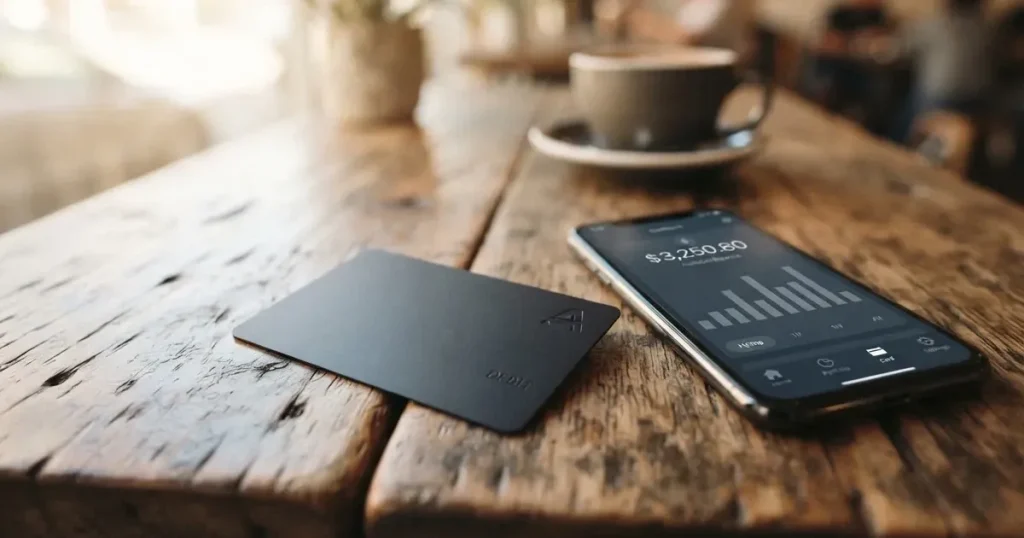
The SwissBorg card is a virtual Mastercard debit card that draws directly from a cryptocurrency balance inside the SwissBorg app. There is no issuance fee, no monthly fee, and a single 0.99% conversion fee on every purchase, which makes it one of the cheaper offers in the crypto-card space. The catch is that it is virtual only, cash withdrawals are not available yet, the card is restricted to residents of the EEA, Switzerland and the UK, and the issuing institution was fined by the Bank of Lithuania in late 2025. The overall score for this card is 6.2 out of 10, and you can see the breakdown in the verdict below.
Conditions are current as of October 28, 2026.
Verdict
The SwissBorg card earns 6.2 out of 10 in this review. The mark reflects a card that is free, cheap to run, and pleasant to top up if you already keep crypto in the SwissBorg app, but that is limited in geography, has no physical card, no ATM access and a regulator-fined issuer.
| Criterion | Mark | Reason |
|---|---|---|
| Who can get it | 5/10 | EEA (30 countries), Switzerland and the UK only; Russia and Belarus excluded |
| Cost | 9/10 | Free issuance, free service, 0.99% conversion on every purchase, no separate FX fee, no ATM |
| Top-up options | 6/10 | Spends directly from crypto (BTC, ETH, SOL, BORG, USDC, USDG, EUROP, TGBP); fiat balances cannot be used, USDT and Tron not named |
| Reliability and complaints | 5/10 | Issuer UAB Monavate supervised by the Bank of Lithuania and fined €270,000 on 2025-11-25; Trustpilot 3.1, recurring complaints about account freezes and slow support |
| Everyday use | 5/10 | Virtual only, no physical yet, Apple Pay and Google Pay supported |
The card is best suited to residents of the EEA, Switzerland or the UK who already hold crypto inside the SwissBorg app and want a free virtual card to spend it with, in shops that take Mastercard, online or through Apple Pay and Google Pay. It is not a good fit for someone who needs cash, who lives outside the listed regions, or who is not comfortable with a custodial product run by a company with a recent regulatory fine.
Who can get the SwissBorg card
The SwissBorg card is open only to residents of specific countries. The list, as published by the card’s terms, runs to 30 EEA member states plus Switzerland and the United Kingdom, and is decided by your country of residence rather than by citizenship. The EEA list is: Austria, Belgium, Croatia, Cyprus, Czechia, Denmark, Estonia, Finland, France, Germany, Greece, Iceland, Ireland, Italy, Latvia, Liechtenstein, Lithuania, Luxembourg, Malta, the Netherlands, Norway, Poland, Portugal, Romania, Slovakia, Slovenia, Spain and Sweden.
Outside this set of countries the card is not offered. The terms also list Russia and Belarus among restricted jurisdictions, alongside other countries the card programme refuses, and card usage is blocked in those places. The rule is by residence: a French citizen living in the United Arab Emirates would not qualify, and a Brazilian citizen living in Germany would.
Eligibility rules are stricter than the headline “Europe plus the UK” suggests, but the offer is wider than a single-country product. For most people in the EEA, Switzerland or the UK, residency is the only real gate.
How to get the card
The signup is built around the SwissBorg mobile app rather than a web form. Here is the order in which it happens, as the card’s documentation describes it.
First, you need KYC Level 2, which is a higher tier than the basic account. That means a verified photo ID and a verified proof of address, and you have to be at least 18 years old. The platform’s KYC levels work as a set of caps: Level 1 lets you move EUR 5,000 in and out cumulatively, Level 2 raises that to EUR 50,000 in and EUR 1,000,000 out, and Level 3 is unlimited. These figures are from the SwissBorg card review by Card Pilled and have not been confirmed by the card’s own pages, so treat them as unofficial until SwissBorg states them in their own materials.
Second, you open a personal account in the app and complete KYC Level 2, which involves uploading documents and waiting for verification. The card terms do not state the processing time, and they do not list a set of specific reasons a card application may be rejected.
Third, you tap “Card” on the Portfolio screen, accept the card terms and choose a primary cryptocurrency from the supported list. The virtual card is then ready in the app immediately, and you can add it to Apple Pay or Google Pay on the spot if your region supports it. Apple Pay was initially available only in Switzerland and France, and the app needs to be on its latest version.
The card itself is a Mastercard debit card. Its base currency is set by where you live: EUR for EEA residents, CHF for Swiss residents, GBP for UK residents. The base currency is fixed when the card is issued and cannot be changed afterwards.
There is no physical card yet. Virtual only at launch, with a physical card described as planned for a later phase. The terms put it this way: “Depending on community demand, physical cards may become available with an additional issuance and shipping fee.” Delivery time, shipping cost, and replacement cost for a future physical card are not stated in the public documentation.
Fees: what the SwissBorg card really costs
The fee structure is simple, and most of it is zero. Issuance is free. There is no service fee, no annual fee, no monthly subscription. The one fee that always applies is the 0.99% crypto-to-fiat conversion, taken on every card purchase.
That conversion happens in real time through the SwissBorg Meta-Exchange, and a “real-time market-liquidity adjustment” may also be added on top, depending on conditions at the moment of the trade. There is no separate FX fee from SwissBorg, so a payment in a currency other than the card’s base currency is converted at the Mastercard exchange rate, and that is all you pay for FX.
Cash is the one big gap: ATM withdrawals are not available at launch, with the card’s own pages saying only that “This feature might be considered in a future iteration.” ATM balance checks are not available either.
Spending limits exist: a daily limit, a monthly limit, an annual limit, a per-transaction limit, and limits on the number of transactions per day and per month. The exact figures are not stated publicly, and the card terms reserve the right to change them at any time. Card spend also counts against the SwissBorg account’s overall withdrawal limits, which scale with your KYC level.
Loyalty ranks change some of the experience. Seven ranks are defined, all gated by how much BORG you lock: Standard at 0 BORG, Bronze at 1,000, Silver at 3,000, Gold at 10,000, Platinum at 30,000, Diamond at 60,000 and Elite at 100,000. Higher ranks raise the cashback rate, a yield boost on app yields, priority access to Alpha Deals, and a multiplier on ecosystem rewards. Cashback itself, paid in BORG tokens, is calculated as a percentage of the 0.99% exchange fee you pay on each transaction: 5% at Standard, climbing to 90% at Elite. The BORG received is locked under a “Paid to Trade” program for some time, and SwissBorg can modify, suspend, or end the cashback scheme at any time.
The base currency set when the card is issued also affects what “free” means in practice. Transactions in a currency other than the base are converted at the Mastercard rate, which is the wholesale rate most banks feed off, so the practical cost is the 0.99% conversion plus any spread the rate carries. Multi-currency fiat balances held inside the SwissBorg app (EUR, CHF, GBP and others) are separate from the card and cannot be used to pay with it.
Here is the costs table, with values taken from the card’s own pages.
| Fee or limit | Amount |
|---|---|
| Issuance fee | None |
| Service / monthly / annual fee | None |
| Crypto-to-fiat conversion | 0.99% per purchase |
| Additional real-time adjustment | Possible |
| FX fee (non-base currency) | Mastercard exchange rate, no SwissBorg fee |
| ATM withdrawal | Not available |
| ATM balance check | Not available |
| Spending limits (daily / monthly / annual / per transaction / count) | Not stated publicly |
A couple of everyday numbers help put the 0.99% in context. A €100 coffee and lunch paid from a euro-base card held in BTC costs €0.99 in conversion, plus whatever the spread on the BTC-to-EUR trade at that moment is, and that is the entire fee. A €1,200 monthly groceries run on the same card costs €11.88 in conversion. A €200 dinner in a non-base currency, say a euro card used in the UK, costs €1.98 in conversion plus the Mastercard rate, with no extra FX markup from SwissBorg.
Top up: how the card gets funded
The SwissBorg card does not have a separate top-up step in the usual sense, and this is the part of the product most worth understanding before you sign up. The card spends directly from a crypto balance inside the SwissBorg app, not from a pre-loaded fiat balance and not from a bank account link. That changes what “top up” means.
The supported cryptocurrencies for card spending, as the card’s own pages name them, are BTC, ETH, SOL, BORG, USDC, USDG, EUROP and TGBP. USDT is not named in the card documentation, and the Tron network is not named either, so a USDT-on-Tron top-up is not an option. USDC, by contrast, is supported, though Circle stopped supporting USDC on Tron in February 2024, which means USDC cannot be sent to SwissBorg over Tron. Crypto deposits themselves are free, with the user paying the gas or network fee on the sending side.
You pick a primary cryptocurrency when you set the card up, and you can also pick backup currencies. If the primary balance is too low at the moment of a payment, the system dynamically draws on a backup, which removes the failure mode of “I have crypto, just not the right coin.”
Fiat balances inside the app cannot be used to pay with the card. This is a deliberate design choice: the card is a crypto-spending card, not a debit card linked to your euro or sterling balance. If you have topped up the app with pounds and want to spend them in a shop, you cannot do it with the SwissBorg card.
Funding the app itself is a separate matter. Crypto deposits are free (you pay the network fee). Bank transfer deposits to the app are free (your bank may charge you on its side). Card, Apple Pay and Google Pay deposits, however, are charged: 2.25% to 1.5% by rank in “Standard” countries (most of the EU) and 4.5% to 3.75% by rank in “International” countries such as the UK and Switzerland, with a €10 minimum deposit and a minimum fee of €5 at Standard and Bronze, or €3 from Silver upwards. In other words, putting money into SwissBorg by debit card is paid for; putting it in by bank transfer is not.
Fiat withdrawals from the app, when you want to cash out, carry a 0.10% execution fee with currency-specific minimums and maximums, for example EUR 1.50 to 100, CHF 5 to 110, and GBP 1.50 to 85. Crypto withdrawals also cost 0.10% plus real-time network fees. Refunds from card purchases land in your fiat account in the card’s base currency, not back in the crypto you spent, and the conversion fee on the original purchase is not refunded.
Paying with it every day
The card is a Mastercard debit card, so it is accepted anywhere Mastercard is taken, online and in physical stores, with the usual merchant category code filtering applied by the card network and the issuer. Apple Pay and Google Pay are supported, which is the practical answer to “I have only a virtual card, how do I pay in a shop” — you add the virtual card to a phone wallet and tap to pay. Curve is also supported, which means the card can sit behind a Curve wallet and route through it.
Merchant categories are restricted. The card’s prohibited list covers gambling and betting, adult content and services, cryptocurrency purchases, financial services such as money transfers, illegal goods (drugs, weapons), cash advances, and some government services. These are policy blocks rather than legal ones, and the exact list varies by issuer. If your typical spend includes any of these, the card will not work for it.
Online payments run through 3-D Secure, the identity-check layer that Visa brands as Visa Secure and Mastercard brands as Identity Check. For SwissBorg that means a biometric prompt in the app for higher-risk transactions. The card can be frozen and unfrozen instantly in the app, which is the standard safety net for any card that lives mostly on a phone.
The app itself holds the experience together. It is available on iOS and Android, and at the time of writing carried a 4.6 rating on Google Play in the UK store with around 15,200 reviews, and a 4.4 on the App Store in Ireland with 88 ratings. SwissBorg’s own site footer shows slightly different figures, 4.2 on Google Play and 4.6 on the App Store, and the gap is a useful reminder that app-store ratings move around.
If something goes wrong with a transaction, the dispute process runs through the app under Profile > Support or by email to [email protected], and you have 8 weeks from the transaction date to raise a chargeback. For refunds where the merchant did not specify the exact amount and the amount was higher than you could reasonably have expected, the card’s terms say you should see the money back within 10 business days of the claim being received. For an unauthorised transaction on a lost, stolen or misappropriated card, your liability is capped at EUR 50 unless the loss was due to fraud or gross negligence, and you have to report it without undue delay and no later than 13 months later. Refunds and reversals are credited in the card’s base currency, not in crypto, and the original conversion fee is not refunded.
What can go wrong
Three things deserve particular attention: the regulator’s action against the issuer, recurring complaints from users, and the limits of the virtual-only launch.
The card’s issuer is UAB Monavate, an electronic money institution incorporated in Lithuania and authorised by the Bank of Lithuania. On 2025-11-25, the Bank of Lithuania fined Monavate €270,000 and issued a warning for breaches related to anti-money-laundering, management and reporting obligations. The fine is on the issuer, not on SwissBorg itself, and Monavate continues to operate under its licence, but it is a real data point when weighing the safety of funds held on the card.
User feedback tells a similar story. SwissBorg’s Trustpilot score sits at 3.1 out of 5, across roughly 1,900 reviews, with three recurring themes: account restrictions and freezes with little explanation and slow resolution, customer support tickets going unanswered for days or weeks, and card-and-wallet deposit “cooldown” periods that lock funds during a security holding period and prevent immediate access or withdrawal. These complaints appear throughout 2025 and 2026, across Trustpilot, Reddit and Google Play reviews, and are not limited to a single bad month. None of this means your account will be frozen, but it is the pattern the company’s users describe.
There are also structural limits. The card is virtual only, with a physical card “planned” rather than promised. There are no ATM withdrawals. There is no way to pay from a fiat balance inside the app, so if you want to spend pounds, you cannot do it through this card. The card’s base currency is fixed at issuance, so changing country of residence in a way that would change the base currency is not a clean transition. Spending limits exist but the numbers are not published, which makes planning around them difficult.
The corporate structure is worth being clear about. The SwissBorg app is owned by SBorg SA in Lausanne, Switzerland. BlockNodes SAS, in Paris, holds MiCA authorisation number A2026-011 from France’s AMF. The card itself is issued by UAB Monavate in Lithuania. The crypto part of the product, the exchange and the wallet, sits under MiCA in France, and the payment-card part sits under electronic money regulations in Lithuania. That separation is normal for a crypto card, but it is also the reason a problem in one part of the stack does not necessarily affect the other.
The security model is custodial: your funds sit in SwissBorg’s wallet, not in your own. Funds on the card are not protected by the UK’s Financial Services Compensation Scheme, and Monavate safeguards them under the Electronic Money Regulations 2011, which is a different regime from bank-deposit protection. A stolen virtual card is reported by freezing it in the app or by emailing [email protected]. Customer support itself runs through in-app chat, email and the help centre, with Monavate also reachable by phone on +37069870638 and at [email protected], and all cardholder communication runs in English per the terms.
A short news timeline helps put the recent history in order. The Paid to Trade Loyalty Ranks and cashback program launched on 2025-09-23. Monavate was fined on 2025-11-25. A Partners Card Design Contest was announced on 2025-12-03. The official Mastercard partnership was announced on 2026-02-18. The virtual card launched on 2026-02-25 in a phased rollout across the EEA and Switzerland. MiCA authorisation A2026-011 was granted to BlockNodes SAS in around March 2026. The Card Rulebook v0.1 was published on 2026-07-22. The United Kingdom was added to the card’s availability on 2026-08-27.
What to take instead
The SwissBorg card is one of several virtual crypto cards aimed at people who want to spend digital assets without going through a centralised exchange-style flow. Three alternatives come up most often, and they are worth knowing about because they show what “free” or “cheap” looks like in slightly different shapes.
| Card | Score | Cost | Fees | Funding | Rewards |
|---|---|---|---|---|---|
| International Visa Card | 6.7/10 | $5 issuance, plans free to $19/month | USD free, 2% FX on other currencies | USDC/USDT into USD account, plus USD/EUR/SEPA/SWIFT/FedNow | None stated |
| UNi Card | 6.1/10 | No annual fee, issuance not stated | No annual or foreign transaction fee, live OTC rates | Not stated | Up to 3% spend-to-earn |
| Whop Cards | 5.2/10 | No extra fees, no issuance or monthly amounts listed | Not stated | Whop balance backed by stablecoin collateral | 5% cashback at select merchants |
The International Visa Card is a US-issued virtual Platinum Visa with a $5 issuance fee, a free Classic plan and paid Pro and Max plans at $9 and $19 a month. Card use in USD is free on all plans, and foreign-currency transactions run at the Visa exchange rate plus a 2% FX fee. It is not available to residents of a long list of countries that includes Russia, Ukraine, Belarus, China, Iran, Iraq, Israel, Cuba, North Korea, Myanmar, Nepal, Nicaragua, Syria, Turkey, Venezuela and Vietnam, and purchases are blocked in North Korea, Cuba, Iran, Russia, Syria, Ukraine and Venezuela. It accepts USDC and USDT into the USD account at 1:1, plus fiat via USD, EUR, SEPA, SWIFT and FedNow, which is a wider payments rail than SwissBorg’s card-to-deposit option. It does not advertise cashback.
UNi Card is a multicurrency Mastercard that spends from the UNi.Global account balance. It charges no annual fee and no foreign transaction fee, converts assets at live OTC rates, and offers a “Spend-to-Earn” reward of up to 3%. Its availability and funding details are not publicly confirmed; it is worth checking directly before assuming it covers your country.
Whop Cards is a Visa product aimed at both consumers and businesses, with consumer availability in 31 US states and corporate availability in 41. The unsupported country list overlaps heavily with the International Visa Card’s, including Russia, Belarus, China, Iran, Iraq, Israel, Cuba, North Korea, Myanmar, Nepal, Nicaragua, Syria, Turkey, Ukraine, Venezuela, Vietnam, plus Hong Kong and India. It spends from a Whop balance backed by stablecoin collateral, and offers 5% cashback at selected merchants (Uber is named, with more planned). The cards can be issued to team members as well, which is a use case the others do not cover.
The pattern across the three is instructive. The International Visa Card is the most open about FX and is the cheapest to fund from stablecoins, with the trade-off being a $5 issuance fee and a 2% FX markup outside USD. UNi Card is the closest in spirit to SwissBorg on the cost side, with no annual fee and no foreign transaction fee, but its published details are thinner. Whop Cards is the most rewarding if you happen to shop at the listed merchants, and the most restricted geographically, with a long list of excluded countries. None of them is a direct replacement for what SwissBorg does (free virtual card, crypto-to-fiat at 0.99%, EEA plus Switzerland plus UK), but each is a serious option if the geographic or product limits of the SwissBorg card do not fit.
Who I would recommend it to
The clearest case for the SwissBorg card is the person who already uses the SwissBorg app, holds a mix of the supported coins, and wants a virtual card to spend them at Mastercard-accepting merchants without paying subscription fees. The 0.99% conversion is low for the category, the free issuance and free service keep the fixed cost at zero, and the Apple Pay and Google Pay support make the “no physical card” limitation easier to live with.
The card is also a reasonable fit for someone in the EEA, Switzerland or the UK who is happy with a virtual-only product, who does not need cash, and who is comfortable with a custodial wallet run by a Swiss company with a card issued by a Lithuanian e-money institution. The 0.99% fee is the kind of number that becomes invisible on a coffee, but it adds up on a large purchase, and the cashback tiers only start to matter at higher Loyalty Ranks that require locking meaningful amounts of BORG.
It is the wrong card for several kinds of readers. It is the wrong card if you live outside the EEA, Switzerland and the UK. It is the wrong card if you need to take cash out at an ATM, which the card does not support. It is the wrong card if you want to spend fiat held inside the SwissBorg app, because the card only draws on crypto. It is the wrong card if the idea of a 2025 regulatory fine against the issuer is a deal-breaker for you. And it is the wrong card if a physical card matters to you, because the public roadmap only describes a future physical card with no confirmed date, cost, or shipping time.
If any of those describe you, the alternatives above are worth a closer look, especially the International Visa Card if you are based in the US or another supported country and want a stablecoin-funded virtual Visa.
Frequently asked questions
What is the SwissBorg card?
The SwissBorg card is a virtual Mastercard debit card issued by UAB Monavate and managed by SwissBorg. It draws directly from a cryptocurrency balance held inside the SwissBorg app rather than from a fiat account, and converts the crypto to fiat in real time at the moment of payment. There is no issuance or service fee; a 0.99% conversion fee is applied to every purchase.
How does the SwissBorg card work?
When you pay, SwissBorg converts the chosen cryptocurrency into the card’s base currency at the Mastercard rate via the SwissBorg Meta-Exchange, and the merchant receives fiat. You pick a primary coin and optional backup coins during setup, and the system picks a backup automatically if the primary balance is too low. 3-D Secure applies to online transactions, with a biometric prompt in the app for higher-risk payments.
Is SwissBorg a bank?
No. SwissBorg is a Swiss company (SBorg SA, Lausanne) that runs a crypto app, and the card is issued by a separate Lithuanian electronic money institution (UAB Monavate). The card is not a bank account, the funds on it are not protected by a deposit guarantee scheme, and they are safeguarded under electronic money regulations rather than as bank deposits.
Who owns SwissBorg?
The SwissBorg app is owned by SBorg SA, registered in Lausanne, Switzerland. BlockNodes SAS in Paris holds a MiCA authorisation for the crypto side of the business. The card itself is issued by UAB Monavate, an electronic money institution in Lithuania supervised by the Bank of Lithuania.
Is the SwissBorg card available in my country?
The card is available to residents of the 30 EEA member states, Switzerland and the United Kingdom, as published in the card’s terms. Russia and Belarus are explicitly listed as restricted, alongside other sanctioned or restricted jurisdictions. The rule is by country of residence, not by citizenship.
How do I get the SwissBorg card?
You download the SwissBorg app, open a personal account, complete KYC Level 2 (photo ID and proof of address, age 18 or over), tap “Card” on the Portfolio screen, accept the card terms, and choose a primary cryptocurrency. The virtual card is generated in the app immediately and can be added to Apple Pay or Google Pay on the same device.
Does the SwissBorg card require KYC?
Yes, KYC Level 2 is required. That means a verified photo ID and a verified proof of address, and a minimum age of 18. The card’s published terms do not state the typical processing time, and they do not list the specific reasons an application might be rejected.
How do I top up the SwissBorg card?
The card does not have a separate top-up step. It spends directly from a cryptocurrency balance inside the SwissBorg app, in BTC, ETH, SOL, BORG, USDC, USDG, EUROP or TGBP. Crypto deposits to the app are free (you pay the network fee), and bank transfer deposits are also free, while card and wallet deposits (Apple Pay, Google Pay) carry a fee of 2.25% to 1.5% by rank in most EU countries and 4.5% to 3.75% by rank in countries such as the UK and Switzerland.
Is the SwissBorg card free?
Issuance and ongoing service are free for the virtual card. A 0.99% conversion fee applies to every card purchase, and a real-time market-liquidity adjustment may also be applied. There is no SwissBorg FX markup on top of the Mastercard rate for non-base-currency transactions. ATM withdrawals are not available at launch.
Is the SwissBorg card safe?
The card is custodial, meaning your crypto is held by SwissBorg rather than in your own wallet, and your funds sit with a regulated e-money institution on the payment side. The card’s issuer was fined €270,000 by the Bank of Lithuania on 2025-11-25 for AML, management and reporting breaches, and user reports describe account freezes and slow support as recurring issues. The card supports 3-D Secure, biometric approval, and instant freeze and unfreeze in the app, and funds on the card are not covered by the FSCS.
App and neobank cards in the catalogue – cryptocardcatalog
Content created by the «cryptocardcatalog» team