
What the MetaMask Card does well, what it charges, and where it still leaves you exposed
 Available in US
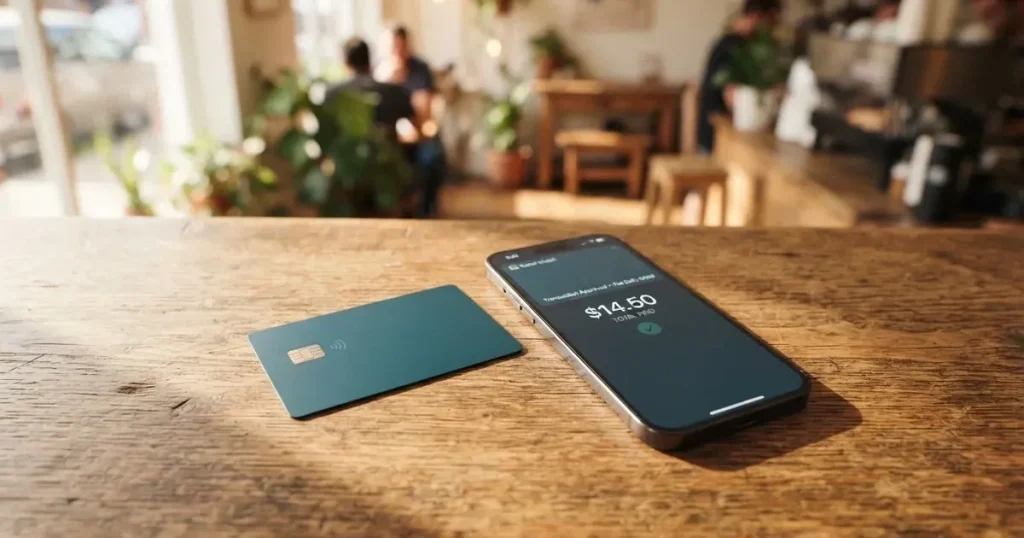
If you already keep your money in a self-custody wallet and the thing stopping you from spending it is the absence of an ordinary card, the MetaMask Card is built exactly for that gap. It turns tokens you already hold into everyday purchases — a Virtual card you get instantly, a Metal card for $199 a year if you want the metal, Apple Pay and Google Pay, and a card that draws the money from your own wallet at the moment of payment rather than from a company’s account. On everyday use it scores about as well as a card can.
But it is not finished, and it is not simple. The official pages contradict each other in places, the support layer is a second company’s, and the complaints that do exist cluster on exactly the part that is hardest to fix: getting a refund back out. I scored this card 7.1 out of 10. Whether that is good news for you depends almost entirely on whether you are inside the 45-country sign-up list and whether you can live with a support desk that lives in email.
The conditions described on this page are current as of October 28, 2026.
The short verdict: 7.1 out of 10
Let me put the score out of the way first, then break it into the pieces that produced it.
| Criterion | Mark | Why |
|---|---|---|
| Who can get it | 7 / 10 | Sign-up is open in 45 listed countries, including Europe, Latin America and Canada; other regions sit on a waitlist, and the US and UK are temporarily closed |
| Cost | 8 / 10 | The Virtual card is free with no annual or monthly fee; Metal is $199/year; there is no foreign-exchange fee; a per-transaction fee is charged but its amount is not published on the pages I read |
| Top-up options | 8 / 10 | It spends directly from the connected wallet across Linea, Base, Monad and Solana, using tokens including mUSD, wETH, EURe, GBPe, USDC and USDT; a Solana-only wallet cannot withdraw |
| Reliability and complaints | 4 / 10 | The issuer is Monavate and the card provider is Crypto Life; complaints include refunds stuck in “Credits”, tickets looping through automated replies, and frozen cards |
| Everyday use | 9 / 10 | Virtual instantly plus Metal on request, Apple Pay and Google Pay, and generous ATM limits of $1,000/day (Virtual) and $5,000/day (Metal) |
| Total | 7.1 / 10 | A strong spending card held back by a support and disputes layer that is not yet mature |
This is a card for self-custody wallet users in Europe and Latin America. If that is you, the everyday mechanics are among the best in this category. If you are somewhere the sign-up list does not cover, there is nothing to wait for — you join a waitlist. If you are in the US or UK, sign-ups are temporarily closed and I would not plan around it.
Who will they give you the card to?
Sign-up is open in 45 listed countries and territories, and the list spans Europe, Latin America and Canada. Examples named on the card’s own pages include Andorra, Argentina, Brazil, Canada, Mexico, Germany, France, Spain and Uruguay. Everywhere else joins a waitlist rather than being refused outright, and the card puts it plainly: ineligible regions limit sign-ups, not spending.
Here is the full list as published: Andorra, Argentina, Austria, Belgium, Brazil, Bulgaria, Canada, Chile, Colombia, Costa Rica, Croatia, Cyprus, Denmark, Dominican Republic, El Salvador, Finland, France, Germany, Gibraltar, Greece, Guatemala, Guernsey, Hungary, Iceland, Ireland, Isle of Man, Italy, Jersey, Liechtenstein, Luxembourg, Malta, Mexico, Monaco, Netherlands, Norway, Panama, Poland, Portugal, Romania, Slovakia, Slovenia, Spain, Sweden, Switzerland, Uruguay. Russia, Belarus and Turkey are not on it.
Two things I want to be precise about, because people ask both constantly. First, proof of residency is required — that is the official requirement. Second, the citizenship rule is not stated on the public pages I read. That is a real gap, not a permission: providers screen nationality and country of birth separately from residence as part of sanctions and issuer risk policy, so the fact that the card’s pages do not spell it out does not mean nationality is irrelevant. If your citizenship differs from your country of residence and that matters to you, the honest answer is that you have to ask them.
Sign-ups in the US and UK are temporarily closed per the FAQ. That is worth noting against a small internal contradiction: the same material describes the Metal card as available in the US.
How to get it
The card is a Mastercard. You get a Virtual card first, issued instantly, and after Virtual approval you can pre-order the Metal card in the app. One card per user. The issuer is Monavate and the card provider is Crypto Life — two different companies, and that split matters later in this review.
The virtual card activates instantly and no physical card is mailed at sign-up. The Metal card “ships securely to a verified address”, which means you need a verified address before it can go out. The delivery time, the delivery cost and the replacement cost are not stated on the pages I read. MetaMask Card Support is available 24/7 for assisted replacement in your region, which is one of the better provisions in this card’s favour.
On verification: the official requirement is proof of residency, handled by Crypto Life, with no credit check. Which documents count, what the verification levels are, how long processing takes and why an application might be refused — none of that is stated publicly. The minimum age is also not stated. A community review on cryptocards.so (unofficial, not confirmed by the card) reports that email, phone and ID are required, that address proof and a selfie are not required, and that approval was fast or near-instant for the reviewer. Treat that as one person’s account, not a specification.
Fees: what it really costs
The headline is genuinely good and the detail is genuinely vague. The Virtual card is free — no annual fee, no maintenance fee. Metal is $199 a year. On the fee side, the card’s pages state a “minimal fee for each transaction” without an amount on the pages I read, plus “no additional MetaMask fees”, and no foreign transaction fee, with conversions handled at the rate Mastercard allows. The card’s own currency is not stated.

One thing you will not find: a third-party table on cryptocards.so (unofficial, and it contradicts the card) lists monthly, issuance, ATM, FX, top-up and decline fees as free. That directly contradicts the official “minimal fee for each transaction” and the $199 Metal charge. I would plan around the official pages, not that table.
| Fee or limit | Virtual | Metal |
|---|---|---|
| Issuance | Free | Included with the $199/year product |
| Annual / monthly fee | None | $199/year, no monthly option |
| Per-transaction fee | A “minimal fee”, amount not stated | A “minimal fee”, amount not stated |
| Foreign exchange fee | None; Mastercard rate used | None; Mastercard rate used |
| ATM limit | $1,000/day | $5,000/day |
| Card spend limit | $15,000/day | $30,000/day |
| Cashback | 1% | 3% on the first $10,000, then 1% |
| $FLY multiplier | 5X | 7X |
Three everyday payments, and which fees bite:
- A standard supermarket shop. No foreign exchange fee if the shop is domestic. The per-transaction “minimal fee” applies, and the network fee is whatever the underlying transfer costs on the chain your tokens sit on. This is the case where the card feels cheap.
- An online subscription in a different currency. No foreign transaction fee is added on top of the Mastercard rate, which is the single most useful thing in that table. But the per-transaction fee still applies, and a declined authorisation can leave a hold on your funds for several days.
- A cash withdrawal. The ATM limit is $1,000 a day on Virtual and $5,000 on Metal. There is a free-ATM allowance of “up to $1,200/mo” with the tier unclear, and — this is the part to watch — an older FAQ version says ATM withdrawals are available only to US card users, which conflicts with the limits shown on the card page. Ask before you rely on it.
Top up: how the card gets money
This is where the MetaMask Card is different enough to be worth reading twice. There is no preloading. You do not convert a balance and hold it. Instead, the card spends directly from the connected wallet, drawing on tokens you have delegated to the card, and the card balance shows the highest-priority token set under Manage.
That design has a real upside: no third party holds your funds between payments, so there is no stored balance to lose. It also has a sharp edge that you should understand before your first large purchase. The networks are Linea, Base, Monad and Solana, and the tokens named include mUSD, wETH, EURe, GBPe, USDC and USDT — the page says nine in total, so the list I have is not exhaustive. A Solana-only wallet cannot withdraw the credit.
Network fees, deposit fees and any minimum top-up are not stated, and the fee table at MetaMask’s support site returned no figures. No fiat top-up route is stated either, so if you were planning to load the card from a bank account, that is not something the public pages describe.
Getting money back off the card is the reverse trip and it has its own rule. Withdrawals go out as mUSD: Money Account holders receive it to the vault as Monad mUSD, everyone else to a priority EVM address as Linea mUSD. Monad withdrawals have sponsored gas. Solana-only wallets cannot withdraw. To close the card you contact Crypto Life support, and when a card is frozen or deactivated your funds stay in your own wallet. The withdrawal fee is not stated.
Paying with it every day
You add the card to Apple Pay or Google Pay. That is most of the daily-use story, and it is why this card scored highest in my everyday-use column.
The cashback is paid in mUSD into the Money Account at 1% on Virtual. On Metal the headline is 3%, with a footnote that limits 3% to the first $10,000 spent and then 1% — the footnote is the honest number, so treat Metal as 3% up to a cap and 1% after it. Separately, there is a $FLY bonus at 5X (Virtual) or 7X (Metal) through the Blackbird dining app. A Metal holder can also opt into a 90-day Club Regular trial.
Two things I could not verify and you should not assume. Which merchant categories are blocked is not stated — and that matters, because blocks on gambling and similar categories are common at the issuer level and vary by issuer. And the app’s store ratings are not given on the card page or FAQ, so I cannot tell you what users rate the app itself.
If a payment goes wrong, the process is: ask the merchant for a refund first, and if that fails, request a chargeback from Crypto Life support. Refunds land in the Credits balance. Time frames are not stated. That Credits detail is the one to remember.
What can go wrong
Start with the company structure, because it explains most of the rest. The card provider is Crypto Life. The issuer is Monavate. The site footer reads “Copyright 2026 Consensys, Inc.”, but the FAQ does not say that Consensys provides the card — so if you were assuming the well-known wallet company stands behind your money, that is not what the pages say. The issuer’s registered country and its licences are not stated. A community post cited by cryptocards.so (unofficial) names Monavate Limited as the FCA-regulated entity for UK complaints.
Now the complaints, which is where this card’s mark is lowest. A Trustpilot score of 1.4 out of 5 from 647 reviews for MetaMask the wallet overall — read 20 October 2026 via rfp.wiki, and note that this is the wallet, not the card — clusters on poor support and slow resolution. Card-specific reports on cryptocards.so for 2026 describe refunds trapped in a Crypto Life “Credits” balance, tickets looping through automated replies, bridging to Linea or Base eroding the cashback value, community posts of cards frozen at lifetime transaction limits until a manual upgrade, account closure for inactivity, and a physical card promised in two weeks arriving after more than a month. A separate community review reports slow responses, copy-paste email replies and no live chat — unofficial, but consistent with the rest.
The security side is the strong half. The card is non-custodial: your private keys never leave your wallet, so a MetaMask account compromise is not a key compromise. You can freeze or replace the card instantly in the app, funds stay in the wallet, the Virtual card stays active for subscriptions, and you get transaction alerts, activity monitoring and your own daily, weekly and monthly limits. Whether any insurance applies is not stated.
The honest summary of the risk is this: your crypto is well protected and your ability to get your money back when something goes wrong is the weak point. Those are different risks, and this card does well on the first and unevenly on the second.
One background point that applies to everyone reading about any card here: the card number starts with a 6- or 8-digit issuer identifier, and merchants can look it up. A card issued in one country can therefore look foreign to a shop in another and draw extra scrutiny. Blockchain transfers are also irreversible, so a deposit on a network the card does not support can be gone.
What to take instead
Let me compare the three alternatives I looked at, because the differences are mostly about what each one asks from you.
| TokenPocket | KAST | Zeal | |
|---|---|---|---|
| Score | 5.8 / 10 | 6.1 / 10 | 6.1 / 10 |
| Card | Mastercard/Visa debit, virtual | Visa: Platinum, Infinite metal, Infinite gold plated | Visa, virtual, Apple Pay |
| Where | Visa across much of Europe; Mastercard across Australia, Canada, Hong Kong, Japan, Taiwan, New Zealand, Singapore, South Korea, UK | Residence-based list shown at KYC; country list not published | Spend in 150+ countries; programme live in EU, UK, Brazil, Colombia, Mexico, Japan, Singapore, Philippines, Indonesia, Thailand |
| Cost | NFT creation fee partly covered, you pay a small portion | Standard $0, Premium $1,000/year, Private $10,000/year | Not stated |
| Fees | 1% fee on depositing crypto into the card | 0% top-up, 0% USD spend, FX 0.5%–1.75%, declined transaction $0.50 | No additional FX fee; conversion at Visa wholesale rate |
| Rewards | None stated; the 1% deposit fee refunded later via rewards | 1.5% / 2% / 3% USD cashback by tier, plus KAST Points on two tiers | Up to 4% cashback in GNO, must hold GNO in the card Safe |
Read across the rows and the choice clarifies itself.
- Take TokenPocket if you want a straightforward prepaid-style card and can live with the 1% deposit fee, which the company says is refunded later through rewards or reduced transaction fees. Its Americas rollout is described as “planned for Q2 2025”, which is the kind of date a page keeps long after it stops being true.
- Take KAST if your use of the card is heavy enough to justify Premium or Private, or if the FX rate matters more than the tier cost. Its fee sheet is the most transparent of the three: 0% stablecoin top-up, 0% USD spend, and an FX fee of 0.5%–1.75% that depends on where you live, where you spend and which programme you hold. Note the access rule, though: the country list is not published, it is shown at KYC, and if you live in a supported country but hold an ID from a restricted region you may still fail. Creating an account in an unsupported country leaves KYC locked.
- Take Zeal if you spend across many countries and your priority is that no FX fee is added on top. It pays up to 4% cashback in GNO, but GNO has to sit in the card Safe to qualify and the rates can change. Its fee schedule is not stated anywhere I could find, on the site or the App Store listing.
MetaMask’s own advantage against all three is the non-custodial structure: none of these give you your keys back. Its disadvantage is that it is the only one of the four whose support story is actively being complained about.
Who I would recommend it to
I would recommend this card to someone who already lives in a self-custody wallet, is inside the 45-country list, spends crypto they were going to hold anyway, and is comfortable treating the card as a thin layer on top of their own money rather than as an account. For that person it is genuinely good: free to start, no FX markup, instant virtual card, mobile wallets, cashback paid in mUSD, and a freeze button that does not touch the underlying funds.
I would not recommend it to you if any of these are true. You need a card this week — virtual is instant, but anything involving Metal shipping is on a timeline the card does not publish. You are in the US or UK, where sign-ups are temporarily closed. You want a Metal card and you are bothered by a published per-transaction fee with no stated amount. You have had a bad experience with refunds before and you need a disputes process you can trust — this is the card’s weakest flank and the complaints are specific enough that I would not wave them away. Or you simply want to be able to read a complete fee table, which is not something the public pages currently give you.
Frequently asked questions
What is the MetaMask Card?
It is a Mastercard you manage inside the MetaMask app, spending tokens directly from a wallet you control rather than from a balance held by a company. A free Virtual card is issued instantly, and a Metal card costing $199 a year can be pre-ordered after approval. The issuer is Monavate and the card provider is Crypto Life.
Is MetaMask a bank?
No. MetaMask is a self-custody wallet, which means you hold the keys and nobody else can move your crypto — that is the whole point. On the card side, Monavate is the issuer and Crypto Life provides the card. Nobody’s public pages say the issuer’s registered country or its licences.
How do I get the MetaMask Card?
Sign up in the app if your country is on the list of 45, prove residency, and the Virtual card activates instantly with no physical card mailed. After Virtual approval you can pre-order Metal in the app, which ships to a verified address. Delivery time and cost are not stated, so do not build a plan around a specific week.
Does the MetaMask Card require KYC?
Proof of residency is required, verification is handled by Crypto Life, and there is no credit check. Which documents count, the processing time and the grounds for refusal are not stated publicly. A community review on cryptocards.so — unofficial, not confirmed by the card — says email, phone and ID, and no selfie.
Is the MetaMask Card free?
The Virtual card is free, with no annual and no maintenance fee. Metal costs $199 a year. There is no foreign transaction fee. Beyond that, the pages state a “minimal fee for each transaction” without giving the amount, so a completely free card is not what the official wording supports.
How do I top up the MetaMask Card?
You do not preload it. Spending draws on tokens you have delegated to the card from your connected wallet, across Linea, Base, Monad and Solana, using tokens including mUSD, wETH, EURe, GBPe, USDC and USDT. No fiat top-up route is stated, and network or deposit fees are not stated either.
Can I add the MetaMask Card to Apple Wallet?
Yes — Apple Pay and Google Pay are both supported, and this is the strongest part of the everyday-use story. It is also what keeps the Virtual card usable for subscriptions when you freeze the physical card, since the wallet token keeps working.
Where can I use the MetaMask Card?
Anywhere Mastercard is accepted, within your card and ATM limits — $15,000/day spend and $1,000/day ATM on Virtual, $30,000 and $5,000 on Metal, with your own tighter limits settable in the app. Ineligible regions limit sign-ups, not spending. Which merchant categories are blocked is not stated.
Is the MetaMask Card safe?
Your crypto is non-custodial, so the card layer cannot take your keys, and you can freeze or replace the card instantly while funds stay in the wallet. The weaker side is after a dispute: refunds reportedly land in a Crypto Life “Credits” balance, and support complaints mention automated reply loops and no live chat.
Is the MetaMask Card worth it?
For the self-custody user inside the 45-country list who already holds the tokens they would spend, yes — free to start, no FX markup, instant virtual card and real cashback. Outside that list, in the US or UK, or if you need a dependable refund process or a published fee table, I would look at KAST or Zeal before committing.
Wallet cards in the catalogue – cryptocardcatalog
Content created by the «cryptocardcatalog» team